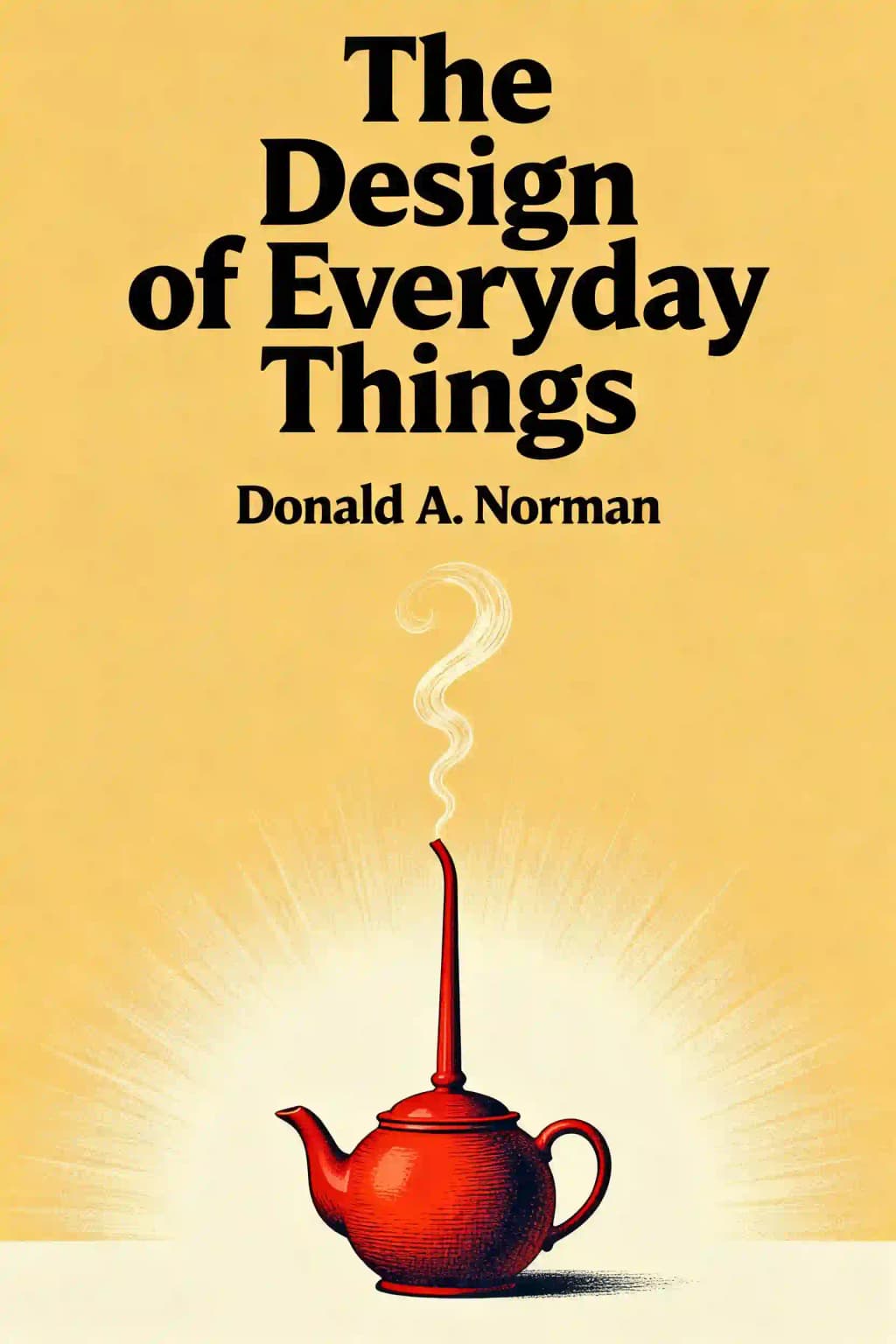
The design of everyday things book cover

The design of everyday things

Donald A. Norman
4.15 (46695 Reviews)

Panoramica di The design of everyday things

Ever wonder why some products frustrate you? Norman's design bible - endorsed by Steve Jobs - revolutionized how we interact with everyday objects. Discover the psychology behind intuitive design that transformed industries and made "user experience" a global obsession.

Temi chiave in The design of everyday things

  • human-centered design
  • user interface psychology
  • affordances and signifiers
  • error-proof systems
  • mental models

Citazioni da The design of everyday things

  • Good design is actually a lot harder to notice than poor design, in part because good designs fit our needs so well that the design is invisible, serving us without drawing attention,

  • Design is really an act of communication, which means having a deep understanding of the person with whom the designer is communicating.

  • When people struggle with objects, blame the design, not the user.

  • When everyday objects need instruction manuals, the design has failed.

  • The question isn't 'Is it pretty?' but rather 'Does its physical form clearly communicate how it should be used?'

Personaggi di The design of everyday things

  • Donald A. NormanAuthor and design expert who wrote the book

Sull'autore

Sull'autore di The design of everyday things

Donald A. Norman, renowned as the “father of user experience,” revolutionized design thinking with his bestselling book The Design of Everyday Things, a cornerstone of design theory and usability studies. A cognitive scientist and electrical engineer with a PhD in psychology from the University of Pennsylvania, Norman bridges academia and industry through his roles as professor emeritus at UC San Diego, Apple Fellow, and co-founder of the Nielsen Norman Group.

His interdisciplinary work in human-centered design and cognitive science underpins the book’s exploration of user interactions with everyday objects.

Norman’s authority extends to influential titles like Emotional Design and Living with Complexity, which further dissect the relationship between human behavior and technology. Recognized by Business Week as one of the world’s most influential designers, he established UC San Diego’s Design Lab to advance human-technology collaboration.

The Design of Everyday Things has become essential reading in design education, translated into over 20 languages and cited as a foundational text in UX curricula globally.

Scarica il riassunto di The design of everyday things

Ottieni il riassunto di The design of everyday things in formato PDF o EPUB gratuito. Stampalo o leggilo offline quando vuoi.

FAQ su questo libro

The Design of Everyday Things by Donald A. Norman explores how design impacts user experience, arguing that intuitive design hinges on understanding human psychology. The book emphasizes principles like affordances (clues about an object’s use), feedback (clear responses to actions), and mapping (logical control layouts). Norman uses examples like confusing doors or stove controls to show how poor design causes errors, urging designers to prioritize user needs over aesthetics or technical constraints.

This book is essential for designers, product managers, and engineers seeking to create user-friendly products. It also appeals to psychology enthusiasts and anyone frustrated by poorly designed objects. Norman’s insights into human behavior and problem-solving make it valuable for educators and business leaders aiming to improve customer satisfaction.

Yes—the book remains a foundational text in design thinking. Its principles apply beyond physical products to digital interfaces, making it timeless. Norman’s blend of cognitive science and real-world examples offers practical guidance for creating intuitive designs, while its engaging style makes complex concepts accessible.

Donald A. Norman is a cognitive scientist, usability engineer, and co-founder of the Nielsen Norman Group. A former Apple VP, he pioneered user-centered design research. His work bridges academia and industry, advocating for designs that align with human capabilities and limitations.

Norman outlines seven principles:

  • Discoverability (users should intuit possible actions).
  • Feedback (clear responses to actions).
  • Affordances (design features that suggest usage).
  • Mapping (controls should relate logically to functions).
  • Constraints (limit user errors through design).
  • Conceptual models (users form mental maps of systems).
  • Tolerance for error (designs should minimize mistakes).

Norman links design to cognitive psychology, showing how users rely on mental models to interact with objects. Poor design forces users to overthink, causing frustration. For example, a door with unclear push/pull signals violates natural mappings, leading to errors. Good design aligns with subconscious processes, reducing cognitive load.

Classic examples include doors with ambiguous handles, stoves with unclear burner controls, and complex light switches. Norman highlights how poor feedback (e.g., no sound when a button is pressed) or hidden functions (e.g., “invisible” thermostat settings) create confusion, blaming design flaws rather than user incompetence.

Human-centered design prioritizes user needs, emotions, and limitations. It involves observing how people interact with products, refining designs iteratively, and ensuring intuitive usability. Norman argues that designers must bridge the gap between technical functionality and human psychology to create effortless experiences.

Norman reframes user errors as design failures. For instance, if a microwave’s buttons are poorly labeled, the blame lies with the designer, not the user. He advocates for empathetic design that anticipates common mistakes and provides clear guidance, reducing frustration and improving usability.

Affordances are design features that suggest how an object should be used (e.g., a button inviting a push). Norman stresses that visible affordances prevent user errors—like flat plates on doors signaling “push” instead of handles implying “pull.” Effective affordances leverage natural user intuition.

The book revolutionized design by shifting focus from aesthetics to usability. Its principles underpin UI/UX design, ergonomic products, and accessibility standards. Companies like Apple and IDEO adopted Norman’s ideas, prioritizing user testing and iterative design to create intuitive interfaces and products.

Some critics argue the book focuses more on physical products than digital interfaces, though Norman later expanded his work to address technology. Others note its examples feel dated, but the core principles remain universally applicable. Despite this, it’s widely praised for foundational insights into user-centered design.

Esplora il Tuo Modo di Imparare

The design of everyday things non è solo un libro — è una masterclass in Psychology. Per aiutarti ad assorbire le sue lezioni nel modo che funziona meglio per te, offriamo cinque modalità di apprendimento uniche. Che tu sia un pensatore profondo, un apprendista veloce o un amante delle storie, c'è una modalità progettata per il tuo stile.

Modalità Personalizza

Vivi The design of everyday things nel tuo stile di apprendimento

Chiedi qualsiasi cosa, scegli il tuo stile di apprendimento e co-crea intuizioni che risuonano davvero con te.

Personalize Mode

Creato da alumni della Columbia University a San Francisco

BeFreed Riunisce Una Community Globale Di 1,000,000 Menti Curiose

"Instead of endless scrolling, I just hit play on BeFreed. It saves me so much time."

@Moemenn
platform
star
star
star
star
star

"I never knew where to start with nonfiction—BeFreed’s book lists turned into podcasts gave me a clear path."

@Chloe, Solo founder, LA
platform
comments
12
likes
117

"Perfect balance between learning and entertainment. Finished ‘Thinking, Fast and Slow’ on my commute this week."

@Raaaaaachelw
platform
star
star
star
star
star

"Crazy how much I learned while walking the dog. BeFreed = small habits → big gains."

@Matt, YC alum
platform
comments
12
likes
108

"Reading used to feel like a chore. Now it’s just part of my lifestyle."

@Erin, Investment Banking Associate , NYC
platform
comments
254
likes
17

"Feels effortless compared to reading. I’ve finished 6 books this month already."

@djmikemoore
platform
star
star
star
star
star

"BeFreed turned my guilty doomscrolling into something that feels productive and inspiring."

@Pitiful
platform
comments
96
likes
4.5K

"BeFreed turned my commute into learning time. 20-min podcasts are perfect for finishing books I never had time for."

@SofiaP
platform
star
star
star
star
star

"BeFreed replaced my podcast queue. Imagine Spotify for books — that’s it. 🙌"

@Jaded_Falcon
platform
comments
201
thumbsUp
16

"It is great for me to learn something from the book without reading it."

@OojasSalunke
platform
star
star
star
star
star

"The themed book list podcasts help me connect ideas across authors—like a guided audio journey."

@Leo, Law Student, UPenn
platform
comments
37
likes
483

"Makes me feel smarter every time before going to work"

@Cashflowbubu
platform
star
star
star
star
star

"Instead of endless scrolling, I just hit play on BeFreed. It saves me so much time."

@Moemenn
platform
star
star
star
star
star

"I never knew where to start with nonfiction—BeFreed’s book lists turned into podcasts gave me a clear path."

@Chloe, Solo founder, LA
platform
comments
12
likes
117

"Perfect balance between learning and entertainment. Finished ‘Thinking, Fast and Slow’ on my commute this week."

@Raaaaaachelw
platform
star
star
star
star
star

"Crazy how much I learned while walking the dog. BeFreed = small habits → big gains."

@Matt, YC alum
platform
comments
12
likes
108

"Reading used to feel like a chore. Now it’s just part of my lifestyle."

@Erin, Investment Banking Associate , NYC
platform
comments
254
likes
17

"Feels effortless compared to reading. I’ve finished 6 books this month already."

@djmikemoore
platform
star
star
star
star
star

"BeFreed turned my guilty doomscrolling into something that feels productive and inspiring."

@Pitiful
platform
comments
96
likes
4.5K

"BeFreed turned my commute into learning time. 20-min podcasts are perfect for finishing books I never had time for."

@SofiaP
platform
star
star
star
star
star

"BeFreed replaced my podcast queue. Imagine Spotify for books — that’s it. 🙌"

@Jaded_Falcon
platform
comments
201
thumbsUp
16

"It is great for me to learn something from the book without reading it."

@OojasSalunke
platform
star
star
star
star
star

"The themed book list podcasts help me connect ideas across authors—like a guided audio journey."

@Leo, Law Student, UPenn
platform
comments
37
likes
483

"Makes me feel smarter every time before going to work"

@Cashflowbubu
platform
star
star
star
star
star

"Instead of endless scrolling, I just hit play on BeFreed. It saves me so much time."

@Moemenn
platform
star
star
star
star
star

"I never knew where to start with nonfiction—BeFreed’s book lists turned into podcasts gave me a clear path."

@Chloe, Solo founder, LA
platform
comments
12
likes
117

"Perfect balance between learning and entertainment. Finished ‘Thinking, Fast and Slow’ on my commute this week."

@Raaaaaachelw
platform
star
star
star
star
star

"Crazy how much I learned while walking the dog. BeFreed = small habits → big gains."

@Matt, YC alum
platform
comments
12
likes
108

"Reading used to feel like a chore. Now it’s just part of my lifestyle."

@Erin, Investment Banking Associate , NYC
platform
comments
254
likes
17

"Feels effortless compared to reading. I’ve finished 6 books this month already."

@djmikemoore
platform
star
star
star
star
star

"BeFreed turned my guilty doomscrolling into something that feels productive and inspiring."

@Pitiful
platform
comments
96
likes
4.5K

"BeFreed turned my commute into learning time. 20-min podcasts are perfect for finishing books I never had time for."

@SofiaP
platform
star
star
star
star
star

"BeFreed replaced my podcast queue. Imagine Spotify for books — that’s it. 🙌"

@Jaded_Falcon
platform
comments
201
thumbsUp
16

"It is great for me to learn something from the book without reading it."

@OojasSalunke
platform
star
star
star
star
star

"The themed book list podcasts help me connect ideas across authors—like a guided audio journey."

@Leo, Law Student, UPenn
platform
comments
37
likes
483

"Makes me feel smarter every time before going to work"

@Cashflowbubu
platform
star
star
star
star
star

Vuoi vedere altre storie?

Come le persone parlano di BeFreed in giro per il web
1.5K Ratings4.7
Inizia il tuo percorso di apprendimento, ora