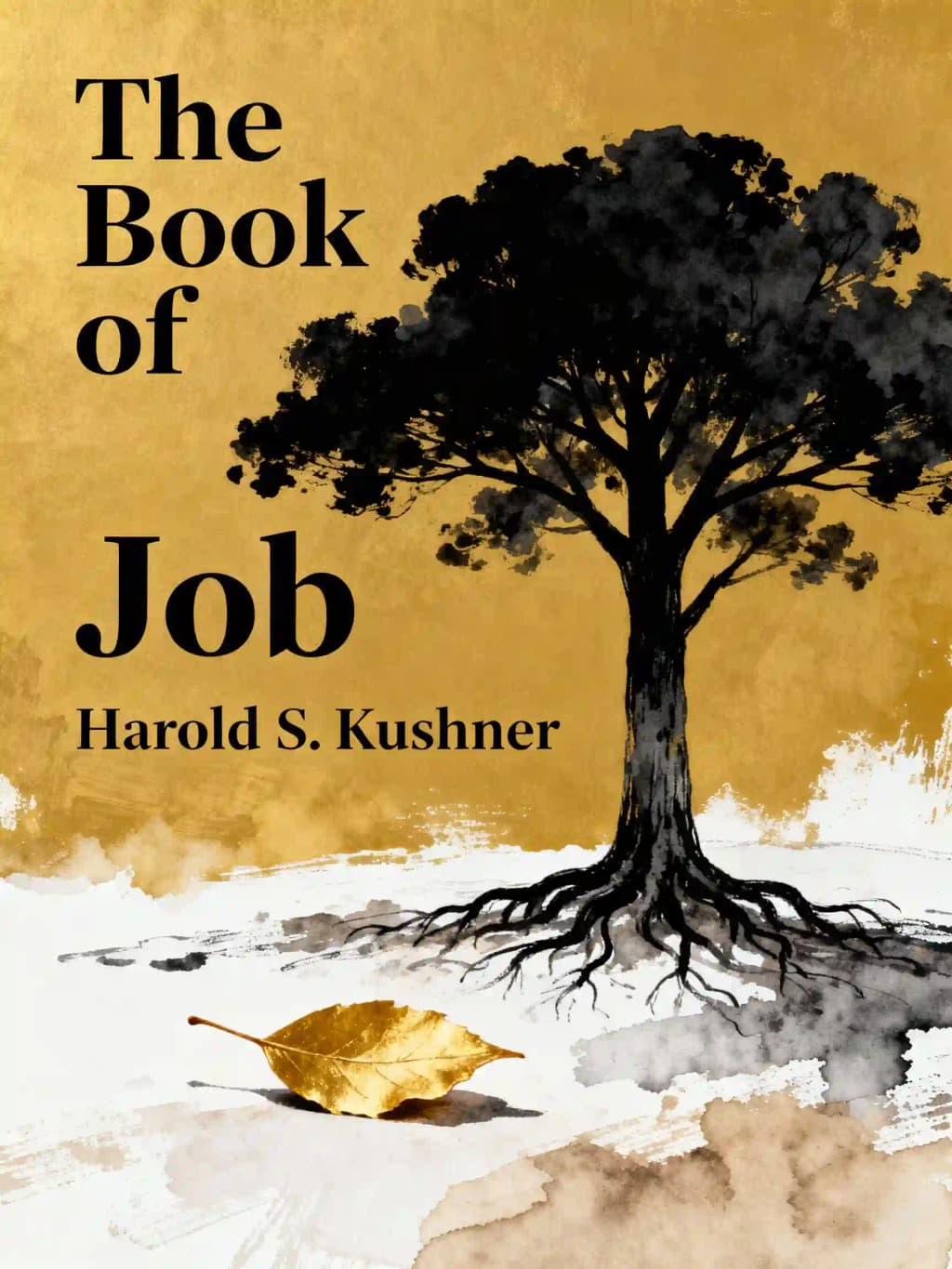
The Book of Job
When Bad Things Happened to a Good Person
Panoramica di The Book of Job
Rabbi Kushner's profound meditation on suffering confronts the Bible's most challenging question: why do good people suffer? Born from personal tragedy, this bestseller has comforted millions across faiths by reimagining God's role in our pain - offering solace where traditional theology falls short.

Temi chiave in The Book of Job
- divine justice
- unmerited suffering
- theodicy and tragedy
- cosmic randomness
- faith under protest
Citazioni da The Book of Job
Many would rather feel guilty than powerless.
Can we love a God we mainly fear?
Job aims to transform its readers.
We desperately want to believe that everything happens for a reason.
Guilt at least implies control over our circumstances.
Personaggi di The Book of Job
- Harold S. KushnerAuthor and rabbi exploring the nature of suffering
- JobA blameless man who loses everything
- Aaron KushnerThe author's son whose illness inspired his work
- SatanFigure who enters a cosmic wager with God
- Elaine PagelsProfessor noted for her insights on guilt
Sull'autore
Sull'autore di The Book of Job
Harold S. Kushner (1935–2023), rabbi and bestselling author of The Book of Job: When Bad Things Happened to a Good Person, was a leading voice on faith, suffering, and ethical living. A Columbia University and Jewish Theological Seminary graduate, Kushner served as rabbi laureate of Temple Israel in Natick, Massachusetts, for over two decades before becoming a full-time writer.
His work blends theological insight with personal tragedy—particularly his son’s death from progeria, which inspired his landmark book When Bad Things Happen to Good People (1981), translated into 12 languages and praised for redefining modern theodicy.
Kushner’s expertise in reconciling faith with human adversity shines in The Book of Job, part of the Jewish Encounters series, where he interprets biblical texts through psychological and philosophical lenses. His other notable works, including Living a Life That Matters and The Lord Is My Shepherd, explore forgiveness, purpose, and spiritual resilience.
A Christopher Medal recipient and frequent speaker at interfaith forums, Kushner’s ideas have been featured in The New York Times, NPR, and academic curricula. His books have collectively sold millions of copies, cementing his legacy as a compassionate guide for readers navigating life’s deepest challenges.
Scarica il riassunto di The Book of Job
Ottieni il riassunto di The Book of Job in formato PDF o EPUB gratuito. Stampalo o leggilo offline quando vuoi.
FAQ su questo libro
Harold S. Kushner’s book explores the biblical story of Job to address why innocent people suffer, blending theological analysis with modern relevance. Kushner argues that God’s goodness coexists with a world where randomness and free will allow suffering, rejecting the notion that pain is divine punishment. The work reinterprets Job’s dialogue with God as a call to embrace faith without demanding easy answers.
This book is ideal for readers grappling with loss, theologians examining theodicy, and anyone seeking solace in ancient wisdom applied to modern crises. Kushner’s accessible style appeals to both secular audiences and faithful individuals questioning divine justice.
Yes, particularly for its compassionate reframing of suffering as a universal human experience rather than a moral failing. Kushner’s synthesis of Jewish scholarship and pastoral insight offers a nuanced perspective on reconciling faith with life’s unpredictability.
While both address undeserved suffering, The Book of Job delves deeper into biblical exegesis, using Job’s story to critique simplistic views of divine control. Kushner expands his earlier themes by contrasting Job’s raw honesty with traditional religious platitudes.
Kushner posits that God is benevolent but not all-powerful, allowing natural laws and human freedom to operate independently. Suffering arises from randomness, not divine intent, and faith involves trusting God’s empathy rather than seeking explanations.
He views Job’s demand for answers as a moral victory, illustrating that authentic faith embraces doubt. God’s whirlwind response affirms cosmic mystery, shifting focus from “why” to resilience and purpose amid adversity.
Some theologians argue Kushner’s limited-God theory undermines omnipotence, while secular critics find his focus on divine goodness irrelevant. Others praise his refusal to trivialize suffering, even if unresolved.
Key takeaways include:
- Rejecting blame or shame for misfortunes
- Finding strength in community rather than isolation
- Accepting life’s unpredictability while maintaining hope
He contends that earthquakes, diseases, and accidents reflect natural processes, not divine judgment. Moral evil (e.g., violence) stems from human choices, with God’s role being to inspire righteousness, not control outcomes.
Their insistence that Job’s suffering must be punishment for sin exemplifies harmful religious dogma. Kushner critiques their rhetoric as spiritually empty compared to Job’s honest struggle.
While not explicitly addressed, his framework rejects blaming victims or God for systemic evil. The book implies that human cruelty, not divine will, causes atrocities, urging moral accountability.
“God is great but not all-powerful” summarizes Kushner’s view that divinity’s power lies in moral influence, not micromanaging outcomes. This quote reflects his reinterpretation of traditional theism.