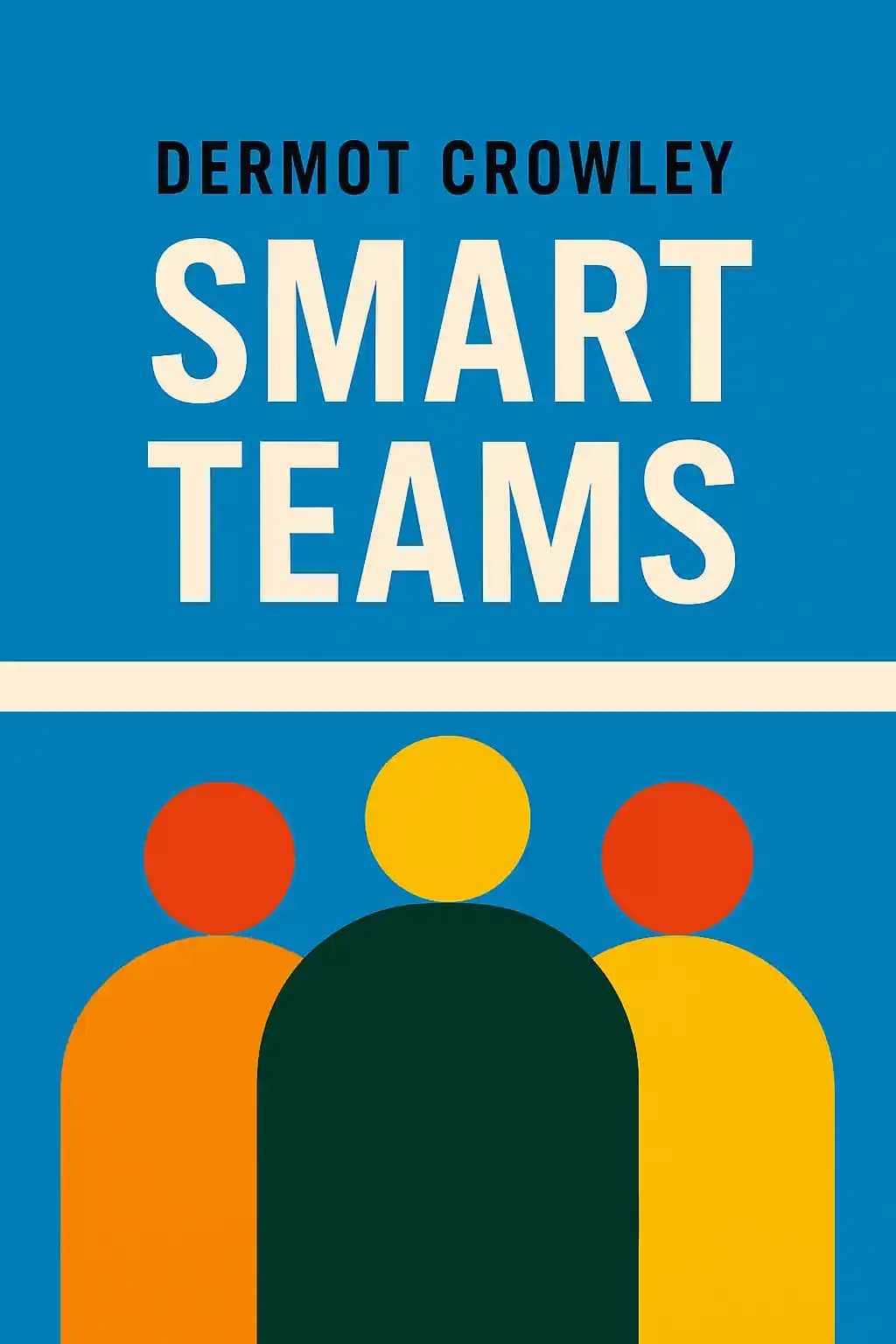
"Smart Teams" reveals how to eliminate workplace friction that silently kills productivity. Dermot Crowley's 2018 guide has become essential reading for business leaders seeking the elusive balance between communication and efficiency. What hidden productivity killer is your team facing right now?
Dermot Crowley, author of Smart Teams, is an Australian productivity expert and founder of Adapt Productivity, specializing in workplace efficiency and collaborative strategies.
With over two decades of experience, Crowley has established himself as a leading voice in modern productivity, blending practical frameworks with tools like Microsoft Outlook to transform team dynamics. His work emphasizes prioritizing tasks, reducing digital overload, and fostering accountability in fast-paced environments.
Alongside Smart Teams, he authored the bestselling Smart Work and Urgent!, which provide actionable systems for individual and organizational effectiveness. Crowley’s methodologies are widely adopted by Australian corporations, financial institutions, and government agencies, cementing his reputation as a trusted advisor in operational excellence.
His insights have been featured in corporate training programs and industry conferences, focusing on aligning technology with human behavior. Smart Teams has been recognized as a practical guide for leaders aiming to optimize collaboration in hybrid work models.
Smart Teams by Dermot Crowley provides actionable strategies to transform unproductive team behaviors into collaborative, high-performance workflows. It emphasizes fostering "superproductive" cultures by reducing email overload, streamlining meetings, and improving project coordination. The book equips leaders and teams with principles to enhance communication, accountability, and work-life balance while achieving impactful results.
This book is ideal for managers, team leaders, and professionals seeking to improve team productivity and collaboration. It offers practical guidance for those struggling with inefficient meetings, email overload, or fragmented workflows. Remote teams, project managers, and organizational leaders will find actionable tactics to build trust and drive results.
Yes, Smart Teams is valuable for its evidence-based frameworks to address common productivity pitfalls. Crowley combines leadership insights with step-by-step strategies, such as creating team charters and reducing interruptions. Reviews highlight its practicality for fostering accountability and improving workplace dynamics.
The book outlines four pillars of high-performing teams: purpose, autonomy, mastery, and collaboration. It stresses aligning teams around clear goals, empowering decision-making, developing skills, and fostering open communication. Crowley also emphasizes "superproductivity" through intentional workflows and reduced distractions.
Crowley advocates for fewer, shorter, and more focused meetings. Tips include setting agendas, limiting attendance to key stakeholders, and using collaboration tools for pre-meeting updates. The goal is to minimize time wasted in unproductive discussions and prioritize actionable outcomes.
"Superproductive" behaviors involve minimizing interruptions, reducing email noise, and promoting deep work. Teams establish norms like designated "focus hours," clear communication channels, and project management systems to avoid multitasking and context-switching.
The book recommends setting email protocols, such as avoiding unnecessary "reply all" responses and using subject-line keywords (e.g., "ACTION" or "FYI"). Teams are encouraged to replace lengthy email threads with quick check-ins or collaborative platforms for real-time updates.
Leaders are tasked with modeling productive behaviors, setting team agreements, and providing resources for success. Crowley highlights the importance of trust-building, conflict resolution, and empowering team members to take ownership of their roles.
Yes, the strategies apply directly to remote work, emphasizing clear communication, structured collaboration tools, and outcome-focused goals. Crowley advises leveraging technology for asynchronous updates while maintaining regular check-ins to sustain team cohesion.
Smart Teams expands on concepts from Crowley’s Smart Work (focused on personal productivity) by addressing team dynamics. It provides complementary frameworks to align individual efficiency with collective goals, ensuring organizational coherence.
Some may find the strategies overly reliant on self-discipline or organizational buy-in. Critics note that implementing cultural shifts requires sustained effort, which may challenge teams resistant to change. However, the book’s structured approach mitigates these hurdles.
With remote work and AI-driven tools reshaping collaboration, Crowley’s focus on intentional communication and workflow optimization remains critical. The principles adapt well to evolving workplace trends, helping teams navigate digital distractions and maintain productivity.
Senti il libro attraverso la voce dell'autore
Trasforma la conoscenza in spunti coinvolgenti e ricchi di esempi
Cattura le idee chiave in un lampo per un apprendimento veloce
Goditi il libro in modo divertente e coinvolgente
Slowing down actually helps teams accomplish more.
The missing piece isn't individual productivity-it's team productivity.
Most of this information is just noise drowning out important signals.
Constant distractions and interruptions fragment our attention.
We need is a slow work movement.
Scomponi le idee chiave di Smart Teams in punti facili da capire per comprendere come i team innovativi creano, collaborano e crescono.
Vivi Smart Teams attraverso narrazioni vivide che trasformano le lezioni di innovazione in momenti che ricorderai e applicherai.
Chiedi qualsiasi cosa, scegli il tuo stile di apprendimento e co-crea intuizioni che risuonano davvero con te.

Creato da alumni della Columbia University a San Francisco
"Instead of endless scrolling, I just hit play on BeFreed. It saves me so much time."
"I never knew where to start with nonfiction—BeFreed’s book lists turned into podcasts gave me a clear path."
"Perfect balance between learning and entertainment. Finished ‘Thinking, Fast and Slow’ on my commute this week."
"Crazy how much I learned while walking the dog. BeFreed = small habits → big gains."
"Reading used to feel like a chore. Now it’s just part of my lifestyle."
"Feels effortless compared to reading. I’ve finished 6 books this month already."
"BeFreed turned my guilty doomscrolling into something that feels productive and inspiring."
"BeFreed turned my commute into learning time. 20-min podcasts are perfect for finishing books I never had time for."
"BeFreed replaced my podcast queue. Imagine Spotify for books — that’s it. 🙌"
"It is great for me to learn something from the book without reading it."
"The themed book list podcasts help me connect ideas across authors—like a guided audio journey."
"Makes me feel smarter every time before going to work"
Creato da alumni della Columbia University a San Francisco

Ottieni il riassunto di Smart Teams in formato PDF o EPUB gratuito. Stampalo o leggilo offline quando vuoi.
In today's workplace, genuine productivity feels increasingly elusive. We've mastered personal productivity hacks yet still drown in emails, meetings, and urgent requests. Why? Because we're missing the crucial piece: team productivity. The counterintuitive truth is that slowing down actually helps teams accomplish more. Think of productivity like sailing a boat-when barnacles build up on the hull, you expend enormous energy just to maintain speed. Similarly, our workplaces accumulate productivity-killing friction through rushed communications, pointless meetings, and constant interruptions. The solution lies in what Dermot Crowley calls "game theory productivity," inspired by Nobel Prize winner John Nash. The best results come when everyone does what's best for both themselves and the group. Most of us operate with either a selfish mindset (focusing solely on our own productivity regardless of how it affects others) or a selfless mindset (helping everyone else at the expense of our own work). Neither works. Instead, we need a "serving mindset" that balances personal efficiency with team effectiveness. Consider how often you send rushed, poorly written emails that create extra work for recipients, or accept meeting invites when you know you can't attend. These seemingly minor behaviors compound across an organization, creating massive productivity drains. When everyone operates with awareness of how their actions affect the group, productivity increases exponentially-like removing those barnacles from the boat. Suddenly, everything moves with less effort.
Four key productivity killers create unnecessary friction in our work lives. First, information overload drowns us in digital noise. Workers face 200-300 emails daily while juggling numerous systems - messaging apps, video calls, collaboration tools, and management platforms. We spend up to 2.5 hours searching for information daily, with only 20% being crucial. Second, unfocused meetings consume disproportionate time. The average worker spends 23 hours weekly in meetings, creating a paradox where collaboration reduces productivity. Without balance between collaborative and individual work time, people extend their workday 2-3 hours just to complete basic tasks. Third, constant distractions fragment attention. It takes 23 minutes to regain focus after an interruption, yet we're interrupted every 11 minutes on average. Ironically, we often enjoy the dopamine hit from notifications while complaining about these same interruptions. Fourth, unnecessary urgency drives reactive rather than thoughtful responses. In urgency-driven cultures, up to 70% of time is spent on urgent but unimportant tasks, reducing quality and increasing stress levels by 27%. What we need is a "slow work" movement - creating responsive rather than reactive cultures that prioritize quality work. Organizations implementing such approaches report up to 40% higher productivity and 25% lower stress levels. Paradoxically, slowing down results in more work done in less time.
Organizations typically exist at one of five productivity levels. At Level 1 (Disruptive), leadership undermines productivity through counterproductive behaviors despite talking about it. Everyone works long hours, jumping between urgent issues amid overwhelming emails and meetings. Level 2 (Passive) organizations don't cause productivity problems but fail to prevent them, clinging to outdated methods. Level 3 (Productive) organizations invest in individual productivity skills, but gains are limited as personal efficiencies are offset by team friction. Level 4 (Collaborative) organizations achieve greater workflow effectiveness where "the sum is greater than the parts," though enthusiasm for new protocols often wanes. At Level 5 (Superproductive), teams experience sustained productivity increases with minimal resistance, enhancing both personal and collective efficiency. Advancing through these levels requires leadership that prioritizes and models productive behaviors. Organizational cultures mirror leadership work styles - if leaders operate reactively and chaotically, the culture follows suit, pulling even well-trained individuals back into "firefighter mode."
Building a smart team requires four key qualities that directly impact productivity. First, smart teams are purposeful-working with clear intent on high-impact activities rather than being distracted by urgency or busywork. Companies like Amazon, Apple, and Atlassian build teams with strong shared purpose that drives productivity. Second, smart teams are mindful about how behaviors affect others' productivity, embodying "game theory productivity" that serves both individual and group needs. Third, smart teams are punctual for meetings, work delivery, and communications. One former Microsoft executive expected team members to arrive five minutes early to meetings, using the analogy that "if you arrive after 8 am, the ship has sailed." Fourth, smart teams are reliable-taking ownership of work, deadlines, and promises while negotiating workload when appropriate. When teams embrace these qualities, they create powerful outcomes: focus, respect, trust, and impact. However, qualities alone won't change behaviors-teams need specific productivity principles with tangible, situation-specific examples of these qualities in action.
Email has become both blessing and curse in modern workplaces. While promising efficiency, it often delivers overflowing inboxes, interruptions, and stress. The three major challenges are: disruption through constant interruptions (with CC and Reply All as culprits); inbox bottlenecks that delay responsiveness; and stress from volume. Organizations typically have four main communication tools: conversations (informal, same-time interactions); meetings (formal, same-time collaboration); email (formal, any-time content delivery); and posts on shared platforms (informal, any-time context sharing). Teams should select the right tool for each situation rather than defaulting to email. Face-to-face conversations, phone calls, or instant messaging can often replace lengthy email chains. A two-minute conversation might eliminate 15 emails between five people. The key to focused communications is: 1) Plan the WHY - clarify your desired outcome; 2) Write the WHAT - structure your message clearly; 3) Send to WHO - consider carefully who needs this information. The SSS approach provides a format for effective emails: Subject, Summary, and Supporting information. A strong subject line describes contents like a newspaper headline. The summary offers an "executive summary" with required actions upfront. Before sending, consider who truly needs your message and adopt the "Pause, Think, Send" approach to break automatic email habits.
Creating a productive culture where flow replaces friction requires thoughtful leadership. Even in large organizations, you can create positive change by starting with your team's culture and watching these behaviors influence others. Teams can develop micro-cultures that differ from the wider organization. A culture is simply collective habits practiced consistently over time. By focusing on your immediate team, you'll achieve faster results and potentially become a model for others. Leaders must replace fear with confidence, confusion with clarity, and mobilize teams toward a better future. They should follow the medical principle of "first, do no harm" regarding productivity. Leaders often cause disruption through last-minute delegation, unnecessary meetings, or requesting unused reports. Your actions as a leader send messages your team notices. Like Snow White caught smoking at Disney (ruining the fantasy), leaders who don't uphold standards lose credibility. Rather than implementing every idea at once, focus on targeted projects to gradually transform team culture. Productivity isn't about working harder - it's about working smarter together. When we consider how our actions affect others, we speed up collective progress. The most productive teams aren't just collections of productive individuals but groups who've reduced friction and created flow between them. What small change could help your team work smarter?