Capitolo 1
The Emotional Edge: How Top Performers Win Complex Deals
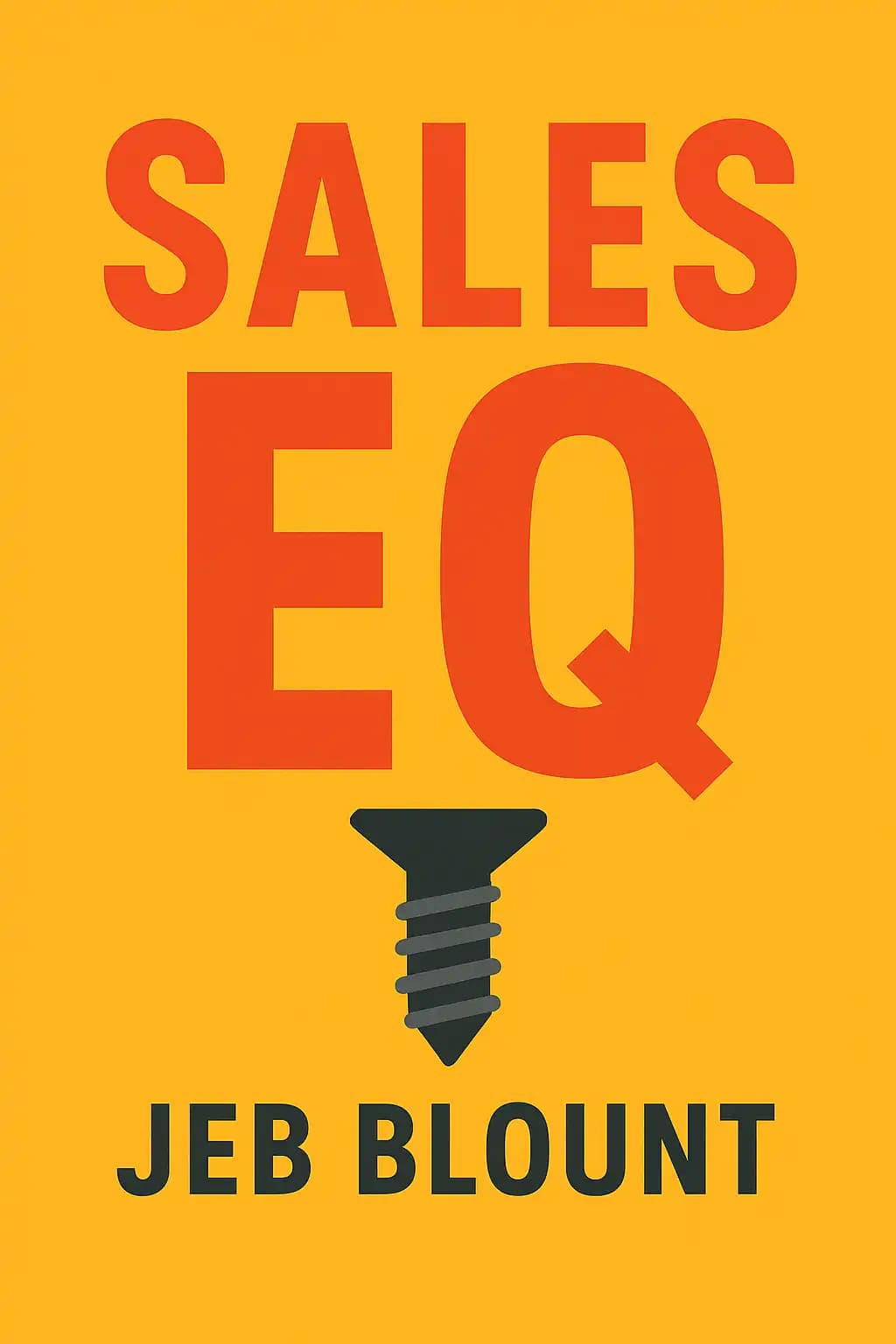
Ever wondered why some salespeople consistently outperform their peers, even when selling identical products? In 2017, Jeb Blount revolutionized the sales world with "Sales EQ," a book that quickly became required reading for sales professionals seeking to break through performance plateaus. As a renowned sales acceleration specialist who spends over 200 days yearly training global organizations, Blount distilled decades of experience into this groundbreaking work. The book has been endorsed by sales luminaries like Anthony Iannarino, who called it "one of the most important sales books in decades." What makes it particularly compelling is how it bridges the gap between process-focused methodologies like SPIN Selling and The Challenger Sale by addressing the missing human element-emotional intelligence. In a profession increasingly threatened by automation and AI, Blount makes a compelling case that the emotional side of selling is what ultimately differentiates ultra-high performers from everyone else.
Capitolo 2
The Irrational Truth: Emotions Drive Buying Decisions
After two years of competing against better-resourced rivals for a major deal, Jeb received the call that would change his life. When he asked why they chose his company over competitors with corporate jets and premier entertainment budgets, the answer was startlingly simple: "We just felt like you guys were a lot like us." Despite extensive RFPs, detailed presentations, and implementation plans, the decision ultimately came down to comfort and similarity bias-they simply liked Jeb's team more.
This experience illuminates a fundamental truth about sales: people act on emotion and justify with logic. Science repeatedly demonstrates this reality, from banking executives making $500,000 decisions because they liked a birthday card to consumers paying more for identical products from salespeople they connect with emotionally.
Even when people believe they're making rational choices, studies prove otherwise. In one experiment, a liquor store played German music on Tuesdays and French music on Wednesdays, correspondingly increasing sales of each country's wines. When interviewed, customers gave logical reasons for their purchases, completely unaware of how the music had influenced their decisions.
The implications for sales are profound. When products and services are relatively equal (as they often are in today's marketplace), the ability to influence stakeholders' emotions while regulating your own provides a distinct competitive advantage. Many salespeople, trainers, and experts miss this truth, focusing instead on process-based, data-driven approaches that fall apart when confronted with irrational emotions.
This disconnect occurs because selling and buying follow different emotional trajectories. Most salespeople begin with logic and gradually shift toward emotion, while buyers start emotionally and gradually move toward logic. To be effective, you must approach people the way they buy rather than the way you sell. This requires sales-specific emotional intelligence-the ability to manage your own disruptive emotions while accurately interpreting and responding to stakeholders' emotions in the context of the sales process.
What makes this particularly challenging is how our brains process information. Humans are pattern-recognition machines, using mental shortcuts to manage overwhelming sensory input. These shortcuts, while necessary for survival, create cognitive biases that affect decision-making. Ultra-high performers understand these patterns and "paint boring sales patterns with bright colors" to disrupt expectations and engage stakeholders emotionally.
Capitolo 3
The Four Intelligences of Sales Success
Ultra-high performers possess intellectual agility, keen observation skills, and insatiable curiosity. While having above-average IQ helps in sales, it's insufficient alone. True sales excellence requires balancing four types of intelligence: innate intelligence (IQ), acquired intelligence (AQ), technological intelligence (TQ), and emotional intelligence (EQ).
Innate intelligence is hardwired into your DNA-you're either born with it or not. People with above-average intelligence excel at seeing relationships between seemingly unrelated ideas and developing unique solutions. However, high IQ can damage relationships through impatience, talking down to people, and overwhelming others with complex solutions to simple problems. Many brilliant people fail in sales because they can't influence others' behaviors.
Acquired intelligence grows through learning, training, reading, practice, and experience. Many struggling salespeople resist learning, making excuses and believing they "know it all." This mindset reveals an external locus of control-believing outside forces determine outcomes rather than personal actions. Ultra-high performers possess an internal locus of control, driving their insatiable thirst for knowledge. They seek learning opportunities, welcome feedback, and view adversity as a chance to grow.
Technological intelligence is the ability to seamlessly integrate technology into daily work. Those who resist developing this skill will be left behind. Beyond relationship skills, tomorrow's successful salespeople must understand data, work effectively with AI, and quickly capitalize on opportunities. Ultra-high performers approach technology through the "Three As": they Adopt new technology early, Adapt it to their unique situations, and become Adept at using it.
Emotional intelligence-the ability to perceive, interpret, respond to, and manage emotions-has become more essential than ever in our tech-dominated world. It's the key that unlocks ultra-high performance, offsetting deficiencies in other intelligence types. In sales, EQ is leveraged to increase win probabilities by shaping stakeholder decisions through four pillars: empathy, self-awareness, self-control, and sales drive.
These four intelligences are tightly intertwined, each amplifying the others. IQ (how smart you are) is fixed in your DNA. AQ (how much you know) makes IQ relevant. TQ (how you leverage technology) frees time for human relationships. EQ (your emotional acuity) amplifies the other intelligences by enabling you to influence and persuade others. People who combine high levels of all four dominate any field they pursue.
Capitolo 4
The Win Probability Game: Strategic Deal Selection
Sales requires adapting to unique contexts-there's no one-size-fits-all solution. Every prospect, conversation, and product differs, requiring flexibility. What makes sales beautiful is that there are no guarantees or magic formulas-only poetry and probability. The ability to manage emotions to create the highest statistical chance of winning separates ultra-high performers from everyone else.
Ultra-high performers approach sales like a probability game. Just as you'd choose a slot machine with a 93% win probability over one with 33%, smart salespeople focus on opportunities with the highest likelihood of success. Unlike slot machines, sales probabilities are fluid, complex, influenced by many variables, and impossible to know with certainty until the deal concludes.
To maximize win probability, ultra-high performers are fanatical prospectors who make prospecting a daily priority. This gives them more opportunities to choose from, allowing them to be selective about which deals to pursue. Average salespeople, by contrast, prospect irregularly and often find themselves riding the "Desperation roller coaster" when their pipeline empties. This desperation becomes a disruptive emotion that stakeholders can sense, lowering win probability.
The Law of Replacement explains why average salespeople get stuck on this cycle. When you close one deal, you must replace not just that prospect but all the prospects that statistically won't close based on your conversion rate. For example, with a 10% closing ratio, closing one deal means you've lost 10 prospects total from your pipeline.
Ultra-high performers invest time only with high-probability prospects. They've learned to manage the disruptive emotion of attachment and can walk away from deals when win probability falls below an acceptable threshold. This discipline requires both a full pipeline and emotional control. Average salespeople treat every prospect the same and continue investing in low-probability deals, becoming emotionally attached to opportunities that will never close.
Human emotions, motivations, and cognitive biases of stakeholders have the greatest impact on win probability. Ultra-high performers identify and map five BASIC stakeholder types: Buyers, Amplifiers, Seekers, Influencers, and Coaches. While average salespeople myopically ask "Are you the decision maker?", UHPs work to understand all stakeholders' roles in the buying process.
Perhaps most importantly, ultra-high performers master not just the sales process, but align three distinct processes: the sales process (how the salesperson advances the deal), the buying process (how organizations vet the deal), and the decision process (how individual stakeholders make commitments). While the first two are linear and rational, the decision process is individual, emotional, nonlinear, and often irrational.
Capitolo 5
Empathy: The Foundation of Sales Connections
Shell, an ultra-high performer in high-end jewelry sales, demonstrates how empathy drives success. When young couples shop for engagement rings, she tunes into their emotions-the bride's fantasy of a massive diamond and the groom's financial stress. Rather than pushing expensive rings, Shell starts conversations about their future plans, then recommends rings that fit their lifestyle without burdening them with debt. This empathetic approach not only closes sales but generates referrals.
Empathy is the foundational pillar of Sales EQ-the ability to step into someone else's shoes and experience emotion from their perspective. It provides insight into others' perspectives and helps salespeople understand that each stakeholder views their problems as unique, allowing ultra-high performers to bridge to personalized solutions.
Interestingly, research shows good salespeople tend to be naturally self-centric rather than other-focused-competitive and achievement-driven. This creates a conundrum: less empathetic people often perform better in sales, yet empathy is key to ultra-high performance. The bridge across this gap is conscious intention. Ultra-high performers intentionally develop competence across four dimensions: desire to understand stakeholders' perspectives, concern about their feelings, focus on serving them, and deep listening with all senses.
While empathy is the most important Sales EQ trait, too much can be problematic. Excessive empathy can lead to projection-assuming others feel as you do-which can paralyze salespeople. In sales, you must be empathetic while keeping your ultimate objective in perspective-this is Dual Process.
In every sales interaction, stakeholders subconsciously ask themselves: "Do I like you?" When stakeholders meet salespeople, they make snap judgments about likability that have lasting impacts on buying decisions. As Michelle's mattress shopping story illustrates, customers will pay more to buy from someone they like, even for identical products. Likability is the gateway to building emotional connections with stakeholders and moving into their "familiarity bubble" or in-group.
First impressions about likability form almost instantly in the stakeholder's subconscious. Unlike trust, which builds over time, likability judgments happen in mere moments and significantly impact whether prospects will engage in conversation.
Most salespeople fail at likability not because they lack social skills but because they talk instead of listen. "Pitch slapping" prospects turns them off immediately. Being likable requires intentional focus on: smiling sincerely, using a friendly voice tone, being consistently polite, dressing professionally, maintaining excellent grooming, giving stakeholders complete attention, flexing your communication style to complement the stakeholder's style, speaking their language, showing genuine enthusiasm, and projecting confidence without arrogance.
Capitolo 6
Self-Awareness: The Mirror of Performance
Ultra-high performers aren't perfect-they have the same issues and hang-ups as everyone else. What distinguishes them is their awareness of their shortcomings and blind spots. They accurately interpret their emotions, acknowledge blind spots, realistically assess strengths and weaknesses, understand their communication style's impact, and recognize disruptive emotions.
Developing self-awareness is difficult because humans aren't naturally adept at seeing themselves clearly. The comfort of delusion is more appealing than cold reality, but success and delusion cannot coexist. Our self-serving bias protects our fragile ego through cognitive distortion. Awareness is the mother of change and growth, but it's difficult to change what you can't see.
Self-awareness of your interpersonal style is critical to effective communication. People feel more comfortable when you interact with them based on who they are-not who you are. Ultra-high performers are keenly aware of their behavioral style and confident enough to adjust when dealing with different personalities.
Elite performers across fields use coaches because you can't change what you can't see. Coaches hold up a mirror to your behavior and help you confront the real you. The key to attracting a coach is being coachable: ask for help, listen with your ego in check, trust their observations about your blind spots, take action on agreed-upon steps, and show progress.
Nothing damages relationships faster than not listening. Despite every sales training emphasizing its importance, listening remains the weakest link in human interaction. When people don't listen to us, we feel small, unappreciated, and unimportant-a universal human experience that stakeholders consistently cite as their number one complaint about salespeople.
Listening is difficult because it requires empathy, cognitive focus, and emotional self-control. Our natural tendency is to spend 95% of our time thinking about ourselves and our offerings. The disruptive emotional need for significance makes telling our own story feel more important than listening to others, despite knowing better.
Great sales conversations should be engaging, thought-provoking, and memorable. Four principles guide effective sales conversations: people respond in kind, people communicate in stories, questions control conversation flow, and listening builds emotional connections. The more you listen, the deeper your connection grows with stakeholders, building trust and breaking down emotional walls.
Capitolo 7
Self-Control: Managing Disruptive Emotions
Self-control in sales is exemplified by Sam Scharaga's story, where he maintained composure when a prospect disrespectfully threw his promotional materials in the trash. Rather than losing his temper, Sam acknowledged the prospect's loyalty to his current vendor, ultimately winning him over and eventually earning his business through emotional discipline.
The sales profession is engulfed in emotion, with virtually every mistake, roadblock, or failure tied directly to disruptive emotions like fear, anger, uncertainty, insecurity, impatience, attachment, arrogance, and blame. These emotions manifest in destructive behaviors that fog focus, derail relationships, cloud situational awareness, and lead to irrational decisions or paralysis.
Our brain's primary function is keeping us safe, but in sales, perceived threats are almost entirely social rather than physical-threats to our ego, status, and self-image. These perceived threats trigger the same fight-or-flight response as physical danger, bypassing rational thought and potentially destroying carefully built relationships.
The fight-or-flight response begins in the amygdala and cascades through your body without your consent. Neurochemicals flood your system, blood rushes to your muscles, and-critically-drains from your neocortex (rational brain), reducing you to "the cognitive capacity of a drunk monkey." You can't think clearly, struggle for words, and lose control.
Self-control requires distinguishing between experiencing emotions and being consumed by them. Emotional self-awareness lets you take the helm during emotional storms and change course. While you have little control over how disruptive emotions originate, you can deploy techniques to recognize them, gain rational control, and regulate them before they cause damage.
When stakeholders are hesitant to engage, average salespeople succumb to disruptive emotions (fear of the unknown, attachment to control, discomfort with silence, impatience, need for significance) and shift from asking questions to pitching. Ultra-high performers recognize these emotional triggers and maintain control, staying focused on the stakeholder rather than their own discomfort.
Capitolo 8
Sales Drive: The Fuel for High Performance
Sales is a tough, grueling profession with unrelenting pressure to deliver results. Despite this high-stress environment, ultra-high performers maintain relaxed confidence and optimism in the face of adversity. Research shows that these top performers share one critical psychological trait: drive. This fundamental component of Sales EQ includes optimism (the mother of perseverance), competitiveness (the mother of persistence), and need for achievement (the mother of self-motivation).
Sales Drive begins with shifting your mindset to develop an internal locus of control, understanding you can only control your actions, reactions, and mindset. While some aspects of drive are innate, it can be developed through two core beliefs: expecting to win and believing everything happens for a reason. This optimistic perspective helps you brush off doubt, ask confidently for what you want, and view setbacks as learning opportunities.
Mental energy is limited by physical resilience. Keeping yourself in great physical condition improves creative thinking, mental clarity, and optimism while boosting confidence and enthusiasm-the two most important emotions in sales. Exercise 30-60 minutes daily, stand while on calls, take walking breaks, and find ways to incorporate movement throughout your day to maintain physical and mental energy.
Mental toughness is the ability to accept pain and sacrifice today for future wins, block out negative self-talk, manage disruptive emotions, and maintain singular focus on goals. Ultra-high performers sacrifice short-term pleasure for long-term gain, leaning into challenges while maintaining focus through emotional control.
The most insatiable human need is to feel significant or important-almost everything we do stems from this desire. Research shows people spend 60-80% of conversations talking about themselves because it triggers dopamine release and creates euphoria. This explains why we feel emotionally connected to those who listen to us and disconnected from those who dominate conversations.
Making others feel important requires shifting focus away from yourself. Use their name-the sweetest sound to them. Remember personal details about them and reference these in conversation. Help them look good in front of others. Express genuine appreciation and ask for their advice. Show authentic interest by researching them beforehand. Demonstrate empathy by valuing their perspective. Listen attentively-when your mouth is closed and ears open, you make a memorable impression.
Capitolo 9
The Three Processes of Sales: Strategic Alignment
For mid to long-cycle complex deals, understanding your prospect's buying process is imperative-knowing the steps involved, stakeholder expectations, timing, and mapping the stakeholders' roles and influence. This isn't easy, as stakeholders may obscure the process for negotiating advantage, have limited visibility into the bigger picture, or struggle to articulate their process.
Most salespeople get pulled into prospects' buying processes late and then dance to their tune. They rush into deals producing proposals, pitching solutions without information, challenging without understanding, ignoring stakeholder influence, and asking without earning the right. With buying and sales processes out of sync, they skip steps, let emotions drive behaviors, and ignore situational awareness.
Ultra-high performers shape buying processes by getting there first through fanatical prospecting or by using leverage-something stakeholders want or need that UHPs never give away for free. At La Petite Academy, Jeb made an immediate change: no more RFP submissions without first meeting the prospect's CEO. This approach tested engagement, provided stakeholder mapping insights, and slowed down the buying process to align with their sales process.
Complex sales involve multiple stakeholders, with their number increasing alongside risk, complexity, and sales cycle length. Even a simple $500 promotional item purchase can involve four stakeholders. For higher-risk decisions, meetings can involve over 20 stakeholders from various departments, each with different concerns and motivations.
There are five stakeholder types encountered in most deals: Buyers, Amplifiers, Seekers, Influencers, and Coaches (BASIC). Sometimes stakeholders play multiple roles, while in larger deals each may have a single function. UHPs identify and map these stakeholders meticulously, building relationships with each.
While sales and buying processes are linear and rational, the decision process is individual, emotional, and often irrational. Average salespeople focus only on organizational needs, forgetting they're working with humans using company money to solve personal problems. UHPs excel at aligning all three processes, creating emotional connections that dramatically improve win probability and competitive differentiation.
Capitolo 10
Understanding Your Stakeholders: The Key to Differentiation
In sales, differentiation through standard marketing materials and pitches often fails because competitors all look identical. In today's age of transparency, information is ubiquitous but confusing, with multiple vendors making identical promises. The brutal truth: to differentiate, YOU must be different.
At its core, sales is simply one person solving another person's problem. Stakeholders become emotionally attached to salespeople who demonstrate they truly understand their unique problems and craft custom solutions. When someone truly "gets" you, the relationship is nonjudgmental, comfortable, accepting, and transparent.
In B2B sales, stakeholders believe their problems are unique, and if you treat their situation generically, they'll disconnect emotionally. Speaking their language and delivering personalized recommendations demonstrates that you understand them, making you stand out from competitors who deliver generic pitches.
Language is the ultimate sales technology-evolutionary biologist Mark Pagel calls it "social technology" that evolved partly to facilitate commerce. Language serves as an "audio technology for rewiring other people's minds," allowing you to implant thoughts directly into someone else's mind. In sales, speaking your stakeholders' language-their jargon, acronyms, processes, and emotional hot buttons-pulls you into their in-group.
The law of reciprocity creates a powerful obligation to repay what others provide us. Making stakeholders feel important creates a subconscious obligation to reciprocate, increasing the probability they'll agree to your next micro-commitment. Each micro-commitment advances deals through the pipeline and creates velocity.
Stakeholders subconsciously ask themselves: "Do you get me and my problems?" When you demonstrate genuine understanding of their unique situation and challenges, you create an emotional connection that competitors can't easily replicate. This understanding must go beyond surface-level business issues to include personal motivations, fears, and aspirations.
Capitolo 11
Building Trust: The Foundation of Sales Success
Trust is the foundation of sales success, yet most stakeholders begin interactions with skepticism due to lifetime experiences and negative stereotypes about salespeople. Despite most salespeople having good intentions, stakeholders judge trustworthiness based on congruence between words, nonverbal communication, and actions.
According to an Associated Press/GfK poll, 70 percent of Americans believe most people can't be trusted-a percentage that would likely be higher if specifically asked about salespeople. Stakeholders bring this emotional baggage into sales conversations, amplified by negative media portrayals.
Salespeople must recognize they're constantly being observed by stakeholders who watch for congruence between words and actions. Small inconsistencies-being late to meetings, not returning calls promptly, showing disorganization, or displaying unprofessional materials-all register as negative signals. The human brain gravitates toward negative perceptions, and these small breaches accumulate over time to undermine trust.
Trust must be earned through consistent evidence of trustworthiness-it's not an entitlement. Every action affects trust positively or negatively as you navigate the sales, buying, and decision processes. You can't rush trust or skip crucial connecting steps; you must patiently lay the foundation brick by brick. Without trust, stakeholders erect emotional walls, discovery remains shallow, next steps are denied, and deals stall. In sales, trust is everything-without it, you have nothing.
Stakeholders constantly ask themselves: "Do I trust and believe you?" This question underlies all other considerations in the sales relationship. Trust isn't established through claims or assertions but through consistent demonstration of reliability, competence, and genuine concern for the stakeholder's best interests. When trust is established, price sensitivity decreases, objections diminish, and the path to closing becomes significantly clearer.
Capitolo 12
The Future Belongs to the Emotionally Intelligent
In an age where technology increasingly commoditizes products and services, emotional intelligence becomes the ultimate differentiator. As artificial intelligence and automation transform the sales landscape, the ability to connect with stakeholders on a human level becomes more valuable, not less.
Ultra-high performers understand that while products may be similar, the emotional experience of buying from them is unique. They leverage sales-specific emotional intelligence to shape win probabilities in their favor by aligning the three processes of sales, managing their own disruptive emotions, and creating genuine emotional connections with stakeholders.
The sales profession isn't just about building relationships-it's about making sales. While relationships matter and increase win probability, the end goal is closing deals. Sales EQ balances these opposing approaches through dual process-the ability to simultaneously empathize with stakeholders while remaining focused on sales objectives.
As we move further into the digital age, those who master the human side of selling will continue to thrive while others struggle. By developing the four pillars of sales-specific emotional intelligence-empathy, self-awareness, self-control, and sales drive-salespeople can position themselves among the ultra-high performers who consistently win in an increasingly competitive marketplace.
The message is clear: in sales, emotional intelligence isn't just a nice-to-have soft skill-it's the essential foundation upon which all other sales capabilities are built. As Jeb Blount concludes, "In sales, trust is everything-without it, you have nothing."