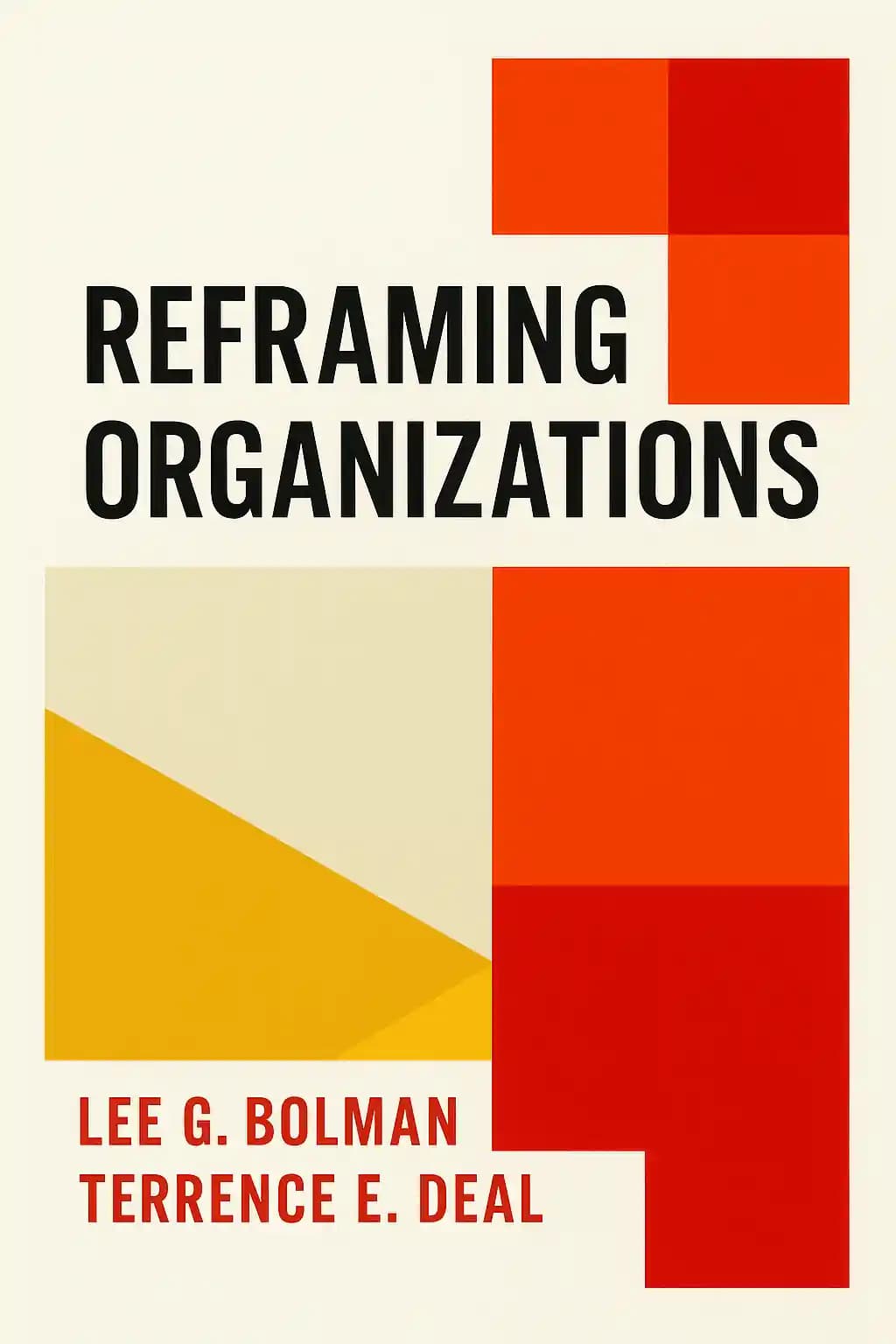
Reframing Organizations
Artistry, Choice and Leadership
Panoramica di Reframing Organizations
Reframing Organizations - the four-decade leadership classic that revolutionized how we understand workplace dynamics. Bolman and Deal's four-frame model has shaped corporate cultures worldwide, becoming essential reading in business schools. Ever wonder why some leaders see opportunities where others see only chaos?
Temi chiave in Reframing Organizations
- four-frame model
- organizational diagnosis
- multi-frame thinking
- structural architecture
- political power dynamics
Citazioni da Reframing Organizations
Structure enhances morale when it helps work get done.
Mintzberg identified five structural configurations.
The power of reframing lies in its ability to liberate managers.
Organizations exist to achieve established goals.
Structure provides both opportunities and constraints.
Personaggi di Reframing Organizations
- Lee G. BolmanCo-author and developer of the four-frame model
- Terrence E. DealCo-author and expert on organizational culture
- Frederick TaylorDeveloper of scientific management theory
- Max WeberSociologist who analyzed rational bureaucracy
Sull'autore
Sull'autore di Reframing Organizations
Lee G. Bolman and Terrence E. Deal, bestselling authors of Reframing Organizations: Artistry, Choice, and Leadership, are pioneering scholars in organizational behavior and leadership development. Bolman, Marion Bloch Chair Emeritus at the University of Missouri-Kansas City, and Deal, former Irving R. Melbo Clinical Professor at the University of Southern California, combine decades of academic rigor at institutions like Harvard and Stanford with global consulting work across business, healthcare, and education sectors. Their seminal four-frame model—structural, human resource, political, and symbolic—has shaped leadership education since the book’s 1984 debut, becoming essential reading in MBA programs and executive training.
The duo’s collaborative works, including Leading with Soul, blend research-backed frameworks with real-world applicability, addressing modern challenges like cross-sector collaboration and crisis management. Their seventh edition (2021) integrates contemporary themes such as virtual workplaces and cultural globalization, reflecting 40+ years of evolving leadership landscapes. Translated into multiple languages and cited in over 1,000 academic papers, Reframing Organizations remains a cornerstone text, with its enduring insights adopted by Fortune 500 firms and nonprofits alike.
Scarica il riassunto di Reframing Organizations
Ottieni il riassunto di Reframing Organizations in formato PDF o EPUB gratuito. Stampalo o leggilo offline quando vuoi.
FAQ su questo libro
Reframing Organizations provides a four-frame model (structural, human resource, political, symbolic) to analyze and improve organizational dynamics. Lee Bolman and Terrence Deal emphasize "reframing"—viewing challenges through multiple lenses to craft creative solutions. The book blends theory with real-world examples, teaching leaders to align strategy, navigate power structures, inspire teams, and foster meaningful workplace culture.
Leaders, managers, HR professionals, and organizational development students will find this book invaluable. Its frameworks help anyone managing teams, leading change, or seeking to understand workplace complexities. Academics also use it to teach leadership theory, while consultants apply its principles to diagnose organizational issues.
Yes—it’s a seminal text praised for its accessible blend of theory and practice. Over 30 years, it’s remained relevant for its actionable strategies to address leadership challenges. Readers credit it with broadening their problem-solving skills and offering tools to diagnose issues like misaligned teams or ineffective communication.
Lee Bolman (Marion Bloch Chair Emeritus, University of Missouri-Kansas City) and Terrence Deal (educational leadership expert) are renowned organizational theorists. They’ve co-authored multiple bestsellers, including Leading With Soul and Reframing Academic Leadership. Their work focuses on integrating empathy, strategy, and symbolism into leadership.
- Structural Frame: Focuses on roles, hierarchy, and efficiency (e.g., optimizing workflows).
- Human Resource Frame: Prioritizes employee needs, motivation, and relationships.
- Political Frame: Examines power dynamics, conflict, and coalition-building.
- Symbolic Frame: Uses culture, rituals, and storytelling to inspire purpose.
Unlike single-perspective guides, this book synthesizes diverse theories into a cohesive toolkit. It’s more analytical than The 7 Habits of Highly Effective People and more practical than purely academic texts. Critics note its corporate focus but praise its adaptability to nonprofits, education, and government.
Reframing means reinterpreting challenges through different lenses to uncover hidden solutions. For example, a failing project might need structural realignment (tasks), human resource support (team morale), political negotiation (stakeholder buy-in), and symbolic storytelling (reviving purpose).
Yes—its political and human resource frames guide leaders to address root causes. The political frame advises mapping power dynamics and building alliances, while the human resource frame stresses empathy and dialogue. Case studies show how reframing reduces tensions and fosters collaboration.
Some argue the frames oversimplify complex issues or prioritize corporate settings over grassroots movements. Others note the symbolic frame’s reliance on “soft” skills like storytelling, which may clash with data-driven cultures. Still, most agree the model’s flexibility outweighs these limits.
Its emphasis on adaptability suits today’s hybrid work, AI integration, and diverse teams. The symbolic frame helps leaders unite remote employees through shared values, while the political frame aids in navigating digital transformation’s power shifts.
- No single approach solves all problems.
- Great leaders diagnose issues through multiple frames.
- Symbolic acts (e.g., rituals) build culture as effectively as policies.
- Quote: “The essence of leadership is not giving things or even providing visions. It is offering oneself and one’s spirit.”
Yes—the book analyzes leaders like Steve Jobs, showing how reframing saved Apple in 1997. Jobs realigned structure (simplifying product lines), addressed politics (rebuilding stakeholder trust), and leveraged symbolism (declaring “innovation” as core to Apple’s rebirth).