Capitolo 1
Breaking Free from Corporate Gravity: A Journey to Creative Liberation
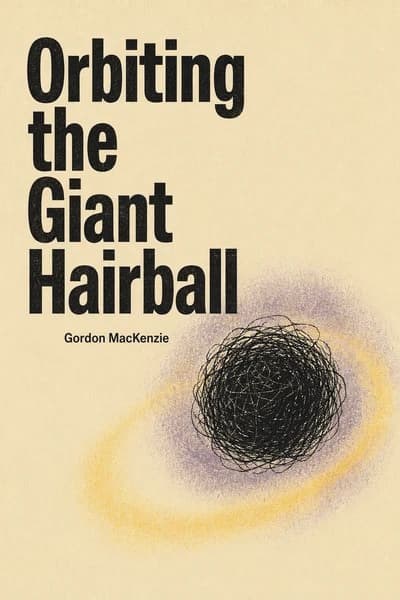
Ever wondered why some people thrive in corporate environments while others feel suffocated? Gordon MacKenzie's "Orbiting the Giant Hairball" offers a radical perspective on maintaining creativity within organizational structures. This cult classic, beloved by innovators like Seth Godin and creative leaders at companies like Pixar and Google, presents a revolutionary framework for balancing professional responsibility with creative authenticity. MacKenzie spent 30 years at Hallmark Cards, where he eventually created his own job title: "Creative Paradox." His journey from conformist to corporate rebel provides a roadmap for anyone feeling trapped in organizational monotony. Through whimsical metaphors and profound insights, MacKenzie shows us how to orbit around corporate constraints while maintaining our creative essence-a skill increasingly valuable in today's rapidly evolving workplace.
Capitolo 2
The Suppression of Genius: How We Lose Our Creative Birthright
Every human is born a creative genius. I discovered this profound truth during my visits to elementary schools as a steel sculptor, where I conducted a simple yet revealing experiment. When I asked first-graders if they were artists, every hand shot enthusiastically into the air, accompanied by excited bouncing and eager faces. These children didn't hesitate or question their creative identity - they knew with absolute certainty they were artists. But by sixth grade, only a few reluctant hands would rise, often with qualifying statements like "I'm not very good" or "I just doodle sometimes." What happened in those five short years to create such a dramatic shift in creative self-perception?
Society systematically suppresses our innate creative genius through a complex web of well-intentioned but creativity-killing practices. Children are gradually trained away from their natural-born "foolishness" toward conformity and boundaries through subtle and overt messages. This process happens through what I call the invisible "Genius Cartel" - teachers, parents, bosses, and institutions - who unconsciously suppress originality because genius threatens established authority. Well-meaning comments like "that's not how we do things" or "be realistic" slowly erode creative confidence. The creative spirit becomes collateral damage in our collective quest for order, predictability, and standardized outcomes.
This suppression intensifies in educational environments where standardized testing and rigid curricula leave little room for creative expression. By the time we reach adulthood, corporate environments further cement these patterns by rewarding compliance over creativity. We're taught to color within the lines, follow established procedures, and avoid rocking the boat. Meeting rooms become creativity graveyards where innovative ideas are killed with phrases like "we've always done it this way" or "that's not in the budget." The spontaneous, audacious inner Fool that once guided our creative expression becomes locked away, accessible only through deliberate effort and conscious resistance to conformity.
Yet this creative genius remains within us, dormant but not destroyed. Like a seed waiting for the right conditions to sprout, our creative potential persists despite years of suppression. As adults, we can choose to become our own authority figures and reclaim our creative birthright through conscious practice and permission-giving. The first step toward breaking free from corporate constraints is recognizing that your creative genius still exists - it's simply waiting for permission to emerge. This awakening marks the beginning of what I call "Orbit" - the ability to remain connected to organizational purpose while expressing your authentic creative self through innovative thinking and bold action.
The journey back to creative freedom isn't easy. It requires courage to question established norms, resilience to face criticism, and unwavering faith in your unique perspective. You might face resistance from colleagues who feel threatened by your renewed creativity or skepticism from supervisors who prefer predictability. But the alternative - remaining creatively suppressed - exacts a far greater cost on both your personal fulfillment and your potential contributions to your organization. Every suppressed idea, every unspoken innovation, represents a lost opportunity for both individual growth and organizational advancement.
Capitolo 3
The Giant Hairball: Understanding Corporate Gravity
What exactly is a corporate hairball? The metaphor came from George Parker, who once described Hallmark's Creative division as "a giant hairball." Though initially disgusted by this image, I eventually recognized its profound accuracy. Hairballs form when individual hairs-policies, procedures, precedents, and past successes-unite into an impenetrable mass that resists change and innovation. Like a cat's hairball, it's a tangled, matted accumulation that serves no productive purpose yet remains stubbornly present.
Hallmark began in 1910 when 18-year-old Joyce Clyde Hall started a mail-order postcard business from his YMCA room in Kansas City. With few industry precedents, he relied primarily on common sense, intuition, and creative instinct. His early decisions were bold and unconventional - switching from postcards to greeting cards, introducing new card categories, and pioneering the use of humor in sentiments. But over decades, as Hallmark grew into a corporate giant, each business decision, procedure, and policy added another "hair" to the corporate hairball. Simple processes became complex protocols. Innovative practices calcified into rigid rules. This created an intricate pattern of what I call "Corporate Normalcy"-a mindset dedicated to preserving past successes rather than encouraging original thinking.
Unlike actual hairballs, corporate hairballs never shed hairs-they only accumulate them. Every new policy, every successful strategy, every "best practice" becomes another strand in the mass. As the mass increases, so does its gravitational pull, drawing everything and everyone toward conformity. This Corporate Gravity tugs relentlessly, pulling creative minds toward the safety of established practices and away from the risks of innovation. Even well-intentioned initiatives often become new layers of bureaucracy, further strengthening the hairball's pull.
Many people succumb to this gravity, becoming suspended in a grey sameness that pervades corporate culture. They learn to navigate the maze of policies, speak in approved corporate language, and make decisions based on precedent rather than possibility. Others escape by fleeing to different companies, only to discover they've merely traded one hairball for another. The pattern repeats itself across industries and organizations, from startups that lose their innovative edge to century-old companies trapped in outdated thinking.
But some manage to achieve what I call "Orbit"-a dynamic state where you remain connected to the company's mission while exploring beyond corporate mindsets. These individuals maintain their authenticity while working within the system. They understand the rules but aren't bound by them, finding creative ways to achieve goals without getting tangled in bureaucracy.
Orbiting requires personal courage to be genuine rather than following "corporate appropriateness." It means establishing a relationship with the institutional mass that allows you to draw on its resources and stability while maintaining enough distance to express your creativity. This delicate balance-being responsible to the organization without being absorbed by it-represents the ideal position for meaningful contribution and personal fulfillment. Successful orbiters learn to translate between corporate language and creative thinking, building bridges that benefit both the organization and their own creative growth.
Capitolo 4
Finding Your Orbit: The Art of Creative Resistance
When I joined Hallmark as a sketch artist in the Editorial department, I immediately felt stifled by the corporate conformity. After working at newspapers where eccentricity was celebrated and creative personalities flourished freely, this corporate decorum felt anemic compared to the colorful products we created. The stark contrast between the vibrant greeting cards we produced and the grey suits who managed their production was jarring. I began to regret joining what veterans called "the Big Grey Place," where even the coffee seemed to taste like bureaucracy.
Then I discovered Contemporary Design-Hallmark's "crazy aunt in the west wing." This department was everything I hoped for: a kindergarten chaos orchestrated by Robert McCloskey (nicknamed "Big Pink" for his imposing physique and rosy complexion) that somehow produced a sparkling flow of saleable products. The space itself was a creative wonderland - walls covered in sketches, prototypes dangling from ceiling tiles, and the constant hum of artistic energy. McCloskey kept corporate predators at bay while allowing his team of creative renegades to thrive, creating a protective bubble where imagination could run wild.
This was my introduction to Hairballs and Orbiting. Here was Hallmark the Hairball with its cultural imperatives, policies, procedures, and unwritten rules accumulated over decades, and Contemporary Design orbiting around it-responsible to but not controlled by the Hairball. McCloskey ran his own show while satisfying Hallmark's business objectives, creating countercultural greeting cards with his band of creative rebels. His department consistently outperformed traditional divisions, proving that creativity and commerce could coexist.
McCloskey understood that renegades resist being led, so he mastered leading-without-leading. He let us fly off on tangents-the first step toward orbit-then used his gravitational pull, often through storytelling and gentle guidance, to transform those tangents into orbits that kept us related to the system but not consumed by it. His management style was more like conducting an orchestra than directing a workforce; he knew when to let certain instruments shine and when to bring the whole ensemble together.
Orbiting isn't about rebellion for rebellion's sake. It's about finding the optimal distance from corporate constraints-close enough to understand and support the organization's goals, yet far enough to maintain your creative perspective. This distance allows you to see opportunities and solutions invisible to those embedded within the hairball. It's like being a satellite - you need enough altitude to see the big picture, but not so much that you lose sight of the details on the ground.
The key to successful orbiting is balance, a delicate dance between freedom and responsibility. Orbit too close, and you'll be pulled into the hairball's gravity, losing your creative edge in the process. Orbit too far, and you'll lose connection to the organization's purpose, becoming irrelevant to its mission. The sweet spot lies in maintaining enough distance to preserve your creative autonomy while remaining engaged with the organization's mission. This requires constant adjustment, like a spacecraft making periodic course corrections to maintain its intended trajectory.
Capitolo 5
The Hypnotic Spell of Corporate Culture
Organizations have a remarkable ability to mesmerize us into conformity, much like a spell that slowly but surely transforms independent thinkers into conformist operators. My father once told me about "mesmerizing" chickens as a child - a vivid metaphor for corporate hypnosis. He and his cousin would draw chalk lines on the porch and hold chickens' beaks to them until they became hypnotized and remained motionless, frozen in an unnatural state of compliance. When adults returned from church to find 70 mesmerized chickens on the porch, his uncle kicked the birds back to consciousness while the scandalized preacher fled, providing an amusing yet profound lesson about the power of imposed constraints.
The same phenomenon manifests in organizational life, often more subtly but just as powerfully. You're gradually pushed down until your beak is on a company line that declares: "This is our history, philosophy, policies, procedures, politics-simply the way we are." The pressure comes in many forms: employee handbooks, orientation sessions, performance reviews, and countless informal interactions that communicate "how things are done here." If you're not vigilantly self-aware, you'll become hypnotized, frozen in place by corporate expectations, losing touch with your innovative spirit.
When you first join an organization, you bring a unique potency-a complex mosaic of personal history, perspective, and creativity that is original and inimitable. This distinctiveness manifests in your problem-solving approaches, your communication style, your creative insights, and your way of building relationships. There's magic in your uniqueness, a special spark that could potentially transform the organization. But if hypnotized by the organization's culture, you become separated from this magic and reduced to mere headcount, deep inside the Hairball, just another interchangeable part in the corporate machine.
Corporate culture isn't inherently malicious-it's simply the accumulated wisdom and practices that have worked in the past. It includes valuable lessons learned through experience, efficient processes developed over time, and protective boundaries that help avoid past mistakes. But when accepted uncritically, it becomes a hypnotic force that suppresses innovation, creativity, and personal growth. The very systems designed to create consistency can become chains that bind potential. Breaking this spell requires conscious effort and sometimes deliberate discomfort, like swimming against a powerful current.
The challenge is to resist the hypnotic spell while remaining committed to the organization's goals that touch your heart. This means maintaining your distinctive perspective while still contributing meaningfully to the organization's mission. Achieve that balance, and you'll move from the Hairball into Orbit-the only place where you can tap your one-of-a-kind magic, genius, and limitless creativity while still serving the organization's legitimate needs.
This resistance isn't about wholesale rejection of organizational norms or becoming a corporate rebel. Rather, it's about maintaining awareness of when you're being asked to sacrifice your unique perspective on the altar of conformity. By staying conscious of the hypnotic pull of corporate culture, you can thoughtfully choose which norms serve both you and the organization, and which ones deserve questioning or reimagining. This discriminating approach allows you to preserve your authenticity while still functioning effectively within the organizational framework.
Capitolo 6
The Invisible Process of Creation
In corporate environments, there's often a dangerous obsession with measurable productivity that undermines true creativity. I witnessed this firsthand at Hallmark, where management's focus on quantifiable output frequently conflicted with the mysterious, unmeasurable nature of creative work.
I created a metaphor to explain this conflict: Picture a pastureland with Holstein dairy cows inside a split-rail fence. Outside stands a rotund gentleman in an expensive suit, leaning over the fence, shaking his finger at the cows and shouting: "You slackers get to work, or I'll have you butchered!"
What this man doesn't understand is that even as he threatens them, the cows are performing the miracle of turning grass into milk. His shouting won't increase milk production-it will likely decrease it by creating stress.
If we drew a line representing a creative occurrence, only a short segment at the end would reflect measurable productivity-equivalent to the cow's time hooked to the milking machine. The earlier, larger part-when the milk was actually being created-remains invisible, like the time cows spend in the pasture, seemingly idle but performing alchemy.
Management obsessed with productivity usually has little patience for the quiet time essential to profound creativity. Their dream is to put cows on the milking machine 24 hours a day. This happens in workplaces everywhere: workers being sucked inside-out by corporate milking machines, expected to produce continuously without time for the invisible process of creation.
True creativity requires incubation-time for ideas to form and connect below the surface of conscious thought. When organizations demand constant visible productivity, they inadvertently sabotage the very creative process they hope to harness. The most valuable creative work often happens during moments that appear unproductive to the outside observer.
Organizations that understand this paradox create space for the invisible work of creation. They recognize that measuring creative output solely through tangible productivity metrics misses the essential nature of the creative process. By honoring both the visible and invisible aspects of creation, they unlock their teams' full creative potential.
Capitolo 7
The Grope-Rote Cycle: Embracing Creative Uncertainty
When Peg from Personnel asked me to develop a creative workshop for Hallmark's management training program, I proposed something unconventional-a workshop called "Grope" instead of the suggested "Creative Manager." Rather than offering ten easy steps to solving management problems, I wanted to expose participants to the uncertainties and dilemmas managers actually face in a world that isn't black and white.
After some hesitation, Peg agreed to try it once. The workshop intentionally lacked structure, generating initial confusion that eventually gave way to exhilaration. For three hours, participants lost their balance, recovered it, lost it again-"groping with abandon" through what I call transrationality. Many left mumbling: "What the hell was that all about?"
What it was about was nonlinearity-stepping outside our corporate culture's analytical, explicit, rational, concrete, goal-oriented reality where "the whole equals the sum of its parts" and experiencing an alternate reality-diffuse, spontaneous, playful, holistic-where "the whole is greater than the sum of its parts." That surplus was creative energy, leaving participants wonderfully bewildered.
The workshop was such a success that Peg scheduled another session. When I prepared by reviewing my notes from the first workshop, I realized I wasn't groping anymore-I was following a formula. Rote had replaced Grope. By seizing upon elements from our first experience and making them into a formula, I'd killed the very energy I was trying to recreate. Throwing away my notes, I returned to true groping and the original energy returned.
This pattern-beginning in naive groping, stumbling onto success, and then relentlessly systematizing that success-is the common history of enterprises. Organizations generate systems that arrogantly turn away from groping-their original source of success-in favor of repeatable processes. Those that choose vigor over "an ultimate state of inert uniformity" must honor both rational exploitation of success and the nonrational art of groping.
Rote is Hairball. Grope is Orbiting. This cycle reveals a fundamental truth about creativity in organizations: the moment we try to systematize creativity, we begin to kill it. True innovation requires comfort with uncertainty and the courage to venture into uncharted territory without a map.
Capitolo 8
Creating Your Own Path: The Power of Authentic Action
In my final years at Hallmark, I discovered the transformative power of authentic action. After three golden years leading the Humor Workshop, I was invited to take a new job in the main corporate headquarters-the "Big Grey Place." My boss vaguely described wanting me to be "a burr in his saddle," essentially a devil's advocate to a notoriously difficult manager.
When asked about a job title, I rejected his suggestion of "aide-de-camp" for its militaristic, servile tone. That evening while jogging, the word "PARADOX" popped into my head. After showing my boss the definition (with the actual word hidden), he eventually agreed to "Creative Paradox" as my title.
With my new title approved but no job description, I transformed my windowless office into a mystical sanctuary. I blocked the fluorescent lights, lit the room with candles, hung Chinese calligraphy and cryptic maxims on the walls, and suspended an "Angel Chair" sculpture from the ceiling.
Soon, frustrated Hallmarkers began bringing me their stalled ideas. I'd receive them in my darkened sanctuary, listening to their ideas and invariably pronouncing them "good." Word spread that if you had an idea stuck in the system, you should call the Creative Paradox.
For three years-my final years of a 30-year Hallmark career-I had no job description and a meaningless title, yet they were my most enriching, productive, and joy-filled years. I supported every idea brought to me, knowing that in large corporations, new ideas face overwhelming resistance. One "yes" in a sea of "no's" can make all the difference for passionate idea champions.
This experience taught me that we often have more power to shape our roles than we realize. By acting authentically-creating environments and practices that reflect our true values-we can carve out spaces for meaningful work even within rigid organizational structures.
The most profound lesson is that waiting for permission to be authentic is a trap. By taking thoughtful initiative to create the conditions for your best work, you demonstrate value in ways that formal systems often fail to recognize. Your authentic action becomes a beacon that attracts others seeking similar freedom and creates ripples of change throughout the organization.
Capitolo 9
The Masterpiece Within: Your Creative Legacy
Imagine comparing the Mona Lisa to a paint-by-numbers version-one with subtle hues and tones, the other with flat colors meeting at hard edges. This stark contrast illustrates the difference between authentic creative expression and conformity to external expectations.
In my fantasy, God sends us into life with a pristine canvas to create a masterpiece. But society takes this canvas, draws blue lines and numbers all over it, then returns it with the implied message that following these instructions will make your life a masterpiece-a lie that many of us believe.
For over fifty years, I diligently painted within those numbered spaces, occasionally rebelling in small ways but mostly conforming. I'd look at others' rich canvases while doubting my talent. After traumatic events forced me to see my life clearly, I realized my stifled strokes had nothing to do with who I truly was.
Today I wield a wider brush, creating the biggest, brightest dragon I can-something that reflects my true self rather than a prescribed plagiarism. You have a masterpiece inside you too, unlike any other. If you go to your grave without painting it, it will never be painted. Only you can paint it.
This metaphor captures the essence of orbiting the giant hairball-finding the courage to express your unique vision while remaining connected to the structures that support your work. The organizational hairball provides the canvas and materials, but the composition must come from within you.
Creativity isn't just about artistic expression-it's about bringing your authentic self to whatever work you do. Whether you're designing greeting cards, managing projects, analyzing data, or leading teams, your unique perspective is your greatest contribution. When you suppress that perspective to conform to organizational expectations, both you and the organization lose something precious.
The ultimate challenge is to recognize that while organizations need structure and consistency to function, they also desperately need the fresh perspectives that come from authentic individual expression. By finding your orbit-that perfect balance between responsibility to the organization and fidelity to your creative truth-you honor both the institution and your own genius. In doing so, you create a masterpiece that could come from no one else.