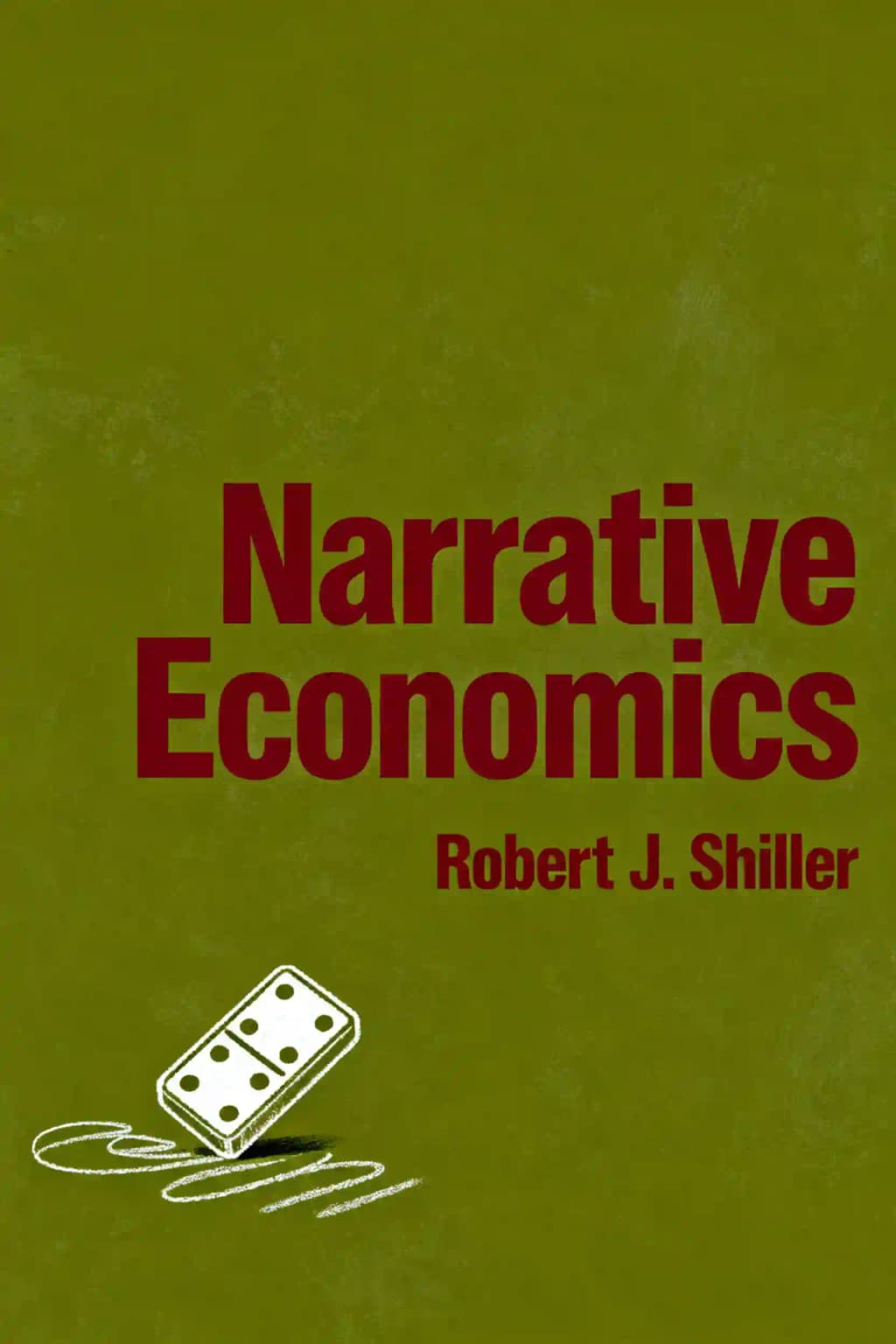
Nobel laureate Robert Shiller reveals how viral stories - not just data - drive economic booms and crashes. Using innovative digital analysis, he shows why understanding narratives could help predict the next financial crisis. Even central bankers are taking notes.
Robert James Shiller, Nobel Prize-winning economist and bestselling author of Narrative Economics: How Stories Go Viral and Drive Major Economic Events, is renowned for pioneering behavioral economics and analyzing financial market psychology. A Sterling Professor of Economics at Yale University, Shiller’s work bridges economic theory with human storytelling, exploring how viral narratives shape recessions, booms, and crises.
His groundbreaking Case-Shiller Index, co-developed with Karl Case, revolutionized real estate valuation and foreshadowed the 2008 housing collapse.
Shiller’s authoritative voice extends beyond academia through his New York Times “Economic View” column and Project Syndicate’s “Finance in the 21st Century.” His influential books, including Irrational Exuberance—which predicted the dot-com crash—and Finance and the Good Society, challenge conventional market wisdom by integrating psychology with quantitative analysis.
Awarded the 2013 Nobel Memorial Prize in Economic Sciences for empirically modeling asset price fluctuations, Shiller uniquely combines historical research, data-driven insights, and narrative theory to decode economic behavior. Narrative Economics has become essential reading for policymakers and investors, cementing his legacy as a visionary interpreter of financial storytelling’s power.
Narrative Economics explores how viral stories, rumors, and collective beliefs shape economic outcomes. Nobel laureate Robert Shiller argues that narratives—like Bitcoin’s rise or housing market crashes—spread like diseases, driving decisions and events more powerfully than traditional economic models suggest. The book combines behavioral economics, history, and epidemiology to explain booms, busts, and policy challenges.
Economists, policymakers, and anyone interested in behavioral science or market trends will find this book valuable. It’s ideal for readers seeking to understand how cultural stories (e.g., “the next big crash”) influence spending, investing, and policy—especially in an era of social media-driven narratives.
Yes. Shiller’s interdisciplinary approach offers fresh insights into economic forecasting and the psychological drivers of markets. The book’s historical case studies (e.g., the Great Depression) and modern examples (e.g., Bitcoin mania) make complex ideas accessible, while its focus on viral storytelling remains critically relevant today.
Narrative economics studies how stories become economic forces. Shiller posits that contagious tales—such as fears of automation erasing jobs or faith in perpetual housing price increases—shape public behavior, often overriding rational analysis. These narratives mutate as they spread, creating self-fulfilling prophecies in markets and policy.
Shiller uses epidemiological models to explain narrative spread, highlighting factors like reinfection rates (story retelling) and mutations (plot twists). For example, Depression-era “bank collapse” stories resurged in the 2008 crisis, accelerating panic. This framework helps predict how narratives might fuel future recessions or bubbles.
The book expands behavioral economics by focusing on collective storytelling—not just cognitive biases. Shiller shows how shared narratives (e.g., “tech stocks can’t lose”) create herd mentalities, distorting markets in ways traditional models fail to anticipate.
Policymakers should monitor emerging narratives through social media and surveys, then counter harmful stories (e.g., deflationary spirals) with factual campaigns. Central banks might also use narrative-aware communication to stabilize expectations during crises.
Bitcoin exemplifies a narrative-driven asset: its value surged not from utility, but from viral stories about disrupting banks and escaping government control. Shiller traces how these tales spread through online forums, media, and celebrity endorsements.
Some argue Shiller overemphasizes narratives at the expense of structural factors like interest rates or inequality. Others note challenges in reliably measuring narrative impact versus conventional economic indicators.
Social media and AI-generated content accelerate narrative spread, making Shiller’s framework essential for understanding crypto trends, AI job loss fears, and climate-driven market shifts. The book equips readers to decode the stories shaping today’s economy.
It builds on his Animal Spirits (2009) by diving deeper into storytelling mechanics. While the earlier book highlighted irrationality, this one provides tools to model narrative transmission and economic consequences.
Yes. By recognizing viral narratives (e.g., “renting is throwing money away”), individuals can avoid herd-driven financial mistakes. The book also teaches skills to critically assess economic stories in news and social feeds.
Senti il libro attraverso la voce dell'autore
Trasforma la conoscenza in spunti coinvolgenti e ricchi di esempi
Cattura le idee chiave in un lampo per un apprendimento veloce
Goditi il libro in modo divertente e coinvolgente
We're all storytellers, and our narratives drive markets as much as markets drive our narratives.
Bitcoin was meant to function as a monetary weapon, as a cryptocurrency poised to undermine authority.
Most Bitcoin traders don't understand its complex underlying technology.
The human brain is fundamentally wired for storytelling.
Minor story details can make one narrative more contagious than another.
Scomponi le idee chiave di Narrative Economics in punti facili da capire per comprendere come i team innovativi creano, collaborano e crescono.
Distilla Narrative Economics in rapidi promemoria che evidenziano i principi chiave di franchezza, lavoro di squadra e resilienza creativa.

Vivi Narrative Economics attraverso narrazioni vivide che trasformano le lezioni di innovazione in momenti che ricorderai e applicherai.
Chiedi qualsiasi cosa, scegli la voce e co-crea spunti che risuonino davvero con te.

Creato da alumni della Columbia University a San Francisco
"Instead of endless scrolling, I just hit play on BeFreed. It saves me so much time."
"I never knew where to start with nonfiction—BeFreed’s book lists turned into podcasts gave me a clear path."
"Perfect balance between learning and entertainment. Finished ‘Thinking, Fast and Slow’ on my commute this week."
"Crazy how much I learned while walking the dog. BeFreed = small habits → big gains."
"Reading used to feel like a chore. Now it’s just part of my lifestyle."
"Feels effortless compared to reading. I’ve finished 6 books this month already."
"BeFreed turned my guilty doomscrolling into something that feels productive and inspiring."
"BeFreed turned my commute into learning time. 20-min podcasts are perfect for finishing books I never had time for."
"BeFreed replaced my podcast queue. Imagine Spotify for books — that’s it. 🙌"
"It is great for me to learn something from the book without reading it."
"The themed book list podcasts help me connect ideas across authors—like a guided audio journey."
"Makes me feel smarter every time before going to work"
Creato da alumni della Columbia University a San Francisco

Ottieni il riassunto di Narrative Economics in formato PDF o EPUB gratuito. Stampalo o leggilo offline quando vuoi.
Why did Bitcoin skyrocket despite having no intrinsic value? What drove Americans to buy overpriced homes before the 2008 crash? Nobel Prize-winning economist Robert J. Shiller reveals a powerful truth: viral stories drive economic behavior far more than rational analysis. Traditional economics focuses on mathematical models and rational actors, but Shiller demonstrates that contagious narratives-spreading like epidemics through populations-trigger booms, busts, and everything in between. These stories don't just reflect economic reality; they create it. When we understand the narratives driving markets, we gain insight into seemingly irrational economic behavior that mathematical models simply can't explain.




