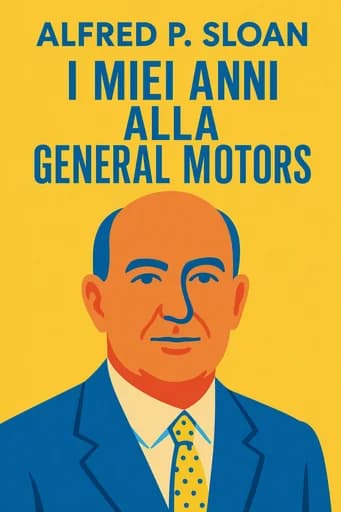
My years with General Motors
Panoramica di My years with General Motors
The management bible that revolutionized corporate America. Alfred Sloan's 1963 bestseller reveals how he transformed GM through decentralized control while maintaining central oversight - a strategy praised by Jim Collins and studied by generations of business leaders seeking sustainable growth.
Temi chiave in My years with General Motors
- decentralized management
- coordinated control
- corporate governance
- capital allocation
- organizational strategy
Citazioni da My years with General Motors
Good management rests on a reconciliation of centralization and decentralization.
Confidence in the automobile's future remained strong.
Plants stood idle, burdened by expensive inventories.
The economic slump unmasked flaws in GM's financial strategies.
The absence of unified management across divisions hindered GM's potential.
Personaggi di My years with General Motors
- Alfred P. SloanAuthor and GM executive who revolutionized management
- William DurantEntrepreneurial founder and former leader of GM
- Pierre S. du PontGM President who led the company through crisis
- Walter ChryslerEarly automotive figure and GM executive
Sull'autore
Sull'autore di My years with General Motors
Alfred Pritchard Sloan Jr. (1875–1966) is the renowned author of My Years with General Motors, a seminal business memoir chronicling his transformative leadership as GM’s president and CEO from 1923 to 1946.
A pioneer of modern corporate management, Sloan revolutionized the automotive industry through innovations like decentralized operations, annual vehicle styling updates, and tiered brand pricing. His strategic vision propelled GM to surpass Ford as the global automotive leader, establishing frameworks still studied in business schools worldwide.
Born in New Haven, Connecticut, Sloan rose from draftsman to president of Hyatt Roller Bearing Company before orchestrating its merger into General Motors. His philanthropic legacy includes founding the Alfred P. Sloan Foundation, which has granted billions for scientific research and education.
My Years with General Motors remains a management classic, lauded for its insights into organizational design and competitive strategy. The book has been widely cited in business literature and continues to influence executives decades after its 1964 publication.
Scarica il riassunto di My years with General Motors
Ottieni il riassunto di My years with General Motors in formato PDF o EPUB gratuito. Stampalo o leggilo offline quando vuoi.
FAQ su questo libro
This management classic details Sloan’s leadership at General Motors (1923–1956), focusing on innovative strategies like decentralized management, annual vehicle styling updates, and brand-tiered pricing (Chevrolet to Cadillac). It emphasizes organizational efficiency, data-driven decision-making, and adapting to market shifts, which helped GM surpass Ford and dominate the auto industry.
Business leaders, management students, and historians interested in organizational design, corporate strategy, or 20th-century industrial history. The book offers timeless insights into balancing centralized oversight with divisional autonomy, making it relevant for modern executives navigating complex enterprises.
Yes, for its foundational management principles, though some find its mid-20th-century corporate examples dated. Sloan’s firsthand account of transforming GM into a global powerhouse remains a blueprint for organizational scalability and innovation.
- Decentralized structure: Divisions (Chevrolet, Buick, etc.) operated autonomously under centralized financial oversight.
- Market segmentation: Pricing tiers catered to different consumer budgets, reducing internal competition.
- Annual model updates: Styling changes and incremental improvements to drive repeat purchases.
While Ford prioritized cost efficiency (e.g., Model T standardization), Sloan focused on diversified product lines and responsive marketing. GM’s brand hierarchy and decentralized structure outperformed Ford’s rigid, centralized approach by addressing broader consumer preferences.
Critics note its lack of modern context (e.g., pre-digital era examples) and limited discussion of labor relations. Some find Sloan’s writing style overly technical compared to contemporary management books.
While not quote-heavy, Sloan’s philosophy is captured in lines like:
- “The ability to get people to work together is of the greatest importance.”
- “A car for every purse and purpose.” (reflecting GM’s tiered branding strategy).
Its principles—decentralized decision-making, adaptive branding, and data alignment—remain applicable to tech firms, multinationals, and startups. Sloan’s emphasis on balancing innovation with structural coherence resonates in agile-driven industries.
Sloan rose from draftsman at Hyatt Roller Bearing Company to president by 1899. After Hyatt merged into GM, he redesigned its management framework, becoming CEO in 1923 and chairman in 1937.
- Decentralization: Empower divisions while centralizing financial control.
- Consumer-centric innovation: Use data to anticipate market needs.
- Brand strategy: Avoid cannibalization with clear product tiers.
Tech firms use decentralized teams (e.g., Google’s “20% time”) akin to GM’s divisional autonomy. Pricing tiers in SaaS platforms mirror GM’s brand hierarchy, targeting diverse customer segments.
Pair with Peter Drucker’s Concept of the Corporation (GM case study) or Jim Collins’ Good to Great for modern organizational insights. Both expand on Sloan’s themes of scalability and leadership.