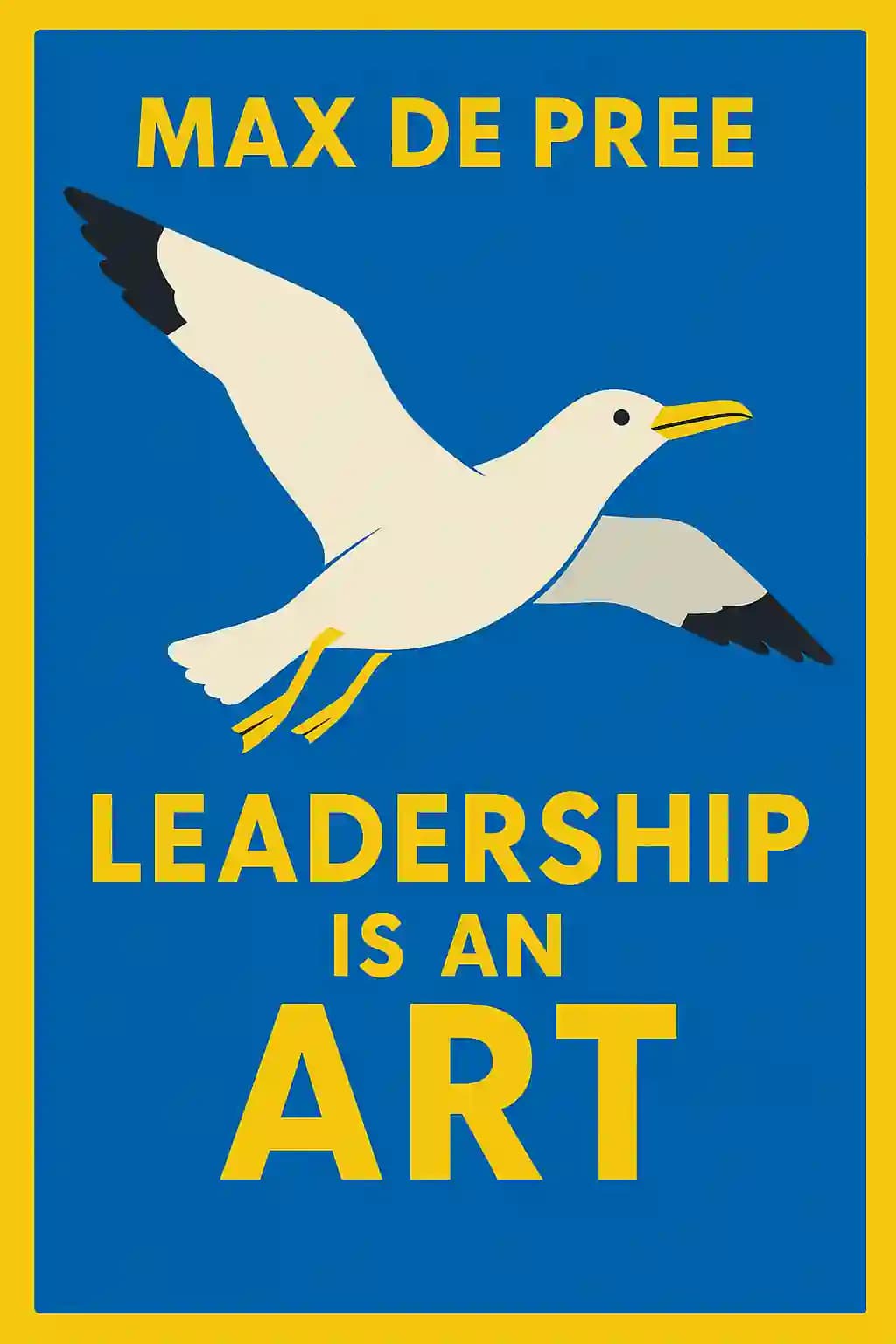
In "Leadership Is an Art," Max De Pree reveals why 800,000+ readers consider his servant-leadership philosophy revolutionary. As Herman Miller's chairman, he proved that treating employees as partners - not resources - doesn't just feel right; it transforms organizations into thriving, human-centered powerhouses.
Max De Pree (1924–2017) was a renowned leadership philosopher and former CEO of Herman Miller Inc. He authored the seminal management classic Leadership Is an Art, which redefined corporate leadership through a human-centered lens.
A 1948 Hope College graduate, De Pree integrated his four-decade tenure at Herman Miller—where he pioneered employee-centric policies like profit-sharing and the “silver parachute”—into his exploration of inclusive capitalism and servant leadership. His works, including Leadership Jazz and Leading Without Power, blend practical business insights with spiritual depth, reflecting his service on boards like Fuller Theological Seminary, where a leadership center bears his name.
Praised by figures from Peter Drucker to President Bill Clinton, Leadership Is An Art has been translated into over a dozen languages and sold more than one million copies worldwide. De Pree’s 2012 Lifetime Achievement Award from the International Leadership Association underscores his enduring influence on modern organizational philosophy.
Leadership Is an Art redefines leadership as a stewardship focused on fostering relationships, nurturing potential, and creating enduring organizational values. Max De Pree argues leaders must prioritize defining reality, enabling others’ growth, and defending civility while ensuring cultural continuity. The book emphasizes that leadership is less about control and more about cultivating trust, accountability, and a “generous spirit” within teams.
This book is essential for CEOs, managers, HR professionals, and aspiring leaders seeking a human-centric approach to organizational success. It’s particularly valuable for those aiming to build inclusive cultures, develop future leaders, or integrate ethical frameworks into their leadership style.
Yes—it’s a seminal work with over 800,000 copies sold, praised for blending philosophical depth with practical insights. De Pree’s emphasis on empathy, mentorship, and corporate stewardship remains influential in modern leadership training programs and business schools.
De Pree frames stewardship as leaders’ responsibility to safeguard their organization’s mission, values, and people. This involves actively nurturing talent, sustaining trust, and ensuring the institution outlasts individual tenures. Key examples include prioritizing employee dignity and institutional legacy over short-term gains.
He states a leader’s first duty is to “define reality” (clarify challenges and opportunities) and their final duty is to “say thank you” (acknowledge contributions). Between these, leaders must empower teams, defend civility, and foster innovation.
De Pree argues culture is shaped by “covenantal relationships” built on mutual respect, not transactional interactions. Leaders sustain culture by modeling integrity, encouraging dissent, and investing in mentorship programs that perpetuate institutional values.
As CEO of Herman Miller, De Pree transformed the company through participative management and employee-centric policies. His experiences inform the book’s focus on democratic leadership, design-driven innovation, and balancing profitability with human dignity.
Both books by De Pree use metaphors (art/jazz) to stress adaptive, collaborative leadership. However, Leadership Jazz delves deeper into improvisation and diversity, while Art focuses on stewardship and institutional legacy.
Some modern critics argue its emphasis on trust and idealism may underestimate systemic barriers in hierarchical organizations. Others note it lacks concrete metrics for measuring leadership effectiveness.
De Pree’s emphasis on clear communication (“defining reality”) and gratitude aligns with virtual leadership challenges. For example, regularly acknowledging contributions in remote settings fosters the covenantal relationships he advocates.
Senti il libro attraverso la voce dell'autore
Trasforma la conoscenza in spunti coinvolgenti e ricchi di esempi
Cattura le idee chiave in un lampo per un apprendimento veloce
Goditi il libro in modo divertente e coinvolgente
The first responsibility of a leader is to define reality. The last is to say thank you.
The signs of outstanding leadership appear primarily among the followers. Are the followers reaching their potential? Are they learning? Serving? Do they achieve the required results? Are they changing for the better? Do they have staying power?
Management has a lot to do with answers. Leadership is a function of questions.
Style is merely a consequence of what we believe.
People build trust, not organizational charts.
Scomponi le idee chiave di Leadership is an Art in punti facili da capire per comprendere come i team innovativi creano, collaborano e crescono.
Distilla Leadership is an Art in rapidi promemoria che evidenziano i principi chiave di franchezza, lavoro di squadra e resilienza creativa.

Vivi Leadership is an Art attraverso narrazioni vivide che trasformano le lezioni di innovazione in momenti che ricorderai e applicherai.
Chiedi qualsiasi cosa, scegli la voce e co-crea spunti che risuonino davvero con te.

Creato da alumni della Columbia University a San Francisco
"Instead of endless scrolling, I just hit play on BeFreed. It saves me so much time."
"I never knew where to start with nonfiction—BeFreed’s book lists turned into podcasts gave me a clear path."
"Perfect balance between learning and entertainment. Finished ‘Thinking, Fast and Slow’ on my commute this week."
"Crazy how much I learned while walking the dog. BeFreed = small habits → big gains."
"Reading used to feel like a chore. Now it’s just part of my lifestyle."
"Feels effortless compared to reading. I’ve finished 6 books this month already."
"BeFreed turned my guilty doomscrolling into something that feels productive and inspiring."
"BeFreed turned my commute into learning time. 20-min podcasts are perfect for finishing books I never had time for."
"BeFreed replaced my podcast queue. Imagine Spotify for books — that’s it. 🙌"
"It is great for me to learn something from the book without reading it."
"The themed book list podcasts help me connect ideas across authors—like a guided audio journey."
"Makes me feel smarter every time before going to work"
Creato da alumni della Columbia University a San Francisco

Ottieni il riassunto di Leadership is an Art in formato PDF o EPUB gratuito. Stampalo o leggilo offline quando vuoi.
What if the person sitting next to you at work harbors a secret life you know nothing about? Max De Pree discovered this truth when his father visited the widow of a longtime Herman Miller employee-a millwright who had recently passed away. As they spoke, the widow shared something unexpected: her husband's beautiful poetry, verses he'd written for years without anyone at the company knowing. The De Pree family wrestled with a haunting question: Was he a millwright who wrote poetry, or a poet who worked as a millwright? This story isn't just a touching anecdote-it's a mirror reflecting how we see everyone around us. How many accountants might be gifted musicians? How many engineers harbor profound philosophical insights? Leadership begins the moment we recognize that people aren't just their job titles. They're infinitely complex beings carrying diverse gifts that traditional workplaces often bury. When we create environments where people can reveal their whole selves-the millwright and the poet-we unlock possibilities that transcend conventional productivity. True leadership means polishing and liberating these hidden talents, preventing them from wasting their sweetness on the desert air.