Just Work
How to Root Out Bias, Prejudice, and Bullying to Build a Kick-Ass Culture of Inclusion
Panoramica di Just Work
"Just Work" tackles workplace injustice with practical solutions endorsed by Sheryl Sandberg and Daniel Pink. Kim Scott's guide helps leaders create environments where everyone thrives - a McKinsey study confirms diverse companies achieve higher profitability. Even a West Point sergeant transformed his leadership using these principles.
Temi chiave in Just Work
- unconscious bias mitigation
- workplace bullying intervention
- upstander training
- confronting systemic prejudice
- inclusive leadership strategies
Citazioni da Just Work
When someone bullies you, their goal is to harm you.
Prejudice is 'meaning it'--the conscious rationalization of biases.
Bias represents unconscious conclusions that often reflect stereotypes.
The default response to workplace injustice is often silence.
Personaggi di Just Work
- Kim ScottAuthor and former tech executive
- DonA colleague who used personality tests to bias
- AustinA person cited in a case study about bullying
Sull'autore
Sull'autore di Just Work
Kim Scott, author of Just Work and co-founder of Radical Candor, is a bestselling leadership expert renowned for transforming workplace dynamics.
A former executive at Google and Apple, she draws on decades of experience coaching CEOs at companies like Twitter and Dropbox to address systemic inequities and collaboration challenges.
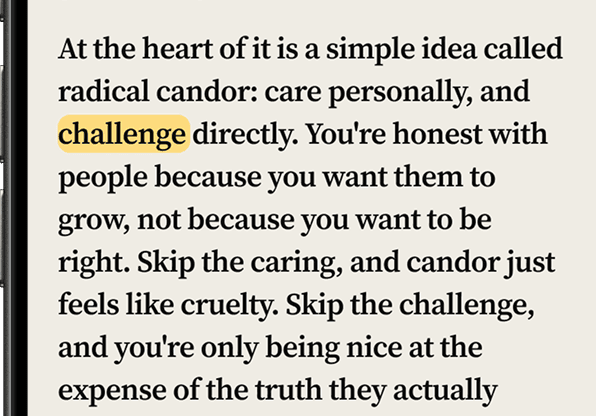
Her prior book, Radical Candor: Be a Kick-Ass Boss Without Losing Your Humanity, revolutionized management practices with its framework of “care personally, challenge directly,” spending years on The New York Times and Wall Street Journal bestseller lists and inspiring a parody on HBO’s Silicon Valley.
Scott’s insights stem from roles spanning tech leadership, international business development, and academic positions at Apple University. She co-hosts the Radical Respect podcast and has trained over 200,000 professionals through her consulting firm. Radical Candor has sold over one million copies and been translated into 20 languages, solidifying Scott’s status as a global voice on ethical leadership.
Scarica il riassunto di Just Work
Ottieni il riassunto di Just Work in formato PDF o EPUB gratuito. Stampalo o leggilo offline quando vuoi.
FAQ su questo libro
Just Work by Kim Scott provides a practical framework to combat workplace injustice—bias, prejudice, and bullying—by fostering inclusivity and collaboration. It offers actionable strategies for leaders and employees to address systemic issues while respecting individuality, aiming to create environments where everyone can thrive. The book blends personal anecdotes, research-backed insights, and tools like the "RESPECT" model to transform workplace dynamics.
Leaders, HR professionals, and employees seeking to dismantle workplace inequality will find Just Work essential. It’s particularly valuable for managers aiming to build equitable teams, advocates of diversity and inclusion, and anyone navigating bias or harassment. Scott’s advice caters to tech, corporate, and startup environments, emphasizing real-world applications over theoretical ideals.
While Radical Candor focuses on feedback and leadership communication, Just Work tackles systemic injustice, offering tools to address discrimination and bullying. It shifts from individual management tactics to organizational culture change, emphasizing collective responsibility over hierarchical solutions. Both books prioritize practicality but diverge in scope: one targets interpersonal dynamics, the other systemic reform.
Key concepts include:
- Bias vs. Prejudice vs. Bullying: Differentiating unconscious bias (systemic), prejudice (conscious bias), and bullying (abuse).
- Upstander vs. Bystander: Encouraging proactive intervention in injustice.
- RESPECT Model: A framework for respectful collaboration (Recognize, Empathize, Specify, Partner, Examine**, Challenge**, Transform*).
The RESPECT model guides inclusive problem-solving:
- Recognize inequity.
- Empathize with affected parties.
- Specify the issue (bias, prejudice, or bullying).
- Partner with stakeholders.
- Examine systemic roots.
- Challenge norms.
- Transform policies.
This structured approach helps teams address conflicts while maintaining productivity.
Scott categorizes bullying as a severe form of workplace injustice, distinct from bias or prejudice. She advises targets to document incidents, enlist allies, and escalate issues formally if needed. Leaders are urged to create zero-tolerance policies and foster environments where reporting is safe and routine.
- For Individuals: Speak up using Scott’s “I-M language” (e.g., “I felt excluded when…”) to clarify experiences without accusatory tones.
- For Leaders: Implement bias-interruption practices, like structured feedback systems.
- For Teams: Regularly audit policies for equity gaps, such as promotion criteria.
Scott argues unconscious bias requires systemic solutions, not just training. She advocates for “bias disruptors” like blind resume reviews, structured interviews, and accountability metrics. Individuals are encouraged to acknowledge their biases and invite peer feedback to correct blind spots.
Some reviewers note the framework oversimplifies complex societal issues into workplace fixes. Others highlight challenges in applying Silicon Valley-centric strategies to non-tech industries. However, most praise its practicality, with Sheryl Sandberg calling it “actionable and effective”.
With remote work and AI tools amplifying communication gaps, Just Work’s focus on clarity, empathy, and accountability remains critical. Its strategies help teams navigate hybrid dynamics, algorithmic bias, and global diversity challenges, making it a timely resource for modern organizational struggles.
- “Injustice is both immoral and inefficient.”
- “The goal isn’t perfection—it’s progress.”
- “Be an upstander, not a bystander.”
These lines underscore Scott’s emphasis on pragmatic, incremental change over idealized solutions.
Yes. Scott’s Radical Candor website offers worksheets, podcasts, and workshops to apply the book’s concepts. Partner organizations like Project Include provide toolkits for measuring workplace equity, complementing the book’s frameworks.