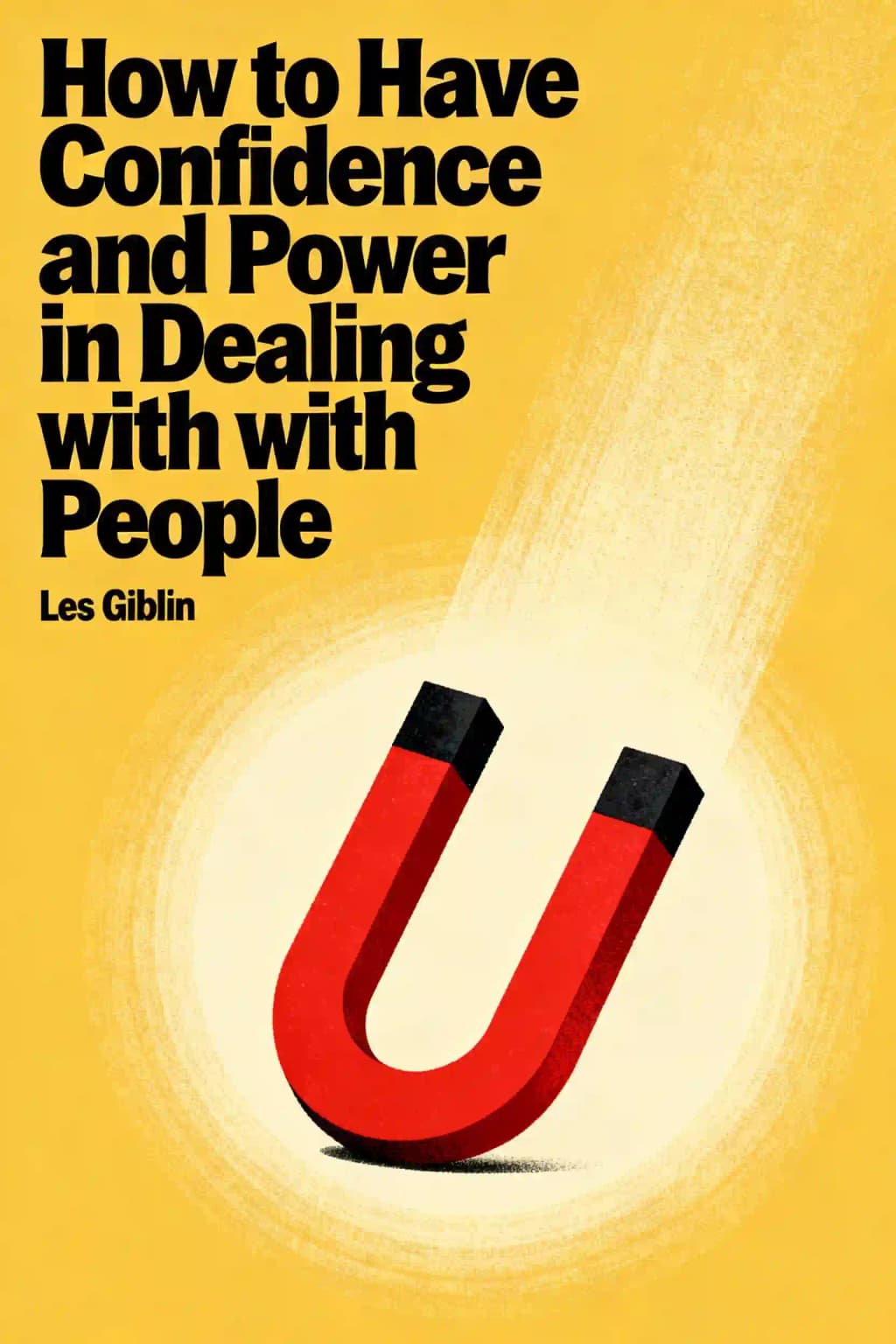
Master the art of human connection with Les Giblin's timeless guide to interpersonal power. Using his celebrated "Triple-A Formula," you'll navigate any social situation with unshakable confidence. Business leaders swear by it - what ego-boosting secret will transform your relationships forever?
Leslie T. Giblin (1912–2000), pioneering personal development expert and bestselling author of How to Have Confidence and Power in Dealing with People, revolutionized interpersonal communication strategies through his actionable insights. Born in Cedar Rapids, Iowa, Giblin honed his expertise during a record-breaking sales career with Sheaffer Pen Company, earning two national Salesman of the Year titles through his mastery of human psychology. His seminal 1956 work blends practical self-help principles with real-world sales experience, offering timeless techniques for building confidence, resolving conflicts, and influencing others.
Giblin’s credibility stems from decades training executives at Mobil, General Electric, and Johnson & Johnson through his corporate seminars. His companion book Skill With People (1968) further distills his people-skills philosophy into essential techniques praised for their workplace applicability. With translations in 12 languages and over 2 million copies sold globally, Giblin’s frameworks remain foundational in sales training programs and leadership curricula, proving especially relevant in today’s digitally disconnected world.
Les Giblin’s How to Have Confidence and Power in Dealing with People teaches practical strategies for effective communication by addressing three core human needs: acceptance, approval, and appreciation. The book provides actionable techniques for building confidence, improving listening skills, and fostering mutually beneficial relationships in personal and professional settings. Each chapter includes summaries for easy retention.
This book is ideal for professionals, leaders, salespeople, and anyone seeking to enhance interpersonal skills. It’s particularly valuable for those navigating workplace dynamics, customer interactions, or personal relationships. Les Giblin’s insights are timeless, making the book relevant for both new and experienced readers.
Yes. Readers praise its no-nonsense approach to human relations, comparing it to Dale Carnegie’s classics. The book offers proven strategies for gaining cooperation and goodwill while maintaining self-respect. Reviews highlight its enduring relevance, with one calling it “worth its weight in gold”.
Key ideas include:
Both books focus on interpersonal effectiveness, but Giblin’s work is more tactical, offering step-by-step methods for immediate application. While Carnegie emphasizes likability, Giblin balances empathy with achieving personal goals, making it a practical complement to Carnegie’s philosophy.
Les Giblin (1912–1986) was a two-time national Salesman of the Year who transitioned into training executives at companies like General Electric and Johnson & Johnson. His door-to-door sales experience shaped his insights into human behavior, which he distilled into seminars and books like Skill With People.
The book teaches how to:
Some modern readers may find the 1950s-era examples dated, though the core principles remain applicable. Critics note it prioritizes practicality over deep psychological analysis, which may disappoint those seeking nuanced theories.
While written before the digital age, Giblin’s emphasis on authenticity and active listening applies to virtual interactions. The book’s advice on clarity and empathy helps readers navigate emails, video calls, and social media mindfully.
A standout principle: “If you put out sunshine to people, sunshine will come back to you.” This metaphor underscores the importance of positivity in relationships, reflecting Giblin’s belief that kindness begets cooperation.
Both books share foundational principles, but Skill With People is a shorter guide focusing on daily interactions, while How to Have Confidence... offers a comprehensive system for long-term relationship building. They work well as companion pieces.
Despite technological shifts, human desire for respect and connection remains constant. Giblin’s focus on adaptable, principle-based communication ensures its utility in diverse modern contexts, from hybrid workplaces to social networks.
Senti il libro attraverso la voce dell'autore
Trasforma la conoscenza in spunti coinvolgenti e ricchi di esempi
Cattura le idee chiave in un lampo per un apprendimento veloce
Goditi il libro in modo divertente e coinvolgente
Ego-hunger is as natural as hunger for food-both serve self-preservation.
LS/MFT-Low Self-Esteem Means Friction and Trouble.
The only effective way to deal with difficult people is to help them like themselves better.
Small slights can have enormous consequences in human relations
Confidence breeds confidence in others.
Scomponi le idee chiave di How to have confidence and power in dealing with people in punti facili da capire per comprendere come i team innovativi creano, collaborano e crescono.
Vivi How to have confidence and power in dealing with people attraverso narrazioni vivide che trasformano le lezioni di innovazione in momenti che ricorderai e applicherai.
Chiedi qualsiasi cosa, scegli il tuo stile di apprendimento e co-crea intuizioni che risuonano davvero con te.

Creato da alumni della Columbia University a San Francisco
"Instead of endless scrolling, I just hit play on BeFreed. It saves me so much time."
"I never knew where to start with nonfiction—BeFreed’s book lists turned into podcasts gave me a clear path."
"Perfect balance between learning and entertainment. Finished ‘Thinking, Fast and Slow’ on my commute this week."
"Crazy how much I learned while walking the dog. BeFreed = small habits → big gains."
"Reading used to feel like a chore. Now it’s just part of my lifestyle."
"Feels effortless compared to reading. I’ve finished 6 books this month already."
"BeFreed turned my guilty doomscrolling into something that feels productive and inspiring."
"BeFreed turned my commute into learning time. 20-min podcasts are perfect for finishing books I never had time for."
"BeFreed replaced my podcast queue. Imagine Spotify for books — that’s it. 🙌"
"It is great for me to learn something from the book without reading it."
"The themed book list podcasts help me connect ideas across authors—like a guided audio journey."
"Makes me feel smarter every time before going to work"
Creato da alumni della Columbia University a San Francisco

Ottieni il riassunto di How to have confidence and power in dealing with people in formato PDF o EPUB gratuito. Stampalo o leggilo offline quando vuoi.
What if I told you that 85% of your professional success has nothing to do with how smart you are? That your happiness depends almost entirely on a skill most of us never formally learn? Since 1956, one slim volume has quietly transformed millions of lives by revealing a truth hiding in plain sight: the people who master human relations don't just succeed-they thrive. Warren Buffett keeps it on his desk. Tony Robbins calls it life-changing. Yet most of us stumble through our days wondering why some people seem to effortlessly attract opportunities, friendships, and influence while we struggle. Here's an uncomfortable truth: for every person fired for incompetence, two lose their jobs because they can't get along with others. The Carnegie Institute's research confirms what most of us suspect but rarely acknowledge-personality and people skills matter far more than technical expertise. Even engineers with mediocre grades but strong interpersonal abilities consistently outearn their academically brilliant but socially awkward peers. We live in an age that worships individual achievement, yet almost everything we accomplish requires cooperation. The lone-wolf mentality might work in frontier mythology, but in today's interconnected reality, it's a recipe for isolation and failure. The real breakthrough comes when you stop treating people skills as innate talents you either have or don't. Like learning piano, mastering human relations means understanding fundamental principles that apply universally. When you truly understand these dynamics, confidence follows naturally. You stop second-guessing every interaction because you're working with human nature rather than against it.
Everyone desperately wants to feel important-this isn't vanity, it's fundamental psychology. When importance feels threatened, people defend their ego as fiercely as their physical body. Arrogant, self-centered individuals aren't suffering from too much self-esteem-they're compensating for too little. Their starving ego grabs for importance wherever possible. People with genuine self-worth are generous and easy to be around. You possess a fortune that costs nothing yet multiplies when shared: making others feel important. Small slights create enormous consequences. Forgetting names, interrupting, checking your phone mid-conversation-these "tremendous trifles" send a clear message: "You don't matter." Studies show workplace unrest traces back to one root: workers don't feel important. Making people feel valued requires three commitments: genuinely believe others matter (you can't fake this), actively notice people, and resist asserting superiority. The fastest way to impress someone isn't demonstrating how impressive you are-it's letting them know they've impressed you.
People automatically mirror what you project. Research shows they match your volume, tone, and energy - speak softly, get soft responses; show enthusiasm, and others catch it. Respond to hostility with calm, and anger often defuses. Napoleon demonstrated this when French soldiers sent to arrest him followed him instead - his supreme confidence proved contagious. Your body constantly betrays your mental state. Drooped shoulders broadcast psychological burdens; downcast eyes signal pessimism; hesitant steps reveal timidity. Confident people move boldly, shoulders back, eyes forward. Winston Churchill understood this: "The best way to get another to acquire a virtue is to impute it to him." First impressions stick. One bad interaction can permanently color perception. The world judges you by how you judge yourself - act insignificant, get treated accordingly. Act like you matter, and people respond in kind. But genuinely confident people are natural and unpretentious - arrogance reveals insecurity. To get "yes" responses, create a "yes" mood by securing agreement on small things first.
Three principles create genuine connection: Acceptance, Approval, and Appreciation. Acceptance means letting people be themselves without judgment - the thing we all crave most. Ironically, those who accept people as they are have the most power to inspire change. Full acceptance acts like a confidence injection, while constant criticism amplifies self-doubt. Approval goes further by actively seeking the positive. A child psychologist transformed an "incorrigible" boy by noticing his carving talent and providing proper tools instead of punishment. The boy's behavior changed almost immediately. Appreciation means "to raise in value" - we gravitate toward people who increase our sense of worth. Some people never meet strangers because they believe others will like them. This belief becomes self-fulfilling. Fear of rejection creates the rejection we dread - our defensiveness makes others uncomfortable. Seemingly unfriendly people often fear rejection from you. They're waiting for you to make the first move. A genuine smile works like magic, but only if it comes from your heart. Your smile communicates: "I like you," "I assume you'll like me," and "You're worth smiling at." Practice before your mirror each morning - think of something pleasant, then let that feeling spread naturally across your face.
Master conversation by making it about them, not you. Steer discussions toward "you" instead of "I"-while "I" acts as a conversational stop sign, "you" functions as a green light. Agreement creates instant bonds; finding common ground says "I'm like you," flattering them and raising their self-esteem. We naturally like people who agree with us because they confirm our worth and worldview. Justice Oliver Wendell Holmes called listening "white magic"-the most effective mechanism for winning friendship and influence. Attentive listeners are perceived as intelligent and wise. One top automobile designer explains: "We don't really design our cars. The public does. What we do is listen." In negotiations, discover the other party's position before revealing yours. To develop listening skills: Look at the speaker, show genuine interest through nodding and facial responses, lean toward them, ask questions, don't interrupt, stay with their subject, and use their own words when responding.
A seven-year study of 10,000 arguments revealed professional debaters were less persuasive than door-to-door salesmen. The difference? Debaters tried defeating opponents; salesmen helped prospects want change. To truly persuade, reach the subconscious through suggestion. Six rules: Let others fully state their case. Pause before answering. Don't insist on winning completely. State your case moderately. Speak through third parties. Let others save face when changing positions. When McCormick & Company's nephew took over in 1932, he created a "junior board of directors" from rank-and-file employees. This board redesigned packaging, improved systems, and suggested new product lines-with 99% of their 5,000 suggestions adopted. Sales multiplied fifteen-fold to $50 million. When seeking endorsement, make others participants: "If you were me, how would you approach this?" Praise releases energy in others. Scientific experiments showed tired children receiving praise experienced surging physical energy, while criticism caused energy to plummet. Workers rated "credit for work" as their top desire, while bosses ranked it seventh. For praise to work, it must be sincere. Praise the act, not the person: "your typing has been excellent" not "you're a good worker." When correcting others: Criticize in absolute privacy. Preface with kindness. Make criticism impersonal. Supply the answer. Ask for cooperation. One criticism per offense. Finish friendly.
In a world prioritizing technical skills, we've forgotten that people aren't obstacles-they're the pathway to success. These aren't manipulation tactics but fundamental truths about human nature. Your shyness or social anxiety aren't personality defects-they're gaps in understanding how people work. Start today. Choose one relationship to improve and one principle to apply. Give that sincere compliment you've held back. Listen without interrupting. Try giving five sincere compliments daily for a week-you'll be amazed how smoother your days become. When you master human connection, you don't just succeed-you help others succeed too. That's when everything changes.