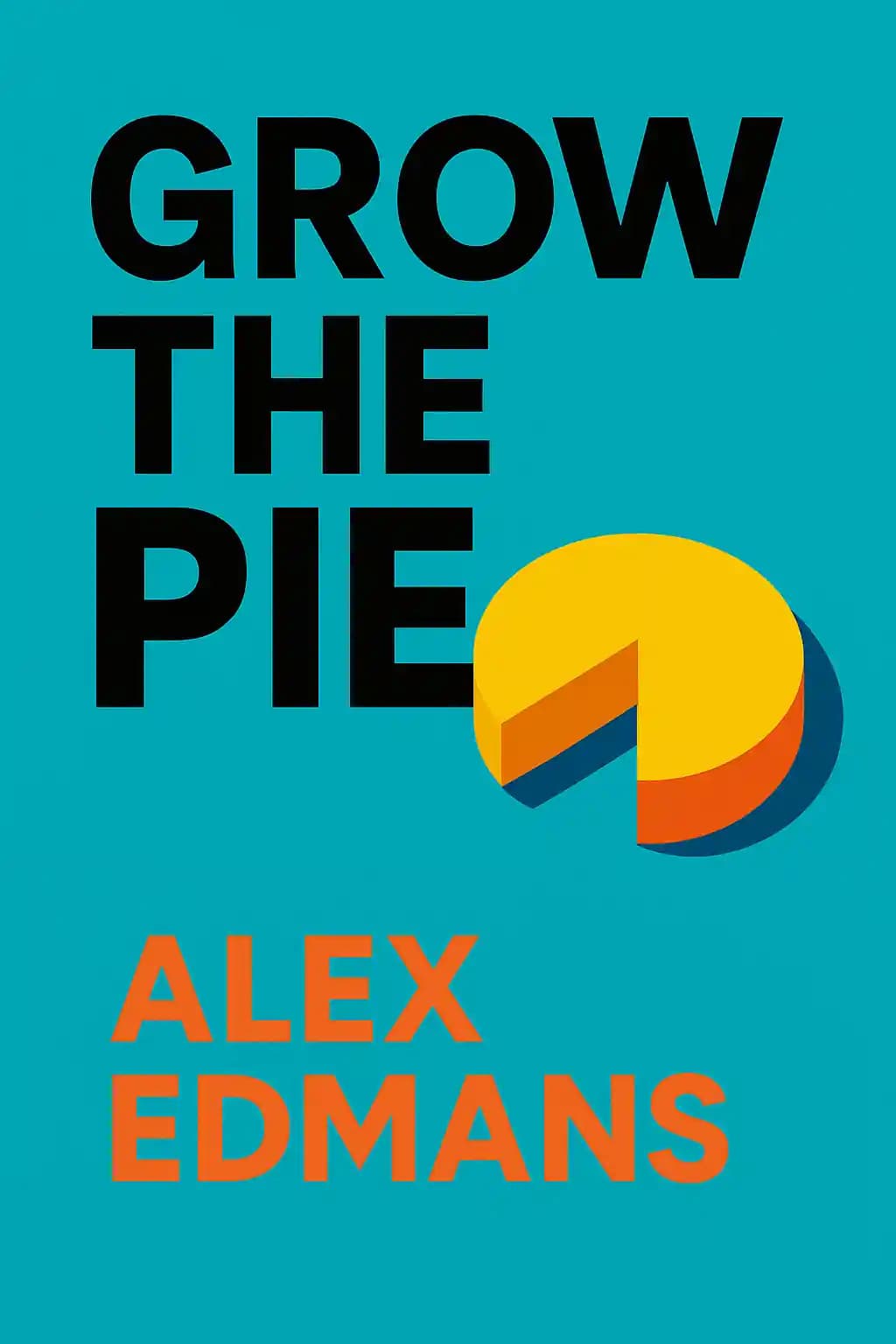
In "Grow the Pie," finance professor Alex Edmans challenges conventional business thinking, proving companies can deliver both purpose and profit. Endorsed as "the most significant book on business purpose yet written," it's sparked debates from Wall Street to the BBC about what truly drives long-term value.
Alex Edmans, award-winning author of Grow the Pie: How Great Companies Deliver Both Purpose and Profit, is a London Business School finance professor and leading voice on sustainable business practices. With a PhD from MIT and prior experience as a Morgan Stanley investment banker, Edmans bridges academic rigor and real-world financial expertise to argue that ethical corporate strategies drive long-term profitability.
His work on stakeholder capitalism and behavioral finance has been featured at the World Economic Forum, the UK Parliament, and TED Talks with over 2.8 million combined views.
Edmans co-authors the seminal textbook Principles of Corporate Finance and recently published May Contain Lies, which tackles misinformation in decision-making. A Fulbright Scholar and Fellow of the British Academy, he advises organizations like Novo Nordisk’s Sustainability Advisory Council and the World Economic Forum’s Global Future Council on Responsible Investing. Grow the Pie was named a Financial Times Book of the Year and has been translated into nine languages, cementing its status as a blueprint for modern purpose-driven leadership.
Grow the Pie challenges traditional profit-first business models by arguing companies can maximize long-term success by creating societal value alongside financial returns. Alex Edmans introduces "pieconomics," advocating for innovation, purpose-driven strategies, and avoiding "omission errors" (missed opportunities from excessive risk aversion). Backed by data and case studies like Merck’s drug development, the book redefines corporate success as expanding value for all stakeholders.
Business leaders, investors, and policymakers seeking to align profit with social impact will find actionable insights. The book also appeals to professionals in corporate social responsibility (CSR) and sustainability, offering frameworks like materiality judgments and comparative advantage to guide ethical decision-making. Students of business ethics or strategic management gain evidence-backed perspectives on stakeholder capitalism.
Yes—Edmans combines academic rigor with accessible storytelling, using real-world examples (e.g., Vodafone’s M-Pesa mobile banking initiative) to show how purpose-driven companies outperform peers. The book’s emphasis on data over ideology and practical tools for balancing profit/social value makes it a standout in business strategy literature.
This mindset prioritizes creating shared value for society rather than merely redistributing existing profits. Companies like Merck exemplify it by investing in long-term innovations (e.g., HIV drug development), while “pie-splitters” like Turing Pharmaceuticals focus on short-term gains. Edmans argues pie-growing often maximizes profit indirectly by building trust and customer loyalty.
Edmans advocates tying executive compensation to long-term value creation (e.g., environmental milestones) rather than short-term stock prices. This aligns leaders’ incentives with sustainable growth and deters harmful practices like cost-cutting at the expense of employee welfare.
Some argue the pie-growing approach underestimates trade-offs in resource allocation or relies overly on idealistic corporate behavior. Edmans counters by emphasizing data showing responsible companies often achieve superior returns, though he acknowledges challenges in measuring societal impact.
Investors are urged to practice stewardship—engaging with companies to improve strategy rather than divesting. Edmans highlights the “multiplier effect”: responsible investments can amplify positive social outcomes while securing financial returns.
Unlike theoretical frameworks, Edmans emphasizes empirical evidence and actionable strategies. While books like ESG Investing focus narrowly on metrics, Grow the Pie offers a holistic view of purpose-driven leadership, innovation, and stakeholder trust.
As consumers and regulators demand greater corporate accountability, Edmans’ research provides a roadmap for businesses navigating ESG reporting, climate action, and ethical AI. The book’s principles align with global trends like the UN Sustainable Development Goals (SDGs).
Employees can advocate for purpose-driven projects, while consumers support ethical brands. Citizens should push for policies rewarding long-term value creation, such as tax incentives for R&D investments.
Senti il libro attraverso la voce dell'autore
Trasforma la conoscenza in spunti coinvolgenti e ricchi di esempi
Cattura le idee chiave in un lampo per un apprendimento veloce
Goditi il libro in modo divertente e coinvolgente
What matters far more is pay structure.
Stakeholder capital represents hidden treasure.
What if companies could grow the total value created?
The pie isn't fixed.
Scomponi le idee chiave di Grow the Pie in punti facili da capire per comprendere come i team innovativi creano, collaborano e crescono.
Distilla Grow the Pie in rapidi promemoria che evidenziano i principi chiave di franchezza, lavoro di squadra e resilienza creativa.

Vivi Grow the Pie attraverso narrazioni vivide che trasformano le lezioni di innovazione in momenti che ricorderai e applicherai.
Chiedi qualsiasi cosa, scegli la voce e co-crea spunti che risuonino davvero con te.

Creato da alumni della Columbia University a San Francisco
"Instead of endless scrolling, I just hit play on BeFreed. It saves me so much time."
"I never knew where to start with nonfiction—BeFreed’s book lists turned into podcasts gave me a clear path."
"Perfect balance between learning and entertainment. Finished ‘Thinking, Fast and Slow’ on my commute this week."
"Crazy how much I learned while walking the dog. BeFreed = small habits → big gains."
"Reading used to feel like a chore. Now it’s just part of my lifestyle."
"Feels effortless compared to reading. I’ve finished 6 books this month already."
"BeFreed turned my guilty doomscrolling into something that feels productive and inspiring."
"BeFreed turned my commute into learning time. 20-min podcasts are perfect for finishing books I never had time for."
"BeFreed replaced my podcast queue. Imagine Spotify for books — that’s it. 🙌"
"It is great for me to learn something from the book without reading it."
"The themed book list podcasts help me connect ideas across authors—like a guided audio journey."
"Makes me feel smarter every time before going to work"
Creato da alumni della Columbia University a San Francisco

Ottieni il riassunto di Grow the Pie in formato PDF o EPUB gratuito. Stampalo o leggilo offline quando vuoi.
Imagine a world where businesses don't have to choose between profits and social good. Where creating value for employees, customers, communities, and the environment actually leads to superior returns for investors. This isn't just wishful thinking - it's the evidence-based reality that finance professor Alex Edmans reveals in "Grow the Pie." The fundamental problem with how we view business today stems from a "pie-splitting" mentality - the assumption that the economic pie is fixed, so any gain for stakeholders must come at shareholders' expense. But what if the pie isn't fixed? What if companies could grow the total value created, allowing both shareholders and stakeholders to benefit? Consider Merck's development of Mectizan, a drug that cures river blindness. When CEO Roy Vagelos discovered it could help millions but wouldn't be profitable, he distributed it for free. Traditional thinking would consider this a shareholder loss. Yet by 2019, Merck's stock had outperformed peers by 54%, partly because this decision attracted talented scientists passionate about solving important problems, enhanced the company's reputation with regulators, and built trust with communities. This isn't charity - it's excellence in action.