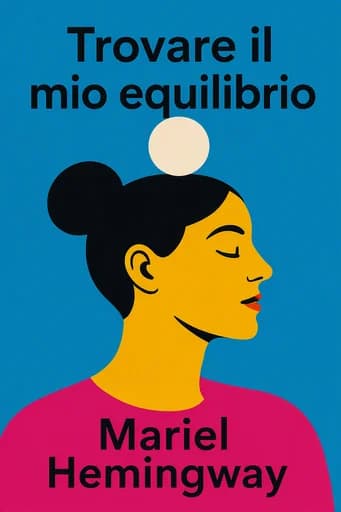
In "Finding My Balance," Oscar-nominated actress Mariel Hemingway confronts her family's tragic legacy - including her grandfather Ernest's suicide - through yoga's healing power. How did this Hollywood star find peace amid chaos when therapy and medication failed?
Mariel Hemingway, acclaimed actress and mental health advocate, is the author of Finding My Balance, a memoir exploring themes of personal growth, mental wellness, and overcoming generational trauma.
Born in Mill Valley, California, in 1961, Hemingway draws from her experiences as the granddaughter of Ernest Hemingway and her family’s public struggles with mental illness, which she detailed in her documentary Running from Crazy.
An Oscar-nominated performer for her role in Manhattan (1979), she starred in over 30 films, including Personal Best and Star 80, and earned a Golden Globe nomination for her work in the TV series Civil Wars.
A frequent TED Talk speaker and mental health spokesperson, Hemingway’s insights blend Hollywood resilience with candid vulnerability. Her earlier memoir, Out Came the Sun, further chronicles her journey toward emotional stability.
Finding My Balance has been hailed as a New York Times bestseller and translated into 12 languages, resonating with readers seeking authenticity in self-discovery.
Finding My Balance is a memoir where Mariel Hemingway intertwines her personal journey with yoga practices to explore her tumultuous life, including early fame from Woody Allen’s Manhattan, family tragedies, and her quest for emotional stability. Each chapter begins with a yoga pose, transitioning into reflections on her dysfunctional upbringing, career challenges, and holistic philosophy for maintaining inner peace.
This book resonates with readers interested in memoirs about resilience, yoga enthusiasts, and those navigating personal upheaval. It’s ideal for fans of Hemingway’s acting career, individuals seeking strategies for mental well-being, or anyone drawn to stories of overcoming familial dysfunction through mindfulness practices.
Yes, for its raw honesty and unique blend of memoir and self-help. Hemingway’s candid storytelling about fame, loss, and self-discovery, paired with actionable yoga exercises, offers both inspiration and practical tools for readers seeking emotional balance.
Each chapter starts with a detailed yoga pose, symbolizing a lesson tied to her life experiences. For example, a balancing posture might precede anecdotes about navigating Hollywood’s pressures, creating a metaphorical link between physical stability and emotional resilience.
Her philosophy emphasizes mindfulness, self-acceptance, and grounding techniques to manage stress. It includes practical advice like meditation, breathwork, and intentional living—strategies Hemingway developed to cope with her family’s legacy of mental health struggles and her own chaotic career.
Hemingway reflects on her famous family’s dysfunctions, including her grandfather Ernest Hemingway’s suicide and her sister Margaux’s struggles. These experiences drove her to seek stability through yoga and holistic living, avoiding the self-destructive patterns that plagued her relatives.
Key takeaways include embracing change, prioritizing mental health, and finding strength in vulnerability. Hemingway underscores the importance of daily rituals, like yoga and journaling, to maintain equilibrium during life’s challenges.
Yes, the final section provides step-by-step yoga sequences and mindfulness exercises. These practices, designed for all skill levels, help readers cultivate physical and emotional balance, mirroring the techniques Hemingway used to navigate her own struggles.
The memoir openly discusses depression, anxiety, and the impact of family trauma. Hemingway advocates for holistic health—combining physical movement, mental clarity, and emotional honesty—as a pathway to healing, offering relatable insights for anyone grappling with similar issues.
Some readers find the narrative overly introspective or wish for deeper exploration of her acting career. However, most praise its authenticity and practicality, particularly the seamless integration of yoga principles with personal storytelling.
She recounts sudden fame after Manhattan, the pressures of Hollywood, and her struggle to reconcile public perception with her private identity. These experiences highlight her journey from external validation to internal grounding through yoga.
Absolutely. By merging autobiographical insights with accessible wellness practices, the book serves as both a motivational memoir and a guide for readers facing career stress, family dynamics, or the pursuit of inner peace.
Senti il libro attraverso la voce dell'autore
Trasforma la conoscenza in spunti coinvolgenti e ricchi di esempi
Cattura le idee chiave in un lampo per un apprendimento veloce
Goditi il libro in modo divertente e coinvolgente
Fat represented losing control and mental illness to her.
Without stable feminine role models, Mariel frantically tried to be good enough to heal everything.
You are not your sister.
Pain made her stronger and more competitive.
This pattern of seeking control through external means would follow her for decades.
Scomponi le idee chiave di Finding My Balance in punti facili da capire per comprendere come i team innovativi creano, collaborano e crescono.
Vivi Finding My Balance attraverso narrazioni vivide che trasformano le lezioni di innovazione in momenti che ricorderai e applicherai.
Chiedi qualsiasi cosa, scegli il tuo stile di apprendimento e co-crea intuizioni che risuonano davvero con te.

Creato da alumni della Columbia University a San Francisco
"Instead of endless scrolling, I just hit play on BeFreed. It saves me so much time."
"I never knew where to start with nonfiction—BeFreed’s book lists turned into podcasts gave me a clear path."
"Perfect balance between learning and entertainment. Finished ‘Thinking, Fast and Slow’ on my commute this week."
"Crazy how much I learned while walking the dog. BeFreed = small habits → big gains."
"Reading used to feel like a chore. Now it’s just part of my lifestyle."
"Feels effortless compared to reading. I’ve finished 6 books this month already."
"BeFreed turned my guilty doomscrolling into something that feels productive and inspiring."
"BeFreed turned my commute into learning time. 20-min podcasts are perfect for finishing books I never had time for."
"BeFreed replaced my podcast queue. Imagine Spotify for books — that’s it. 🙌"
"It is great for me to learn something from the book without reading it."
"The themed book list podcasts help me connect ideas across authors—like a guided audio journey."
"Makes me feel smarter every time before going to work"
Creato da alumni della Columbia University a San Francisco

Ottieni il riassunto di Finding My Balance in formato PDF o EPUB gratuito. Stampalo o leggilo offline quando vuoi.
Four suicides. Three generations. One granddaughter determined not to become the fifth statistic. This is the arithmetic of the Hemingway family-where literary genius and mental illness flow through the bloodline like twin rivers that sometimes merge into tragedy. At eleven years old, Mariel Hemingway became her bedridden mother's nighttime nurse, cleaning up after the cat while absorbing curses meant for an absent father. She watched her sister Muffet run naked through town believing she could fly, and her supermodel sister Margaux abandon school to party her way toward an early grave. The question wasn't if the "Hemingway curse" would claim her-it was when. But what makes this story remarkable isn't the darkness Mariel inherited; it's how she learned to transform it into light through the most unexpected medicine: the simple act of breathing and bending on a yoga mat.
When your family disintegrates, control becomes your religion. At fifteen, Mariel began her obsession-fruit during the day, nighttime binges, fasting fueled by iced espressos. She manipulated her metabolism so severely her thyroid shut down and her period didn't arrive until twenty-one. She was proud of her boyish leanness, rejecting anything feminine that might connect her to the troubled women in her family. Fat meant losing control. Fat meant becoming them. After her father's affair, family dinners moved in front of the television to avoid confrontation. Without stable role models, Mariel frantically tried to be good enough to heal everything-the impossible task of a child who doesn't understand some things break beyond repair. She escaped to the mountains, finding comfort in their unchanging presence, and built a cabin in the Idaho wilderness at eighteen. But you can't build your way out of generational trauma.
At nineteen, Mariel got breast implants-not for herself, but to convince director Bob Fosse she could transform from the "athletic, prepubescent lesbian from Personal Best" into Dorothy Stratten, the murdered Playboy playmate. It worked. Fosse taught her to embody femininity as performance. But when he chased her around her hotel room one night, she refused: "I can't be naked on set all day and then naked with you at night-I'd have no soul left." Years later, nursing her first daughter, those implants hardened and ruptured. After their removal, her breasts regained their natural shape through yoga and hiking. She would have developed the feminine figure she'd wanted all along. This realization arrived like a quiet revolution: her body had never been the problem. Her inability to trust it had been. Competitive skiing from ages seven to fifteen reinforced this disconnection. She believed pain made her stronger, more competitive. In reality, it made her insecure and terrified. Her stomach churned with such anxiety before races that she needed antacids and suffered diarrhea. A collision left her with forty stitches and a permanent scar-a physical reminder that there was always another test, another challenge to prove her worth.
On May 11, 1984, at the Hard Rock Cafe, Mariel spotted a strawberry-blond cowboy and declared to her friend: "That's the guy I want to marry." The next night, he appeared on her blind date. They talked until he left for a meeting, promising to return in "thirty-six minutes and eighteen seconds." When he came back, they walked through Central Park at 2:30 AM, climbed the Alice in Wonderland sculpture, and shared a kiss so overwhelming she asked him to leave. Eight months later, they married. Stephen saw her-not the Hemingway name or Hollywood actress, but the woman outrunning her family's demons. With him, she began building the stable family she'd craved. When daughter Dree arrived weighing five pounds, Mariel spent a sleepless night staring at her delicate fingers under the full moon. Twenty-two months later, Langley Fox was born. Through motherhood, Mariel created the nurturing environment she'd never received-breaking the cycle of emotional distance that had defined her childhood.
The losses came in waves. Her mother, who had harbored lifelong fear and resentment, showed remarkable tenderness in her final days. The day before she died, she told Mariel: "You'll be a good mother," giving her a deeply loving smile she would never forget. Then her father, who looked great after bypass surgery until he suddenly began wheezing and convulsing. For three weeks, he lay brain-dead while she whispered that it was okay to go. Days after his death, Stephen learned that a mole removed from his head was stage-five malignant melanoma. Their daughters reacted with anger and terror. Mariel pulled herself into "mommy mode," establishing routine while hiding her fears. Stephen fought back-exploring his emotional pain, maintaining his diet, working with a therapist, and meditating daily. A year and a half later, scans showed no new cancer. Through it all, Mariel learned the most crucial lesson: caring for her family required first caring for herself. You cannot pour from an empty cup.
Mariel approached yoga competitively. In Bikram's 110-degree studio, she pushed until the master mocked her form. Humiliated, she quit. Years later at Power Yoga, endless Downward Dogs exhausted her-she didn't understand that strength comes from the center, not straining. Gradually, deeper messages penetrated: "This is your practice-only for you." "Quit watching others." "Simply breathing with attention benefits body, mind, and spirit more than any posture." Physical exhaustion evolved into an exquisite remedy for mental noise. Meditation became her oxygen-sitting in Lotus position, spine elevated, hands in hip creases with palms up, gazing toward her third-eye center. Like all Hemingways, she battled addictive tendencies, constantly seeking highs that always faded. She'd felt unconditional love only in rare moments-atop mountains, gazing at newborn daughters, during her wedding when light streamed through stained glass. Meditation became her path to finding this connection consistently rather than waiting for lightning strikes of transcendence.
Triangle pose became her metaphor for life. Daily surprises pull us from center, but by engaging her core and keeping her feet planted, she found balance even when thrown off. Our bones ground us like souls-silent and stable. Our muscles chatter like minds-constant and complaining. She practiced observing the noise without letting it control her. In Mountain pose, she discovered what she'd sought: true balance comes not from controlling circumstances but from finding the quiet center within. Her father had found peace outdoors-moments of prayer with creatures and places he loved. He passed that wilderness love to Mariel, a gift she hoped to give her daughters. The Hemingway curse didn't break because Mariel was stronger-it broke because she stopped fighting herself. She learned that instability is learning, breakdown is understanding, and pain transforms. By accepting this pattern rather than controlling it, she returned to balance. In a world promising control through achievement, we've forgotten the most radical truth: you are already whole. The balance you seek isn't something to build or earn-it's something to remember. Stand in your Mountain pose. Plant your feet. Breathe. The legacy you create begins not with what you inherit, but with what you choose to transform.