Capitolo 1
The Sacred Journey Through Darkness: Nick Cave's Spiritual Odyssey
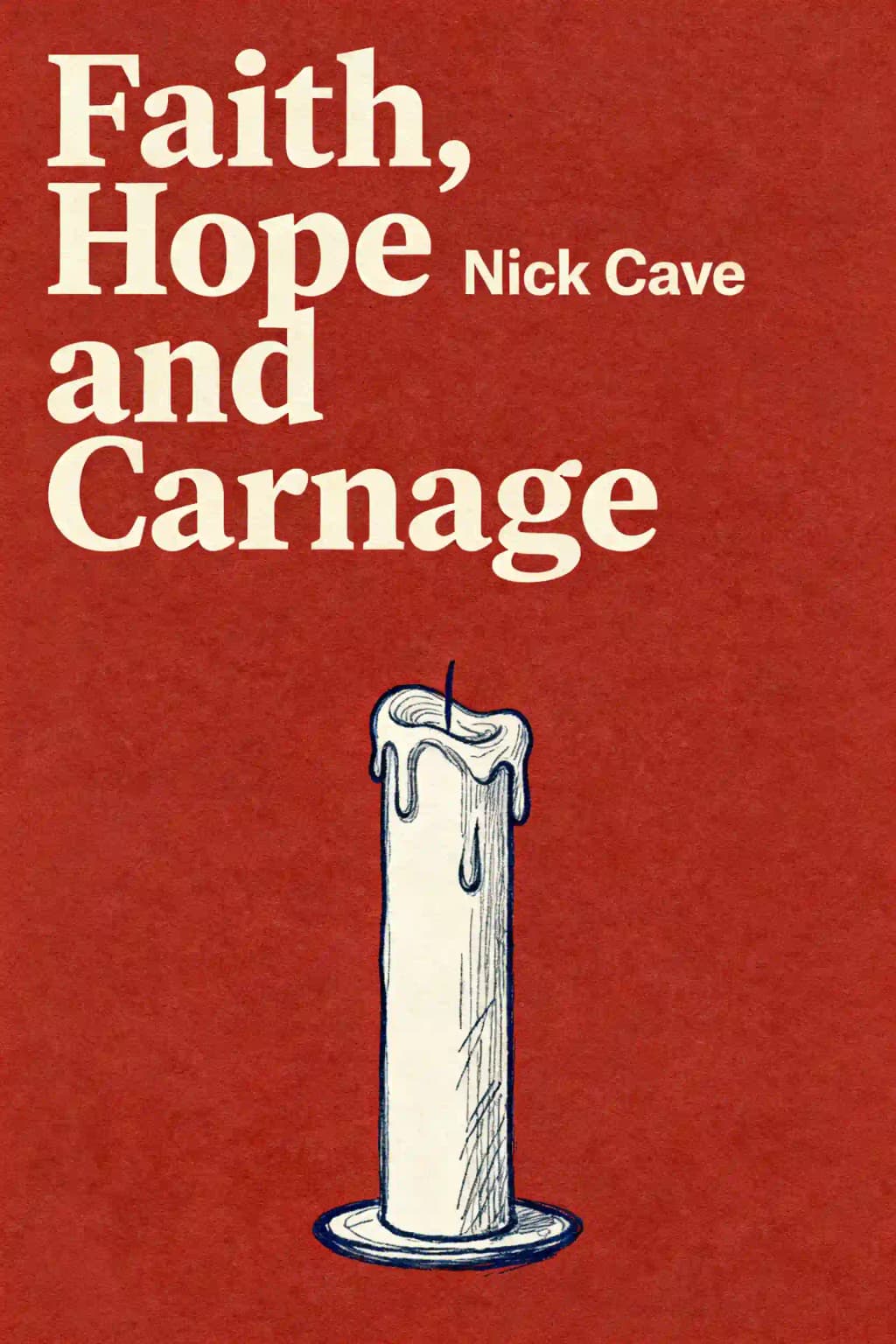
In a world increasingly detached from spiritual meaning, Nick Cave stands as a towering figure of artistic devotion. "Faith, Hope, and Carnage" emerged as one of the most profound musical memoirs of recent years, capturing Cave's raw, unfiltered reflections following the devastating loss of his son Arthur in 2015. The book, structured as an extended conversation with journalist Sean O'Hagan, has resonated deeply with readers far beyond Cave's fanbase, becoming a New York Times bestseller and earning praise from figures ranging from Patti Smith to Bono. What makes this work so compelling isn't just Cave's celebrity status but his unflinching exploration of grief, creativity, and spiritual yearning. As Elton John noted, "Nick Cave's honesty is like nothing else in music." Through these conversations, Cave doesn't just tell his story-he invites us into the sacred, mysterious space where art and spirituality converge, offering a roadmap for anyone navigating life's darkest passages.
Capitolo 2
The Beautiful Freedom of Creative Surrender
Nick Cave's approach to songwriting underwent a profound transformation following his son Arthur's death, shifting from linear narratives toward more fragmented, abstract forms that better reflected his disrupted experience of life. This evolution is particularly evident in the album Ghosteen, which emerged from what Cave describes as a "strange, haunted time" where both he and longtime collaborator Warren Ellis were in precarious emotional states. From this confusion emerged what he calls "weird, beautiful, holy music."
The creative process Cave describes is one of radical vulnerability and surrender. Working with Ellis, he engages in what he terms "informed improvisation"-building songs from extended improvisational sessions while maintaining a ruthless editorial approach to lyrics. While Cave meticulously crafts lyrics at home, in the studio he becomes "a butcher" willing to dismantle treasured lines in service of something more authentic. He views improvisation as "an act of acute vulnerability" but also "a path to creative freedom" where value emerges through musical misunderstandings and unexpected connections.
This approach creates a fascinating creative tension between Cave and Ellis, who approach creativity from complementary angles. Ellis sees the "bigger picture" and beauty earlier in the process, while Cave remains uncertain "right up to the wire." Their different sensibilities create productive friction-Ellis can "sit there in a kind of dissociative state and play essentially the same thing for hours," forcing Cave beyond his carefully constructed lyrics into a space where "the real treasure is found" as "other more mysterious influences seem suddenly to be at work."
Ghosteen originated not from narrative ideas but from persistent visual hallucinations-"a man standing on a beach surrounded by panicking animals," burning hills, and "a spiral of spirit children that climbed up to the sun." These "extremely vivid solitary images" recur throughout the songs, creating what Cave describes as "an inbuilt feeling of deja vu." The album's emotional core stems from an ordinary moment-Susie "sitting at the kitchen table listening to the radio"-the last unbroken memory before learning of their son's death.
For Cave, the most profound aspect of this creative approach is how it allows him to discover lines he could "never have found by writing songs in my office." He cites the repeated "And I love you" followed by "Peace will come" in "Spinning Song" as a moment he wouldn't have had "the nerve or confidence" to write conventionally. In these moments of creative surrender, Cave believes Arthur's spirit literally "inhabits this work," not metaphorically but "roaming around the songs," though he acknowledges this as "a whispered intuition" easily dismantled by rational thought.
Capitolo 3
The Utility of Belief in a Fractured World
Throughout his life, Nick Cave has maintained a spiritual yearning that defies easy categorization. He prefers the term "religious" over "spiritual," as it implies tradition and rigor rather than vague new-age sentiments. Despite his chaotic early career with The Birthday Party-which he describes as "old time, God-bothering religion" with their "purging of demons and speaking in tongues"-Cave maintained a spiritual search, often reading the Bible even during his wildest days on tour.
His religious interests trace back to childhood experiences in the cathedral choir, where he fell in love with biblical stories and was drawn to religious art that possessed "a kind of supplemental power." Even as a child, he bought a wooden cross supposedly made from "the True Cross," signaling an early fascination with religious symbolism and meaning.
For Cave, doubt is not the enemy of faith but rather a crucial energy that fuels both creativity and spiritual growth. He's grown "increasingly impatient" with his own skepticism, seeing it as "obtuse and counter-productive," particularly after experiencing "terrible things, great obliterating events" that left rational explanations feeling woefully inadequate. He rejects the "rigid and self-righteous certainty" of both religious fundamentalists and atheists, suggesting that perhaps "God is the search itself."
Cave articulates a concept of "poetic truth" or things being "true enough" that offer practical benefits even when not empirically verifiable. He illustrates this with the example of Narcotics Anonymous, where desperate addicts surrender to a higher power and find healing regardless of whether God actually exists. The believing itself has utility-a spiritual benefit that transforms lives. For Cave, having a religious dimension makes him happier, improves his relationships, and enhances his writing.
Music plays a central role in Cave's spiritual framework, functioning as a transcendent force that penetrates "all the fucked-up ways we have learned to cope with this world" to reach "the sacred essence" within us. He considers Ghosteen a religious record concerned with human struggle and transcendence, possessing a spiritual healing power evidenced by letters from listeners. Cave argues that atheism disadvantages songwriters by narrowing options and denying music's sacred dimension, noting that even songs not explicitly religious can have transcendent qualities-"Breathless," which O'Hagan thought purely romantic, is actually "a love song to God."
Despite government incompetence, environmental crisis, and societal divisiveness, Cave remains cautiously optimistic about our current moment. He senses a "subterranean undertow of concern and connectivity" that could lead to "a more empathetic and enhanced existence" if we recognize the potential for collective transformation through shared vulnerability.
Capitolo 4
The Impossible Realm: Prophecy, Grief, and Transformation
Cave explores the mysterious, prescient nature of songwriting, where songs seem to possess knowledge of future events before they occur. While he once viewed this phenomenon playfully, he now takes it more seriously. The frequency and accuracy of songs predicting life events has become "too insistent to ignore," particularly after his album Skeleton Tree contained lyrics that seemed to predict Arthur's death, especially the opening line "You fell from the sky and landed in a field near the River Adur."
These experiences have led Cave to consider songs as "channels through which some kind of greater or deeper understanding is released into the world," suggesting we possess "deeper intuitions than we realize." He references religious writer Cynthia Bourgeault's concept of "the imaginal realm"-a liminal state of awareness beyond rationality and separate from imagination. Cave describes it as an "impossible realm where glimpses of the preternatural essence of things find their voice" and where he feels his son Arthur lives.
After Arthur's death, Cave experienced "acute disorder" and "interior screaming"-both mental torment and physical sensations "rushing through my body and bursting out the ends of my fingers." He describes grief as "capsizing" and "the covenant of life and death." Through meditation in Arthur's room, he glimpsed "that things could somehow be all right"-a significant shift. Eventually, this grief gave way to "weird, urgent energy" and "strange reckless power" because "the worst had happened and nothing could hurt us."
Cave found his path through grief through public rehabilitation-taking Skeleton Tree on tour and doing In Conversation events where he "learned my own way of talking about grief." Though initially risky in his vulnerable state, these events became transformative as he entered the "impossible realm" where he felt Arthur's presence supporting him. Through this process, he discovered "a kind of invincibility through acute vulnerability" and a new artistic freedom by "relinquishing concern for the outcome."
Creating Ghosteen was "as intense as things can get. But beautiful, fiercely beautiful." Cave describes the recording sessions in Chris Martin's Malibu studio as having "a kind of holiness" that "spoke into the absence of my son and breathed life into the void." Beyond making music, Cave saw the album as "an attempt to somehow bring whatever spirits there may be towards me"-a way to communicate with Arthur, "to make contact again and saying goodbye" to a son who "was snatched away, he just disappeared."
Cave emphasizes that grieving people do become different-"we become better"-though the process is incremental. Vulnerability becomes essential to spiritual and creative growth, existing "adjacent to collapse or obliteration"-a nuanced place that feels both dangerous and "teeming with potential." This state of vulnerability creates freedom because "the more time you spend there, the less worried you become of how you will be perceived or judged."
Capitolo 5
Love and Creative Dissonance: The Collaborative Spirit
Nick Cave describes Ghosteen as having a unique "prayer-like aspect" with "radical intimacy" unlike his other work. When listening to it, he feels "that someone else, or something else, is performing them" and strangely that he himself is "their intended audience." Unlike earlier songs like "Into My Arms" (which he recalls writing in rehab), Ghosteen "feels like it is moving towards me, with all its secrets and mysteries in tow."
The album's standout track "Spinning Song" is possibly "the finest piece of songwriting" Cave's been involved in, despite not remembering much of its creation. The song begins with a folk tale about Elvis Presley before transitioning to an image of Susie at the kitchen table-his "last intact memory" before hearing of Arthur's death. This creates a "physical rupture" in the song where the music shifts to a mantra-like repetition of "And I love you" sung "slightly out of tune and slightly out of time," symbolizing "the breaking apart of our world."
Cave's collaborative process with Warren Ellis involves a creative tension that produces unexpected beauty. Their approach differs markedly from Cave's earlier songwriting methods-from his early days with The Birthday Party where he would sing words and musical ideas to Mick Harvey who would "interpret and order the chaos," to the Bad Seeds era where he'd write songs on piano and present them to the band. The improvisatory method developed with Ellis allows for more "vertical" compositions that are "heaven bound"-something Cave loves about Ghosteen's perpetually ascending quality.
In contrast to Ghosteen's transcendent quality, Cave describes Skeleton Tree as "the antithesis"-a record that "throbbed with pain and darkness and confusion" and made him physically ill. The recording environment for Ghosteen was "rare" and "haunted," with Cave, Warren Ellis, and filmmaker Andrew Dominik (who was "nursing a broken heart") all in "this strange, wounded place." Producer Hal Willner (who later died from Covid) was deeply moved by the album, saying "I have never heard a record like that in my life."
Cave reflects on creative tensions in the studio, acknowledging his own tendencies toward being dictatorial as an "Enneagram type 8." He expresses regret about his past behavior, particularly with Mick Harvey, though he's grateful they've reconciled. The album's approach was about "revealing a song's essential self"-creating music with "no place to hide" that could serve as "the gateway through which the spirits can enter and play."
Throughout his career, Cave has needed creative partners-beginning with Mick Harvey, then Rowland S. Howard, and later Blixa Bargeld. He describes Blixa as "the least nuanced person I've ever met" with a "brutality of thinking" and "resoluteness" that Cave found both enviable and productive. Their relationship ended abruptly when Blixa quit via email-"a weird 'Dear John' letter of the most rudimentary kind." His current partnership with Warren Ellis differs fundamentally-they write songs together as a true duo, creating music in "a free and intuitive way" where "it is difficult to untangle who did what."
Capitolo 6
Maternal Loss and the Inheritance of Stoicism
In a poignant exploration of another profound loss, Cave discusses his mother's recent death, describing it as "a kind of disappearance" and reflecting on their relationship during a difficult time when pandemic restrictions prevented him from traveling to be with family. His mother's unconditional love was "the undercarriage of my life" that prevented him from "falling all the way" through his darkest periods, including his years of addiction and self-destructive behavior.
Cave shares touching anecdotes revealing her unwavering support even during his most troubled phases, including when police searched him for drugs after a flight while she waited. Despite her concern seeing his squalid London squat, she beamed with pride upon seeing his band mentioned in an English music paper-a moment that showed her hope that "something might come good for her troublesome son."
Her stoic nature-"not one to make a fuss" despite enduring significant hardships-represents a generational quality that Cave both admires and recognizes as sometimes limiting. After watching One More Time with Feeling, the documentary about Cave's grief following Arthur's death, she surprisingly opened up about his father's death and its impact on her. Cave expresses regret that his "furious whirlwind of self-absorption" prevented him from acknowledging her pain earlier, realizing too late that "children need their parents, but parents need their children, too."
Cave reveals his mother wasn't religious but "envied those who were," unlike Cave who declares "I believe. Especially today." He describes her as embodying civility and decency with "a dry, dark, wicked sense of humour" expressed through "quiet, acerbic, well-placed" remarks. Her death during the pandemic prevented Cave from visiting her in hospital or attending her funeral-what his son Earl bleakly called a "Zoomeral"-creating an unresolved grief where Cave occasionally forgets she's gone, a "universal phenomenon" of pandemic loss.
During his last Australian visit, his mother listened repeatedly to Ghosteen, visibly moved by it. Cave recalls finding her sitting in her kitchen chair, "lost to it," as if the album spoke to her not just about Arthur's death but all the many people a 93-year-old woman has inevitably lost. Their final goodbye carried "that unspoken sorrow" that it might be their last meeting-"And, well, this time it was."
This maternal relationship connects to Cave's childhood in Wangaratta, Australia, which he describes as "idyllic" and "unbounded"-an unsupervised existence where he and friends roamed freely, swimming in rivers and jumping off railway bridges. This paradise began to feel "cramped and stifling" as he grew into a teenager with bigger dreams. After developing "serious behavioural problems" at the high school where both parents worked, he was sent to Melbourne, marking "an abrupt and absolute severing from my childhood" where "a different Nick Cave emerged, more problematic, more pissed-off."
Capitolo 7
The Haunted House of Memory and Loss
Cave's exploration of his past reveals how trauma shapes our memories and narratives. Discussing Mark Mordue's biography of his early life, Boy on Fire, Cave reflects on how "our remembered past, especially around traumatic incidents, is based on assumptions and misunderstandings." He questions whether our life stories are merely "semi-fictions" and "false, or eroded, memories" that we've shaped and reshaped, suggesting that perhaps only traumatic memories-"the sharp, horrific pictures that live in our bodies"-are authentic.
The most searing of these memories is learning about his father's death while at a police station after a minor burglary arrest. His most vivid memory is his mother telling him, "Nicky, your dad's dead," while policemen nearby discussed a murdered prostitute. Cave remembers focusing entirely on his mother's pain, thinking, "What are we going to do with Mum?" while feeling "completely and utterly ill-equipped to be of any help."
Cave believes his creative life was an attempt to articulate the loss he felt after his father's death, believing that grief must be articulated to be processed. This early loss connects to his later experience with Arthur's death, which "literally changed everything" and created a profound divide between his past and present life. The loss made him "a religious person" in the sense of feeling "a kind of deep inclusion in the human predicament" and understanding human vulnerability.
Grief either changes people or causes them to contract around an absence, Cave observes. Devastating experiences-whether death, betrayal, or public shaming-can shatter someone completely before they rebuild themselves as "a different, more complete, more clearly drawn person." While he experienced despair rather than anger after Arthur died, he and Susie eventually discovered that "happiness was a form of insubordination" and "a choice" in the face of life's indifference.
Cave describes the night of Arthur's death with devastating clarity: receiving a call from a stranger who found Arthur's belongings near a cliff, the panic of calling emergency services, police arriving at their door with the news, and seeing Arthur's body at the hospital looking "so calm and beautiful" with "a clean white bandage around his head." The physical sensation of grief felt like he was "literally detonating" with his body "stuffed with despair" while trying to support Susie who lay "completely still in the dark, like a stone."
Just days after Arthur's death, Cave approached Warren Ellis saying, "the music and the work are the only things that have ever saved me in the past, and I need to do it." Despite being "deeply disturbed" by the seemingly prophetic nature of songs like "Jesus Alone" and "Girl In Amber," Cave attempted to continue work on Skeleton Tree. During this period, he found comfort in the proximity to Arthur's grave at Daphne's Field, visible from their Ovingdean studio window: "I'd just walk up from the studio and sit by his grave."
Capitolo 8
Creative Defiance Against the Void
In response to grief's devastating impact, Cave and his wife Susie each found their own forms of creative defiance. Cave engaged in a frenetic creative schedule during the pandemic-scoring scenes for a Jeffrey Dahmer film, recording a children's audiobook, collaborating with a jazz-punk band, working on his Seven Psalms record of "petitions to God," designing merchandise, and crafting ceramic figurines. He characterizes this period as having "an openness and freedom to things that I've never experienced before."
Cave reframes the idea of "encroaching mortality," explaining that he doesn't view death as an endgame waiting down the line. Instead, he feels "enmeshed in death" daily, experiencing it as "a clear and present state of being that manifests itself in a sort of vitality." He observes the same quality in Susie-"this invigorating force, born of a hard-earned understanding of the immediate and urgent proximity of death."
Susie channeled her grief into creating The Vampire's Wife fashion line: "She built The Vampire's Wife entirely on the mad energy of her grief." Cave describes how after Arthur's death, she found "this new, vital, mutinous energy" that made "everything she did an act of insubordination towards what seemed like the callous indifference of the world." Cave views his work and Susie's fashion label as "part of the same operation" with "constant cross-pollinating."
Their creative relationship isn't always easy-Susie has "a maddening tendency to question the original idea at the eleventh hour," which frustrates Cave but "generally turns out for the best." Cave admits he doesn't easily take advice, preferring to "go with my flow," while characterizing Susie as "a perfectionist" and himself as "an imperfectionist."
Cave feels uncomfortable with the term "muse" as it "sanctifies a subordinate role," but acknowledges Susie as his "point of influence" whose presence permeates his songs. He describes how his songwriting involves managing multiple voices-"my voice, Susie's voice and our shared voice"-explaining that at their "melding point" they become "indistinguishable." Though they don't directly collaborate on each other's work, Cave views their creations as gifts to each other: "We are both waving to each other, through our work, that we are both still present in the world."
Their creative work serves as "a solace" and "a strategy for survival" in the wake of their son's death: "Susie and I are essentially bound together by love and catastrophe, but there is also the shared project of grief." Neither could have survived without their work-"We had to get up in the morning because something needed to be done." For them, creativity has become "a sense of shared defiance" against their loss.
Capitolo 9
The Astonishing Idea: Art as Spiritual Revelation
Cave's approach to creativity is deeply intertwined with his spiritual seeking. He describes waiting patiently for what he calls "the astonishing idea" or "the Jesus idea"-a moment of creative revelation that transcends the "residual idea" (comfortable leftover concepts from previous work). This pursuit of artistic revelation connects to his belief that music can transform people's way of being, calling this "its primary function." He argues music can "influence the heart in a righteous way that enables us to do better," especially in live performances where collective experience creates a "moral force."
His musical influences reveal a deep appreciation for storytelling traditions. Cave particularly loves grand ballads like those of Jimmy Webb, whose songs are "heroic in their way, but doomed, too." He admires how Webb's songs like "By The Time I Get To Phoenix" and "Wichita Lineman" use movement and metaphor in sophisticated storytelling. These influences connect to Cave's early exposure to American culture through TV shows like "The Johnny Cash Show," "I Dream of Jeannie," "The Addams Family," and "Bewitched"-programs that were "a great unifying force" for his generation of Australians.
Cave's artistic sensibility is profoundly visual-he experiences the world "through stories and symbols and metaphors," writing songs as "a series of highly visual images, often violent, mostly sorrowful." Childhood books like The Fairy Tale Tree and his grandmother's Bible, with their vivid illustrations, profoundly shaped his imagination. Unlike Warren Ellis who "hears the world," Cave sees it-a sensibility that drew him to painting before music.
Three religious artworks particularly impacted Cave: Grunewald's Crucifixion, "a kind of horror image" that contrasted with the "placid image of Christ" from his choirboy days; Michelangelo's Rondanini Pieta, where Christ is "hacked back to its essentialness"-a process that inspires Cave's lyrical editing; and Rodin's Christ and the Magdalen sculpture, a "tortured and sexual and sad" image that became "the spiritual heart of The Boatman's Call." These works transcend art to become "ladders to spiritual experience."
For Cave, performing creates "a communal sense of awe" where both performer and audience experience something sacred. He describes this as "reaching an essential and shared state through music" that creates profound moments where "each audience member feels implicit in the experience." His evolution from the chaotic performances of The Birthday Party days to the "emotional purity" of the Skeleton Tree concerts achieved "radical intimacy" with audiences through vulnerable songs that connect on a "soul level."
Capitolo 10
Seeking Absolution: Art as Redemption
At the heart of Cave's creative output since Arthur's death lies a profound spiritual quest-the search for absolution. His latest project, creating ceramic figurines centered on the Devil rather than Jesus, forms a narrative sequence similar to the Stations of the Cross. The eighteen-piece series traces the Devil's life from birth through various life stages to death and ultimate forgiveness. Though not intentionally about Arthur, Cave admits "Arthur always seems to be patiently waiting at the end of the idea," appearing in his work without deliberate planning.
Cave describes these figurines as "soul objects" that reveal something about his predicament more explicitly than his music could. When asked what they communicate, Cave explains they aren't declaring anything but asking for something-the same thing all his work has asked for since Arthur's death: "Absolution." He clarifies this means forgiveness, a release from personal culpability regarding Arthur.
This search for absolution extends across all his creative output-Skeleton Tree, Ghosteen, Carnage, The Red Hand Files, In Conversation Events, live shows, even his conversation with O'Hagan. Cave explains: "I'm seeking forgiveness, release from my personal culpability regarding Arthur. When I think of him, I feel a weight in my heart. I worry he feels sorry for what happened and the hurt we feel. As his father, I feel he was my responsibility and I wasn't vigilant enough."
Susie shares this burden, and their work-his music, writings, sculptures, her ghost-like dresses-"every song, word and stitch asks for forgiveness." They're trying to lift this burden from themselves and from Arthur. Art has the power to save, Cave believes, "to put beauty back into the world as a form of making amends." After Andrew Dominik made One More Time with Feeling, Cave felt "exonerated, a burden lifted." The work brings order to chaos, "drawing my story out of darkness to stand in testament. This is art's gift-deliverance."
Cave believes art reconciles the artist with the world through active atonement-putting good into the world requires the participation of others. Our deepest regrets often concern those no longer with us, which makes them particularly painful. He's found value in expressing contrition toward the departed through prayer, meditation, and song, living his best life "in their name."
Looking back at his artistic journey, Cave sees that apparent "points of arrival" are illusions-each seemingly stable position is constantly being shed. What matters isn't so much the work itself (the "what") but how he approached it-showing up completely regardless of circumstances. Hope remains implicit in everything-"hope is optimism with a broken heart."
Through his Red Hand Files project, Cave has created a platform for "a sincere and loving exchange that goes some way towards mutual restoration." He views the project as a form of prayer-"concentrated listening" where he attends to others through "a sharing of our collective need to be listened to." Despite occasional anxiety about the responsibility, he finds the exchanges invaluable for creating existential meaning and genuine happiness, describing it as "a small gesture of service" and "a form of spiritual sustenance and kindness."