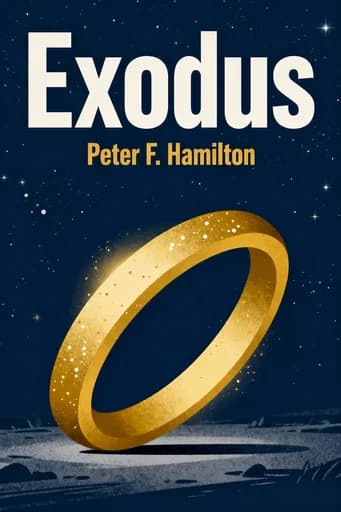
In "Exodus," Peter F. Hamilton's epic 928-page sci-fi masterpiece spans 40,000 years of human evolution while doubling as a prequel to an upcoming AAA RPG. This groundbreaking multimedia venture has already captivated readers with its "superb worldbuilding" and mind-bending cliffhanger ending.
Peter F. Hamilton, born in 1960 in Rutland, England, is the bestselling author of Exodus: The Archimedes Engine and Britain's leading science fiction space opera writer. With a career spanning nearly four decades, Hamilton has become renowned for crafting vast, intricately detailed space operas that explore humanity's future across galaxies, alien encounters, and advanced technologies.
Hamilton began writing in 1987 and published his first novel, Mindstar Rising, in 1993. Since then, he has authored numerous acclaimed series including the epic Night's Dawn trilogy, the expansive Commonwealth Saga, the Void trilogy, and the Salvation Sequence. His standalone novels such as Fallen Dragon and Great North Road have further cemented his reputation for blending hard science fiction with compelling human drama.
Hamilton's work is characterized by ambitious worldbuilding, complex plots spanning multiple timelines, and thought-provoking examinations of technology's impact on society. Exodus: The Archimedes Engine launches a new two-book series, with the sequel The Helium Sea scheduled for 2026. Hamilton's novels have captivated millions of readers worldwide, establishing him as one of contemporary science fiction's most influential voices.
Exodus: The Archimedes Engine is a space opera set 40,000 years after humanity fled Earth in massive arkships. The novel explores tensions between Celestials—evolved, powerful transhuman rulers—and Uranic humans, descendants of later-arriving arkships who face oppression. The story follows Finn Jalgori-Tubu, a young man who joins a rebellion using the mysterious Archimedes Engine to disrupt the oppressive Crown Dominion's power structures.
Peter F. Hamilton is Britain's biggest-selling living science fiction author, born in 1960 in Rutland, England. He began writing in 1987 and is renowned for epic space operas featuring vast timelines, intricate world-building, and multiple interconnected plotlines. Hamilton's signature style includes brick-thick novels spanning thousands of years, complex political intrigue, advanced technology, and grand-scale space battles that appeal to readers who enjoy immersive, detailed science fiction universes.
Exodus: The Archimedes Engine is ideal for space opera enthusiasts who enjoy epic world-building, complex political intrigue, and multi-threaded narratives. Readers who appreciate Peter F. Hamilton's previous works like the Commonwealth Saga or Night's Dawn Trilogy will find familiar elements. This novel suits patient readers willing to invest in a 900-page journey with slow-burn world-building in the first 300 pages before the action accelerates.
Exodus: The Archimedes Engine delivers what Hamilton fans expect: big ideas, vast timescales, and action-packed adventure across multiple storylines. While the first 300 pages focus heavily on world-building, the narrative becomes a "barnstormer" in the final 200 pages. Readers seeking epic space opera with political intrigue, rebellion themes, and far-future technology will find this 900-page novel rewarding, though it requires patience during the exposition-heavy opening.
Celestials in Exodus: The Archimedes Engine are biologically and technologically advanced posthumans who evolved from humanity's earliest arkship pioneers 40,000 years ago. These powerful beings dominate the Centauri Cluster through vast interstellar empires, including the Crown Dominion ruled by five queens. Celestials possess extraordinary abilities, advanced neural interfaces, extended lifespans through longevity techniques, and maintain rigid hierarchies that oppress later-arriving Uranic humans who perform menial labor.
The Archimedes Engine is a powerful device attached to Dolod, an iron exotic gas giant entering the Kelowan system. In Exodus: The Archimedes Engine, the Uranic resistance uses this technology to manipulate the planet's orbit, disrupting the Crown Dominion's economic balance. While the Engine doesn't become central to Peter F. Hamilton's plot until approximately 400 pages into the novel, it serves as the key weapon enabling ordinary humans to challenge their Celestial oppressors.
Exodus: The Archimedes Engine weaves three primary narratives: Finn Jalgori-Tubu's journey from bored aristocrat to resistance fighter alongside Ellie Aponi from the arkship Diligent; detective Terence Wilson-Fletcher's police procedural investigating murder and subversive activities in Santa Rosa; and the political maneuverings of five Celestial Queens jockeying for power under the Imperial Accord. These threads converge around the Uranic rebellion against Celestial oppression.
Exodus: The Archimedes Engine spans approximately 900 pages with deliberate pacing. Peter F. Hamilton dedicates the first 300 pages to extensive world-building, introducing characters, planets, and political systems before the main plot accelerates. The titular Archimedes Engine becomes important around page 400, while the final 200 pages deliver intense, fast-paced action. Readers should expect a slow-burn epic requiring patience before reaching the explosive conclusion.
The Crown Dominion in Exodus: The Archimedes Engine is a vast Celestial empire encompassing tens of thousands of worlds within the Centauri Cluster. Ruled by five queens through the Imperial Accord—an alliance of great houses including the Royal House of Wynid—this dominion controls critical resources like the helium-rich HeSea. The Crown Dominion uniquely allows Uranic humans to establish their own worlds and businesses, though these later-arriving humans face systematic oppression.
Uranic humans in Exodus: The Archimedes Engine are descendants of later-arriving arkships who spent 40,000 years in deep space using time dilation and cryosleep. Unlike evolved Celestials, Uranics remain closer to original Earth humans and face second-class status, performing menial labor in Celestial-dominated systems. The tension between thousand-year-old Celestials and recently-arrived Uranics expecting habitable planets—not colonized worlds—drives the rebellion central to Peter F. Hamilton's narrative.
Exodus: The Archimedes Engine returns to Peter F. Hamilton's signature epic style after the more constrained Salvation Sequence trilogy. This novel features classic Hamilton elements: 900-page length, vast timelines spanning 40,000 years, multiple interconnected plots, and grand-scale world-building. Unlike his previous trilogies, Exodus launches a new series with fresh universe-building while maintaining the political intrigue found in the Commonwealth Saga and the expansive scope characteristic of Night's Dawn Trilogy.
Exodus: The Archimedes Engine explores class conflict between evolved Celestials and ordinary Uranic humans, examining how technological advancement creates social hierarchies and oppression. Peter F. Hamilton addresses themes of rebellion, freedom versus security, political succession, and humanity's evolution across millennia. The novel questions whether technological and biological superiority justifies authoritarian control, while highlighting how ordinary people resist systemic oppression through collective action and strategic use of ancient technology.
Senti il libro attraverso la voce dell'autore
Trasforma la conoscenza in spunti coinvolgenti e ricchi di esempi
Cattura le idee chiave in un lampo per un apprendimento veloce
Goditi il libro in modo divertente e coinvolgente
We're living in a prison.
Information is the foundation of our work.
Scomponi le idee chiave di Archimedes Engine in punti facili da capire per comprendere come i team innovativi creano, collaborano e crescono.
Vivi Archimedes Engine attraverso narrazioni vivide che trasformano le lezioni di innovazione in momenti che ricorderai e applicherai.
Chiedi qualsiasi cosa, scegli il tuo stile di apprendimento e co-crea intuizioni che risuonano davvero con te.

Creato da alumni della Columbia University a San Francisco
"Instead of endless scrolling, I just hit play on BeFreed. It saves me so much time."
"I never knew where to start with nonfiction—BeFreed’s book lists turned into podcasts gave me a clear path."
"Perfect balance between learning and entertainment. Finished ‘Thinking, Fast and Slow’ on my commute this week."
"Crazy how much I learned while walking the dog. BeFreed = small habits → big gains."
"Reading used to feel like a chore. Now it’s just part of my lifestyle."
"Feels effortless compared to reading. I’ve finished 6 books this month already."
"BeFreed turned my guilty doomscrolling into something that feels productive and inspiring."
"BeFreed turned my commute into learning time. 20-min podcasts are perfect for finishing books I never had time for."
"BeFreed replaced my podcast queue. Imagine Spotify for books — that’s it. 🙌"
"It is great for me to learn something from the book without reading it."
"The themed book list podcasts help me connect ideas across authors—like a guided audio journey."
"Makes me feel smarter every time before going to work"
Creato da alumni della Columbia University a San Francisco

Ottieni il riassunto di Archimedes Engine in formato PDF o EPUB gratuito. Stampalo o leggilo offline quando vuoi.
Imagine waking up 40,000 years in the future to discover your descendants have evolved into godlike beings who view you as primitive curiosities. This is the unsettling premise of Peter F. Hamilton's "Exodus," a sweeping space opera where humanity's desperate flight from a dying Earth leads to profound transformation. By the 42nd millennium, humans have split into numerous species-from baseline humans to the immortal Celestial rulers who transfer their consciousness between bodies. When arkships carrying original humans arrive after millennia in transit, they find themselves in a universe where their own descendants have become their oppressors. This collision of past and future forms the backdrop for a tale of rebellion, identity, and what it truly means to remain human in a post-human universe.
Earth's environmental collapse in the 22nd century forces humanity to flee on experimental arkships, many lost to space. The survivors reach the Centauri Cluster-a region 16,000 light-years away with thousands of habitable planets across hundreds of star systems. Over millennia, genetic engineering transforms humans into divergent transhuman species called Celestials. These beings establish interstellar empires throughout the Remnant Era. By 30,000 AD, the advanced Elohim Celestials create the Gates of Heaven-an interstellar transit network connecting all Centauri systems. In 31,080 AD, six Imperial Celestial families form the Crown Dominion, each ruling their own planetary system as queens in a feudal aristocracy. By 42,350 AD-the novel's present-this civilization has become both magnificent and oppressive, with orbital towers reaching space, neurally-commanded growing buildings, and courts of blinding opulence. The ultimate irony: in fleeing Earth for survival, humanity evolved into beings that barely resemble humans at all.
The Crown Dominion's glittering facade masks a rigid hierarchy: Imperial Celestials at the top, lesser Celestial houses below, genetically engineered servants next, and baseline humans at the bottom as primitive curiosities. On worlds like Gondiar, "uranics" serve as aristocracy with neural connections to Celestial technology, while "Gath" perform manual labor. This system operates through extensive surveillance networks managed by archons-intelligence chiefs serving each queen. These archons engage in their own "Great Game" of espionage, using humans as pawns in centuries-long power struggles. The capital Kelowan showcases this splendor with fifteen orbital towers and palaces of living stone. Empress Helena-Chione maintains a court of Princess Congregants competing to become her next host body. When arkships arrive from Earth after 40,000 years in transit, passengers are stunned to find their evolved descendants already in control. As Finn Jalgori-Tobu explains to a new arrival: "We're living in a prison. My family serves as the jailers, maintaining a stagnant society mimicking Celestial culture without allowing true human progress."
Finbar "Finn" Jalgori-Tobu personifies restlessness within the Crown Dominion's rigid structure. Born to aristocratic uranic parents on Gondiar, he enjoys rare privileges yet resents his predetermined path. Despite neural abilities marking him for the governing class, he longs to explore beyond Celestial-imposed boundaries. "I want to be a Traveler," Finn confesses to his teenage love. "To sail between the stars, to see what's beyond the Crown Dominion." This dream drives him to reject privilege for work in the criminal underworld, building skills for eventual escape. When Finn rescues Josias and Ellie Aponi from the arkship Diligent, he trades his coastal property for their vessel - giving the arkship's people a planetary home while securing his means to escape the Dominion. His quest takes an unexpected turn when recruited by the mysterious "Gyvoy" for a mission involving the iron exotic planet Dolod. After his parents are killed during the Imperial occupation of Gondiar, his personal freedom quest transforms into vengeance against the Celestials - demonstrating how individual journeys become entangled in the power structures spanning the Centauri Cluster.
Eleanor "Ellie" Faith Aponi provides our window into the Crown Dominion's bewildering complexity. As the granddaughter of the arkship Diligent's owner, she arrives after a 40,000-year journey expecting uninhabited planets but finds a civilization built by humanity's evolved descendants. Through Ellie's eyes, we experience this future society's wonder and horror. Observing Gondiar, she's "astonished by its seven orbital towers and georing-a massive loop encircling the planet at geostationary orbit, supporting hundreds of industrial stations and habitats." As an "osee"-genetically enhanced for intelligence and memory-Ellie represents an alternative evolutionary path. Unlike the Celestials who embraced radical body modification, her enhancements preserved her humanity while augmenting her capabilities. Her outsider status reveals the Crown Dominion's flaws more clearly. When Finn dismisses Gondiar's society as stagnant, Ellie highlights stability and security aspects he takes for granted, enriching the exploration of what progress truly means. Ellie's crucial moment comes when she uses rekaul-a perfect-recall drug-to discover Gyvoy's manipulation of Finn's memories and the shocking truth: "Gyvoy is a Celestial." This revelation transforms her understanding of their mission.
Behind the Crown Dominion's glittering facade lies a shadow war of intelligence agencies led by archons-the queens' spymasters conducting elaborate operations spanning centuries. These master manipulators play a "Great Game" of espionage, sabotage, and proxy conflicts designed to weaken rival dominions without triggering open warfare. The archons' operations follow unwritten rules-they avoid direct confrontation and maintain plausible deniability. When these norms are violated through assassination, it signals a dangerous escalation threatening the delicate balance between dominions. What makes the Great Game truly terrifying is its timeframe. Archons think in centuries rather than years, implementing plans that may not bear fruit until long after human agents have lived and died. As one archon tells his human agent, "It might take centuries to uncover the full operation." This inhuman perspective underscores the fundamental disconnect between Celestials and humans. The novel's most shocking revelation comes when we discover that Queen Helena-Thyra herself has been playing the longest game of all. Her elaborate scheme involving Dolod culminates in a catastrophic collision between planets that eliminates her rival, Empress Carolien-Amaia. "Ooops," she murmurs coldly after the empress's evacuation craft explodes. "One bitch down, three to go."
Against Celestial dominance, human resistance movements fight for dignity and autonomy-from Josias Aponi's Regal Democrats to underground networks like Human Liberation and radical figures like Tose and Liliana. The Imperial occupation of Gondiar becomes a turning point. Outrage spreads when "YouBusters" weapons-which erase victims' memories-are used excessively on prisoners. This anger, amplified by Aponi's broadcasts, creates unprecedented unity among humans against their rulers. More radical resistance emerges through direct action: assassinations, sabotage, and the theft of degenerate antimatter-"enough to destroy entire worlds and force the Celestials to negotiate with humans as equals." As "Exodus" concludes, humanity's future hangs in balance. The planetary collision threatens to destabilize the Crown Dominion, while the Diligent's escape with advanced technology opens possibilities for human autonomy. The novel ultimately suggests that humanity's greatest strength is its adaptability and resilience. Despite 40,000 years of separation, Earth's descendants continue fighting for freedom across the stars. As Finn tells his sister before their escape, they will return to help their homeworld because their mother "would expect nothing less."