Capitolo 1
The Power of Clarity: When Words Matter Most
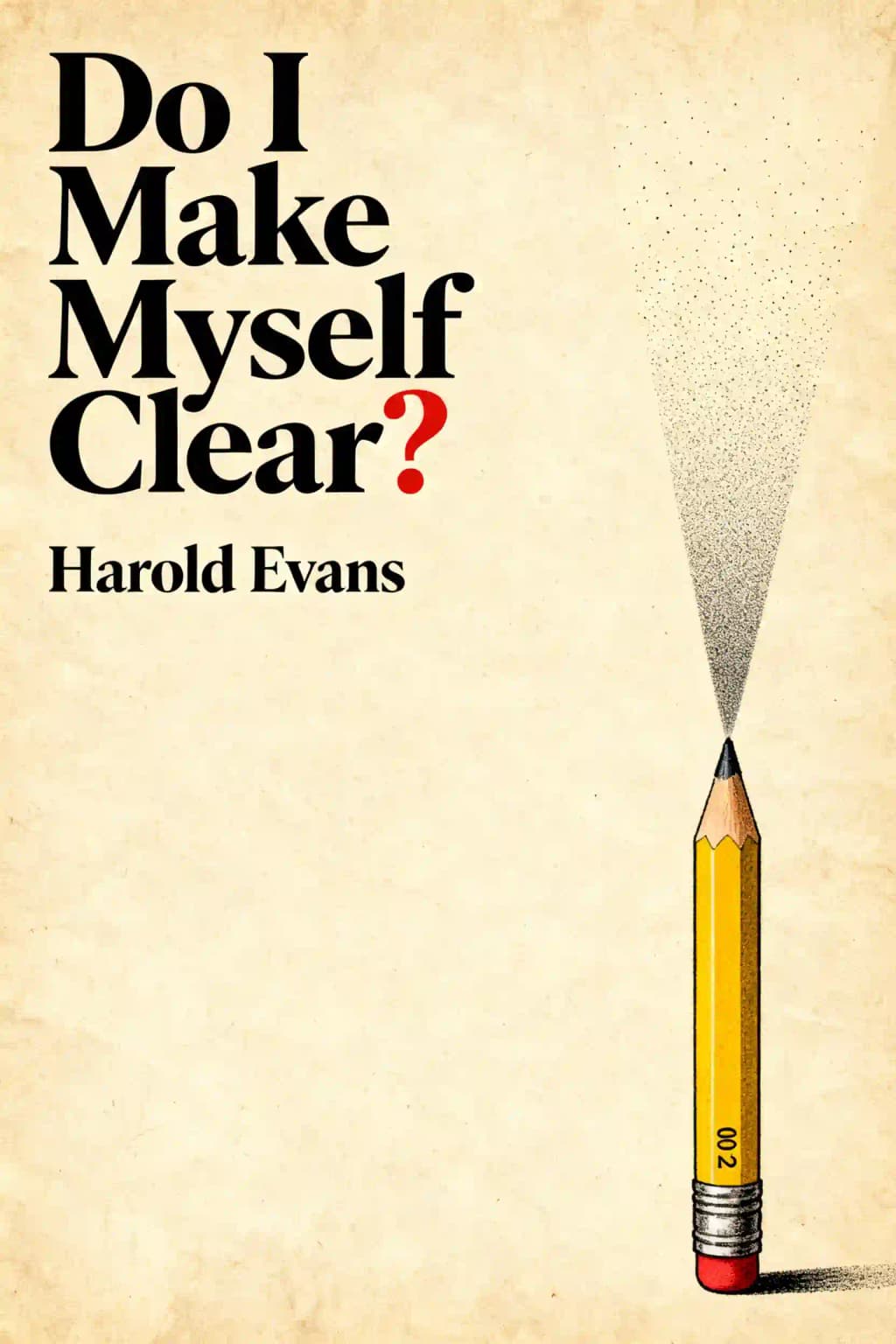
Have you ever read a sentence so convoluted that by the time you reached the end, you'd forgotten the beginning? Harold Evans certainly has-and he's made it his mission to combat such linguistic crimes. In "Do I Make Myself Clear?", Evans, the legendary editor who transformed The Sunday Times into an investigative powerhouse, wages war against what he calls "zombie nouns"-bloated abstractions that devour lively verbs and leave readers bewildered.
This isn't just another style guide gathering dust on your shelf. Evans' book has become required reading in newsrooms worldwide and counts among Barack Obama's favorites for its practical approach to untangling verbal knots. When The Economist named it among the best books of 2017, they noted how Evans "practices what he preaches," delivering insights with the same clarity he advocates. In an era when words can trigger financial meltdowns or justify military strikes, Evans argues that clear writing isn't merely aesthetic-it's moral. As fake news proliferates and political discourse deteriorates, his decades of experience editing everyone from front-line reporters to Henry Kissinger offers a timely antidote to our growing linguistic fog.
Capitolo 2
The Medium Shapes the Message
Marshall McLuhan's famous paradox "The medium is the message" is often misunderstood but proves increasingly prophetic in our digital age. McLuhan wasn't suggesting content doesn't matter but rather highlighting how communication channels fundamentally reshape our social interactions and thought patterns. The digital revolution proves his point dramatically, transforming not just how we communicate but how we think and process information. Instead of fostering thoughtful exchange, platforms like Twitter have reduced discourse to character-limited put-downs, while Instagram prioritizes visual impact over substance, and TikTok fragments attention into ever-shorter bursts.
This transformation is perfectly exemplified by Donald Trump's mastery of social media, particularly his use of dismissive nicknames like "Lying Ted" and "Crooked Hillary." These linguistic weapons proved devastatingly effective precisely because they were optimized for the medium - short, memorable, and easily shareable. The success of such simplified communication demonstrates how digital platforms aren't neutral conduits but active shapers of political discourse.
Social media has become particularly fertile ground for falsehoods, with platform mechanics amplifying the problem. Facebook's algorithms favor emotional engagement over accuracy, creating what researchers call "engagement traps" where sensational content spreads faster than fact-based reporting. This makes C.P. Scott's journalistic principle that "the unclouded face of truth must not suffer wrong" more vital yet harder to uphold than ever. Studies show that false news spreads six times faster than truth on Twitter, largely because falsehoods trigger stronger emotional responses.
Mark Thompson argues in "Enough Said" that this breakdown in public language has eroded trust between citizens and leaders, creating a vacuum filled by simplistic rhetoric and tribal signaling. The complexity of modern problems demands nuanced discussion, yet our communication platforms push in the opposite direction. This dynamic was perfectly demonstrated during the COVID-19 pandemic, where complex public health messages struggled to compete with simple but misleading narratives.
Trump's rise demonstrated this transformation of political communication. His repetitive assertions proved devastatingly effective despite their factual emptiness, with phrases like "fake news" and "build the wall" functioning as viral memes rather than policy positions. When analyzing his speeches, what's striking isn't just their content but their form-short, emphatic sentences that hammer home points through repetition rather than evidence. This represents a fundamental shift in how political communication works in our digital environment, where attention is the scarcest resource.
Writing clearly has always been challenging because thoughts evolve during expression. As Pascal famously noted, "I would have written something shorter, but I didn't have time" - a paradox that highlights how brevity requires more effort than verbosity. Poor writing often results when thoughts collide mid-sentence or when abstractions replace concrete details. Even Trump's rambling climate change denial demonstrates this difficulty-clear expression requires meeting readers more than halfway through careful revision, something increasingly rare in our rapid-fire digital discourse where the pressure to post quickly often trumps the need to communicate clearly.
Capitolo 3
The Science Behind Readability
Language has evolved dramatically over centuries, reflecting both cultural shifts and our deepening understanding of human cognition. Sherman's groundbreaking "Analytics of Literature" documented how average sentence length shrank from fifty words in the early sixteenth century to twenty-three by the early twentieth century-bringing greater clarity without sacrificing literary value. This evolution wasn't random but reflected prose adapting to the directness of speech, exemplified by Flaubert's practice of reading his work aloud to test its rhythm and flow. Writers like Hemingway further revolutionized prose style by embracing shorter sentences and concrete language, proving that simplicity could carry profound meaning.
Sherman established himself as "the first digital humanist," setting the agenda for a century of readability research by applying statistical analysis to literature. His methodical study of word patterns and sentence structures created the foundation for modern computational linguistics. His work inspired Rudolf Flesch, a Jewish refugee from Nazi Austria, who created the first mathematical readability formula in 1943. Flesch's formula considered sentence length and syllable count, making it possible to quantify text complexity. Robert Gunning followed with his "fog index," which identified complex sentences and multisyllabic words that cloud comprehension, particularly focusing on business and technical writing. The Dale-Chall formula took a different approach, focusing on vocabulary familiarity rather than word length, using a carefully curated list of 3,000 words familiar to fourth-grade students.
These formulas serve as valuable diagnostic tools but have significant limitations. They can't evaluate meaning, logic, metaphor, or the energy of good writing. A passage might score perfectly on readability metrics yet contain nonsensical content or lack coherent structure. Technical documents, legal contracts, and academic papers often require specialized vocabulary that would fail readability tests yet serve their intended audience perfectly. Conversely, some complex writing serves legitimate purposes-John Reed's vivid reporting from revolutionary Mexico uses challenging vocabulary to capture a chaotic reality that simpler words couldn't convey. Similarly, James Joyce's stream-of-consciousness style deliberately challenges conventional readability to mirror human thought patterns.
What these formulas do reveal is that comprehension improves when writers use concrete language, active voice, and varied sentence structure. Studies show that readers retain information better when text combines short and medium-length sentences, uses familiar vocabulary in new contexts, and maintains clear logical progression. The science confirms what good writers have always known intuitively: clarity emerges not from dumbing down ideas but from expressing them with precision and purpose. Modern digital tools like Hemingway Editor and Grammarly build on these foundations, helping writers balance readability with sophistication while maintaining their unique voice and style.
Capitolo 4
The Moral Dimension of Clear Writing
Language gives us godlike creative power-for good or ill. Throughout his book, Evans demonstrates how slipshod writers and lackluster editors inflict cruel punishment on our language, while competent but deceptive writers deliberately obfuscate to serve their interests. Sir William Haley, former Times editor, called this a moral issue: "There are things which are bad and false and ugly and no amount of specious casuistry will make them good or true or beautiful." This observation underscores how clarity in writing reflects moral clarity, while obscurity often masks moral failure.
Consider the real-world consequences: A 2010 White House document about a failed terrorist attack used 2,567 words of bureaucratic fog to avoid assigning responsibility. Evans' rewrite required just 1,030 words while maintaining all essential information. This wasn't merely stylistic improvement-it represented moral clarity about accountability for public safety failures. The original document buried crucial details about intelligence failures in passive voice constructions and nominalization, effectively obscuring who knew what and when. Evans' version restored active voice and clear agency, revealing the systematic breakdown in communication between agencies.
The financial crisis of 2008 stemmed partly from deliberately obscure language. While traditional banks faced scrutiny, a jungle of unregulated "shadow banks" operated without oversight, packaging risky loans as complex financial instruments with convoluted names like "collateralized debt obligations" and "credit default swaps." The linguistic complexity prevented effective regulation until economist Paul McCulley coined the term "shadow banks," breaking the cognitive impasse-though by then, the damage was done. These institutions had deliberately created linguistic smokescreens to obscure their risky practices from regulators and investors alike.
Even more disturbing are cases where vague language costs lives. In 2015, an American AC-130 gunship mistakenly attacked a Doctors Without Borders hospital in Afghanistan, killing 42 innocents. The tragedy stemmed partly from ambiguous terms like "softening the target" and imprecise location descriptions in military communications. The subsequent investigation revealed how euphemistic military jargon and imprecise coordinate systems contributed to the catastrophic error. Similarly, General Motors' avoidance of words like "stall" and "defect" (preferring "customer convenience issue") delayed recalls of vehicles with faulty ignition switches that ultimately killed 124 people. Internal documents showed how GM's legal department had created a list of forbidden words, effectively preventing clear communication about serious safety issues.
The fog enveloping English isn't just about style or aesthetics-it's about honesty, accountability, and human lives. When organizations prioritize linguistic obfuscation over clarity, they create conditions where mistakes multiply, responsibility dissolves, and people suffer. Clear writing, therefore, becomes not just a matter of good style but of moral imperative, essential for maintaining transparency, accountability, and public safety in our increasingly complex world.
Capitolo 5
Practical Strategies for Powerful Writing
Evans doesn't just identify problems; he provides concrete solutions that can transform any writer's work. His practical approach begins with eight fundamental principles that transform muddy writing into crystal clarity, each supported by compelling examples and detailed explanations:
1. Get Moving: Use active voice to create sentences with "muscle" and directness. Passive constructions like "A baby was kissed on the forehead by the pope" or "The meeting was attended by twelve executives" add unnecessary words and obscure responsibility. Active voice ("The pope kissed a baby on the forehead" or "Twelve executives attended the meeting") makes the subject the actor, creating immediate impact and reducing word count. Evans demonstrates how active voice can reduce corporate communications by up to 30% while increasing comprehension.
2. Be Specific: Abandon vague abstractions for concrete particulars that paint vivid pictures. Abstract nouns like "amenities," "circumstances," and "infrastructure" squeeze life from sentences. Evans contrasts a generic TripAdvisor description ("The hotel offered various amenities in pleasant surroundings") with Martha Gellhorn's vivid reporting from Mombasa: "Sikhs with their beards in hair nets" and "Muslim African women, enormous and coy, hidden except for their eyes in black rayon sheets." He also cites George Orwell's rule: "Never use a metaphor, simile, or other figure of speech which you are used to seeing in print."
3. Ration Adjectives, Raze Adverbs: Interrogate every modifier with the question: "Is your journey really necessary?" Adverbs ending in -ly particularly enfeeble writing, creating what Stephen King calls "the road to hell." Evans ridicules sports reporting stuffed with empty intensifiers like "magnificent," "glowing," and "relentlessly," showing how removing just half of these modifiers strengthens prose. He provides before-and-after examples: "He quickly ran" becomes simply "He ran"; "very unique" becomes "unique."
4. Cut the Fat: Eliminating bloat dramatically improves comprehension and retention. Evans demonstrates how a 108-word corporate message ("In order to facilitate the expeditious processing of your application, we kindly request that you ensure all required documentation is submitted in its entirety...") can be condensed to 59 words ("Please submit all required documents...") without losing meaning. He calculates that such verbosity cumulatively wastes thousands of hours of readers' time and millions in corporate costs.
5. Organize for Clarity: Use parallel structure to enhance rhythm and comprehension in complex ideas. Repeating grammatical patterns creates emphasis and momentum, as in Evans' description of the Wright brothers' wing experiments: "They tested, they measured, they calculated, they built." He celebrates Jane Austen's elegant character descriptions: "a woman of mean understanding, little information, and uncertain temper." This principle extends to bullet points, lists, and multi-paragraph structures.
6. Be Positive: Assert rather than negate. Positive statements are quicker to understand than negative ones: "The project failed" communicates more clearly than "The project was not successful." Double negatives particularly confuse readers, as in a New York Times editorial stating "The Fed's inflation target of 2 percent is not a ceiling that inflation cannot surpass." Evans provides multiple examples where negative constructions created ambiguity in legal documents and public communications.
7. Don't Be a Bore: Vary sentence structure and style to maintain reader engagement. Evans encourages writers to avoid becoming a "writing metronome" with monotonous rhythm. Good writing resembles music with "noble swing and perfect control of pulsation," mixing loose sentences (starting with main ideas), periodic sentences (building to climactic conclusions), and balanced sentences (creating symmetrical structures). He demonstrates this principle through analysis of great writers from Hemingway to Virginia Woolf.
8. Put People First: Make sentences directly relevant by using concrete illustrations rather than abstractions. "How to qualify for state money for insulating your house" engages readers more effectively than "a domestic accommodation energy-saving improvement program." Evans shows how successful advertising always follows this principle, speaking directly to human needs and experiences rather than abstract benefits.
Capitolo 6
When Language Obscures Rather Than Reveals
Some of the most egregious examples of unclear writing come from institutions that should prioritize transparency. Government documents frequently bury crucial information under avalanches of jargon and qualifications. Evans presents two pages of Social Security Act text that "deprived millions of people of cash benefits" through language so convoluted it "might as well be written in hieroglyphs." The document contained 72 words between the subject and verb, making it virtually impossible for average citizens to comprehend their rights and obligations.
The Affordable Care Act's complexity made it vulnerable to political distortion. Despite being debunked by medical organizations, falsehoods like "death panels" persisted because the law's impenetrable language violated the Plain Writing Act's requirements for clear government communication. The Act's 906 pages contained dense technical language that even healthcare professionals struggled to interpret. Kaiser Family Foundation research confirmed widespread misunderstanding with real consequences: an Indiana man with treatable Hodgkin's lymphoma went uninsured due to confusion about the law's provisions. Similar cases emerged across the country, with studies showing that 57% of Americans didn't understand basic terms like "deductible" and "co-pay."
Insurance companies exploit linguistic ambiguity to deny claims, often through deliberately complex policy language. Evans recounts how Travelers insurance cut off treatment for a child with cerebral palsy by narrowly defining "medical necessity" to require "significant progress." Though a judge later reversed most decisions, finding them "revolting," the policy's language requiring speech therapy to "restore speech" (impossible for a child who never spoke) allowed the company to deny this crucial treatment. This case exemplifies a broader industry pattern where insurers use linguistic technicalities to avoid payments, with studies showing that up to 40% of complex medical claims are initially denied.
Even seemingly precise terms prove slippery in legal contexts. Jean Niven of Merlin Law explains how "collapse" in insurance policies has been interpreted differently across jurisdictions-from "abrupt falling down" to merely "impairment of structural integrity." Courts in Florida have ruled that visible damage constitutes collapse, while New York courts require complete structural failure. Similarly, phrases like "prompt notice," "comprehensive coverage," and "all-risk policy" have spawned countless lawsuits due to their ambiguity. One notable case saw a homeowner's claim denied because "prompt notice" wasn't defined, despite reporting damage within 72 hours.
Corporate communication often suffers from similar problems, with tech companies being particularly notorious offenders. From Facebook's Mark Zuckerberg writing about "attribution of users to different geographic regions" (instead of simply saying users weren't where Facebook thought they were) to Google "deprecating" features instead of discontinuing them, business writing relies on passive voice, needless adverbs, and empty phrases that obscure meaning rather than clarify it. Silicon Valley's tendency toward euphemistic language has created its own dialect, where "pivoting" means changing direction after failure and "sunset" means killing a product. This corporate doublespeak has real consequences, making it difficult for consumers to understand product changes, privacy policies, and terms of service.
Capitolo 7
The Art of Masterful Writing
Evans balances his critique with celebration of writers who demonstrate exceptional clarity and power. Roger Angell's six-decade career at the New Yorker exemplified how masterful prose could elevate even mundane subjects. He "could make a paper clip sing" through his conversational, unintimidating style that relied on concrete images and crystalline sentences. His baseball writing, in particular, showed how technical expertise could be conveyed with grace and accessibility, describing pitches as "dying quails" and capturing the poetry of the game without sacrificing precision.
Richard Cohen's 744-word piece on historical legacies artfully structures an argument around the power of conjunctions-"and" versus "but"-to show how we must hold contradictory truths simultaneously. He demonstrates how Thomas Jefferson could be both a champion of human liberty and a slave owner, using linguistic precision to explore moral complexity. This technique allows readers to grasp nuanced historical perspectives without oversimplification.
David Foster Wallace's profile of John McCain's POW experience demonstrates how vivid, idiomatic narration can make readers "feel the pain" and appreciate moral complexity. Wallace builds his narrative by acknowledging young voters' cynicism about politics before revealing McCain's extraordinary sacrifice-refusing release from brutal captivity to honor the military code that POWs be released in order of capture. Through careful attention to detail and emotional resonance, Wallace transforms a political biography into a meditation on honor, duty, and human resilience.
Barbara Demick's reporting on North Korea illuminates what satellite photos cannot: human lives unfolding in literal darkness. Her unobtrusive style lets readers visualize a teenage couple who "learned to love in the darkness," walking together "scattering ginkgo leaves in their wake" under surprisingly brilliant night skies. She weaves together individual stories with broader social commentary, showing how ordinary people maintain their humanity under extraordinary circumstances. Her writing captures both the bleakness of a starving nation and the universal human capacity for love that persists within it, using specific details to illuminate larger truths.
Great writing begins with powerful openings that captivate immediately. Barbara Tuchman's masterful beginning to "The Guns of August" required eighteen drafts but rewards with vivid, orderly description of Edward VII's funeral procession, foreshadowing World War I's destruction of the old order. Her attention to detail - from the placement of mourners to the symbolism of military uniforms - creates a rich tapestry that draws readers into the historical moment. Similarly, James Bramhall's D-Day account uses staccato style and carefully controlled pacing to maintain suspense until the final three words, demonstrating how rhythm and structure can create dramatic tension.
The most effective writing often comes from meticulous revision. FDR's "date which will live in infamy" speech demonstrates this perfectly. His initial draft referred to Pearl Harbor as a "date which will live in world history"-a flat, unremarkable phrase. Through careful editing, Roosevelt replaced it with "infamy," a fifteenth-century word meaning "public disgrace and dishonor" that perfectly captured the vileness of Japan's surprise attack and helped galvanize a nation for war. This single word choice transformed a competent speech into an historic declaration, showing how precise language can shape public consciousness and national resolve. The speech's evolution through multiple drafts reveals how even naturally gifted communicators rely on revision to achieve maximum impact.
Capitolo 8
The Enduring Power of Words
In our attention-starved digital age, conciseness is paramount. News writing demands answering Who, What, Why, Where and When questions efficiently, with maximum impact and minimum phrasing. Social media's character limits and diminishing attention spans have only heightened this need. Yet there's still room - and crucial need - for narrative journalism that creates understanding through emotional connection rather than mere information transfer.
Evans demonstrates this distinction by contrasting two approaches to the same story. A standard 63-word news brief might efficiently report facts about casualties and locations, but Barry Bearak's 1,200-word narrative from Macedonia captures the human tragedy of Kosovo refugees encountering a minefield through precise details: refugees "trying to determine if the wetness was sweat or blood," a dying child's final words "Daddy, I'm dying," and a sister collapsing at her sibling's grave "as if listening for a pulse." These vivid details transform abstract statistics into visceral human experience, making distant tragedies immediate and personal.
Words have consequences far beyond the page, shaping not just our understanding but our very reality. They influence policy decisions, sway public opinion, and determine whether we hold powerful institutions accountable. When language becomes clouded - whether through carelessness, complexity, or deliberate obfuscation - democracy itself suffers. Consider how financial institutions masked toxic assets with terms like "collateralized debt obligations" before the 2008 crisis, or how political euphemisms like "enhanced interrogation" obscure harsh realities. Citizens cannot make informed choices about policies they cannot understand.
Evans concludes that the fight for clear language is never-ending and increasingly urgent. Each generation must confront new forms of obfuscation, from corporate jargon ("synergistic solutions") to political doublespeak ("alternative facts") to technological gobbledygook ("blockchain-enabled digital transformation"). The stakes are higher than ever: unclear language doesn't just waste time and patience - it can cost money, health, and lives. Medical instructions, safety warnings, and legal documents with ambiguous language have led to tragic consequences.
The solution begins with awareness and requires constant vigilance. By recognizing linguistic fog for what it is - whether negligent or nefarious - we can demand better. We can write with precision and purpose, choosing active voice over passive, concrete examples over vague abstractions, and direct statements over hedging qualifications. We can read critically, questioning not just what words say but what they hide, especially when passive constructions obscure responsibility ("mistakes were made"). And we can celebrate those who, like Evans himself, champion clarity not as a mere stylistic preference but as an ethical imperative in a world increasingly shrouded in verbal mist. The best writing, Evans reminds us, isn't just clear - it's honest, revealing truth rather than concealing it.