Capitolo 1
The Art of Clarity: Why Good Writing Matters
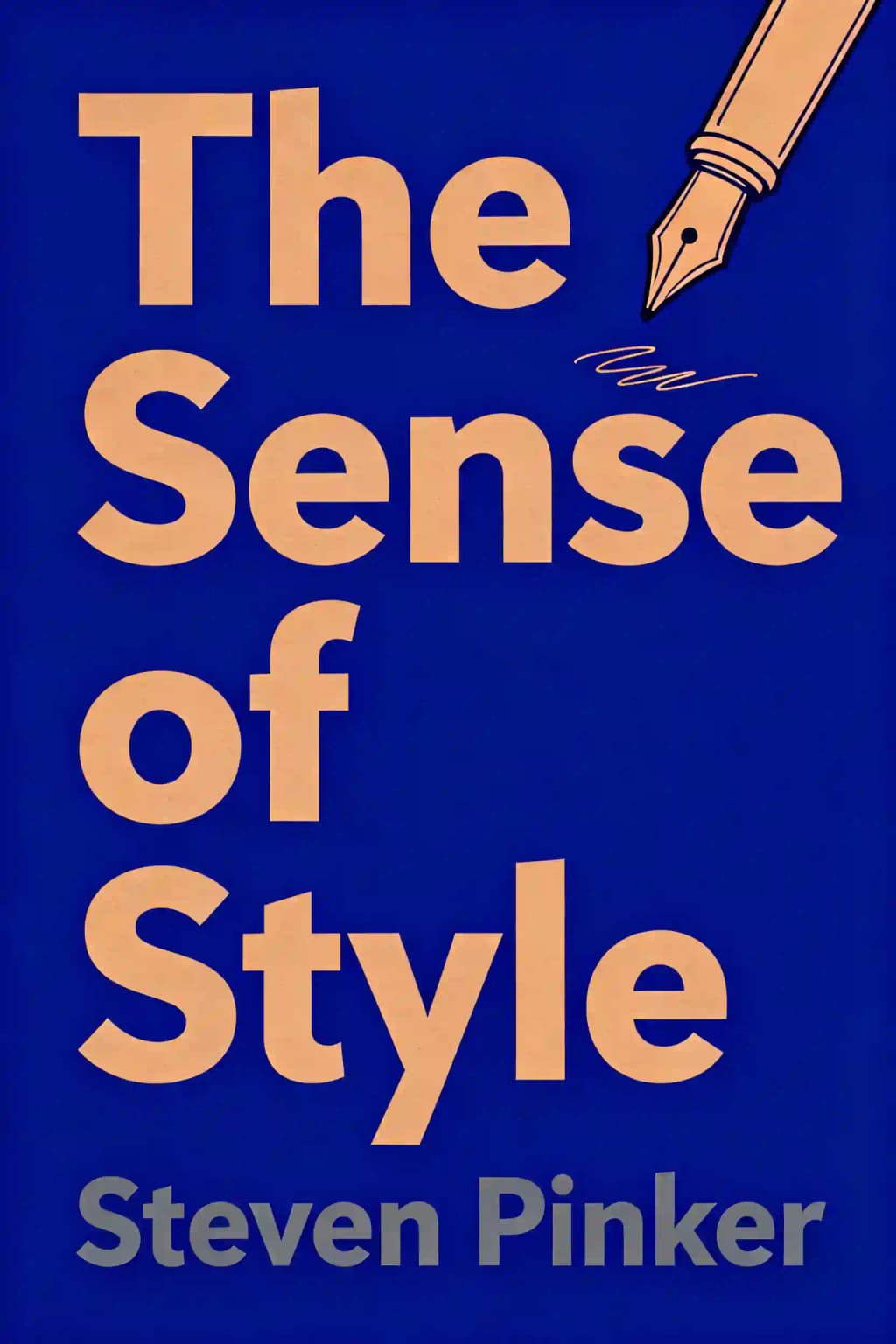
Steven Pinker's "The Sense of Style" has been called the thinking person's guide to writing in the 21st century. Unlike traditional style manuals that often present rigid rules without explanation, Pinker's approach combines cognitive science with linguistic insight to explain not just how to write well, but why certain techniques work. The book has garnered praise from literary giants like Patricia Cornwell and Richard Dawkins, who called it "the most cheerful and helpful book on language use I've read." Since its publication, it has become required reading in university writing programs and a favorite among professional writers, journalists, and anyone seeking to communicate with greater clarity and grace. What makes this book particularly valuable is that Pinker doesn't just tell us what to do-he shows us through his own crystalline prose exactly how good writing works.
Capitolo 2
The Cognitive Science Behind Effective Writing
At the heart of Pinker's approach lies a revolutionary insight: good writing isn't just about following arbitrary rules-it's about understanding how the human mind processes language. Traditional style guides often present writing as a matter of adhering to commandments handed down from on high, but Pinker reveals that many of these "rules" are actually linguistic superstitions with no basis in how language actually works. For instance, the prohibition against starting sentences with "and" or "but" has no linguistic foundation, and great writers have been doing it for centuries.
Instead, he argues that writing is fundamentally unnatural. While spoken language is instinctive-children naturally learn to speak without formal instruction-writing is a recent cultural invention that requires deliberate learning and practice. Archaeological evidence suggests writing emerged only about 5,000 years ago, making it a newcomer in human evolutionary history. The key difference lies in the relationship between communicators: speakers can see their listeners and adjust in real time based on facial expressions, questions, and body language, while writers must imagine invisible readers who cannot ask for clarification or signal confusion.
This cognitive challenge explains why even brilliant thinkers often produce terrible prose. When we know something well, we find it difficult to imagine what it's like not to know it-a phenomenon psychologists call "the curse of knowledge." This curse makes writers forget that readers don't share their background knowledge, vocabulary, or mental organization of the subject. A physicist might casually reference quantum entanglement without explaining it, while a lawyer might pepper documents with legal jargon that confuses laypeople. The result is prose that seems perfectly clear to the writer but baffles readers with unexplained terminology, missing context, and abstractions that never get grounded in concrete examples.
Overcoming this curse requires a deliberate mental effort to simulate the reader's mind-to step outside your own expertise and see your words through fresh eyes. Professional writers develop specific strategies to combat this tendency: they create detailed reader personas, share drafts with test readers from their target audience, and deliberately simplify complex concepts. This is why professional writers rely so heavily on editors and why revision is essential. Multiple drafts allow writers to catch instances where they've assumed too much knowledge or failed to explain crucial concepts. As Pinker notes, "The form in which thoughts occur to a writer is rarely the same as the form in which they can be absorbed by a reader." Successful writers learn to bridge this gap through careful attention to their readers' needs and perspectives.
The implications of this cognitive science approach extend beyond just clarity. Understanding how the brain processes information helps writers structure their work more effectively. For instance, readers better remember information presented in a logical sequence with clear transitions, and they process concrete examples more easily than abstract concepts. This knowledge can inform everything from sentence structure to paragraph organization.
Capitolo 3
Classic Style: The Secret to Engaging Prose
To combat the natural tendencies that lead to bad writing, Pinker recommends adopting what scholars Francis-Noel Thomas and Mark Turner call "classic style." This approach treats writing as a window onto reality rather than a performance of the writer's intelligence. In classic style, the writer has seen something in the world and is directing the reader's attention toward it, as if saying, "Look at that!" The writer assumes the role of a knowledgeable guide showing the reader something that already exists, rather than constructing or arguing for a particular viewpoint.
This approach contrasts sharply with the self-conscious, hedging prose that dominates academic and bureaucratic writing. The difference becomes apparent in how these styles present the same information:
Academic style: "It has been observed that the presence of significant quantities of dihydrogen monoxide in the cranial cavity is associated with adverse cognitive and physiological outcomes."
Classic style: "Water in the brain can kill you."
Technical report: "The implementation of precipitation monitoring protocols revealed statistically significant variations in annual moisture levels."
Classic style: "It rained more last year than the year before."
The classic stylist avoids several common writing traps. They eliminate meta-discourse (writing about the writing), such as "This paper will argue" or "In the following sections." They strip away unnecessary hedging phrases like "it seems that," "it could be argued," or "in most cases." They abandon professional narcissism ("in my humble opinion," "as I have demonstrated") and reject the excessive use of abstract nouns derived from verbs ("the implementation of," "the development of," "the establishment of").
Instead, classic style creates the impression of a natural conversation between writer and reader. The writer presents ideas as if pointing to something visible to both parties, using concrete language and direct statements. This approach works particularly well in explanatory writing, whether describing scientific concepts, historical events, or complex processes.
This doesn't mean classic style is simplistic or unsuited for sophisticated ideas. Rather, it assumes the reader is equally intelligent but simply lacks specific knowledge the writer possesses. A classic stylist writing about quantum physics or philosophical concepts still aims for clarity and directness, but without sacrificing technical precision where necessary.
Adopting classic style solves many common writing problems. It forces writers to clarify their thoughts before putting them on paper - if you can't explain something simply, you might not fully understand it yourself. It eliminates unnecessary jargon and abstractions that often mask incomplete thinking. Most importantly, it creates the sense that there's a real person behind the words - someone who has seen something worth sharing and is guiding you to see it too, much like a friend pointing out a constellation in the night sky.
The result is prose that respects readers' time and attention by presenting information clearly and directly, without the verbal smoke screens that often mask insecurity or fuzzy thinking. This approach creates engagement through transparency rather than complexity, making even difficult subjects more accessible and compelling.
Capitolo 4
The Architecture of the Sentence
While many writing guides focus on word choice or grammar rules, Pinker argues that understanding sentence structure is crucial for clear communication. Drawing on modern linguistics, he explains that sentences are not merely strings of words but hierarchical structures-trees with branches that connect related ideas.
This tree structure explains why some grammatically correct sentences are nearly impossible to understand. Consider: "The man the woman the child hugged kissed laughed." Though technically correct, this sentence overloads our mental processing because we must hold too many unresolved dependencies in memory before we can assemble the meaning.
Good writers intuitively avoid such constructions by following principles that align with how our brains process language. One key principle is "light before heavy"-placing short, simple phrases before longer, more complex ones. Another is "given before new"-introducing familiar information before novel concepts. These aren't arbitrary rules but cognitive principles that reduce the mental effort required to understand a sentence.
Understanding syntax also helps writers deploy the right construction for the right purpose. The much-maligned passive voice, for instance, isn't inherently bad-it's a tool that serves specific functions, like emphasizing the recipient of an action or maintaining thematic continuity. The problem isn't passive voice itself but its overuse or inappropriate use.
Pinker offers practical advice for untangling syntactic knots: When a sentence becomes too complex, break it into several shorter ones. When a modifier could attach to multiple phrases, rewrite to eliminate ambiguity. And when you need to present complex relationships, use parallel construction to help readers see the pattern.
By understanding the architecture of sentences, writers can build prose that guides readers smoothly from one idea to the next, without forcing them to backtrack or puzzle over meaning. This architectural approach treats sentences not as collections of rules to follow but as structures designed to perform specific cognitive functions.
Capitolo 5
Creating Coherent Prose: Beyond the Sentence
While well-constructed sentences form the foundation of good writing, coherent paragraphs and essays require additional skills. Pinker explains that readers desperately seek connections between sentences, so much so that they'll often supply coherence where none exists. This explains why disjointed sentences can create unintentional humor, as in the famous church bulletin blooper: "The ladies of the church have cast off clothing of every kind and they can be seen in the church basement on Friday afternoon."
Creating coherence requires managing what linguists call "arcs of coherence"-the threads that connect ideas across sentences and paragraphs. These include consistent references to entities (using pronouns and descriptions consistently), logical relationships between propositions (using appropriate connectives like "however" and "therefore"), and thematic consistency (organizing related concepts together).
One particularly powerful tool for creating coherence is what Joseph Williams calls "thematic strings." After introducing a topic, writers typically present multiple concepts that explain or comment on that topic. To maintain coherence, these concepts should be organized around recurring themes, with each reference clearly connected to previous mentions.
Pinker illustrates this principle by contrasting two historians writing about warfare. One jumps haphazardly between loosely related concepts-Clausewitz, monotheistic religions, the Enlightenment, Freud-without explaining their connections. The other clearly labels his themes (criminal warfare and disciplined warfare), explores each in consecutive paragraphs, and uses transparently related terms within each thematic string. The second approach creates a coherent narrative that readers can follow without struggling to connect the dots.
Coherence also depends on managing negation, proportion, and thematic consistency. Negation creates unique cognitive challenges-readers struggle to process statements that deny implausible propositions without context. Proportion requires balancing the space devoted to a point with its importance to the overall argument. And thematic consistency means maintaining clear connections between related concepts throughout a text.
By attending to these principles, writers can create prose that flows naturally from one idea to the next, carrying readers along without forcing them to stop and reconstruct the logical connections on their own.
Capitolo 6
Grammar Myths and Language Reality
Perhaps the most controversial aspect of Pinker's approach is his debunking of many traditional grammar rules. As both a linguist and a cognitive scientist, he distinguishes between genuine rules that enhance clarity and mere superstitions that impede good writing.
Many supposed grammar rules turn out to be myths with dubious origins: prohibitions against splitting infinitives or ending sentences with prepositions stem from misguided attempts to force English into Latin grammatical structures; the distinction between "which" and "that" in restrictive clauses was invented by a usage maven in 1926; and the idea that "between" applies only to two items while "among" requires three or more misunderstands how these prepositions actually function.
Pinker argues that language isn't governed by edicts from authorities but evolves through the collective choices of its users. This doesn't mean "anything goes"-standard written English follows conventions that signal a writer's care and competence. But these conventions should be understood as agreements among community members rather than eternal truths.
This perspective allows writers to distinguish between genuine errors that impede comprehension and harmless variations that reflect the natural evolution of language. It also explains why even the best writers throughout history have "violated" many supposed rules-these weren't errors but legitimate alternatives within the language's grammatical system.
For instance, the singular "they" ("Everyone returned to their seat") isn't a modern corruption but has appeared in English literature for centuries. It serves a useful function by providing a gender-neutral pronoun for indefinite antecedents. Similarly, beginning sentences with conjunctions like "and" or "but" has been common practice among great writers for hundreds of years, despite what elementary school teachers might claim.
This doesn't mean grammar doesn't matter. Clear communication depends on following the genuine patterns of English syntax. But Pinker encourages writers to distinguish between rules that enhance clarity and superstitions that merely signal membership in a linguistic in-group. The former deserve respect; the latter can often be safely ignored.
Capitolo 7
The Art of Word Choice
Beyond grammar and structure lies the art of choosing the right words-what traditional rhetoricians called "diction." Pinker approaches this topic not as a matter of rules but of judgment, balancing several competing values: precision, clarity, concreteness, familiarity, and appropriateness to context.
One key principle is avoiding unnecessary jargon and abstractions. Technical terms serve valuable functions within specialized fields, but writers often forget that readers may not belong to their "clubhouse." When technical terms are necessary, considerate writers explain them ("Arabidopsis, a flowering mustard plant") and provide concrete examples that ground abstractions in sensory experience.
This doesn't mean all writing should be simplified to the lowest common denominator. Pinker celebrates the richness of English vocabulary, where careful writers appreciate subtle distinctions between near-synonyms. When writers misuse "upmarket" words (like "simplistic" for "simple"), they reveal inattention to reading and pollute a common resource.
The solution isn't to avoid sophisticated vocabulary but to use it precisely and appropriately. A well-chosen technical term or literary word can express a concept more efficiently than a lengthy explanation in simple language. The key is ensuring that each word serves a purpose rather than merely signaling the writer's erudition.
Pinker also addresses the evolution of language through "verbing" (converting nouns to verbs) and other neologisms. While purists often object to innovations like "to contact" or "to impact," such conversions have been a natural part of English for centuries. About a fifth of English verbs began as nouns or adjectives. The question isn't whether such conversions are "allowed" but whether specific examples add useful tools to our linguistic toolkit or merely create redundant jargon.
This approach to word choice emphasizes judgment over rigid rules. Writers must constantly balance competing values-precision versus accessibility, novelty versus familiarity, concision versus elaboration-based on their purpose and audience. The goal isn't to follow a formula but to develop the judgment to make these trade-offs wisely.
Capitolo 8
The Psychology of Punctuation
Punctuation might seem like a minor technical matter, but Pinker reveals how it reflects deeper cognitive principles that shape how we process written language. Punctuation marks serve as sophisticated visual cues that guide readers through the syntactic structure of sentences, indicating pauses, connections, and hierarchical relationships among ideas. These marks essentially function as traffic signals in text, directing the flow of meaning and helping readers navigate complex thoughts.
Consider the Oxford comma-the comma before "and" in lists like "red, white, and blue." While style guides disagree about its necessity, Pinker shows how omitting it can create genuine ambiguity in numerous situations. For example, "I'd like to thank my parents, Ayn Rand and God" could be read as claiming that Ayn Rand and God are the writer's parents. The Oxford comma clarifies the intended meaning by separating each item in the list. Similar confusion can arise in more practical contexts, as in "The highlights of his global tour included encounters with Nelson Mandela, an 800-year-old demigod and a dilettante." The Oxford comma would clearly separate these into three distinct entities.
Similarly, the placement of quotation marks and periods reflects different cognitive priorities and cultural approaches to punctuation. The American convention of placing periods inside quotation marks ("like this.") prioritizes visual tidiness and typographical elegance, while the British convention ("like this".) prioritizes logical accuracy about what falls within the quotation. Neither is inherently superior-they simply reflect different trade-offs between competing values of aesthetics and precision. This difference exemplifies how punctuation conventions often emerge from balancing multiple cognitive and practical considerations.
Even seemingly arbitrary conventions serve sophisticated cognitive functions that aid comprehension. Paragraph breaks signal shifts in topic or perspective, helping readers chunk information into manageable units and providing natural pauses for processing complex ideas. Dashes create dramatic pauses or set off parenthetical information more emphatically than commas, allowing writers to create subtle hierarchies of emphasis. Semicolons connect closely related independent clauses, suggesting a relationship stronger than separate sentences but less integrated than clauses joined by coordinating conjunctions. Em dashes, colons, and parentheses each offer distinct ways of managing the flow of information and marking relationships between ideas.
Understanding these cognitive functions helps writers deploy punctuation strategically rather than mechanically following rules. Effective writers consider how different punctuation marks affect reading rhythm, emphasis, and clarity. For instance, the difference between "Stop walking" and "Stop, walking" demonstrates how a single comma can completely alter meaning. The goal isn't perfect adherence to arbitrary conventions but using visual signals to guide readers smoothly through complex ideas while maintaining clarity and impact. This understanding transforms punctuation from a set of mechanical rules into a sophisticated tool for precise communication.
Capitolo 9
The Ethics of Good Writing
Throughout "The Sense of Style," Pinker suggests that good writing isn't merely a technical skill but an ethical practice-a form of respect for readers and their cognitive limitations. This perspective transforms writing from a performance of the writer's intelligence into a service to readers seeking knowledge or insight. Whether in academic papers, business communications, or creative works, writers bear a responsibility to facilitate understanding rather than demonstrate their own sophistication.
The curse of knowledge-our difficulty imagining what it's like not to know something we know-creates a moral challenge as well as a cognitive one. Overcoming it requires a kind of empathy-stepping outside our own perspective to understand how others will receive our words. This empathetic leap doesn't just improve writing; it cultivates a valuable human quality that extends beyond the page. For instance, when explaining complex scientific concepts, writers must consciously bridge the gap between expert understanding and novice comprehension, much like a teacher adapting material for students at different levels.
Similarly, the classic style's emphasis on clarity and directness reflects an ethical commitment to honest communication. By presenting ideas as if pointing to visible objects in the world, writers implicitly invite readers to verify their claims rather than accepting them on authority. This transparency stands in stark contrast to styles that use obscurity to mask weak reasoning or lack of evidence. Academic writing often falls into this trap, using complex terminology and convoluted sentences when simpler expressions would suffice.
Even grammatical choices reflect ethical values. Using precise language shows respect for truth; avoiding unnecessary jargon demonstrates concern for accessibility; and maintaining coherence acknowledges readers' limited cognitive resources. These aren't merely stylistic preferences but expressions of how writers view their relationship with readers. For example, choosing active voice over passive construction often reveals a commitment to accountability and directness. Similarly, organizing paragraphs with clear topic sentences and logical transitions shows respect for readers' time and attention.
Good writing also involves ethical decisions about what to include and exclude. Writers must balance completeness against concision, deciding which details serve the reader's needs and which merely indulge the writer's desire to display knowledge. This requires honest self-reflection about whether each element truly serves the reader's understanding.
Pinker concludes by placing writing in this broader ethical context. Style matters not because following arbitrary rules signals membership in an educated elite, but because clear, coherent prose helps spread ideas, earns readers' trust, and adds beauty to the world. In this view, the effort to master good writing isn't merely practical but a contribution to human flourishing-an endeavor that enriches both writer and reader through the shared pursuit of understanding. Good writing becomes an act of generosity, sharing knowledge in a way that respects and empowers readers rather than intimidating or excluding them.
Capitolo 10
The Practical Path to Better Writing
Pinker's approach to improving writing is refreshingly practical. Rather than memorizing rules or striving for an unattainable perfection, he recommends specific strategies that align with how our minds actually work.
First, he emphasizes the importance of reading good prose and reverse-engineering its techniques. Good writers are invariably avid readers who have absorbed a vast inventory of words, idioms, constructions, and rhetorical devices. By reading attentively-noticing how skilled writers construct sentences, organize paragraphs, and maintain coherence-aspiring writers develop that elusive "ear" for good prose that no rulebook can provide.
Second, he stresses the value of revision. Few writers can produce coherent prose in a single pass because too many things must go right simultaneously. Instead, most skilled writers get their thoughts on the page first, then revise extensively to make sentences grammatical, graceful, and transparent. This multi-stage process allows writers to focus on different aspects of the task sequentially rather than juggling all concerns simultaneously.
Third, he recommends getting feedback from actual readers. Social psychologists have found that we're overconfident about inferring what others think, so even showing your draft to someone who isn't your target audience helps break the curse of knowledge. Each reviewer brings their own biases, so the goal isn't to implement every suggestion but to identify patterns in feedback that reveal where your prose isn't achieving its intended effect.
Finally, he suggests showing drafts to yourself after time has passed. The temporal distance helps you read your own writing with fresh eyes, noticing gaps in logic, unclear references, or awkward constructions that weren't apparent when the ideas were fresh in your mind.
These practical strategies demystify the writing process. Rather than presenting good writing as an innate talent or the result of following arcane rules, Pinker shows how it emerges from specific cognitive skills that anyone can develop through deliberate practice. This approach makes writing more accessible while acknowledging the genuine challenges involved in transforming complex thoughts into clear prose.