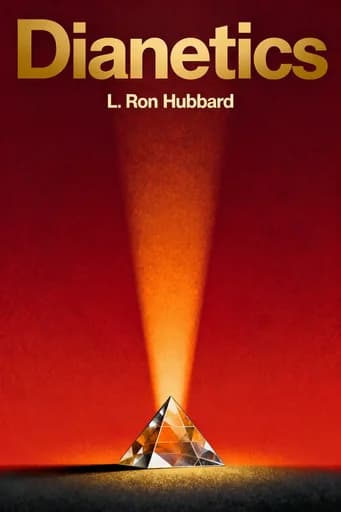
Dianetics - the publishing phenomenon that transformed mental health thinking, selling 20+ million copies and spawning nationwide "clubs." What mental breakthrough captivated NASCAR sponsors, topped bestseller lists 40 years after publication, and redefined time itself as "After Dianetics"?
Lafayette Ronald Hubbard is the author of Dianetics: The Modern Science of Mental Health and a former American writer who spent decades developing his theories on the human mind and mental health. Born in 1911 in Tilden, Nebraska, Hubbard began his career as a prolific pulp fiction writer in the 1930s and 40s, publishing stories across multiple genres including science fiction and horror, before turning his focus to psychology and self-improvement.
Published in 1950, Dianetics introduced Hubbard's theories on mental health and personal development, presenting what he called "auditing" techniques designed to address traumatic memories and achieve mental clarity. The book's success led to the establishment of the Hubbard Dianetic Research Foundation and later evolved into the founding of the Church of Scientology in 1954.
Hubbard continued to develop his ideas, producing more than 5,000 writings and 3,000 recorded lectures on Dianetics and Scientology throughout his career. Dianetics became a major commercial success and has been translated into more than 50 languages, establishing Hubbard as a controversial but influential figure in alternative approaches to mental health and self-improvement.
Dianetics: The Modern Science of Mental Health by L. Ron Hubbard presents a methodology for understanding and improving mental health through addressing what Hubbard calls the "reactive mind." Published in 1950, the book claims that traumatic memories called "engrams" stored in the unconscious mind cause psychological and physical ailments. Hubbard proposes a counseling technique called "auditing" to eliminate these engrams and achieve a superior mental state called "Clear."
L. Ron Hubbard was an American author and science fiction writer who founded Dianetics and later Scientology. He claimed to have developed Dianetics from personal experience, Eastern philosophy, and psychoanalytic theory while researching the human mind. Hubbard stated he isolated the "dynamic principle of existence"—survival—and discovered the source of mental aberrations. He wrote Dianetics to provide a comprehensive handbook for applying his discoveries to improve mental and physical health.
Dianetics appeals to readers interested in alternative approaches to mental health, self-improvement seekers, and those curious about the foundational text of Scientology. The book targets individuals looking for explanations of psychological problems and promises of achieving superior mental functioning. However, potential readers should note that Dianetics has been widely criticized by medical and scientific professionals as pseudoscience lacking empirical evidence and is primarily studied today for its cultural and historical significance.
Dianetics remains culturally significant as the foundation of Scientology, but its scientific claims have been thoroughly debunked by medical professionals and researchers. The book lacks empirical evidence and presents pseudoscientific theories about mental health that contradict established psychology and medicine. It may be worth reading for those studying religious movements, cult psychology, or controversial self-help literature, but should not be considered a legitimate mental health resource or substitute for evidence-based psychological treatment.
According to L. Ron Hubbard in Dianetics, the reactive mind is an unconscious portion of the mind that operates on pure stimulus-response mechanisms and stores traumatic memories. Unlike the "analytic mind" which Hubbard claimed functions perfectly, the reactive mind cannot think rationally or make distinctions. Hubbard identified this reactive mind as the single source of all mental aberrations, psychosomatic illnesses, and irrational behavior, claiming it feeds incorrect data to the otherwise perfect analytical mind.
Engrams are traumatic memory recordings that L. Ron Hubbard describes in Dianetics as being stored in the reactive mind during moments of unconsciousness or pain. Unlike regular memories, engrams supposedly contain complete sensory recordings of traumatic experiences and can be restimulated later in life, causing psychological problems, irrational behavior, and physical ailments. Hubbard claimed that identifying and clearing these engrams through Dianetic auditing would eliminate their negative effects and cure associated conditions.
The Clear state is a superhuman condition that L. Ron Hubbard promises readers can achieve through Dianetics auditing. Hubbard claimed that Clears would have perfectly functioning minds, superior IQ scores, photographic memory, and freedom from psychosomatic illnesses ranging from poor eyesight to cancer. He predicted Clears would become the world's new aristocracy, though notably admitted he had not achieved this state himself. The concept remains central to Scientology doctrine despite lacking scientific verification.
Dianetics by L. Ron Hubbard centers on three main discoveries: the dynamic principle of existence (survival as the sole human motivation), the reactive mind as the source of all aberration, and Dianetic therapy as the cure. The book divides the mind into analytical and reactive components, introduces engrams as traumatic memory recordings, and presents the Clear state as the goal. Hubbard also outlines four "dynamics" or survival urges spanning self, family, groups, and mankind.
L. Ron Hubbard describes four dynamics in Dianetics as fundamental survival urges that motivate all human behavior.
Hubbard positions survival as the single driving force behind human existence, though critics note this framework oversimplifies human motivation and ignores evolutionary perspectives.
Dianetic auditing is the counseling process described in Dianetics where a trained "auditor" helps individuals recall and process traumatic memories called engrams. During auditing sessions, the auditor asks questions to guide the subject through past experiences stored in the reactive mind. Hubbard claimed this process would eliminate engrams' negative effects and eventually achieve the Clear state. The technique resembles psychoanalytic methods but lacks scientific validation and has been criticized as potentially harmful by mental health professionals.
Dianetics has been extensively criticized by scientists and medical professionals as pseudoscience lacking empirical evidence and proper scientific methodology. Critics note that Hubbard's claims about curing physical ailments like cancer, arthritis, and poor eyesight through mental processes are unsupported and dangerous. The book uses superficially scientific language without rigorous research or peer review. Mental health experts warn that Dianetic auditing is not a substitute for evidence-based psychological treatment and may delay proper medical care for serious conditions.
Dianetics: The Modern Science of Mental Health is the foundational text that launched the movement L. Ron Hubbard later formalized as the religion of Scientology. Published in 1950, Dianetics focused on mental health techniques, while Scientology expanded into spiritual matters addressing the human soul. Scientologists refer to Dianetics as "Book One" and consider it essential scripture. The auditing techniques, terminology like Clear, and core concepts from Dianetics remain central to Scientology practice and doctrine today.
Senti il libro attraverso la voce dell'autore
Trasforma la conoscenza in spunti coinvolgenti e ricchi di esempi
Cattura le idee chiave in un lampo per un apprendimento veloce
Goditi il libro in modo divertente e coinvolgente
Humans are inherently good - oriented naturally toward creation.
Societies flourish when pleasure and survival are aligned.
The primary goal of all human behavior is survival.
What we perceive as 'evil' behaviors are actually manifestations of pain.
The analytical mind functions as a flawless computer.
Scomponi le idee chiave di Dianetics in punti facili da capire per comprendere come i team innovativi creano, collaborano e crescono.
Vivi Dianetics attraverso narrazioni vivide che trasformano le lezioni di innovazione in momenti che ricorderai e applicherai.
Chiedi qualsiasi cosa, scegli il tuo stile di apprendimento e co-crea intuizioni che risuonano davvero con te.

Creato da alumni della Columbia University a San Francisco
"Instead of endless scrolling, I just hit play on BeFreed. It saves me so much time."
"I never knew where to start with nonfiction—BeFreed’s book lists turned into podcasts gave me a clear path."
"Perfect balance between learning and entertainment. Finished ‘Thinking, Fast and Slow’ on my commute this week."
"Crazy how much I learned while walking the dog. BeFreed = small habits → big gains."
"Reading used to feel like a chore. Now it’s just part of my lifestyle."
"Feels effortless compared to reading. I’ve finished 6 books this month already."
"BeFreed turned my guilty doomscrolling into something that feels productive and inspiring."
"BeFreed turned my commute into learning time. 20-min podcasts are perfect for finishing books I never had time for."
"BeFreed replaced my podcast queue. Imagine Spotify for books — that’s it. 🙌"
"It is great for me to learn something from the book without reading it."
"The themed book list podcasts help me connect ideas across authors—like a guided audio journey."
"Makes me feel smarter every time before going to work"
Creato da alumni della Columbia University a San Francisco

Ottieni il riassunto di Dianetics in formato PDF o EPUB gratuito. Stampalo o leggilo offline quando vuoi.
Imagine discovering that your lifelong struggles with anxiety, depression, and even physical ailments aren't permanent parts of who you are, but rather recordings of past traumas that could be completely erased. This revolutionary idea forms the foundation of Dianetics, which proposes that anyone can achieve optimal mental functioning-a state called "Clear"-by eliminating unconscious trauma recordings called "engrams." Despite the controversy surrounding its author and the religious movement that later evolved from it, Dianetics has sold over 20 million copies worldwide and continues to influence millions who seek to understand the hidden mechanisms of the mind. The book's enduring appeal lies in its audacious claim: that we all possess the potential for extraordinary mental clarity and emotional freedom once we address the hidden sources of our limitations.
Dianetics argues that survival drives all human behavior across four interconnected "dynamics": personal survival, survival through reproduction, survival through groups, and survival of humanity as a species. These dynamics reinforce each other, creating a complex web of motivations shaping our choices. When pleasure aligns with survival across these dynamics, societies flourish - as seen during the Renaissance, where artistic expression and scientific discovery created a virtuous cycle of growth. Conversely, when pleasure becomes stigmatized, as after Rome's fall, societies decline into darkness. According to Dianetics, the most successful solutions provide the greatest good across all survival dynamics. Yet many make seemingly irrational decisions. Why fear public speaking more than death? Why sabotage thriving relationships? These behaviors stem from survival-oriented commands buried in our unconscious - once helpful during trauma but now limiting our potential. This perspective reveals something profound: humans are inherently good, naturally oriented toward creation and growth. "Evil" behaviors are manifestations of pain, not our natural state. Remove these pain recordings, and what emerges is a rational being oriented toward survival and creation.
Dianetics divides the mind into three components. The analytical mind functions like a flawless computer, storing every perception-sight, sound, smell, taste, sensation-with perfect accuracy in standard memory banks that operate continuously except during "unconsciousness." While most experiences remain accessible in memory, the analytical mind cannot reach those recorded during pain or unconsciousness-these become trapped in the reactive mind. The reactive mind operates through total identity (A=A=A=A), where every perception during trauma becomes equal to all others. Like a fish injured in yellow, brackish water that later flees from similar water even without danger, humans form irrational associations through this mechanism. The somatic mind executes physical solutions determined by either the analytical or reactive mind, controlling bodily functions and implementing whatever commands it receives. This model explains why we sometimes act against our interests. When circumstances similar to original trauma "restimulate" an engram, the reactive mind temporarily overrides the analytical mind, forcing us to follow irrational commands recorded during moments of pain or unconsciousness.
The cornerstone of Dianetics is the engram - a complete recording of every perception present during moments of pain and unconsciousness. Unlike normal memories, engrams aren't consciously accessible but powerfully influence us when "restimulated" by similar circumstances. Consider a pregnant woman bumping into a table while her husband shouts, "Watch where you're going! You're always so clumsy!" Dianetics claims this entire experience is recorded by the fetus, including physical pain, sounds, and words. Later in life, similar situations can activate this engram, triggering physical pain, emotional reactions, or compulsive behaviors. Engrams come in several types: counter-survival engrams contain messages hindering survival; pro-survival engrams appear helpful but aren't; compassion engrams form when care is shown during pain, linking illness with receiving love; painful emotion engrams involve significant loss or rejection. What makes engrams powerful is their command value - the reactive mind interprets their content as literal instructions. A prenatal engram containing "I can't see straight" might manifest as vision problems; "I'm stuck" could create feelings of being trapped. Dianetics claims these engrams are the single source of all psychosomatic illnesses and irrational behaviors, and that "erasing" them can dramatically improve mental and physical health.
Dianetics defines "Clear" as a state free from engrams, resulting in freedom from psychosis, neurosis, compulsions, repressions, and psychosomatic illnesses. A Clear person demonstrates superior intelligence and enjoys a vigorous life with enhanced sensory perception. Clears possess "returning"-the ability to fully relive past experiences with all original sensations-and imagination that functions completely across all senses. Their rationality is flawless, as the human mind only makes errors when aberrated or working with incorrect data. Most significantly, Clears operate from self-determination rather than compulsion. They aren't merely "adjusted" but truly free to act rationally based on their own assessment. The gap between a Clear and a "normal" person parallels the difference between that normal person and a mental patient-representing a dramatic improvement in capability. This Clear state embodies Dianetics' vision of optimal human potential-individuals freed to use their natural abilities without limitations imposed by past traumas, suggesting we typically operate at only a fraction of our true capabilities.
Dianetics therapy involves an "auditor" guiding a patient to locate and eliminate engrams. The process uses "reverie"-a relaxed yet fully conscious state unlike hypnosis-where the individual maintains complete awareness throughout the session. The auditor guides the patient along their "time track" to find moments of pain and unconsciousness. Through repeated recounting, the emotional charge diminishes until the engram "erases," becoming a standard memory without aberrative power. The therapy follows key principles: non-judgmental removal of engram content; adherence to the "Auditor's Code"; addressing recent pain before earlier engrams; working with the mind's natural "file clerk"; and using techniques like repetition and "flash answers" to uncover engrams. Challenges include commands embedded in engrams that create resistance: "holders," "bouncers," "deniers," "groupers," and "misdirectors." The "ally computation"-an unconscious belief that engrams are necessary for survival-presents particular difficulty. Dianetics claims anyone can achieve Clear through persistent therapy, typically requiring between 100 and 1,000 hours depending on case complexity.
Since its 1950 publication, Dianetics has had a profound and controversial impact on our understanding of the human mind. The book sold out its first printing within weeks, remained on bestseller lists for months, and eventually spawned Scientology. Practitioners report transformative effects across various life domains - from improved relationships to enhanced creativity and decision-making. The book's enduring appeal lies in its promise that psychological problems aren't permanent conditions but can be resolved through specific techniques. However, the scientific community has largely rejected Hubbard's claims about prenatal engrams and the concept of Clear, citing lack of empirical evidence and reliance on anecdotal reports. The development of Scientology has further complicated its reception. Despite these controversies, elements of Dianetics methodology have influenced various self-help approaches, with its focus on resolving traumatic memories finding parallels in modern trauma therapy. The book concludes with Hubbard's challenge: "For God's sake, get busy and build a better bridge" - representing the ongoing human quest to bridge the gap between our current state and our potential.