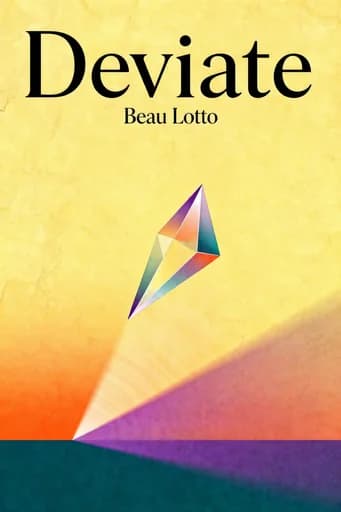
In "Deviate," neuroscientist Beau Lotto reveals why your brain doesn't see reality - it creates it. Endorsed by Pixar creatives and Harvard scholars, this mind-bending journey explains "dressgate" and transforms uncertainty into innovation. What if your perception is your greatest untapped resource?
Beau Lotto, Ph.D., is a neuroscientist, professor, and bestselling author of Deviate: The Science of Seeing Differently, a groundbreaking exploration of perception, creativity, and innovation.
A professor at the University of London and visiting scholar at New York University, Lotto merges decades of neuroscience research with real-world applications through his neuro-design studio, Lab of Misfits, which has partnered with organizations like Cirque du Soleil and Microsoft. His work on augmented reality via Ripple Inc.—holding five patents in the field—reinforces his authority in bridging science and technology.
Lotto’s earlier books, Why We See What We Do and Why We See What We Do Redux, established him as a leading voice in perceptual neuroscience. A three-time TED speaker with over 9 million views, he has presented at Davos, Google Zeitgeist, and Burning Man, and his insights are regularly featured in National Geographic, BBC, and PBS.
Deviate challenges readers to rethink reality through the lens of neural adaptation, drawing from Lotto’s research on human and even bumblebee behavior. The book’s concepts underpin educational programs like iScientist, which produced the world’s youngest peer-reviewed researchers. His talks and tools are utilized by Fortune 500 companies and educators alike, cementing his legacy as a pioneer in transforming how we perceive uncertainty.
Deviate by Beau Lotto explores how perception shapes reality, arguing that our brains construct experiences based on past contexts rather than objective truth. Blending neuroscience and psychology, Lotto uses optical illusions, historical examples, and experiments to show how embracing uncertainty and reinterpreting biases unlock creativity. The book challenges readers to question assumptions and adopt a mindset open to innovation.
Beau Lotto is a renowned neuroscientist, NYU scholar, and TED speaker with over 20 years of research on perception and adaptability. Founder of the Lab of Misfits, he merges academic rigor with public engagement, advising businesses and educators on leveraging perceptual science for innovation. His work focuses on how humans navigate uncertainty through biological and psychological frameworks.
This book suits creatives, professionals, and anyone seeking to overcome rigid thinking patterns. Entrepreneurs, educators, and neuroscience enthusiasts will gain actionable strategies for fostering adaptability. Critics note its broad appeal but caution that some sections may oversimplify complex concepts.
Yes—Deviate offers fresh perspectives on perception, praised for its engaging storytelling and practical insights. Reviewers compare it to Kahneman’s Thinking, Fast and Slow, calling it a “groundbreaking guide” to creativity. However, a minority critique its occasional lack of empirical depth.
Key ideas include:
While both explore cognitive biases, Deviate emphasizes perceptual reinterpretation over decision-making errors. Lotto’s interactive style (using illusions and exercises) contrasts with Kahneman’s analytical approach. Kirkus Reviews notes Deviate’s focus on “ecology of perception” as its unique contribution.
Some reviewers argue Lotto’s claims lack sufficient empirical backing, particularly around educational reforms. Others find the prose overly elliptical, though most praise its accessibility. Despite this, the book maintains a 4/5 rating on platforms like Goodreads.
The book provides tools to reframe challenges, enhancing problem-solving in careers and relationships. For example, recontextualizing workplace conflicts or creative blocks through perceptual “ecologies” can reveal novel solutions. Lotto’s exercises, like analyzing optical illusions, train flexible thinking.
These methods aim to build habits of mindful observation and creative deviation.
Senti il libro attraverso la voce dell'autore
Trasforma la conoscenza in spunti coinvolgenti e ricchi di esempi
Cattura le idee chiave in un lampo per un apprendimento veloce
Goditi il libro in modo divertente e coinvolgente
The point is that the brain didn’t evolve to see the world accurately.
Our brains don't give us access to reality.
All information, in its raw form, is inherently meaningless.
Seeing reality accurately isn't necessary for survival and might even hinder it.
Our brains are designed to adapt through active engagement with our environment.
Scomponi le idee chiave di Deviate in punti facili da capire per comprendere come i team innovativi creano, collaborano e crescono.
Distilla Deviate in rapidi promemoria che evidenziano i principi chiave di franchezza, lavoro di squadra e resilienza creativa.

Vivi Deviate attraverso narrazioni vivide che trasformano le lezioni di innovazione in momenti che ricorderai e applicherai.
Chiedi qualsiasi cosa, scegli la voce e co-crea spunti che risuonino davvero con te.

Creato da alumni della Columbia University a San Francisco
"Instead of endless scrolling, I just hit play on BeFreed. It saves me so much time."
"I never knew where to start with nonfiction—BeFreed’s book lists turned into podcasts gave me a clear path."
"Perfect balance between learning and entertainment. Finished ‘Thinking, Fast and Slow’ on my commute this week."
"Crazy how much I learned while walking the dog. BeFreed = small habits → big gains."
"Reading used to feel like a chore. Now it’s just part of my lifestyle."
"Feels effortless compared to reading. I’ve finished 6 books this month already."
"BeFreed turned my guilty doomscrolling into something that feels productive and inspiring."
"BeFreed turned my commute into learning time. 20-min podcasts are perfect for finishing books I never had time for."
"BeFreed replaced my podcast queue. Imagine Spotify for books — that’s it. 🙌"
"It is great for me to learn something from the book without reading it."
"The themed book list podcasts help me connect ideas across authors—like a guided audio journey."
"Makes me feel smarter every time before going to work"
Creato da alumni della Columbia University a San Francisco

Ottieni il riassunto di Deviate in formato PDF o EPUB gratuito. Stampalo o leggilo offline quando vuoi.
What if I told you that 90% of what you're seeing right now isn't coming from your eyes? That the world you perceive is less like a photograph and more like a hallucination your brain agrees to believe? This isn't philosophical musing-it's neuroscience. When that infamous dress broke the internet in 2015, dividing people into warring camps of blue/black versus white/gold, it wasn't just a quirky viral moment. It was a crack in the facade of objective reality. Friends and family saw completely different colors in the same image, which felt deeply unsettling because color seems so undeniably real. Yet this viral sensation revealed something profound: your brain doesn't show you reality. It constructs a useful fiction based on your past, and that fiction is what you call "seeing." Only about 10% of visual information comes from your eyes-the rest is your brain filling in gaps, making predictions, and creating meaning from meaningless light particles. This isn't a bug in human perception; it's the feature that made us the most adaptable species on Earth.