Capitolo 1
Faith's Ultimate Rebellion: When Conviction Defies Tyranny
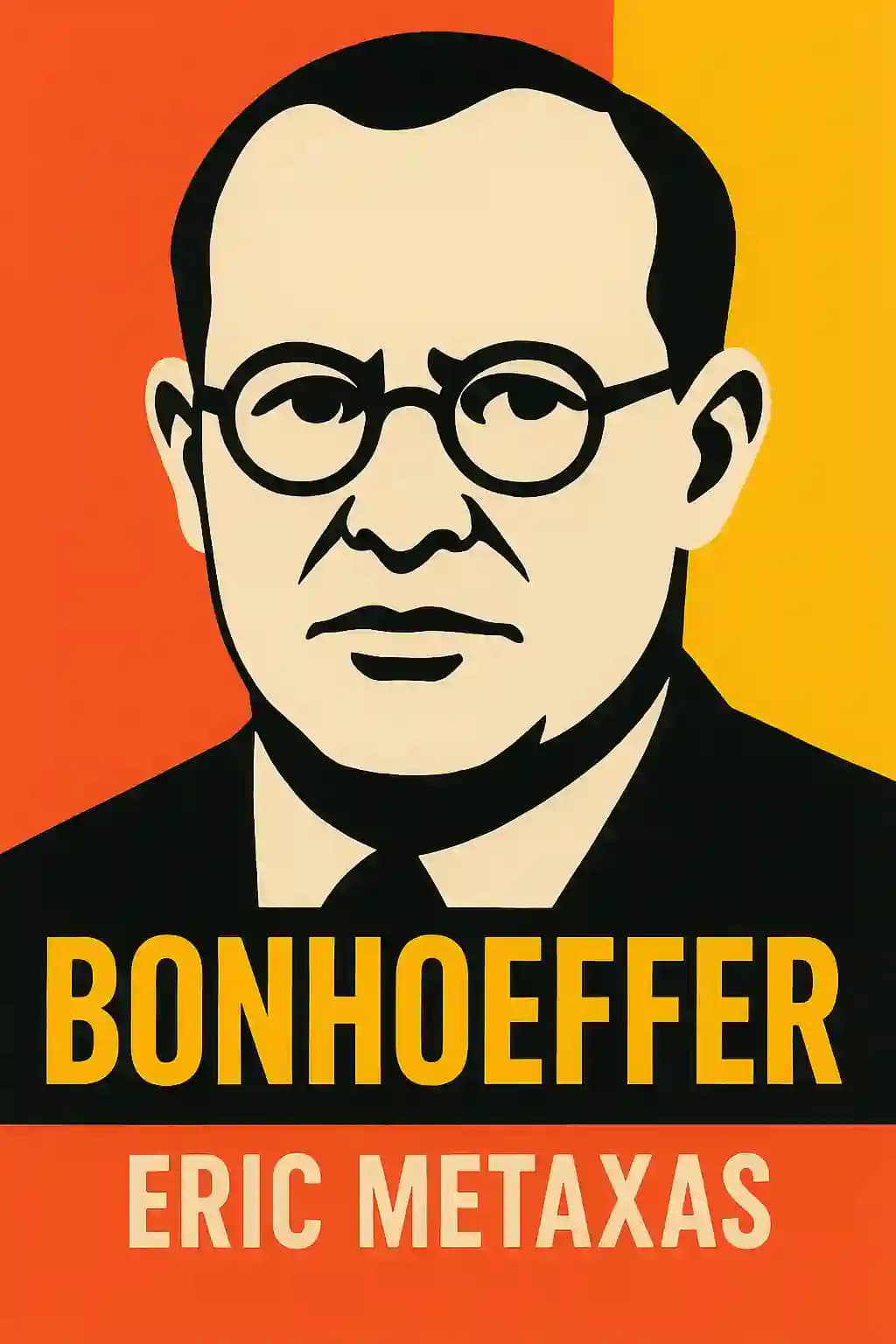
In Hitler's Germany, one man's faith became the Third Reich's greatest threat. Dietrich Bonhoeffer - Lutheran pastor, brilliant theologian, and ultimately martyr - chose the path of resistance when compliance would have been infinitely easier. Eric Metaxas masterfully resurrects this towering figure whose theological works are still studied in seminaries worldwide, revealing how Bonhoeffer's journey from pacifism to joining a plot to assassinate Hitler represents one of history's most profound moral evolutions.
The book, which spent over a year on the New York Times bestseller list and sold over one million copies, doesn't just chronicle a hero's life - it challenges readers to examine their own moral courage. What would you sacrifice for your deepest convictions?
Metaxas doesn't just tell Bonhoeffer's story; he invites us into the agonizing decisions of a man who concluded that "silence in the face of evil is itself evil." In our age of moral compromise and comfortable faith, Bonhoeffer's radical commitment stands as both inspiration and indictment.
Capitolo 2
The Making of a Theologian: Family and Early Influences
The Bonhoeffer household was an extraordinary cradle for intellectual and spiritual development. Born in 1906 to Karl and Paula Bonhoeffer, young Dietrich grew up in a family that valued both rigorous thinking and genuine kindness. With his flaxen hair and fair complexion, Dietrich stood out among his darker-haired siblings, but it was his gentle chivalry that truly distinguished him. Even as a child, he demonstrated remarkable generosity, ensuring his sisters never went without.
Karl Bonhoeffer, a renowned psychiatrist and neurologist, brought empirical thinking and skepticism to the household. When the family moved to Berlin in 1912 for Karl's prestigious academic appointment, his influence became even more pronounced. He stood firmly against the tide of psychoanalytic theories sweeping through German academia, insisting on observable evidence rather than speculative theories. "If you can't see it or measure it," he would say, "be very cautious about claiming it exists."
Despite Karl's scientific skepticism, religion thrived in the Bonhoeffer home through Paula's quiet devotion and the influence of their governess. This created a fascinating dynamic where faith and reason coexisted without conflict. The family didn't attend church regularly, but Christianity's cultural and ethical dimensions permeated daily life. The children absorbed biblical stories, hymns, and prayers as naturally as they did German literature and music.
Music, in particular, became central to Dietrich's development. He displayed remarkable aptitude for piano from an early age, playing with such skill that a professional career seemed possible. Saturday musical evenings were family traditions, with each child performing. Even during wartime scarcity, music remained essential to the Bonhoeffers, providing both cultural enrichment and emotional sustenance. This deep appreciation for music would later influence Dietrich's theological understanding of harmony, community, and beauty.
The family's move to the prestigious Grunewald district in 1916 placed them in Berlin's intellectual heart. Their grand home, surrounded by beautiful gardens, became a hub for stimulating conversation and artistic appreciation. Young Dietrich absorbed everything, his curiosity seemingly boundless. What might have been merely a privileged upbringing became, through the Bonhoeffer parents' intentionality, a training ground for intellectual integrity and moral courage.
Capitolo 3
Shadows of War: Loss and Vocation
The Great War cast its long shadow over Dietrich's adolescence. While initial reactions to Germany's declaration of war were euphoric among many, the Bonhoeffers maintained a more sober perspective. Unlike the prevailing nationalistic fervor, they recognized the profound dangers that lay ahead. This measured response to patriotic excess would later characterize Dietrich's approach to Nazi Germany's jingoistic propaganda.
Tragedy struck the family when Dietrich's older brother Walter died on the Western Front in 1918. His death devastated the family, particularly their mother Paula, whose health and daily routines were profoundly affected for years. For young Dietrich, this loss marked his first serious confrontation with mortality and suffering. The family turned to their faith for comfort, finding solace in hymns despite overwhelming sorrow. This experience of grief would later inform Bonhoeffer's theological reflections on suffering and God's presence in human pain.
As Germany faced defeat and the collapse of the Kaiser's regime, unprecedented turmoil engulfed the nation. The Weimar Republic emerged chaotically amid Communist uprisings and the infamous "stab-in-the-back" theory that blamed Germany's defeat on internal betrayal. The harsh terms of the Treaty of Versailles further outraged Germans, sowing seeds for future conflict. Against this backdrop of national humiliation and uncertainty, fourteen-year-old Dietrich made his surprising announcement in 1920: he intended to become a theologian.
This decision provoked skepticism, particularly from his scholarly brothers. During spirited family debates, his brother Klaus dismissed the church as feeble and irrelevant. Dietrich's response was prophetic: "If the church is feeble, then I shall have to reform it!" Despite familial skepticism, Dietrich's theological path was solidified through his connection with Pastor Hermann Priebe's confirmation classes and his daily use of his late brother Walter's Bible.
What's remarkable about Bonhoeffer's vocational choice is that it wasn't born from naive piety or sheltered religiosity. He had witnessed war's devastation, his nation's humiliation, and his family's grief. He had grown up in a household that valued critical thinking and questioned empty traditions. His decision to study theology emerged not despite these experiences but because of them-a conviction that the gospel must speak meaningfully to a world in crisis.
Capitolo 4
Academic Brilliance and Spiritual Awakening
Bonhoeffer's academic journey began at Tubingen University, where he quickly distinguished himself as an exceptional theological mind. Despite the political and economic chaos of post-war Germany, he immersed himself in student life, joining the Igel fraternity and even participating in covert military training with the Ulm Rifles Troop-a clever German maneuver around the Versailles Treaty's restrictions. This experience reflected both his sense of duty to his country and the complex reality of life under post-war constraints.
A fateful slip on ice led to the life-altering opportunity to study in Rome. This wasn't merely academic tourism but a profound spiritual awakening. In Rome, Bonhoeffer witnessed the Catholic Church's liturgical splendor and universal character, experiencing what he called "the church as church for the first time." This revelation of the church's universality would later fuel his theological breakthroughs and his steadfast opposition to Nazi ideology.
Upon returning to Berlin University, Bonhoeffer navigated a theological landscape dominated by giants like Adolf von Harnack, whose liberal approach to Christianity emphasized historical criticism and ethical teachings over supernatural elements. Yet Bonhoeffer was increasingly drawn to Karl Barth's revolutionary ideas, which reasserted God's transcendence and the primacy of divine revelation. Despite Harnack's personal admiration for Bonhoeffer's brilliance, the young theologian aligned himself with Barth's perspective, opposing theological liberalism that merely critiqued biblical texts instead of receiving them as divine revelation.
For his doctoral dissertation, Bonhoeffer chose to work under Reinhold Seeberg, focusing on the nature of the Church. His thesis, "Sanctorum Communio" (Communion of Saints), transcended mere historical study, defining the Church as "Christ existing as church-community." This work merged theological depth with philosophical insight, showcasing his intellectual independence and laying groundwork for his later ecclesiology.
What's striking about Bonhoeffer during these formative academic years is his refusal to separate intellectual rigor from spiritual commitment. While many scholars treated theology as an abstract discipline, Bonhoeffer insisted that theological truth must be lived. Even as he pursued academic excellence, he engaged in parish work, teaching children's classes and contemplating pastoral ministry. This integration of thought and practice would become his hallmark, challenging the artificial separation between theology and discipleship.
Capitolo 5
Barcelona and Beyond: Pastoral Formation
In 1928, following his theological instincts, Bonhoeffer moved to Barcelona to serve as an assistant pastor to the German congregation there. This decision reflected his growing conviction that theology must be grounded in the practical realities of church life. Surprisingly, his sermons attracted increasing attendance even during the heat-stricken summer when church participation typically declined. What drew people was not rhetorical flourish but his authenticity and depth.
Barcelona offered Bonhoeffer the opportunity to engage with people beyond academic circles. He developed a heart of empathy for the marginalized, seeking to understand the circumstances of those less fortunate around him. These experiences profoundly shaped his theological reflections and sermons, as he began to explore what would become defining aspects of his theology-particularly his understanding of grace and divine judgment.
A touching pastoral moment illustrates Bonhoeffer's empathetic approach. When counseling a grieving child over a beloved dog's death, he responded with theological sensitivity rather than dismissive platitudes. Respecting the child's belief in reunion with the pet in heaven, Bonhoeffer offered comfort while honoring the genuine sorrow. This ability to balance theological depth with pastoral care would characterize his ministry throughout his life.
During this period, Bonhoeffer also delivered three ambitious lectures for young German men. The first examined the enduring significance of prophecy; the second argued provocatively that Christianity centers on Christ himself rather than religious traditions or moral directives; and the third challenged Greek dualistic thought and identified humanism as a severe ideological threat. These early lectures laid groundwork for his future theological development, particularly his critique of religion that compartmentalizes faith rather than allowing Christ's complete claim over believers' lives.
Upon returning to Germany in 1929, Bonhoeffer encountered a nation increasingly disillusioned with the Weimar Republic and yearning for strong leadership. Navigating between academia and ministry, he completed his second thesis, "Act and Being," which sought to distinguish theology from philosophy through a framework of divine revelation. His social life flourished during this period, particularly through his profound friendship with Franz Hildebrandt, who would become a key ally during the church struggles against Nazi ideology.
Capitolo 6
American Sojourn: Encountering a Different Christianity
Bonhoeffer's journey to America in 1930-31 proved transformative, though not in ways he anticipated. Arriving at Union Theological Seminary in New York, he was struck by the vibrant chaos of Manhattan, a metropolis actively defying its economic slump post-crash. However, his sophisticated European theological training clashed with America's burgeoning liberal theology. He perceived a concerning departure from fundamental Christian tenets and what he considered insufficient scholarly rigor among students.
In letters home, Bonhoeffer critiqued American churches for reducing sermons to social and ethical teachings while sidelining the core Christian message of sin, forgiveness, and the gospel. The grand scope of church activities-from sports to social gatherings-reflected what he saw as a shift from spiritual to theological concerns. "In New York," he wrote, "they preach about virtually everything; only one thing is not addressed, or is addressed so rarely that I have as yet been unable to hear it, namely, the gospel of Jesus Christ, the cross, sin and forgiveness, death and life."
Yet amidst this critique, Bonhoeffer discovered authentic Christianity in Harlem's Abyssinian Baptist Church led by Dr. Adam Clayton Powell Sr. He was awestruck by the congregation's spiritual vitality and sincerity, which contrasted sharply with the more socially oriented white churches. Engaging deeply with this community, Bonhoeffer taught Sunday school and eagerly participated in church life. The experience opened his eyes to racial injustice and the hypocrisy of a nation that proclaimed brotherhood while enforcing segregation.
Through his friendship with French pacifist Jean Lasserre, Bonhoeffer also began serious engagement with pacifism, ecumenism, and questions about nationalism and war. These conversations challenged his previous assumptions and planted seeds that would later flourish in his commitment to peace and international Christian solidarity.
When Bonhoeffer returned to Germany after just ten months-cutting short his planned stay-he brought with him critical insights about American Christianity and a deepened commitment to authentic faith. He had seen both the dangers of reducing Christianity to social ethics without spiritual foundation and the power of genuine faith expressed through marginalized communities. These experiences would inform his growing resistance to the nationalistic Christianity emerging in Nazi Germany.
Capitolo 7
The Rise of Hitler and the Church's Capitulation
As Hitler rose to power in the early 1930s, Bonhoeffer recognized the fundamental threat posed by the Fuhrer Principle-the idea that the leader derives authority from himself rather than being accountable to higher moral principles. In a radio address cut short by authorities, Bonhoeffer warned that such leadership inevitably becomes idolatrous, transforming the leader into a misleader who views himself as the ultimate authority.
The Reichstag fire in February 1933 provided Hitler the pretext to consolidate power through emergency decrees that suspended civil liberties. The Enabling Act effectively dismantled democracy by channeling absolute control to Hitler. As Bonhoeffer observed, "Democracy was slaughtered by its own legal instruments." Within months, Germany transformed from a democracy into a totalitarian state.
Most alarming to Bonhoeffer was the German church's rapid capitulation to Nazi ideology. The "German Christians" movement emerged, attempting to merge Christianity with Nazi racial theories. They portrayed Jesus as an Aryan hero fighting against Jewish influence, sought to eliminate the Old Testament from Christian scripture, and replaced church symbols with swastikas. As Bonhoeffer noted with horror, "The question is really: Germanism or Christianity?"
The introduction of the Aryan Paragraph into church law, excluding Jewish Christians from ministry, became a defining crisis. While most church leaders accommodated this racial policy for perceived benefits, Bonhoeffer articulated three essential roles for the church regarding the state: questioning state actions that create too much or too little law and order, aiding victims of state action, and, when necessary, direct action against the state to stop it from exercising too much or too little law and order.
This third role was particularly radical-Bonhoeffer was suggesting that the church might need to "put a spoke in the wheel" of the state itself. He insisted that the church must stand in solidarity with Jews, not merely out of humanitarian concern but because abandoning them would violate the church's very identity as the body of Christ. "If the church excludes the Jewish Christians, it ceases to be the church of Christ," he declared.
The Bonhoeffer family experienced Nazi antisemitism directly when Dietrich's Jewish brother-in-law faced intimidation during the April 1 boycott of Jewish businesses. While many Germans complied with the boycott out of fear or conviction, Dietrich's grandmother Julie Bonhoeffer demonstrated the family's moral courage by boldly defying SA intimidation while shopping, declaring, "I shall buy where I wish."
Capitolo 8
The Confessing Church and Finkenwalde Seminary
As the German church increasingly aligned with Nazi ideology, Bonhoeffer became instrumental in establishing the Confessing Church-a movement of pastors and congregations committed to maintaining Christian orthodoxy against Nazi influence. The movement gained theological clarity through the Barmen Declaration of 1934, which rejected false doctrines subordinating sections of life to powers contrary to Christ's lordship.
Recognizing the need for ministers trained outside Nazi-controlled seminaries, the Confessing Church established alternative institutions. In 1935, Bonhoeffer was appointed to lead one such seminary, first at Zingst and then at Finkenwalde. This represented his vision for a monastic community rooted in true discipleship according to Jesus' Sermon on the Mount. Despite skepticism from those wary of anything resembling Catholicism, Bonhoeffer believed in the need for spiritual renovation within Lutheran theology.
The seminary at Finkenwalde embodied Bonhoeffer's radical commitment to authentic Christian community. The daily routine emphasized collective and individual spiritual disciplines drawn from diverse traditions. Morning and evening services framed each day, with intense periods of meditation on scripture encouraged. Bonhoeffer's approach was not authoritarian but promoted a servant-leader ethos, as demonstrated by his willingness to perform humble kitchen duties alongside his students.
Bonhoeffer approached preaching as a divine calling, emphasizing that it was more than an intellectual venture-it was an act of revelation akin to the Incarnation. He urged his ordinands to confront congregations with core messages, avoid superfluous religious piety, and trust the inherent strength of God's Word. Most radically, he reintroduced the practice of personal confession among his students, reviving Martin Luther's idea that Christians could confess to one another. Despite being considered overly Catholic by many Lutherans, Bonhoeffer stressed its importance and chose Eberhard Bethge as his own confessor.
During this period, Bonhoeffer also developed significant relationships with the Junkers of Pomerania-traditional aristocratic families distinctly different from his Berlin circles. Among these conservative yet supportive families, particularly Ruth von Kleist-Retzow, Bonhoeffer found enduring alliances tied by shared values and eventual commitment to anti-Nazi resistance.
The Gestapo closed Finkenwalde in 1937 as part of the Nazi crackdown on the Confessing Church, during which over 800 clergy and lay members were arrested. However, Bonhoeffer remained undeterred, establishing "collective pastorates" as covert theological training grounds. Organized around churches with sympathetic senior pastors, these communities continued the work of forming pastors committed to authentic Christianity rather than Nazi ideology.
Capitolo 9
From Confession to Conspiracy
As Nazi persecution of Jews intensified and Germany marched toward war, Bonhoeffer faced an agonizing decision. Having briefly visited the United States again in 1939, he chose to return to Germany despite friends' warnings about the dangers. He felt compelled to endure his nation's tribulations alongside his compatriots, believing that only through shared suffering could he rightfully participate in Germany's eventual Christian rebuilding.
Upon returning, Bonhoeffer confronted the moral dilemma of military service under Hitler. Despite his pacifist leanings, he recognized that open defiance would lead to swift arrest. Through his brother-in-law Hans von Dohnanyi, who worked in military intelligence, Bonhoeffer was introduced to a circle of conspirators planning Hitler's overthrow.
In 1940, Bonhoeffer joined the Abwehr (German military intelligence) as a civilian agent. This position, arranged by conspirators within the organization, provided him with cover for resistance activities while exempting him from military service. His official role involved using his ecumenical contacts for intelligence gathering, but in reality, he was working to inform Western allies about resistance efforts within Germany and help victims of Nazi persecution.
One such effort was "Operation 7," an audacious plan to smuggle Jewish individuals into Switzerland under the guise of working for the Abwehr. This dangerous operation, which saved fourteen lives, revealed Bonhoeffer's willingness to move beyond theological statements to direct action against Nazi atrocities.
Bonhoeffer's theological reflections during this period, particularly in his unfinished work "Ethics," grappled with the moral complexities of resistance. He moved beyond simplistic understandings of truth-telling to emphasize responsible action before God. "What is truth?" he asked, concluding that sometimes truth requires discretion and that the Christian must discern God's will in complex situations rather than adhering to abstract principles.
Even while engaged in conspiracy, Bonhoeffer continued his theological work. His 1940 book "The Prayerbook of the Bible," focusing on the Psalms, was a bold assertion of Christianity's Jewish roots and a subtle rebuke to Nazi ideology. He linked prayer to God's grace, emphasizing that authentic prayer originates outside ourselves and that in praying the Psalms, Christians participate in Christ's own prayers.
The failed assassination attempt on Hitler on July 20, 1944, led by Claus von Stauffenberg, would eventually expose the broader conspiracy network, including Bonhoeffer's involvement. However, Bonhoeffer had already been arrested on April 5, 1943, for his role in helping Jews escape and his connection to the resistance.
Capitolo 10
Prison, Letters, and Legacy
Bonhoeffer's imprisonment began at Tegel military prison, where he initially faced harsh conditions but gradually received better treatment due to family connections and the respect he earned from guards and prisoners alike. During this period, he wrote letters that would become his most influential legacy, collected after his death as "Letters and Papers from Prison."
In these letters, particularly those to his friend Eberhard Bethge, Bonhoeffer explored profound theological questions. He developed the concept of "religionless Christianity"-not abandoning Christianity but critiquing its superficial expressions and institutional trappings. He envisioned a faith where Christ's lordship extended into all aspects of life beyond conventional religious boundaries, rejecting the "God of the gaps" who merely fills in what science cannot explain.
While imprisoned, Bonhoeffer also became engaged to Maria von Wedemeyer, a young woman he had met through his friend Ruth von Kleist-Retzow. Their correspondence reveals a tender relationship sustained by faith and hope despite separation. Maria's steadfast support during his imprisonment demonstrated remarkable courage and commitment.
After the failed July 20 plot against Hitler, Bonhoeffer was transferred to Gestapo prisons and eventually to Buchenwald and Flossenburg concentration camps. On April 9, 1945, just weeks before the war's end, he was executed by hanging at Flossenburg. The camp doctor who witnessed his death later recalled: "I have hardly ever seen a man die so entirely submissive to the will of God."
Bonhoeffer's final recorded words reflect the culmination of his theological journey: "This is the end-for me the beginning of life." His poem "Stations on the Road to Freedom" written in prison, traces this spiritual path through discipline, action, suffering, and ultimately death, which he envisioned not as defeat but as the final liberation into divine presence.
A memorial service held at Holy Trinity Church in London on July 27, 1945, brought together family and friends to honor Bonhoeffer's legacy. Bishop George Bell's address captured the indelible impact of Bonhoeffer's life and teachings, emphasizing how his witness had transcended national boundaries to inspire Christians worldwide.
Capitolo 11
The Enduring Challenge of Bonhoeffer's Witness
Dietrich Bonhoeffer's life and thought continue to challenge and inspire more than seventy-five years after his death. His journey from brilliant theologian to active conspirator against tyranny raises profound questions about the nature of Christian discipleship in the face of systemic evil. What does it mean to follow Christ when doing so might require breaking commandments? How should faith communities respond when political powers demand allegiance that compromises core theological convictions?
Bonhoeffer's concept of "costly grace" stands in stark contrast to the "cheap grace" he observed in much of German Christianity-a grace that offered forgiveness without discipleship, comfort without challenge. True grace, he insisted, transforms the believer from the inside out, compelling concrete action in the world. This understanding led him to conclude that confession without action becomes complicity with evil, and that the church must stand with the persecuted regardless of the consequences.
His theological insights continue to speak to contemporary issues. His critique of "religionless Christianity" anticipated secular society's challenges to institutional religion while affirming the enduring relevance of Christ's lordship. His emphasis on the church as community rather than institution offers a corrective to individualistic faith. His insistence that Christian ethics must be grounded in reality rather than abstract principles provides guidance for moral discernment in complex situations.
Perhaps most challenging is Bonhoeffer's willingness to act decisively against evil, even when such action violated conventional Christian ethics. His participation in the conspiracy to assassinate Hitler emerged not from abandoning his faith but from a profound understanding that sometimes obedience to God requires breaking human rules. As he wrote in prison: "It is not the religious act that makes the Christian, but participation in the sufferings of God in the secular life."
Bonhoeffer's legacy reminds us that authentic faith cannot remain abstract or private. In a world still plagued by injustice, oppression, and the idolatry of power, his witness calls believers to costly discipleship-a faith that engages fully with the world's suffering while maintaining unwavering hope in God's ultimate redemption. His life embodied the paradox at the heart of Christian faith: that the path to true freedom sometimes leads through sacrifice, and that resurrection hope enables courageous action even in history's darkest moments.
Capitolo 12
When Faith Demands Resistance: Bonhoeffer's Ethical Framework
Bonhoeffer's journey from pacifist theologian to resistance conspirator represents one of history's most profound ethical evolutions. His transformation wasn't abandonment of principles but their deepening through concrete engagement with evil. How does a Christian committed to peace and loving enemies justify participating in a plot to kill? This question haunted Bonhoeffer as he wrestled with what discipleship required in Nazi Germany.
Central to his ethical framework was the rejection of abstract principles in favor of responsible action before God. In "Ethics," he wrote: "The question of good becomes the question of participation in the divine reality which is revealed in Christ." Rather than applying universal rules, Bonhoeffer emphasized discernment of God's specific will in each situation. This "contextual ethics" recognized that extraordinary times might require extraordinary actions.
His concept of "guilt and freedom" acknowledged that sometimes all available choices involve guilt. In conversation with fellow conspirator Werner von Haeften, Bonhoeffer reflected that taking action against Hitler would incur guilt, but inaction would incur greater guilt through complicity with mass murder. The Christian's responsibility, he concluded, was not to remain pure but to act responsibly and then rely on God's grace.
This ethical stance emerged from his Christology-his understanding of Jesus Christ as the center of reality. For Bonhoeffer, Christ's incarnation meant God's total engagement with the world rather than retreat from it. Therefore, Christians must fully engage with reality rather than hide behind religious principles. As he famously wrote: "It is only by living completely in this world that one learns to believe."
Bonhoeffer's framework challenges both religious fundamentalism that reduces ethics to rule-following and secular relativism that denies moral foundations. Instead, he offers a third way: ethics grounded in relationship with God and responsible engagement with reality. This approach remains profoundly relevant for those facing moral complexity in our own time-from medical ethics to environmental crises to political resistance against authoritarian regimes.
The question Bonhoeffer forces us to confront is not simply "What would Jesus do?" but "What is Jesus calling us to do here and now?" His life reminds us that faithfulness sometimes requires breaking convention, risking reputation, and accepting guilt-all while trusting in the grace that ultimately redeems our imperfect attempts at obedience.
Capitolo 13
A Faith for This World: Bonhoeffer's Living Legacy
Dietrich Bonhoeffer's brief life-he was only 39 when executed-left an indelible mark on theology, ethics, and Christian witness. His writings continue to sell millions of copies worldwide, and his example inspires believers across denominational and political divides. What explains this enduring impact?
Perhaps it's because Bonhoeffer bridges divides that often separate Christians. Theological conservatives appreciate his defense of orthodox doctrine against liberal dilution, while progressives embrace his commitment to social justice and peace. His life demonstrates that deep theological conviction and social engagement aren't opposed but necessarily connected.
Or perhaps it's because Bonhoeffer speaks to our deepest anxieties about faith's relevance in a secular age. His concept of "religionless Christianity" anticipated post-Christian society while affirming Christ's lordship over all reality. He rejected both religious retreat from the world and secular abandonment of transcendence, offering instead a faith fully engaged with contemporary challenges while rooted in eternal truth.
Most powerfully, Bonhoeffer's life embodies integrity between belief and action. In an age of performative virtue and empty religious rhetoric, his willingness to risk everything for his convictions stands as a rebuke to comfortable Christianity. As he wrote shortly before his arrest: "The ultimate question for a responsible person to ask is not how he is to extricate himself heroically from the affair, but how the coming generation shall continue to live."
This concern for the future-expressed through his seminary teaching, his resistance activities, and even his prison writings-reveals Bonhoeffer's fundamental hope. Despite witnessing Christianity's failure in Nazi Germany and facing his own death, he maintained unwavering faith in Christ's ultimate victory. His final recorded words, "This is the end-for me the beginning of life," express not resignation but confident hope in resurrection.
Bonhoeffer challenges each generation to discover what costly discipleship means in their own context. His legacy isn't a set of answers but a way of questioning that drives believers deeper into both scripture and engagement with the world's suffering. His life reminds us that Christian faith, at its core, is not about securing heaven while ignoring earth, but about bringing heaven's reality into the midst of earth's brokenness-whatever the cost.