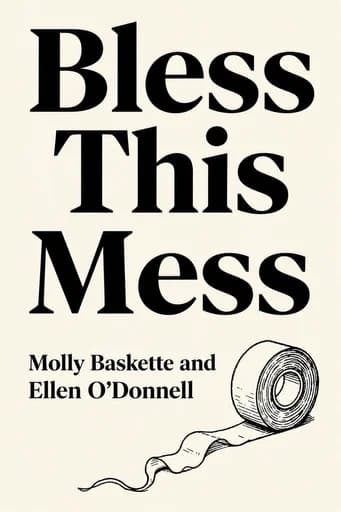
Bless This Mess
A Modern Guide to Faith and Parenting in a Chaotic World
Panoramica di Bless This Mess
Parenting meets progressive spirituality in "Bless This Mess," the Library Journal-acclaimed guide that rejects one-size-fits-all approaches. Endorsed by parenting expert Wendy Mogel as "groundbreaking," it tackles everything from sexuality to social justice with refreshing authenticity. What if raising moral children requires embracing their chaos?
Temi chiave in Bless This Mess
- progressive christian parenting
- spiritual child development
- intrinsic motivation
- moral reasoning
- autonomy support
Citazioni da Bless This Mess
Embrace the beautiful chaos of family life rather than promising unrealistic perfection.
Children are "fearfully and wonderfully made" with distinct personalities.
Setting clear limits is actually a form of love.
Transformation often comes through suffering and maturation.
Personaggi di Bless This Mess
- Molly BasketteAuthor and pastor providing spiritual guidance
- Ellen O’DonnellAuthor and child psychologist
- Jean PiagetPsychologist who studied moral development
- Lawrence KohlbergPsychologist known for stages of moral reasoning
- Lev VygotskyPsychologist who developed learning theories
Sull'autore
Sull'autore di Bless This Mess
Molly Baskette, a progressive Christian pastor and church renewal advocate, and Ellen O’Donnell, a clinical psychologist specializing in child development, co-authored Bless This Mess: A Modern Guide to Faith and Parenting in a Chaotic World. Baskette, senior minister of First Church Berkeley UCC and author of Real Good Church and How to Begin When Your World is Ending, combines her theological expertise with O’Donnell’s psychological research to address parenting challenges through a lens of liberal spirituality and science.
Their collaboration began as new mothers seeking actionable strategies to foster generosity, ethical awareness, and resilience in children—topics underserved by conventional parenting guides.
O’Donnell contributes evidence-based frameworks for stress reduction and developmental milestones, and Baskette, a 2018 Yale Divinity School Distinction in Congregational Ministry Award recipient, interweave personal anecdotes with tools for discussing money, sexuality, disability, and faith.
The book has been praised by authors like Sarah Bessey and Wendy Mogel for its relatable, research-grounded approach to raising kids in an anxiety-driven world. Their prior joint works include grief workbooks for children, Remembering My Pet and Remembering My Grandparent. Bless This Mess stands out for its integration of progressive Christian values with modern developmental psychology, offering parents a trusted resource across their child’s growth stages.
Scarica il riassunto di Bless This Mess
Ottieni il riassunto di Bless This Mess in formato PDF o EPUB gratuito. Stampalo o leggilo offline quando vuoi.
FAQ su questo libro
Bless This Mess offers a modern guide to integrating progressive Christian values with evidence-based parenting strategies. Co-authored by Reverend Molly Baskette and psychologist Ellen O’Donnell, it provides actionable advice on raising compassionate, resilient children while addressing topics like ethics, service, and overcoming parental anxiety. The book blends spiritual rituals (like blessings) with psychological tools to help families thrive in chaotic times.
This book is ideal for progressive Christian parents seeking to reconcile faith with modern parenting challenges, caregivers interested in fostering generosity and ethical awareness in children, and readers exploring intersectional approaches to spirituality and psychology. It’s particularly relevant for those navigating interfaith families or raising kids in socially diverse environments.
Baskette’s theological insights and O’Donnell’s clinical expertise create a dual framework:
- Faith-based tools: Daily blessings, gratitude practices, and service-oriented rituals.
- Psychological strategies: Science-backed methods to reduce parental anxiety and promote emotional resilience in children.
The book emphasizes how these approaches synergize to build family cohesion.
Key actionable strategies include:
- Framing difficult conversations (e.g., money, disability) through a lens of curiosity and compassion.
- Designing family rituals that blend spiritual practices (prayer) and psychological grounding (mindfulness).
- Cultivating a “deep generosity” mindset by engaging children in service projects.
Core themes include:
- Progressive Christianity: Rejecting dogma while embracing social justice and inclusivity.
- Fearless parenting: Tools to combat anxiety in an uncertain world.
- Ethical foundations: Teaching children to navigate difference, privilege, and responsibility.
The book tackles contemporary issues like:
- Navigating social media’s impact on self-image.
- Discussing systemic inequities with children.
- Balancing structure and flexibility in routines.
It provides scriptural parallels and psychological research to contextualize these challenges.
Notable quotes include:
- “Parenting is less about control and more about cultivating sacred curiosity”.
- “Blessings are not magic—they’re commitment devices for our best intentions”.
- “Fearlessness isn’t the absence of fear; it’s loving your kids too much to let fear lead”.
Unlike traditional faith-based guides, this book:
- Rejects purity culture in favor of body-positive theology.
- Integrates LGBTQ+ affirmation with biblical teachings.
- Prioritizes psychological safety alongside spiritual growth.
It’s frequently compared to Raising White Kids and The Gift of Failure for its intersectional approach.
Some conservative readers critique its progressive theology, particularly its support for queer-affirming parenting and rejection of punitive discipline. However, it’s widely praised in mainstream Christian circles for bridging the gap between modern psychology and faith.
Yes—while rooted in Christian tradition, its psychological frameworks and ethical exercises (e.g., gratitude journals, service challenges) are adaptable for secular or interfaith families. The authors emphasize universal values like kindness over doctrinal adherence.
Baskette’s experience as a cancer survivor, LGBTQ+ ally, and senior minister at a socially active church informs the book’s emphasis on resilience and community-led parenting. Her prior work on church renewal shapes the focus on adaptable faith practices.
Yes—its evidence-based strategies for reducing parental anxiety and fostering emotional intelligence appeal beyond religious readers. Over 60% of cited studies come from clinical psychology rather than theology, making it a hybrid resource.
The book provides phased scripts for discussing:
- Money: Framing wealth as a tool for justice.
- Disability: Normalizing difference through community exposure.
- Social inequality: Age-appropriate activism projects.
Each strategy pairs biblical parables with developmental psychology principles.