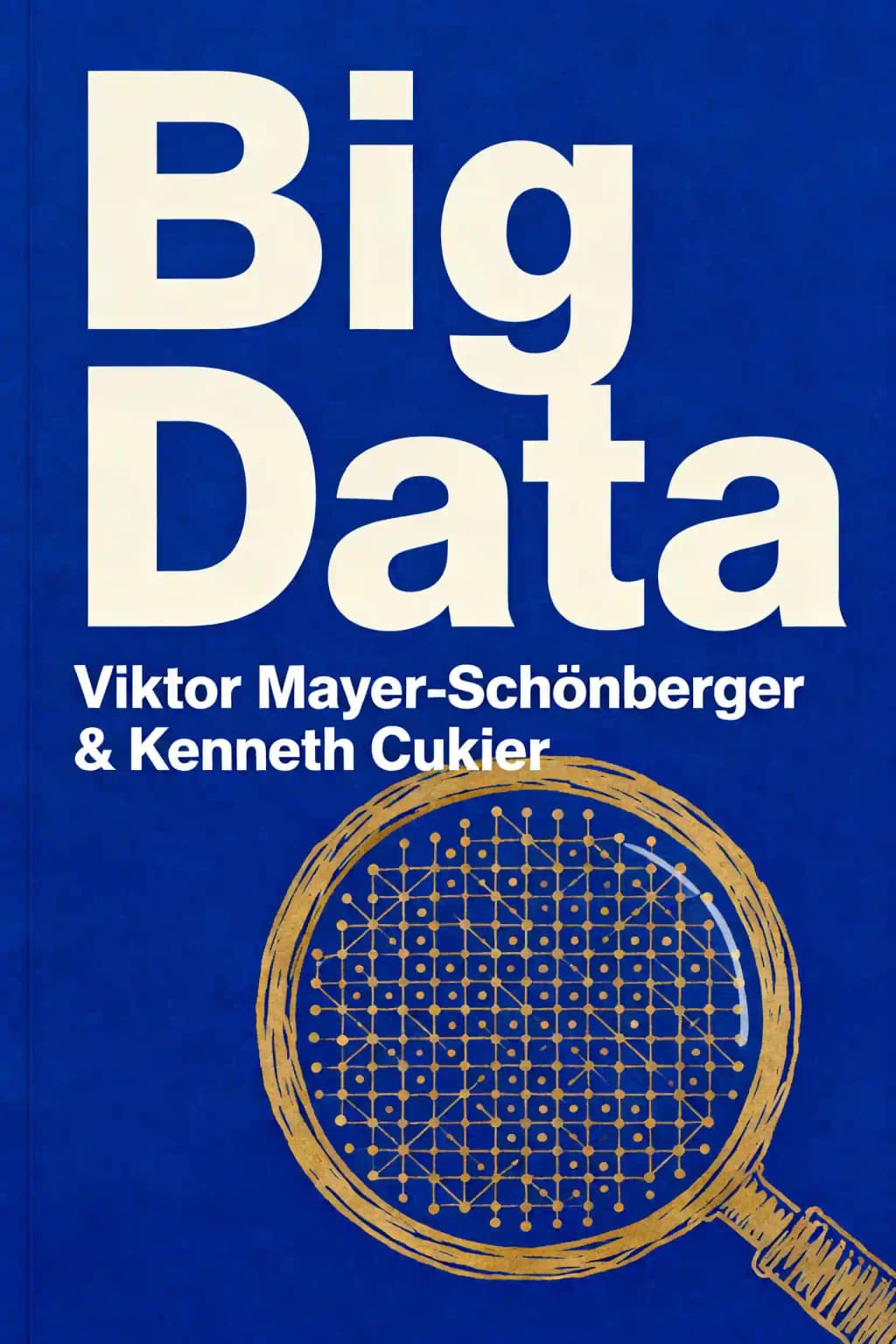
"Big Data" reveals how massive datasets are revolutionizing everything from flu prediction to crime prevention. Featured on the US Air Force's reading list, Oxford professor Mayer-Schonberger shows why correlation now trumps causation. Could your digital footprint predict your next purchase - or disease?
Senti il libro attraverso la voce dell'autore
Trasforma la conoscenza in spunti coinvolgenti e ricchi di esempi
Cattura le idee chiave in un lampo per un apprendimento veloce
Goditi il libro in modo divertente e coinvolgente
When Google tracked the 2009 H1N1 flu pandemic faster than the CDC by analyzing search queries, it signaled a fundamental shift in how we understand reality. This wasn't just clever technology-it was the dawn of the Big Data era. For most of human history, we've been forced to work with limited information. The 1880 U.S. census required eight years to process, making its insights obsolete before publication. These weren't just logistical problems but fundamental constraints on human knowledge. Today, those constraints have shattered. With billions of sensors, smartphones, and connected devices generating continuous data streams, we can analyze entire datasets rather than mere samples. Consider how Xoom, a financial services company, detected fraud by analyzing all transactions rather than investigating suspicious samples. They discovered subtle patterns that would have remained invisible using traditional approaches. This shift from sampling to comprehensive analysis fundamentally changes what we can know. Economist Steven Levitt's examination of 64,000 sumo wrestling matches revealed match-fixing patterns that would have been undetectable through sampling. Similarly, network analysis of millions of mobile phone connections showed that peripheral members with outside connections are more crucial to network stability than well-connected central figures-a counterintuitive finding that traditional methods would have missed. What makes this revolution particularly fascinating is its prescience. Written before terms like "data science" became household phrases, Big Data accurately predicted how information would transform everything from healthcare to criminal justice, fundamentally changing our relationship with information and decision-making.
Scomponi le idee chiave di Big Data in punti facili da capire per comprendere come i team innovativi creano, collaborano e crescono.
Distilla Big Data in rapidi promemoria che evidenziano i principi chiave di franchezza, lavoro di squadra e resilienza creativa.

Vivi Big Data attraverso narrazioni vivide che trasformano le lezioni di innovazione in momenti che ricorderai e applicherai.
Chiedi qualsiasi cosa, scegli la voce e co-crea spunti che risuonino davvero con te.

Creato da alumni della Columbia University a San Francisco
"Instead of endless scrolling, I just hit play on BeFreed. It saves me so much time."
"I never knew where to start with nonfiction—BeFreed’s book lists turned into podcasts gave me a clear path."
"Perfect balance between learning and entertainment. Finished ‘Thinking, Fast and Slow’ on my commute this week."
"Crazy how much I learned while walking the dog. BeFreed = small habits → big gains."
"Reading used to feel like a chore. Now it’s just part of my lifestyle."
"Feels effortless compared to reading. I’ve finished 6 books this month already."
"BeFreed turned my guilty doomscrolling into something that feels productive and inspiring."
"BeFreed turned my commute into learning time. 20-min podcasts are perfect for finishing books I never had time for."
"BeFreed replaced my podcast queue. Imagine Spotify for books — that’s it. 🙌"
"It is great for me to learn something from the book without reading it."
"The themed book list podcasts help me connect ideas across authors—like a guided audio journey."
"Makes me feel smarter every time before going to work"
Creato da alumni della Columbia University a San Francisco

Ottieni il riassunto di Big Data in formato PDF o EPUB gratuito. Stampalo o leggilo offline quando vuoi.