Capitolo 1
The Art of Seeing Differently: How Criticism Transforms Our World
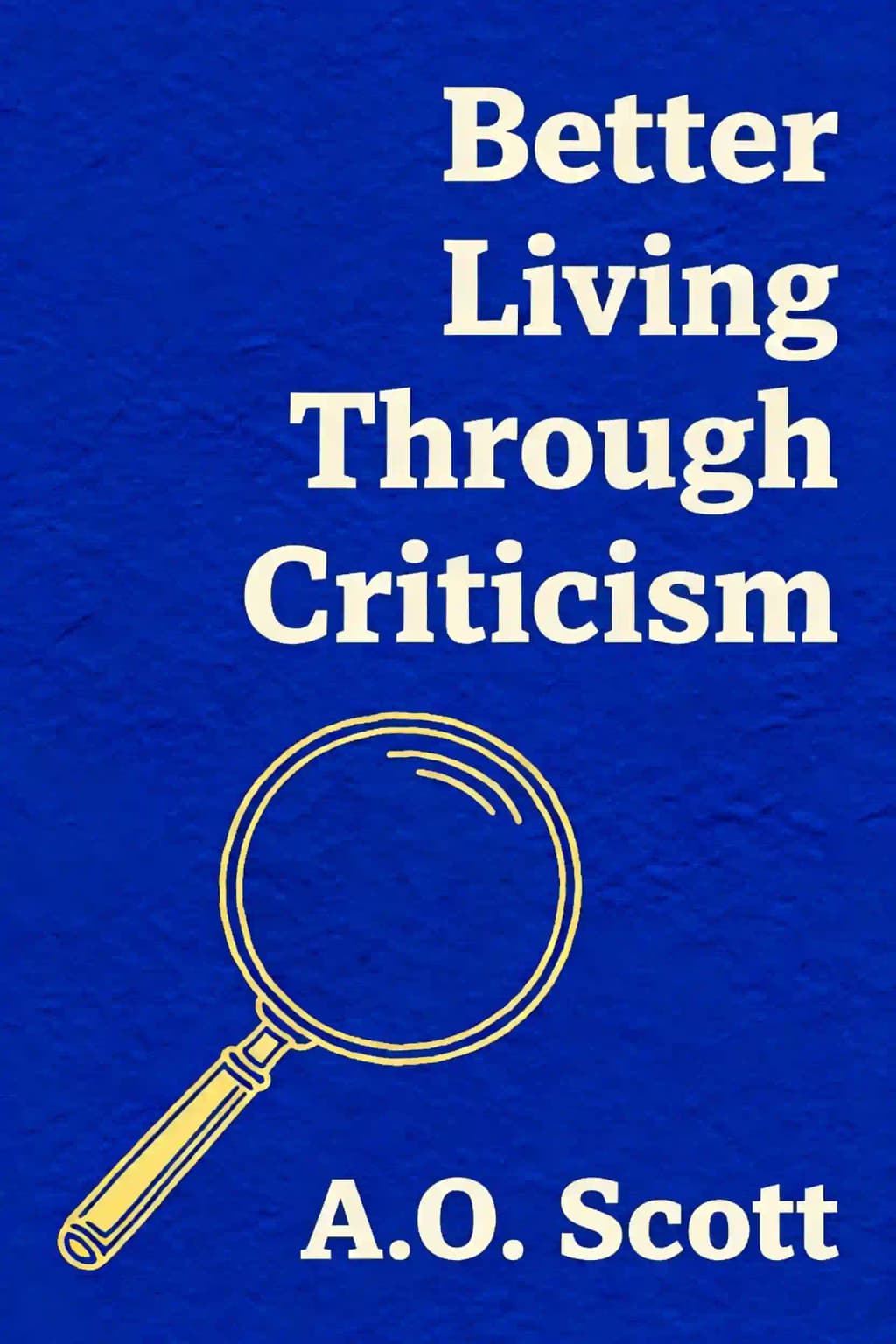
Have you ever watched a film, read a book, or viewed a painting and felt an inexplicable urge to talk about it afterward? That impulse-to process, analyze, and share your experience-is the beating heart of criticism. In "Better Living Through Criticism," New York Times film critic A.O. Scott takes us on an intellectual journey that transforms how we think about art, culture, and our own responses to them. This isn't merely a defense of professional critics but a passionate argument that criticism is fundamental to human consciousness-as natural as breathing yet as sophisticated as philosophy. The book arrives at a cultural moment when everyone with internet access can publish opinions, yet traditional critical voices face extinction. Scott's work has resonated with cultural luminaries from Quentin Tarantino (who once publicly challenged Scott's review) to Meryl Streep, who praised its "elegant clarity." Beyond the literary world, it speaks to our contemporary struggle with information overload and the search for meaningful engagement in an age of hot takes and algorithm-driven recommendations.
Capitolo 2
Criticism's Paradox: Everyone's a Critic, No One Wants Critics
What exactly is criticism? The question immediately reveals a circular problem: criticism is what critics do, but anyone who criticizes is a critic. Is it a professional discipline, like literary analysis or art history? A casual activity like card-playing or movie-watching? Or something as instinctive as breathing and reacting? The very nature of criticism invites skepticism and hostility-"How dare you! What gives you the right?"-making defensiveness not just an occasional response but an inherent part of the critic's daily experience.
Scott argues that criticism begins with the fundamental act of thinking deeply about our experiences with art, whether that's a Renaissance painting or the latest superhero movie. He challenges the prevalent notion that thinking critically about popular entertainment somehow diminishes or ruins it, pointing out that anti-intellectualism has become "virtually our civic religion" in America, even while "critical thinking" remains an educational buzzword in our schools and universities. In our contemporary culture, we're increasingly encouraged toward either passive consumption or shallow eclecticism as fans, while our political and cultural discourse devolves into ideological belligerence and tribal allegiances.
The essential task of criticism, Scott maintains, is to "figure out what to do with" the freedom that art provides - a freedom that can be both exhilarating and overwhelming. We should honor our experiences by taking them seriously, using our minds to strike a delicate balance between healthy skepticism and genuine open-mindedness against the intellectual inertia surrounding us. This requires a particular kind of courage-the willingness to stand by our judgments while simultaneously recognizing their inherent subjectivity and limitations.
Criticism exists in a perpetual state of contradiction and paradox. We simultaneously believe taste cannot be disputed ("de gustibus non est disputandum") while constantly engaging in heated arguments about it. Our aesthetic judgments are presented as both innate reflexes we can't control and carefully acquired sensibilities we've developed over time. They're supposedly private matters that nonetheless fundamentally define our social identities and cultural tribes. We habitually use polite subjective language-"I think" or "in my opinion"-while secretly desiring objective certainty, wanting to say not just "I like it" but "This is genuinely great!"
These tensions reveal the foundational philosophical questions underlying all criticism: How do we know what we know about art and culture? Why do we feel what we feel when encountering a piece of work? What shapes our responses - personal history, cultural context, or something more universal? And perhaps most importantly, why do we feel so compelled to communicate these experiences to others, to share our judgments and seek validation or challenge? The critic's role exists precisely within these tensions, attempting to navigate between personal response and public discourse, between subjective experience and shared understanding.
Capitolo 3
The Critic as Artist: Breaking Down False Hierarchies
Scott boldly challenges the common perception of critics as failed artists, pointing to numerous historical figures who excelled in both criticism and creative work. He cites Charles Baudelaire, whose poetry revolutionized French literature while his art criticism defined modernism; John Ashbery and Frank O'Hara, who seamlessly merged poetic and critical voices; George Bernard Shaw, whose reviews transformed theater criticism while he wrote groundbreaking plays; and the French New Wave directors like Truffaut and Godard, who moved from writing penetrating film criticism to creating revolutionary cinema. Yet he acknowledges these dual practitioners are exceptions to a deeply embedded cultural hierarchy that values "real art" over criticism, which is typically dismissed as reactive, secondary, and disposable.
Against this reductive view, Scott asserts that "criticism is art's late-born twin" and that critics are creators in their own right, crafting narratives and insights that shape how we understand culture. Drawing on H.L. Mencken's provocative essays, he argues that criticism isn't merely pedagogical but fundamentally artistic-driven by the same creative impulse to "function freely and beautifully" and "make an articulate noise in the world." While criticism differs from other arts by necessarily referencing them, this makes criticism not parasitic but primary-larger in scope and more eclectic in method, synthesizing multiple art forms and cultural contexts.
The solitary creator, Scott emphasizes, is a romantic myth; all recognizable art responds to other art in an endless dialogue. Artists are first readers, listeners, and viewers driven to imitate, correct, and build upon their predecessors. He points to contemporary examples: hip-hop's sophisticated sampling transforms existing music into new compositions; Tarantino's films create original narratives by recombining and recontextualizing cinema history; Lin-Manuel Miranda's Hamilton reimagines American history through contemporary musical forms. Jean-Luc Godard's work particularly exemplifies this fusion of criticism and creation-his groundbreaking films like Breathless and Contempt continue the critical investigations begun in his Cahiers du Cinema essays, analyzing cinema's language while expanding its possibilities.
This pattern extends throughout art history: modernists like James Joyce wove Homeric epic into urban Dublin; Ezra Pound incorporated Chinese poetry into modern verse; T.S. Eliot constructed The Waste Land from literary fragments spanning centuries. In painting, Manet's Olympia critically engaged with Titian's Venus of Urbino, while Picasso's Les Demoiselles d'Avignon conducted a radical dialogue with African art and European tradition.
The creative process involves what Scott calls "loving demystification"-breaking down admired works to understand and potentially surpass them. Through T.S. Eliot's concept of tradition and Harold Bloom's theory of influence, Scott shows how artists necessarily alter the existing order through creative misreading and revision. This eternal struggle to transcend precedent while inevitably engaging with it reveals the existential paradox at art's core: originality emerges not from isolation but from deep engagement with tradition, and criticism is integral to this creative process.
Capitolo 4
Aesthetic Experience: The Transformative Encounter
What happens when we truly engage with art? In 2010, Marina Abramovic's groundbreaking MoMA exhibition "The Artist is Present" drew over 750,000 visitors who waited hours-sometimes entire days-for a brief face-to-face encounter with the silent, seated artist. This performance piece provoked intense emotional reactions-many spectators wept during or after their encounter, while others reported feelings of profound peace or unexpected vulnerability. Unlike traditional art that moves us through narrative or technical mastery, Abramovic wasn't making anything-she was simply present, creating an unprecedented space for pure human connection through sustained eye contact and shared silence.
Curator Klaus Biesenbach observed that participants felt Abramovic was falling in love with them, inverting the usual dynamic of art appreciation where viewers project emotions onto artworks. Many described feeling "seen" in ways they had never experienced before, highlighting art's unique ability to bypass social conventions and create authentic human connections. The exhibition's power lay in offering genuine human connection in an age of screens and networks, affirming art's ancient capacity to disrupt everyday consciousness and create transformative encounters that transcend cultural and linguistic barriers.
This transformative potential appears vividly in Rilke's "Archaic Torso of Apollo," which creates paradoxical perception-we intuit wholeness from fragments, imagine invisible details, and experience the uncanny sensation of being seen by an eyeless statue. The poem's sensual language transforms cold stone into erotic presence, synthesizing Apollonian form with Dionysian passion. Through precise imagery and metaphorical power, Rilke makes readers feel the radiance emanating from the damaged sculpture, turning absence into presence. Its famous final command-"You must change your life"-calls readers to enter art's transformative realm, not as casual observers but as those willing to be fundamentally altered by aesthetic experience.
This represents a democratic yet elite vision: anyone might be called to art's priesthood, but few answer. The poem itself performs criticism while claiming to transcend it, demonstrating how aesthetic experience collapses distinctions between creator, critic and spectator. This collapse reveals art's capacity to dissolve conventional boundaries between subject and object, viewer and viewed, creating a space where transformation becomes possible.
Scott concludes that artistic encounters-whether with Rilke's headless torso, Larkin's nameless trumpeter, or Abramovic's performance-share effects adjacent to but distinct from sexuality. These encounters generate an intimate form of knowledge that exists outside conventional understanding. Art, like sex, provokes anxieties and taboos, challenging our usual modes of perception and understanding. Criticism emerges from our desire to communicate our pleasures, to make them less solitary, to share and validate our experiences. It originates in innocent yet risky questions that echo intimate conversations: "Did you feel that? Was it good for you? Tell the truth." These questions reveal our deep need to connect through shared aesthetic experiences, even as they highlight the ultimately personal nature of artistic transformation.
Capitolo 5
Museums and Authority: The Institutionalization of Art
The modern museum experience often precludes the sublime encounters it promises to deliver. Scott examines this through the Louvre-a pilgrimage destination receiving over eight million visitors annually. The museum represents not just art but civilization itself, though visitors rarely experience the transformative power Rilke described in his poetry. Instead, they navigate crowded galleries to see famous works like the Mona Lisa, now viewed primarily through screens and reproductions. The experience has become increasingly mediated, with visitors often more focused on capturing photos for social media than engaging directly with the artworks themselves.
Museums present themselves as arguments from authority, their institutional power of judgment far exceeding our own hesitant reactions. Their architecture - often imposing and classical - reinforces this authority, while curatorial decisions about placement, lighting, and contextual information shape our interpretation of works. We visit because we're supposed to, our opinions rendered trivial before works whose evaluation has been predetermined. The audio guides, plaques, and docent tours further reinforce official interpretations. We can either doubt ourselves when we fail to appreciate what we should, or rebel against established hierarchies with passive indifference or outright defiance.
The question of "who decides what's valuable" erupted in the culture wars of the 1990s, when debates raged about what books deserved teaching in college. One side defended the self-evident supremacy of traditional Western masterworks, while opponents argued these hierarchies were political constructs serving those in power. Both sides mistakenly viewed the canon as immutable rather than what it truly is: a perpetually renegotiated list reflecting fluctuating tastes and unexamined habits. This debate extends beyond literature to visual art, where questions of representation, cultural appropriation, and institutional bias have become increasingly central.
The solution in democratic consumer societies is always "more"-more discourse, more access, more opinions. Instead of hierarchy, we embrace pluralism, replacing canons with polls, lists, and digital platforms that reflect our collective preferences. Museums have responded by expanding their programming, creating interactive exhibits, and embracing digital engagement. This populist approach-where judgments are confirmed and modified by public consensus-appears perfectly democratic. Critics and cultural gatekeepers have lost their authority, replaced by peer recommendations, social media influence, and sophisticated recommendation algorithms.
Yet this leveling of taste hierarchies doesn't truly resolve questions of cultural authority. The consumer economy remains profoundly unequal, replacing barriers of pedigree with barriers of income and access. Major museums still charge substantial admission fees, while blockbuster exhibitions cater to wealthy donors and corporate sponsors. Our story of increasing cosmopolitanism also brings standardization and homogenization. The modern world reverses Babel's tale-instead of distinct cultural enclaves with unified sensibilities, we have global entertainment and commercial products epitomized by Hollywood's worldwide conquest. Museums themselves have become global brands, with institutions like the Guggenheim and Louvre establishing satellite locations worldwide, further blurring the lines between cultural preservation and commercial enterprise.
Capitolo 6
The Critic's Dilemma: Between Savagery and Softness
Criticism is fundamentally not nice. To criticize means finding fault and accentuating negatives. Yet while we suppress this critical instinct for social harmony, we simultaneously value truthfulness, sound judgment, and high standards. This ambivalence permeates our cultural discourse-oscillating between corrosive argument and dismaying softness, between angry takedowns and treacly affirmations that everyone is special.
The critic embodies our internal antagonism-simultaneously superfluous and ubiquitous, indispensable and useless, trusted and reviled. Since human artistic expression separated from ritual, we've needed people to judge, compare, and interpret creative works. These self-authorized experts possess elusive expertise; they can't create the art they critique, but they've paid close attention to how things are and should be done.
The history of criticism is an endless cycle of complaint, with critics themselves frequently under attack. As Plato's brother Glaucon complained (according to Aristotle), critics "jump at groundless conclusions" and "find fault if a thing is inconsistent with their own fancy." This pattern persists today, with the literary world oscillating between accusations of excessive niceness and brutal meanness.
Criticism isn't a pendulum swinging between savagery and softness but a pit of opposing impulses in perpetual confusion and self-doubt. Artists routinely complain that critics don't understand their work, imposing their own agendas and prejudices. In the age of mass culture, vindication comes through popularity-if critics don't appreciate a work, perhaps ordinary people or posterity will.
The romantic poets articulated the anti-critical position most eloquently. Keats's assertion that "a thing of beauty is a joy forever" and that "Beauty is truth, truth beauty" suggests art exists beyond analysis. Yet ironically, his "Ode on a Grecian Urn" is itself criticism, interpreting a silent artifact. The ideal critic, according to Matthew Arnold, should operate in "the pure intellectual sphere," steering society toward "what is excellent in itself." Yet this creates a paradox: if criticism aims to point toward perfection without disturbing artistic sublimity, perhaps the right approach is not to criticize at all.
Capitolo 7
The Sacred Duty of Being Wrong
Being wrong is not a critic's failure but their "sacred duty." While experts in other fields suffer little consequence for errors, critics must "trace a twisted, looping, stutter-stepping, incomplete path toward the truth." In our polarized culture of certainty, where data and algorithms promise to solve all problems, criticism stands apart by embracing uncertainty. This uncertainty isn't weakness but strength - it acknowledges the complexity of human expression and experience that defies simple quantification.
Unlike scientists who test hypotheses or journalists who gather facts, critics operate in "the fuzzier realm of intuition, judgment, and conjecture." No aggregation of scores or opinions can determine rightness. The critic's statistical sample of one means they will inevitably be "overruled, corrected, or outvoted"-not a flaw but a feature of aesthetic judgment. This singular perspective, though potentially fallible, offers unique insights that consensus might miss.
Critics inevitably miss the point-it's what they do. But there's a pattern to this error, not just random mistakes. Take Frank Nugent's 1938 dismissal of "Bringing Up Baby" as "breathless, senseless and terribly fatiguing"-a film now revered as quintessential screwball comedy. Nugent suffered from overexposure, having "seen too many movies" to discern this one's brilliance. He was "too busy hacking through the forest to appreciate this particular tree." Similar examples abound: initial dismissals of Monet's impressionism, early rejection of jazz as mere noise, and contemporary resistance to experimental literature all follow this pattern of misrecognition.
This myopia reflects a fundamental critical dilemma: being imprisoned in the present. Critics either become too credulous about the new or overly cynical, dismissing innovations as "more of the same." Some celebrate every technological advancement as revolutionary, while others dismiss emerging art forms as degraded versions of classical forms. Consider how video games were long dismissed as mere entertainment before being recognized as a legitimate artistic medium, or how television was initially viewed as cinema's inferior cousin.
Criticism offers two antidotes to our imprisonment in the present: looking backward or squinting toward the future. The cult of the dead is challenged-and complemented-by an equally dogmatic religion of the new. The funeral procession marches alongside the avant-garde parade. These opposing forces create a productive tension: traditionalists preserve cultural memory while innovators push boundaries.
Both the conservative impulse to preserve what's valuable and the revolutionary drive toward an unseen future have merit. Yet both fail in their attempt to master time-either by declaring the human project complete or by imagining its perfection lies just ahead. We need both perspectives to avoid being trapped in the present's exhausting flux. This dynamic tension between past and future, preservation and innovation, creates the space where meaningful criticism can flourish. Critics must navigate between these poles, acknowledging both the wisdom of tradition and the necessity of change.
Capitolo 8
Criticism in Crisis: The Digital Transformation
At virtually any moment in its modern history, criticism exists in a paradoxical crisis-in danger of disappearing because there's too much of it. Henry James noted in 1891 that criticism "flows through the periodical press like a river that has burst its dikes," with quantity far outstripping quality. He likened the press to a train that must depart with every seat filled, necessitating "the manufacture of dummies" when real passengers are lacking.
Today, James's "huge, open mouth" of print has become a ravening digital maw. There is more criticism than ever, yet predictions of criticism's death grow louder. This seems strange since criticism as an activity is ancient-the jealous twin of art itself. But criticism as a profession is more recent, a creature of print culture that has flourished in an ecosystem of widening literacy and periodical publication.
This species now faces extinction as digital media transforms the world of print. The material infrastructure of literacy-newspapers, magazines, journals, and books-seems in danger of vaporizing or becoming something more ephemeral. As traditional business models crumble, morale has collapsed among those working in "traditional media." Revenues have fallen even as readership has risen, leading to widespread layoffs, including hundreds of critics.
The Internet has transformed the media landscape. While print outlets diminish, the web offers a dizzying diversity of critical voices-blogs, specialized communities, and forums mixing mockery, snark, and intellectual stamina. Visions of this post-print universe swing between utopian and apocalyptic extremes: either a democratic garden of unfettered expression or an anarchic wasteland where civility gives way to cyberrage.
This supposed battle between Internet upstarts and media dinosaurs has devolved into a straw man argument. The digital frontier, like territory in a John Ford Western, is coming under the sway of law and private property. The blogosphere has professionalized, with veterans adapting to online formats while young renegades get hired by legacy media.
What's certain is that there will be no shortage of words. Digital culture is a culture of abundance, yet this deluge is often perceived as a drought. The sheer quantity threatens to erode the value of particular texts. This predicament isn't new-every technological evolution has felt desperately acute. We dwell in a culture of surplus that cries out for criticism to sort through the glut, even as criticism produces its own surpluses.
Capitolo 9
The Endless Work of Appreciation
Scott concludes his exploration with a passionate analysis of Pixar's "Ratatouille," which he describes as "the perfect summation of everything I believe," particularly through Anton Ego's character. The film's climactic moment-when the austere critic tastes Remy's ratatouille and is instantly transported to his childhood-represents criticism's highest purpose: reconnecting with genuine appreciation. This scene masterfully illustrates how authentic criticism can bridge the gap between technical expertise and emotional resonance, showing that the most powerful cultural experiences often combine both elements.
Both Remy (the rat chef) and Ego (the critic) share the same vocation-"the especially intense appreciation of something everyone else either takes for granted or enjoys in a casual, undisciplined way." Through detailed analysis of ratatouille's proper preparation ("It's not stewed vegetables; it's flavored oil"), Scott illustrates how technical understanding enhances appreciation rather than diminishing it. The parallel between cooking and criticism becomes clear: just as a chef must understand ingredients, techniques, and traditions to create something meaningful, a critic must possess deep knowledge of form, context, and history to offer valuable insights.
The work of criticism, properly understood, is endless because art and culture constantly evolve, presenting new challenges and perspectives. Yet a true critic is someone who knows, at long last, when to stop-when to set aside analysis and simply experience the transformative power of art. This delicate balance between analytical distance and emotional engagement is what distinguishes great criticism from mere opinion. The critic must simultaneously maintain professional objectivity while remaining open to being moved, surprised, and transformed by the work.
In an age of algorithmic recommendations and instant opinions, Scott makes a compelling case that thoughtful criticism matters more than ever. Not as a gatekeeper function or consumer guide, but as a fundamental human activity-the ongoing conversation we have with ourselves and others about what moves us, what matters to us, and ultimately, who we are. The digital age has democratized opinion-sharing but has also created an environment where nuanced, well-reasoned criticism becomes increasingly valuable as a counterpoint to snap judgments and viral hot takes.
The role of the critic, Scott argues, is to serve as a bridge between the creator's intention and the audience's experience, helping to illuminate the complexities and subtleties that might otherwise go unnoticed. Like Ego's famous review at the end of Ratatouille, the best criticism combines personal vulnerability with professional insight, showing how individual experience can lead to universal understanding. This approach to criticism doesn't diminish our enjoyment but rather enriches it, adding layers of meaning and appreciation to our cultural experiences.