Capitolo 1
Ancient Echoes, Modern Resonance
Beowulf, the cornerstone of English literature, continues to captivate readers across cultures and centuries with its timeless exploration of heroism, mortality, and the human condition. This Old English epic poem, composed between the 7th and 10th centuries, has influenced everything from J.R.R. Tolkien's Middle-earth to modern superhero narratives. When Seamus Heaney's translation was published in 2000, it became an unexpected bestseller, spending weeks on the New York Times bestseller list-remarkable for a thousand-year-old poem. Celebrities from Neil Gaiman to Angelina Jolie have cited Beowulf as a profound influence, with Jolie even producing and starring in a film adaptation. Beyond entertainment, the poem serves as a cultural bridge, offering insights into pre-Norman England while speaking to universal human experiences of courage, grief, and the inevitable passage of time.
Capitolo 2
The Warrior's World: Honor, Glory, and the Mead Hall
At the heart of Beowulf lies the warrior culture of early medieval Scandinavia and Anglo-Saxon England-a world where reputation was paramount and glory in battle was the highest aspiration. The mead hall, epitomized by Hrothgar's magnificent Heorot, served as the center of this society. More than merely a drinking establishment, it functioned as the physical and symbolic heart of the community-a place of refuge, celebration, and cultural transmission.
Within these timber-framed halls, kings distributed treasure to loyal warriors, creating bonds of mutual obligation. Gold rings, swords, and armor weren't simply valuable possessions but visible symbols of a warrior's worth and his lord's favor. When Beowulf defeats Grendel, Hrothgar rewards him lavishly with "a gold standard as a victory gift, an embroidered banner; also breast-mail and a helmet; and a sword carried high, that was both precious object and token of honor." These gifts weren't merely compensation but recognition of Beowulf's incorporation into Hrothgar's extended kinship network.
The hall also served as the venue for scops (poets) to perform tales of ancestral heroism, preserving cultural memory while inspiring young warriors. When Hrothgar's scop recites the tale of Sigemund the dragon-slayer after Beowulf's victory over Grendel, he's not merely entertaining-he's placing Beowulf within a heroic lineage, elevating the Geatish warrior's status through comparison with legendary predecessors.
This warrior society operated on a complex code of honor, where one's reputation (or "dom" in Old English) could outlive physical existence. As Beowulf himself declares before his final battle: "For every one of us, living in this world means waiting for our end. Let whoever can win glory before death. When a warrior is gone, that will be his best and only bulwark." This sentiment-that fame after death constitutes a form of immortality-permeates the poem's ethical framework.
Yet even as the poem celebrates this heroic ethos, it acknowledges its limitations. The recurring motif of ancient treasures found in burial mounds suggests the transience of earthly glory. What remains, the poem suggests, is not gold or weapons but the stories told about those who wielded them-a meta-commentary on the very poem we're reading.
Capitolo 3
Monsters and Meanings: Grendel, His Mother, and the Dragon
The three monsters Beowulf confronts-Grendel, Grendel's mother, and the dragon-are far more than mere adversaries to be overcome. Each represents distinct challenges to the social order and embodies different aspects of chaos threatening the human community.
Grendel, described as a descendant of Cain, exists as an outsider to human society, consumed by envy of the joy he witnesses in Heorot. His nightly attacks on the hall represent a direct assault on civilization itself. When he "grabbed thirty men from their resting places" in a single night, he violates not just their lives but the sacred bonds of hospitality that the hall represents. His physical monstrosity-with a glowing gaze "like a flame" and body impervious to ordinary weapons-makes him the perfect antagonist for a society that values physical prowess.
What makes Grendel particularly disturbing is his liminal status-neither fully human nor completely bestial. He understands human language and customs but rejects them, making him not simply a predator but a perversion of humanity. When Beowulf defeats him using only bare hands, matching Grendel's disdain for weapons with a display of superhuman strength, the victory represents the triumph of human excellence over animalistic rage.
Grendel's mother presents a different kind of threat. Her attack is not mindless aggression but calculated vengeance-a dark mirror of the revenge code that governs human society. Her underwater lair, "where water burns," inverts the natural order, creating a hellish anti-hall beneath a mere. When Beowulf descends to confront her, he journeys symbolically into the underworld, facing not just a physical opponent but the darker aspects of the very code he upholds.
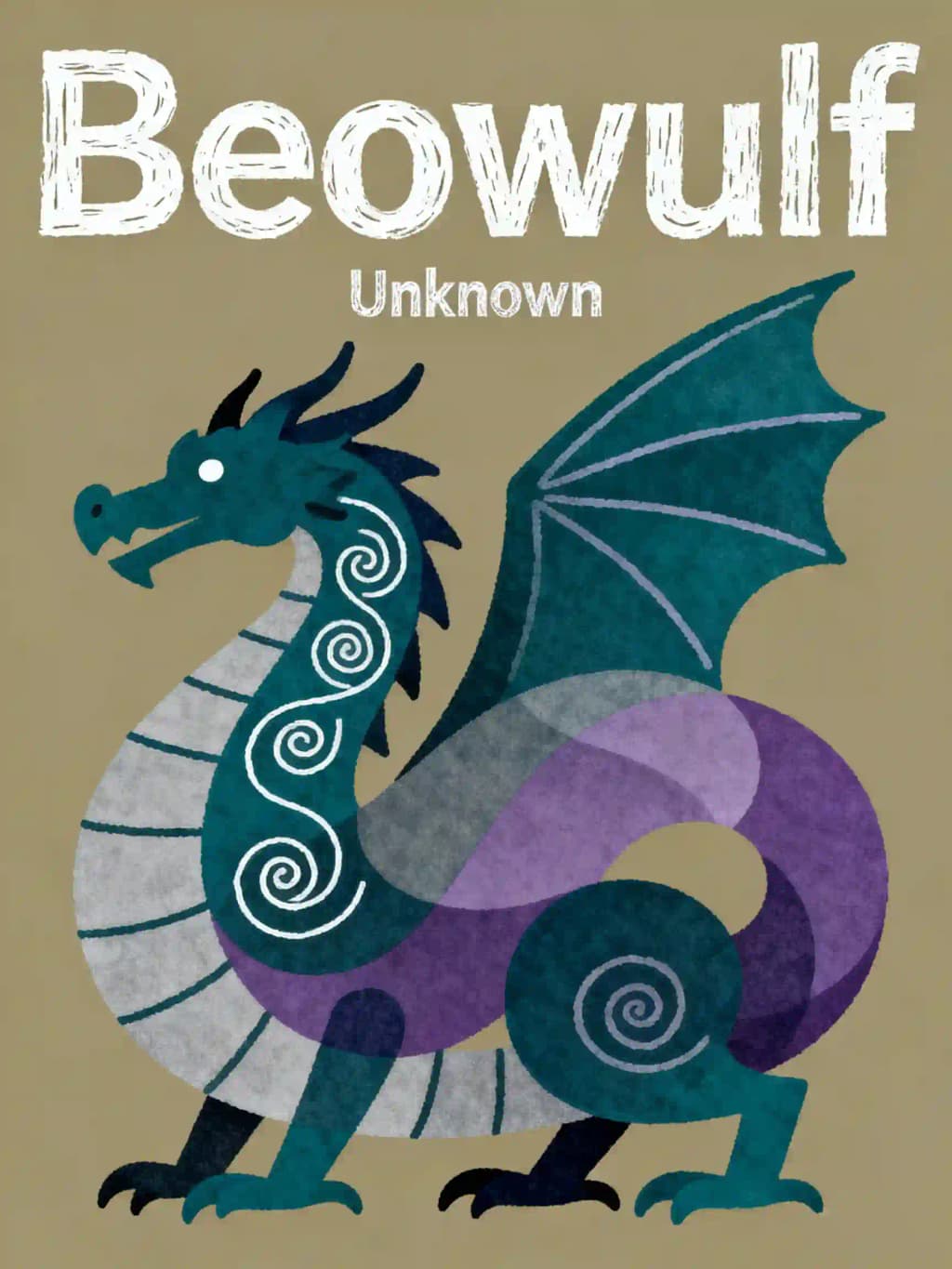
The dragon, Beowulf's final adversary, represents the ultimate challenge-not just to the hero but to heroism itself. Unlike the earlier monsters, the dragon acts according to its nature, awakened to fury when a thief steals from its hoard. Its fiery breath and ancient wisdom make it a force of elemental destruction against which human strength alone proves insufficient. The dragon embodies time itself-patient, inevitable, and ultimately victorious even in defeat.
Through these three progressively more difficult confrontations, the poem traces not just Beowulf's life journey but a meditation on the nature of heroism. From the youthful triumph over Grendel to the mature victory against Grendel's mother to the final, fatal confrontation with the dragon, we witness the hero's capabilities tested against increasingly complex manifestations of chaos and mortality.
Capitolo 4
Between Worlds: Pagan Heroism and Christian Perspective
One of Beowulf's most fascinating aspects is its position at the cultural crossroads between pagan Germanic traditions and Christian worldview. Though set in pre-Christian Scandinavia, the poem was composed in Christian Anglo-Saxon England, creating a unique tension between its heroic ethos and religious framework.
The poet skillfully navigates this tension, neither fully condemning the pagan past nor abandoning Christian perspective. When describing the Danes' response to Grendel's attacks, he notes how they "sometimes at pagan shrines they vowed offerings to idols, swore oaths that the killer of souls might come to their aid." The narrator explicitly criticizes these practices while still honoring the warrior culture from which they emerge.
This dual perspective creates a remarkable historical consciousness throughout the poem. The narrator frequently references how events will unfold beyond the immediate narrative-Hrothgar's magnificent hall will eventually burn in a feud; the peace-weaving marriage between Freawaru and Ingeld will collapse into violence; the Geats will face invasion after Beowulf's death. This awareness of historical contingency gives the poem a melancholic tone even in moments of triumph.
The Christian elements appear most explicitly in references to biblical figures. Grendel is described as a descendant of Cain, the first murderer, connecting the monster to a biblical archetype of fraternal violence and exile. Similarly, the poem references the Flood and the giants destroyed by God's judgment. Yet these Christian references coexist with decidedly non-Christian elements, such as the importance of vengeance and the pursuit of earthly glory.
Perhaps most striking is how the poem transforms the pagan concept of wyrd (fate) into something approaching Christian providence. When Beowulf declares before his final battle that "Fate always goes as it must," his fatalism reflects both Germanic acceptance of destiny and Christian submission to divine will. This syncretic approach allows the poem to honor the heroic past while placing it within a Christian moral framework.
The poem's treatment of treasure reveals this dual perspective most profoundly. Gold, central to the gift economy of warrior society, undergoes a transformation from symbol of generosity and social bonds to emblem of transience and futility. When the last survivor in an earlier passage buries his people's treasures, he laments that there remains "no one to lift the sword or burnish plated goblets, precious vessels." The dragon's hoard, similarly, becomes "as useless to men now as it ever was" when reburied in Beowulf's barrow-a pointed commentary on the ultimate vanity of material wealth from a Christian perspective.
Capitolo 5
The Weight of Legacy: Kingship, Succession, and Social Order
Beyond its monster fights and heroic boasts, Beowulf offers a sophisticated meditation on political power and social stability. Throughout the poem, kings are judged not merely by their martial prowess but by their ability to maintain peace and protect their people.
The contrast between good and bad rulers forms a recurring motif. Hrothgar represents the ideal king-generous, wise, and protective of his people. His construction of Heorot demonstrates his commitment to creating a space for community and culture. When he delivers his "sermon" to Beowulf after the defeat of Grendel's mother, he warns against the corrupting influence of power and pride, showing wisdom born of experience.
Conversely, Heremod serves as the poem's prime example of a failed king-one who "cut down comrades, a paragon of evil" whose reign ended in isolation and death. Similarly, the Swedish king Ongentheow and the Geatish ruler Haethcyn demonstrate how poor leadership leads to bloodshed and social collapse. These negative examples highlight the poem's concern with proper governance.
The question of succession looms large throughout the narrative. Hrothgar's advanced age raises questions about Denmark's future, while the complex dynastic politics of the Geats and Swedes demonstrate how quickly peace can dissolve into feud. When Beowulf himself dies childless, the poem explicitly connects this personal tragedy to national catastrophe: "Now war is looming over our nation, soon it will be known to Franks and Frisians... That is the sorrow song, the dirge of the Geats."
The poem's digressions into historical conflicts-the Finn Episode, the Battle at Ravenswood, the Swedish-Geatish wars-aren't merely decorative but demonstrate how quickly the social order can collapse into violence. These stories-within-the-story create a sense of historical depth while highlighting the fragility of peace in a warrior society.
Particularly poignant is the poem's treatment of "peace-weaving"-the practice of marrying women across tribal boundaries to secure alliances. The poet repeatedly emphasizes how these arrangements fail, as with Hildeburh who "had no cause to praise the Jutes" after losing both her brother and son to violence. These failed alliances underscore the poem's pessimistic view of human efforts to overcome ingrained patterns of vengeance and feud.
Beowulf himself evolves from warrior to king, demonstrating different aspects of heroism at different life stages. His fifty-year reign over the Geats represents a period of peace and prosperity, showing that the impulsive young hero has matured into a responsible ruler. Yet even this exemplary kingship cannot permanently secure his people's future-a sobering reflection on the limits of even the greatest human achievements.
Capitolo 6
The Heroic Paradox: Individual Glory and Communal Good
At the heart of Beowulf lies a fundamental tension between individual heroic achievement and communal welfare-a tension that becomes increasingly pronounced as the narrative progresses. The young Beowulf who arrives in Denmark embodies the heroic ideal: supremely confident, physically exceptional, and eager for glory. His boast that he will fight Grendel without weapons exemplifies this individualistic heroism-a deliberate choice to increase personal risk for greater glory.
This approach proves successful against Grendel, where Beowulf's exceptional strength allows him to defeat a monster that had terrorized the Danes for twelve years. His individual prowess serves the community's needs perfectly. Similarly, his descent into the mere to confront Grendel's mother represents heroic individualism that benefits the broader society.
However, the dragon episode reveals the limitations and potential costs of this heroic ethos. The aged king insists on facing the dragon personally, declaring: "This fight is not yours, nor is it up to any man except me to measure his strength against the monster or to prove his worth." While admirable as a statement of courage, this decision prioritizes personal honor over communal welfare. When Beowulf falls in battle, his people face a future of likely invasion and suffering.
This tension is further illustrated through the contrast between Beowulf and Wiglaf. When the dragon proves too powerful for the aging hero, Wiglaf alone among his retainers comes to his aid, demonstrating a different kind of courage-one based on loyalty rather than glory-seeking. Wiglaf's scathing condemnation of the cowardly retainers who abandoned their lord emphasizes the reciprocal obligations that should balance individual action within a functioning society.
The poem also explores this tension through its treatment of vengeance. The code of blood-feud, while honoring individual and familial honor, threatens social stability. The various digressions into historical conflicts-such as the feud between Geats and Swedes or the tragedy of Finn and Hengest-demonstrate how the pursuit of personal or familial vengeance can spiral into generations of violence.
Perhaps most poignantly, the poem concludes with a Geatish woman's lament, voicing fears of invasion and enslavement following Beowulf's death. This anonymous figure, whose personal grief expands to encompass national catastrophe, provides a powerful counterpoint to the heroic individualism celebrated elsewhere. Her "wild litany of nightmare and lament" reminds us of the ordinary people whose lives are shaped by the actions of exceptional heroes and kings.
Through this complex interplay between individual heroism and communal consequences, Beowulf offers no simple resolution but rather a nuanced exploration of how exceptional individuals both sustain and potentially endanger the societies they serve.
Capitolo 7
Language as Power: Boasts, Laments, and the Scop's Art
In Beowulf's world, words carry almost magical power. Speech acts-particularly boasts, laments, and formal storytelling-don't merely describe reality but help create it, binding speakers to actions and preserving memory across generations.
The formal boast (or "gilp" in Old English) represents a public commitment that shapes future action. When Beowulf declares, "I shall fulfill that purpose, prove myself with a proud deed, or meet my death here in the mead-hall," he's not simply bragging but creating a verbal contract that will govern his behavior. These boasts serve multiple functions: they establish the speaker's identity, commit him to specific actions, and create witnesses who will later testify to his success or failure.
The effectiveness of Beowulf's initial boast is confirmed when Hrothgar's coastguard, initially suspicious, recognizes the verbal markers of heroism: "Anyone with gumption and a sharp mind will take the measure of two things: what's said and what's done." Throughout the poem, a character's worth is judged by how well his actions align with his words.
Formal storytelling, performed by scops within the mead hall, serves to preserve cultural memory while establishing models for current behavior. When Hrothgar's scop recites the tale of Sigemund after Beowulf's victory over Grendel, he's not merely entertaining but actively shaping how Beowulf's deed will be remembered. Similarly, when Beowulf recounts his adventures to Hygelac upon returning home, he participates in this tradition of verbal commemoration.
The poem also features powerful laments that counterbalance heroic boasting. The "Father's Lament" recited by an old man who has lost his son to the gallows expresses universal grief: "The man is deprived of his portion of joy in the hall, of delight in the world." Similarly, the Geatish woman's mourning at Beowulf's funeral pyre gives voice to collective anxiety about the future. These formalized expressions of grief provide ritual containment for potentially destructive emotions.
Most meta-textually, the poem itself represents the ultimate speech act-preserving the memory of heroic deeds across centuries. The poem's final lines emphasize this commemorative function, noting that Beowulf was "the man most gracious and fair-minded, kindest to his people and keenest to win fame." Through the poet's art, Beowulf achieves the lasting reputation he sought in life.
This self-awareness about the power of language extends to the poem's complex narrative structure, with its numerous digressions and stories-within-stories. Each embedded narrative comments obliquely on the main action, creating a sophisticated web of verbal meaning. When we hear about Hrothgar's ancestor Scyld Scefing or the tragic queen Modthryth, these seemingly tangential stories provide interpretive frameworks for understanding the central narrative.
Capitolo 8
The Last Survivor: Time, Memory, and the Transience of Glory
Perhaps Beowulf's most profound theme is its meditation on time and mortality. Despite celebrating heroic achievement, the poem maintains a clear-eyed awareness of its ultimate transience. This temporal consciousness appears most explicitly in the figure of "the last survivor"-an unnamed man who buries his people's treasures while lamenting that none remain to use them.
This haunting passage serves as a memento mori within the poem: "Pillage and slaughter have emptied the earth of entire peoples... and who shall polish the cup, the precious vessel? Who shall take thought for the gleaming gold?" The image of treasures returning to earth, divorced from human use and meaning, recurs when the dragon's hoard is buried with Beowulf, becoming "as useless to men now as it ever was."
The poem's numerous references to ancient ruins and forgotten battles create a vertiginous sense of historical depth. When Beowulf and his men first approach Heorot, they travel a "stone-paved road" built by forgotten hands. Similarly, the dragon guards an ancient barrow containing treasures from a civilization long vanished. These archaeological references remind readers that even the grandest human achievements eventually crumble.
This awareness of time's passage creates the poem's elegiac tone. Even in moments of triumph, the narrator frequently gestures toward future disasters-Heorot will burn, alliances will collapse, the Geats will face invasion after Beowulf's death. This historical consciousness transforms what might otherwise be a simple adventure story into a profound meditation on human transience.
Particularly moving is the poem's treatment of aging. The young Beowulf who defeats Grendel with bare hands becomes the aged king who needs a sword and shield-and ultimately, Wiglaf's help-against the dragon. The hero explicitly acknowledges this change: "I risked my life often when I was young. Now I am old, but as king of the people I shall pursue this fight." This recognition of physical decline adds poignancy to Beowulf's final battle.
Yet against this awareness of mortality, the poem posits the power of memory and commemoration. When Beowulf faces death, he takes comfort in his reputation: "I have been sustained by this through my life and old age; now I, the guardian of my people, stained with blood, must go from here." The poem itself fulfills this commemorative function, preserving Beowulf's name and deeds across centuries.
The final image of twelve warriors riding around Beowulf's barrow, reciting dirges and praising his character, encapsulates this tension between transience and memory. Their ritual circumambulation acknowledges death while defying its finality through commemoration. As they declare Beowulf "the man most gracious and fair-minded, kindest to his people and keenest to win fame," they ensure that something of him survives beyond his physical remains.
Capitolo 9
The Translator's Art: Heaney's Beowulf and Cultural Inheritance
Seamus Heaney's translation of Beowulf represents more than a simple linguistic rendering-it's a complex cultural negotiation that bridges ancient and modern, Anglo-Saxon and Celtic traditions. Heaney approaches the text not as a detached scholar but as a poet deeply engaged with questions of language, identity, and cultural inheritance.
Heaney's introduction reveals how personal this project became for him. His discovery that Old English words like "thole" (to suffer) survived in his aunt's Ulster dialect created an unexpected connection across centuries: "I recognized with a deep sense of familiarity...this language that once was spoken all over England." This recognition collapsed the supposed binary between Celtic and Saxon traditions, offering "an escape route from the partitioned intellect."
This cultural complexity informs Heaney's translation choices. When rendering the famous opening "Hwt!" as "So," he draws on the speech patterns of his father's relatives-"big-voiced Scullions" whose rural Ulster English carried "an immense dignity." Similarly, his occasional use of distinctly Irish words like "bawn" for Hrothgar's hall acknowledges the complex colonial history between Ireland and England.
Heaney's approach prioritizes poetic effectiveness over strict literal accuracy. While maintaining the poem's four-stress line and alliterative pattern, he allows himself freedom to create a text that works as contemporary English poetry. As he explains, "I wanted to avoid some unthinking antiquarian reverence for the archaic." The result is a translation that honors the original while speaking directly to modern readers.
Particularly significant is Heaney's treatment of the poem's violence. Rather than sanitizing or glorifying the brutal combat scenes, he renders them with unflinching precision. When Beowulf tears off Grendel's arm, Heaney writes: "The monster's whole body was in pain, a tremendous wound appeared on his shoulder. Sinews split and the bone-lappings burst." This visceral quality makes the ancient violence immediate and disturbing rather than safely distant.
Heaney's translation also highlights the poem's psychological complexity. His rendering of Hrothgar's "sermon" to Beowulf emphasizes its wisdom literature qualities, while his treatment of the various digressions maintains their emotional resonance. The "Father's Lament" becomes particularly moving: "Sorrow has gone to his heart when he sees his son's dwelling, the banquet hall windswept and bereft of revel."
Through these choices, Heaney creates what he calls a "once-in-a-lifetime translation"-one that acknowledges its position at a specific cultural and historical moment while reaching toward timelessness. Like the poem itself, which balances Christian perspective with pagan material, Heaney's translation exists at a productive intersection of traditions, demonstrating how ancient texts remain vital through thoughtful reinterpretation.
Capitolo 10
The Enduring Power of Beowulf
Why does this ancient poem continue to resonate with contemporary readers? Beyond its historical significance as the earliest major work in English literature, Beowulf speaks to perennial human concerns-the desire for meaningful achievement, the inevitability of death, the tension between individual glory and communal welfare.
The poem's psychological insight remains startlingly relevant. Grendel's motivation-envy of human joy and community-feels recognizably modern in its complexity. Similarly, Beowulf's evolution from glory-seeking youth to responsibility-bearing king traces a developmental arc familiar to readers across centuries. When Hrothgar warns Beowulf about the corrupting influence of power and success, his wisdom transcends its specific historical context.
The poem's unflinching confrontation with mortality also gives it continuing power. In an age that often denies death or hides it from view, Beowulf's clear-eyed acceptance of life's transience offers a bracing alternative. The hero's final words-"You are the last of us, the only one left of the Waegmundings. Fate has swept our race away"-acknowledge extinction while still affirming the value of courage and right action in the face of inevitable defeat.
Perhaps most significantly, Beowulf explores the fundamental human need for meaning-making through narrative. The various stories embedded within the poem-whether recounted by scops in the mead hall or by characters relating their experiences-demonstrate how humans use narrative to create order from chaos and find significance in suffering. The poem itself, as an act of cultural memory preserved across a millennium, testifies to this enduring human impulse.
Contemporary adaptations continue to reinvent Beowulf for new audiences-from John Gardner's novel "Grendel," which retells the story from the monster's perspective, to Maria Dahvana Headley's feminist translation that begins with the provocative "Bro!" These reinterpretations demonstrate the text's remarkable elasticity and ongoing cultural relevance.
Ultimately, Beowulf endures because it speaks to contradictions at the heart of human experience-our desire for individual distinction alongside our need for community, our awareness of mortality alongside our yearning for lasting significance. In its complex exploration of these tensions, this ancient poem continues to illuminate what it means to be human in any era.