Capitolo 1
The Wall of Resistance: A Literary Enigma That Shaped Modern Thought
"I would prefer not to." With these five simple words, Herman Melville created one of literature's most enigmatic characters and a phrase that would echo through literary history. Published in 1853, "Bartleby, the Scrivener: A Story of Wall Street" emerged during America's tumultuous pre-Civil War period when the nation was grappling with profound questions about freedom, resistance, and human dignity. The novella has since captivated generations of readers, from Franz Kafka (who cited Bartleby as a major influence) to philosophers like Slavoj Zizek and Giorgio Agamben who have written extensively about Bartleby's passive resistance. Even contemporary figures like Barack Obama have referenced the story when discussing political obstruction. This deceptively simple tale about a Wall Street law clerk who gradually stops working has become a cornerstone of American literature, offering a meditation on capitalism, free will, and the human condition that feels remarkably prescient in our modern era of burnout and quiet quitting.
Capitolo 2
The Inscrutable Scrivener: Bartleby's Entrance and Enigma
The story unfolds through the eyes of an elderly Wall Street lawyer, a self-described "safe man" who has built his reputation on prudence and routine, managing a respectable business dealing with wealthy men's bonds, mortgages, and title deeds. His small office, situated in a building that becomes increasingly significant as the narrative progresses, employs two copyists whose contrasting temperaments create a delicate daily balance. Turkey, a short, rotund Englishman in his sixties, produces impeccable work in the morning but becomes reckless and accident-prone after his lunch hour, frequently staining documents with ink and making careless errors. Nippers, about twenty-five years old, suffers from what appears to be chronic indigestion and ambitious frustration, making him irritable and restless during mornings, though he settles into reliable work by afternoon. A third employee, twelve-year-old Ginger Nut, serves as office boy and errand runner, earning his nickname from the ginger nut cakes he frequently fetches for the others - a detail that emphasizes the office's peculiar ecosystem of habits and accommodations.
When increasing business necessitates hiring another copyist, Bartleby appears - described in three haunting adjectives that foreshadow his fate: "pallidly neat, pitiably respectable, incurably forlorn." His entrance is notably different from typical job seekers; he simply materializes, as if summoned by necessity rather than actively seeking employment. Initially, Bartleby proves himself an exceptional worker, producing enormous quantities of high-quality copies with mechanical precision, working silently and ceaselessly, even on Sundays and by candlelight. The narrator positions Bartleby's desk near his own, separated by a high green folding screen that provides "privacy and society" simultaneously - a symbolic arrangement that allows the lawyer to both observe and avoid his employee, while creating a physical barrier that later becomes metaphorically significant.
The first crack in Bartleby's productivity appears when the lawyer asks him to help proofread a document - a standard practice in law offices where accuracy is paramount. Bartleby responds with what will become his famous phrase: "I would prefer not to." This response, delivered in a "mild, firm voice," represents not an outright refusal or insubordination, but rather a gentle, immovable statement of preference that leaves the lawyer bewildered. The peculiar formulation - not "I don't want to" or "I won't," but a preference stated with quiet dignity - somehow defies conventional workplace hierarchy without directly challenging it, creating an impossible situation where authority meets immovable passive resistance.
As days pass, Bartleby's scope of preferences expands like a slowly spreading frost. He prefers not to verify his copies, prefers not to run the simplest errands, prefers not to explain himself, each refusal delivered in the same mild, unchanging tone. Yet he continues copying documents silently, becoming a strange fixture in the office - present but increasingly detached, working but progressively limiting what work he will do. The narrator, rather than firing this peculiar employee as any reasonable businessman would, finds himself accommodating Bartleby's eccentricities, drawn into a psychological struggle between conventional authority and this passive but absolute resistance. The lawyer's fascination with Bartleby grows, mixed with disturbance and an increasing sense of responsibility for this mysterious figure who seems to exist in but not of the practical world of commerce.
Capitolo 3
The Descent into Stillness: Bartleby's Progressive Withdrawal
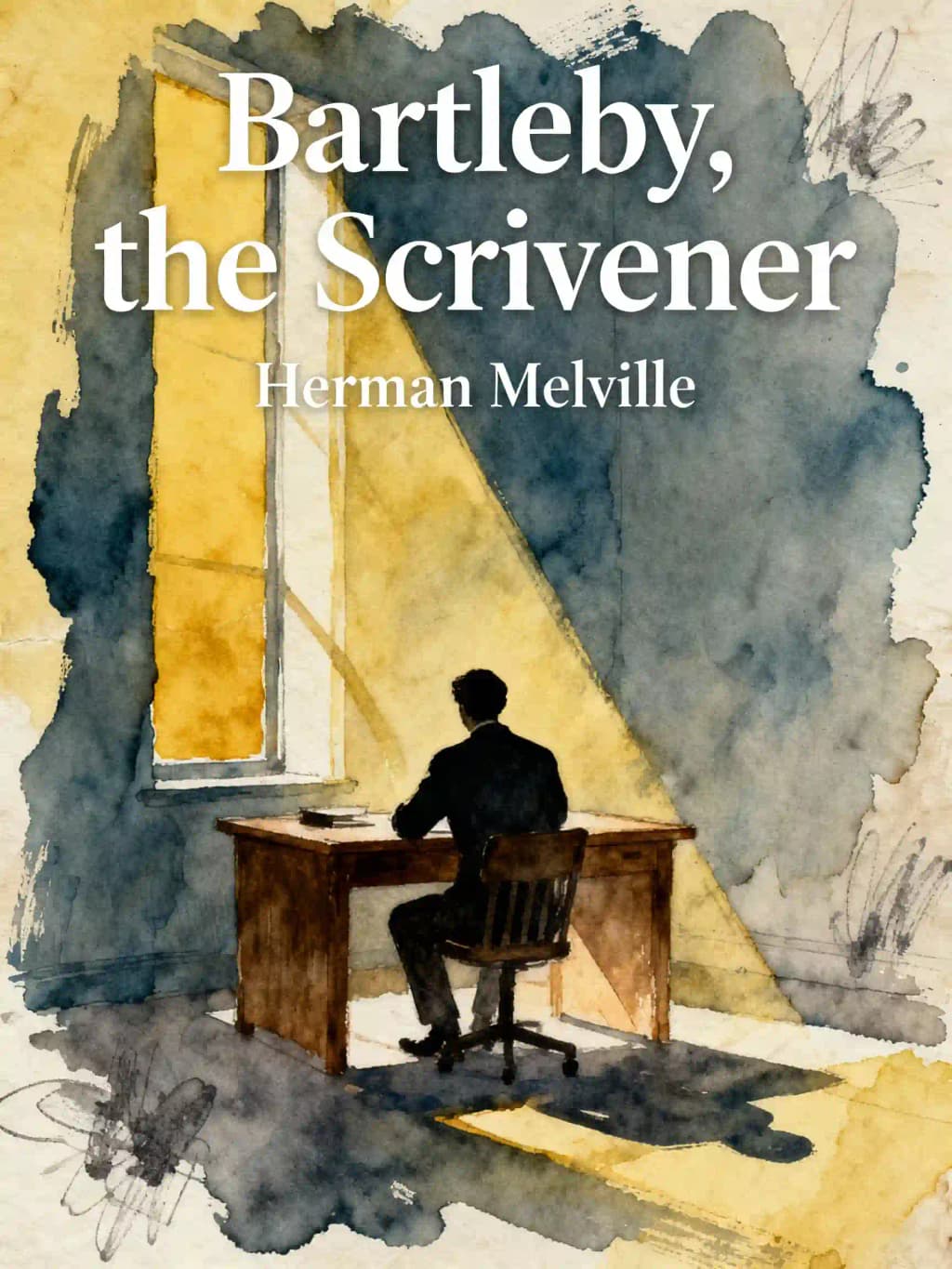
Bartleby's withdrawal accelerates when the lawyer arrives at the office one Sunday morning to find Bartleby has been living there secretly. The discovery of Bartleby's personal effects - a toothbrush tucked behind a folding screen, a small cake of soap beneath his desk, and a threadbare blanket rolled up in a corner - reveals the scrivener has made the office his permanent residence. These humble possessions, carefully hidden yet speaking volumes about their owner's circumstances, inspire both pity and profound unease in the narrator. The office space, initially just a workplace, has become Bartleby's entire universe - his bedroom, his dining room, his whole world compressed into a few square feet of Manhattan real estate.
Soon after, Bartleby's final decline begins when he announces, with his characteristic calm, "I have given up copying." This declaration marks a crucial turning point - the abandonment of his sole professional function. Standing motionless at his window, gazing for hours at the blank brick wall outside, Bartleby has ceased all productive activity. His stillness becomes almost statue-like, as if he's slowly transforming into part of the office architecture. Yet he refuses to leave, creating an impossible situation that the narrator struggles to resolve. The lawyer methodically considers various options: firing Bartleby (which proves meaningless since he already doesn't work), physically removing him (which the lawyer considers beneath his professional dignity and social standing), or allowing him to remain (which creates increasing tension and disruption in the office's daily operations). Each potential solution reveals the inadequacy of conventional workplace responses to Bartleby's unconventional form of passive resistance.
The lawyer's increasingly desperate attempts to understand Bartleby prove futile. When asked directly about his history, family connections, or future intentions, Bartleby responds with his signature phrase, "Would you not prefer that I not answer?" or simply, "At present I prefer to give no answer." His past remains an impenetrable mystery, his motivations obscured behind a wall of gentle refusal. The only window into his inner state comes from the narrator's careful observation that Bartleby spends countless hours staring at the blank wall outside his window - a dead view of yellowed brick that seems to mirror his increasingly deadened engagement with the world around him. This wall becomes both a literal barrier and a powerful symbol of Bartleby's isolation from society.
What makes Bartleby's withdrawal so powerful is its gradual, inexorable nature. He doesn't dramatically quit or stage any form of protest; he simply, quietly, step by step, withdraws from the expectations placed upon him by society and his employer. His resistance is not active but passive, not violent but immovably firm. He doesn't argue or attempt to justify his actions - he merely states his preferences with an almost philosophical calm and stands by them with a strange, gentle dignity that proves more disruptive than any confrontation could be. His method of resistance challenges not just workplace authority but the very foundations of social interaction and obligation.
Capitolo 4
The Lawyer's Moral Crisis: Compassion Versus Convenience
As Bartleby's behavior becomes increasingly problematic, the narrator experiences a profound moral crisis that forms the emotional core of the story. Initially annoyed and bewildered by Bartleby's refusals, the lawyer's feelings evolve into a complex mixture of pity, responsibility, and exasperation. "Nothing so aggravates an earnest person as a passive resistance," he observes, recognizing that Bartleby's quiet persistence affects him more deeply than open rebellion would.
The lawyer's responses to Bartleby reveal his character's complexity. At times, he shows remarkable compassion, defending Bartleby to other employees and making allowances for his strange behavior. "Poor fellow!" he thinks, "he means no mischief." He even attempts to learn about Bartleby's history and offers him various alternative employment opportunities. These moments of genuine human concern suggest the lawyer possesses moral depth beyond his professional identity.
Yet the narrator also repeatedly retreats from full ethical engagement with Bartleby's situation. When his business associates express discomfort with Bartleby's presence, the lawyer's concern for his professional reputation ultimately outweighs his compassion. "I might give alms to his body; but his body did not pain him; it was his soul that suffered, and his soul I could not reach," he rationalizes, using philosophical distance to absolve himself of deeper responsibility.
The crisis reaches its peak when the lawyer, unable to remove Bartleby from his office, takes the extraordinary step of moving his entire business to a new location-literally fleeing from the moral problem Bartleby represents. This physical escape mirrors his psychological evasion of responsibility, choosing convenience over the difficult work of genuine human connection. "Since he will not quit me, I must quit him," the lawyer decides, revealing the limits of his compassion when it requires true sacrifice.
The lawyer's moral struggle resonates because it reflects our own complicated relationship with social responsibility. How far does our obligation to others extend? When does self-preservation justifiably outweigh compassion? The story offers no easy answers, instead inviting readers to recognize themselves in the lawyer's conflicted responses.
Capitolo 5
Society's Machinery: Walls, Windows, and the Prison of Conformity
Melville's story unfolds in a landscape dominated by walls-physical, social, and psychological barriers that confine and separate. The office itself is surrounded by walls, with Bartleby's window facing a blank brick wall just three feet away. This "dead-wall reverie" becomes Bartleby's primary occupation after he ceases copying, suggesting both his spiritual imprisonment and his refusal to engage with the illusory prospects society offers.
The walls serve as powerful metaphors for the constraints of 19th-century commercial society. Wall Street itself-the setting named in the story's subtitle-represents American capitalism's emerging power, with its demands for productivity, conformity, and the subordination of human needs to economic imperatives. Within this system, workers like the scriveners function as human copying machines, reproducing documents without creative input or personal meaning.
The office's physical arrangement reinforces this mechanistic view of humanity. Turkey and Nippers share a table, their complementary dysfunctions (Turkey useless after noon, Nippers before) creating one functional worker between them. They are valued not for their humanity but for their utility-parts in the legal machinery that can be optimized and managed. Even their nicknames reduce them to consumables (food items) rather than full persons.
Against this dehumanizing backdrop, Bartleby's famous phrase-"I would prefer not to"-represents a profound assertion of human will. By expressing preference rather than outright refusal, Bartleby maintains his dignity while exposing the voluntary nature of social compliance. His resistance reveals that the walls constraining human potential are not merely physical but constructed through shared agreement to prioritize productivity over personhood.
The story's climax in the Tombs-New York's infamous prison-makes this metaphorical imprisonment literal. Found "strangely huddled at the base of the wall" in the prison yard, Bartleby dies having refused food, a final preference that completes his withdrawal from society's demands. The prison's nickname-"the Tombs"-underscores that conformity to social expectations is a kind of living death, while Bartleby's physical death paradoxically represents his ultimate freedom from these constraints.
Capitolo 6
The Dead Letter Office: Undelivered Messages and Failed Communication
The story's epilogue reveals a crucial detail about Bartleby's past through a rumor that he previously worked in the Dead Letter Office in Washington, D.C. This seemingly minor biographical detail serves as a powerful metaphor that illuminates the entire narrative. In this role, Bartleby would have spent years sorting through mail that never reached its intended recipients - a job that required him to be a daily witness to countless instances of failed human connection and thwarted communication.
The Dead Letter Office itself functions as a repository of human tragedy on both grand and intimate scales. These undelivered messages represent a spectrum of human experience and loss: "money sent in swift mercy" that never alleviates poverty or suffering; "pardons for those who died despairing" on death row; "hope for those who died unhoping" in their darkest moments; letters of reconciliation that never mended broken relationships; and declarations of love that remained forever unread. Each dead letter represents not just a failed message but a small tragedy of human intention left unfulfilled. The cumulative weight of handling thousands of such aborted communications would be enough to induce what the narrator describes as "pallid hopelessness" in even the most resilient soul.
This context transforms our understanding of Bartleby's infamous phrase, "I would prefer not to." Rather than mere obstinacy or rebellion, his response can be interpreted as an existential position derived from intimate knowledge of communication's futility. If messages consistently fail to reach their destinations, if human connection is ultimately impossible, why participate in the charade of meaningful work? Bartleby's withdrawal becomes a logical, albeit extreme, response to the absurdity of continuing to function in a system where meaning itself has become hollow.
The dead letter metaphor extends throughout the story's own communicative structure, manifesting in multiple layers. The lawyer's repeated attempts to understand Bartleby are themselves like dead letters - messages that never reach their intended recipient. Their conversations form a pattern of failed communication: the lawyer speaks from a position of social convention and practical concern, while Bartleby responds from a philosophical space beyond these considerations. Their dialogue consists of statements that never truly connect, questions that receive non-answers, and intentions that find no reception. Even the physical space of the office becomes a metaphor for this communicative disconnect, with Bartleby's screen both connecting and separating him from others.
The story's final line - "Ah, Bartleby! Ah, humanity!" - takes on deeper resonance when viewed through this lens. It becomes not just a lament for one man's tragedy but a recognition of the universal human condition of isolation. The lawyer's exclamation acknowledges both the particular tragedy of Bartleby and the broader human struggle with connection and meaning. In this light, Bartleby becomes an extreme example of a universal condition - the difficulty, perhaps impossibility, of truly bridging the gap between individual consciousness and achieving genuine human connection.
The Dead Letter Office metaphor ultimately suggests that all human communication might be, to some degree, "dead letters" - attempts at connection that never fully reach their destination, leaving us all, like Bartleby, in various states of isolation and disconnect.
Capitolo 7
Transcendental Refusal: Bartleby and American Philosophy
Melville wrote "Bartleby" during the height of American Transcendentalism, and the story can be read as a complex response to this philosophical movement. Transcendentalists like Ralph Waldo Emerson and Henry David Thoreau advocated self-reliance, spiritual intuition, and resistance to social conformity-ideas that Bartleby seems simultaneously to embody and subvert. The movement's emphasis on individual conscience and spiritual self-discovery found its fullest expression in works like Emerson's "Self-Reliance" and Thoreau's "Walden," which celebrated the individual's capacity to transcend social conventions and connect directly with deeper truths.
Bartleby's famous phrase "I would prefer not to" echoes Thoreau's philosophy of civil disobedience, where conscience trumps social obligation. In "Resistance to Civil Government," Thoreau writes that the individual must "be a counter friction to stop the machine" of unjust society-a description that perfectly captures Bartleby's effect on the law office. By preferring not to participate, Bartleby becomes sand in the gears of commercial machinery. His passive resistance mirrors Thoreau's tax refusal and imprisonment, though Bartleby takes this principle to an extreme that even Thoreau might have found excessive.
Yet Bartleby lacks the positive vision that animates Transcendentalist thought. Where Thoreau withdrew to Walden Pond to "live deliberately" and discover essential truths, Bartleby withdraws into nothingness. His resistance leads not to self-realization but to self-annihilation. He embodies what critic Leo Marx called "the negative Transcendentalism of Melville"-skepticism about whether spiritual truth exists beyond social convention. This darker vision reflects Melville's own philosophical struggles with questions of truth and meaning, evident in works like "Moby-Dick" and "Pierre."
Bartleby's window-gazing parodies the Transcendentalist reverence for nature and vision. Instead of Emerson's transparent eyeball absorbing the divine through nature, Bartleby stares at a blank wall-suggesting that beyond social constructs lies not transcendent truth but emptiness. His preference "not to" can be read as a nihilistic inversion of Transcendentalist self-affirmation, a refusal that leads not to higher truth but to death. The contrast between Bartleby's dead wall reveries and Emerson's nature-based epiphanies highlights Melville's skepticism about Transcendentalist optimism.
Through this complex engagement with Transcendentalism, Melville raises profound questions about resistance and withdrawal. Is Bartleby's refusal heroic or pathological? Does his death represent triumph over a dehumanizing system or defeat by it? The story offers no definitive answers, instead inviting readers to consider the ambiguous boundary between principled resistance and self-destruction. This ambiguity extends to broader questions about the relationship between individual conscience and social obligation, the limits of passive resistance, and the possibility of finding meaning in a mechanized world.
The story's ending, with Bartleby's death in the Tombs prison, can be read as Melville's dark commentary on the ultimate fate of Transcendentalist ideals in an increasingly materialistic society. While Thoreau emerged from his withdrawal stronger and more certain, Bartleby's resistance leads only to isolation and death, suggesting perhaps that pure individualism, pushed to its logical extreme, becomes self-negating. This tension between idealistic philosophy and harsh reality reflects Melville's own struggles with Transcendentalist thought and his growing pessimism about human nature and society.
Capitolo 8
The Preference Not to: Free Will in a Deterministic World
At its philosophical core, "Bartleby" explores the nature and limits of human freedom. The scrivener's famous phrase-"I would prefer not to"-occupies a fascinating middle ground between assertion and negation, activity and passivity, that challenges conventional understandings of free will.
Bartleby's statement is neither compliance nor direct refusal. By framing his response as preference rather than refusal, he maintains a strange kind of freedom even within the constraints of his subordinate position. He doesn't say "I won't" (which would acknowledge the authority to command) or "I can't" (which would suggest inability). Instead, "I would prefer not to" asserts his agency through the very expression of preference while simultaneously withdrawing from expected action.
This formulation resonates with philosophical debates about free will that were prominent in Melville's time. Determinists argued that human choices are ultimately caused by prior conditions and motivations, making true freedom illusory. Libertarians (in the philosophical sense) countered that genuine freedom requires the ability to choose independently of prior causes. Bartleby's phrase suggests a third possibility: freedom might consist not in uncaused choice but in the capacity to withhold assent from the causal chain-to prefer not to participate in the determined world.
The lawyer's bewildered response to Bartleby reveals how profoundly this passive resistance disrupts social and philosophical assumptions. "Nothing so aggravates an earnest person as a passive resistance," he observes, recognizing that Bartleby's stance challenges not just workplace authority but the entire system of social relations built on predictable responses to incentives and commands.
As Bartleby's withdrawal progresses from specific tasks to all activity and finally to life itself, the story raises increasingly urgent questions about the nature of freedom in a constrained existence. Is Bartleby's death a final assertion of freedom-the ultimate preference not to participate-or its opposite, the inevitable conclusion of a life that found no sustainable mode of resistance? The ambiguity persists, making the story a continuing provocation to philosophical reflection on human agency and its limits.
Capitolo 9
The Legacy of Bartleby: From Wall Street to Modern Resistance
Though initially overlooked, "Bartleby" has grown in stature to become one of the most analyzed and influential American short stories. Its impact extends far beyond literary circles into philosophy, political theory, and popular culture, where Bartleby's passive resistance continues to inspire new forms of protest against dehumanizing systems.
Philosophers from Gilles Deleuze to Giorgio Agamben have found in Bartleby a paradigm for thinking about resistance outside traditional political categories. Deleuze sees in Bartleby's formula a "logic of preference" that disrupts binary oppositions and creates new possibilities. Agamben interprets Bartleby as representing "pure potentiality"-the capacity to not-do that precedes and makes possible genuine action. These philosophical readings have established Bartleby as a conceptual figure representing resistance through withdrawal.
In political discourse, "Bartleby politics" has come to describe forms of protest based on non-participation rather than active opposition. From the "quiet quitting" movement in contemporary workplaces to various forms of consumer boycott and tax resistance, Bartleby's preference not to participate offers a model for resistance that doesn't require direct confrontation with power.
The story's setting on Wall Street has gained additional resonance as financial capitalism has become increasingly dominant in modern life. Contemporary readers often interpret Bartleby's resistance as specifically directed against the dehumanizing aspects of financial systems-the reduction of human value to productive output, the endless copying and circulation of documents representing wealth rather than creating it, the subordination of human needs to market imperatives.
Perhaps most significantly, Bartleby's famous phrase has entered common language as a polite but firm way to decline participation without explanation or apology. "I would prefer not to" offers a linguistic model for maintaining dignity while withdrawing consent-a verbal formula that acknowledges social expectations while gently refusing to fulfill them.
This continuing resonance suggests that Melville's story captured something essential about modern existence: the tension between social demands for productive participation and the human need for autonomy and meaning. As long as this tension persists, Bartleby will remain a compelling figure-the man who simply preferred not to comply with a world that offered him walls instead of horizons, copying instead of creation, existence instead of life.