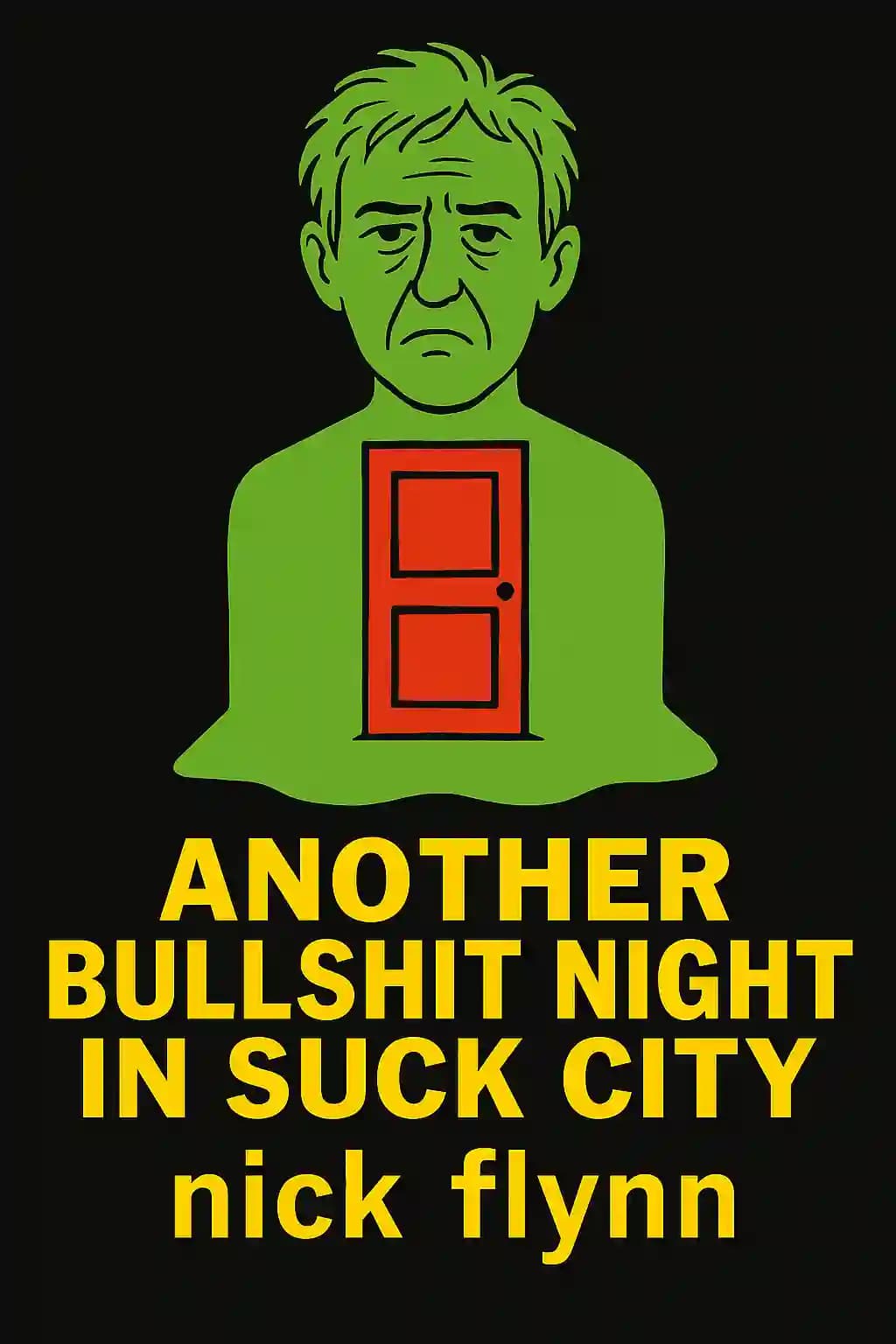
Another Bullshit Night in Suck City
A Memoir
Panoramica di Another Bullshit Night in Suck City
Nick Flynn's raw memoir collides with his father at a homeless shelter where he works. The Robert De Niro film adaptation "Being Flynn" brought this PEN Award finalist to wider audiences, revealing how family bonds persist through addiction, homelessness, and the unexpected poetry found in life's darkest corners.

Temi chiave in Another Bullshit Night in Suck City
- paternal abandonment
- homelessness crisis
- intergenerational addiction
- literary delusion
- family reconciliation
Citazioni da Another Bullshit Night in Suck City
Another Bullshit Night in Suck City
a name without a body
styling himself as 'Barracuda Buck, Native Guide.'
ignorance of facts being a step toward knowledge.
Personaggi di Another Bullshit Night in Suck City
- Nick FlynnThe author and son working at a homeless shelter
- Jonathan FlynnNick's father, a self-proclaimed poet and drifter
- JodyNick's mother who raised him alone
Sull'autore
Sull'autore di Another Bullshit Night in Suck City
Nick Flynn, a critically acclaimed author and poet, delves into the intricate themes of addiction, homelessness, and fractured family dynamics in his groundbreaking memoir, Another Bullshit Night in Suck City. A master of hybrid literary forms, Flynn skillfully intertwines his personal experiences, including his father’s incarceration and his mother’s suicide, with sharp social commentary.
His body of work, which includes the memoirs The Ticking Is the Bomb, an exploration of trauma through the prism of the Abu Ghraib scandal, and This Is the Night Our House Will Catch Fire, a genre-bending examination of childhood arson and parental failure, solidifies his standing as an unflinching autobiographical storyteller.
A Guggenheim Fellow and a professor of creative writing at the University of Houston, Flynn's poetry collections, such as I Will Destroy You and Some Ether, which garnered the PEN/Joyce Osterweil Award, further exemplify his profound psychological insight. The film adaptation of his memoir, Being Flynn, starring Robert De Niro and Julianne Moore, has reached a global audience through translations into fifteen languages, and his collaborations with visual artists continue to redefine the scope of literary expression.
Scarica il riassunto di Another Bullshit Night in Suck City
Ottieni il riassunto di Another Bullshit Night in Suck City in formato PDF o EPUB gratuito. Stampalo o leggilo offline quando vuoi.
FAQ su questo libro
Another Bullshit Night in Suck City is Nick Flynn’s acclaimed memoir exploring his turbulent relationship with his homeless father, their unexpected reunion at a Boston shelter, and intergenerational cycles of addiction and abandonment. Blending raw vulnerability with poetic prose, Flynn traces his mother’s suicide, his own struggles with alcoholism, and the fraught process of rebuilding identity amid familial wreckage.
This memoir resonates with readers interested in addiction narratives, fractured family dynamics, and unconventional literary styles. Its unflinching honesty appeals to fans of memoirs like The Glass Castle or Educated, while its experimental structure attracts poetry enthusiasts. Those exploring themes of homelessness or intergenerational trauma will find it particularly impactful.
Yes—Flynn’s memoir is widely praised for its lyrical precision and emotional intensity, earning recognition as a PEN/Martha Albrand Award finalist and inspiring the film Being Flynn starring Robert De Niro. While some criticize its fragmented style as disorienting, most agree it offers a haunting, transformative look at redemption and self-discovery.
Flynn’s poetry collections (Some Ether, Blind Huber) inform the memoir’s condensed, imagery-driven chapters. Scenes unfold through vignettes rather than linear narrative, mirroring memory’s disjointed nature. Phrases like “suck city” (his term for despair’s gravitational pull) demonstrate his ability to distill complex emotions into visceral metaphors.
The memoir employs:
- Moby Dick-inspired structure: Chapters alternate between present-day recollections and mythic, allegorical passages.
- Second-person narration: Sections addressing Flynn’s father heighten emotional immediacy.
- Metatextual layering: Flynn critiques his own memory’s reliability, questioning how we reconstruct identity.
Flynn portrays homelessness not as a moral failing but a systemic and psychological crisis. His father’s letters (“I am the King of the Hoboes”) reveal the delusional self-mythologies survival often requires. The shelter where they reunite becomes a liminal space where societal roles dissolve, challenging stereotypes about poverty.
Addiction emerges as both inherited trauma and coping mechanism. Flynn charts his descent into alcoholism parallel to his father’s deterioration, examining how substances function as “anesthesia for the soul”. His eventual sobriety—achieved through therapy and writing—frames recovery as an ongoing negotiation with pain.
Critics lauded its originality, with The New York Times calling it “a scorching, indelible vision of a lost world”. However, some readers found the nonlinear structure confusing, and a minority criticized Flynn’s portrayal of his father as overly detached. It remains a landmark in contemporary memoir for its formal daring.
- “Every family wrecks themselves in their own way.”
- “Suck city: located just below the reality you know.”
These lines encapsulate the book’s exploration of inherited trauma and the gravitational pull of self-destruction.
Unlike The Ticking Is the Bomb (which interrogates torture through personal and political lenses) or This Is the Night Our House Will Catch Fire (a meditation on parenthood and infidelity), Suck City focuses narrowly on filial reconciliation. All share his signature blend of memoir, philosophy, and fragmented narrative.
Some accused Flynn of exploiting his father’s homelessness for literary gain, though most scholars praise his ethical nuance in depicting agency amid marginalization. The memoir’s title—a crude phrase borrowed from his father—also sparked debates about reclaiming derogatory language.
While the film softens Flynn’s childhood trauma and simplifies his relationship with his father, it retains the core theme of inherited brokenness. Robert De Niro’s portrayal emphasizes performative masculinity, whereas the book delves deeper into generational shame.
Its unflinching examination of addiction, housing insecurity, and mental health remains urgent amid ongoing crises. The memoir’s critique of how society dehumanizes the marginalized continues to inform contemporary debates about poverty and compassion.