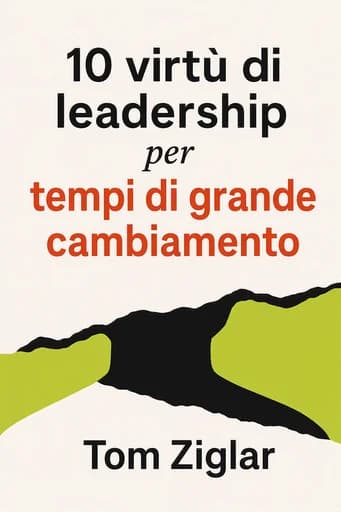
In disruptive times, leadership requires more than strategy - it demands virtue. Tom Ziglar's guide, endorsed by Ken Blanchard, bridges the empathy gap between managers and teams. Can kindness and humility actually drive success? Discover why ethical leadership is your competitive advantage in chaos.
Tom Ziglar, CEO of Ziglar, Inc. and author of 10 Leadership Virtues for Disruptive Times, is a globally recognized leadership strategist and torchbearer of the Ziglar legacy in personal development.
Building on the philosophy pioneered by his father, motivational icon Zig Ziglar—"You can have everything in life you want if you help others get what they want"—this book distills decades of corporate training expertise into actionable strategies for modern turbulence.
A sought-after keynote speaker for Fortune 50 companies and academic institutions like Harvard and Cambridge, Ziglar reinforces his leadership framework through his TEDx talk "The Coach Leadership Model" and his earlier bestselling book Choose to Win.
As steward of the Ziglar brand—6.5M+ Facebook followers and a top-ranked business podcast—he merges timeless principles with AI-enhanced coaching tools. The Ziglar Corporation’s programs, trusted by organizations worldwide, have equipped over 250 million people through content spanning 33 books and transformational seminars.
10 Leadership Virtues for Disruptive Times provides a framework for leading teams through uncertainty by cultivating 10 core virtues: kindness, selflessness, humility, positivity, self-control, and others. Tom Ziglar blends his father Zig Ziglar’s motivational philosophy with modern coaching strategies, emphasizing that leadership starts with personal transformation, not just organizational change. Practical examples and real-world stories make it actionable for today’s challenges.
This book is ideal for managers, entrepreneurs, and anyone leading teams through rapid change, such as hybrid work transitions or industry disruptions. It’s particularly valuable for leaders seeking to balance performance with empathy, and those interested in Ziglar’s Coach Leadership Model to attract and retain top talent.
Yes—the book offers timeless principles for modern crises, like pandemic recovery and AI-driven workplace shifts. Readers praise its actionable steps, such as implementing “coaching conversations” to boost productivity while improving work-life balance. Over 150 coaches globally use Ziglar’s system, demonstrating its practicality.
The 10 virtues are grouped into three categories:
Unlike theoretical guides, Ziglar focuses on self-directed change rather than fixing teams. It’s faith-friendly but secular-applicable, avoiding overt religious references while emphasizing ethical leadership. The book also integrates Ziglar’s proprietary coaching system, used by companies like Harvard-backed startups.
Introduced in Ziglar’s TEDx talk, this model teaches leaders to attract, develop, and retain talent by prioritizing mentorship over micromanagement. It’s designed for post-pandemic challenges, helping managers address remote work burnout and “quiet quitting” through empathetic communication.
Absolutely. The book provides tools to maintain engagement in hybrid environments, like virtual “coaching check-ins” and conflict resolution templates. Ziglar cites case studies where leaders reduced turnover by 40% using these methods post-2020.
Some reviewers note the virtues are broad (e.g., “be kind”) and lack niche tactics for industries like tech or healthcare. However, most praise its adaptability—Ziglar encourages tailoring frameworks to specific team needs rather than one-size-fits-all rules.
Tom modernizes Zig Ziglar’s iconic “help others achieve their goals” philosophy for the digital age. While Zig senior focused on sales psychology, Tom emphasizes sustainable leadership through coaching and legacy-building. Both share a focus on balanced success across career, health, and relationships.
Chapters follow a Learn-Apply-Reflect format:
With 72% of companies facing AI-driven restructuring (per Ziglar’s 2024 data), the book’s focus on adaptability and emotional intelligence addresses today’s skills gap. Updated case studies cover leading multigenerational teams and ethical AI implementation.
Senti il libro attraverso la voce dell'autore
Trasforma la conoscenza in spunti coinvolgenti e ricchi di esempi
Cattura le idee chiave in un lampo per un apprendimento veloce
Goditi il libro in modo divertente e coinvolgente
We always have a choice: fold up or rise up to create a better world.
Quality of life leads to quality of work.
Help team members see they're working for dreams, not paychecks.
Coaches get better results than managers.
It is how you handle what happens to you.
Scomponi le idee chiave di 10 Leadership Virtues for Disruptive Times in punti facili da capire per comprendere come i team innovativi creano, collaborano e crescono.
Vivi 10 Leadership Virtues for Disruptive Times attraverso narrazioni vivide che trasformano le lezioni di innovazione in momenti che ricorderai e applicherai.
Chiedi qualsiasi cosa, scegli il tuo stile di apprendimento e co-crea intuizioni che risuonano davvero con te.

Creato da alumni della Columbia University a San Francisco
"Instead of endless scrolling, I just hit play on BeFreed. It saves me so much time."
"I never knew where to start with nonfiction—BeFreed’s book lists turned into podcasts gave me a clear path."
"Perfect balance between learning and entertainment. Finished ‘Thinking, Fast and Slow’ on my commute this week."
"Crazy how much I learned while walking the dog. BeFreed = small habits → big gains."
"Reading used to feel like a chore. Now it’s just part of my lifestyle."
"Feels effortless compared to reading. I’ve finished 6 books this month already."
"BeFreed turned my guilty doomscrolling into something that feels productive and inspiring."
"BeFreed turned my commute into learning time. 20-min podcasts are perfect for finishing books I never had time for."
"BeFreed replaced my podcast queue. Imagine Spotify for books — that’s it. 🙌"
"It is great for me to learn something from the book without reading it."
"The themed book list podcasts help me connect ideas across authors—like a guided audio journey."
"Makes me feel smarter every time before going to work"
Creato da alumni della Columbia University a San Francisco

Ottieni il riassunto di 10 Leadership Virtues for Disruptive Times in formato PDF o EPUB gratuito. Stampalo o leggilo offline quando vuoi.
In a world where change accelerates daily, Tom Ziglar offers a refreshing perspective on leadership. The COVID-19 pandemic demonstrated how quickly our work environments can transform-and surprisingly, many organizations discovered increased productivity as remote work eliminated commutes and rigid schedules. This massive disruption is just one example of the accelerating pace of change reshaping our world. From flying cars with AI pilots to healthcare delivered by drones, the future arriving on our doorstep demands a new leadership approach. The wisdom of Zig Ziglar remains relevant: "It's not what happens to you that determines how far you will go in life; it is how you handle what happens to you." During disruption, we always face a choice-fold up or rise up to create something better. The answer lies in ten leadership virtues that enable what Tom calls "Coach Leaders" to thrive during uncertainty by building bridges between people's pain and the organization's vision. These virtues form a "corrosion-proof" connection that grows stronger, not weaker, during times of challenge.
The shift toward coach-style leadership has accelerated because coaches get better results than managers - especially in remote environments. While managers delegate through authority, coaches serve as guides who co-create, ask questions, and focus on growth. During disruption, team members experience uncertainty that threatens their security. Coach Leaders understand the crucial "atmosphere connection" - people's feelings about their jobs directly correlate with their feelings about leadership. This becomes even more critical with remote teams, where building relationships and fostering innovation requires intentional empathy. The Ziglar approach unlocks potential through four steps: Inspire (breathe life into hopes), Influence (shape mindset through positive choices), Impart (build confidence for action), and Introduce (practices that transform habits). This removes pressure by focusing on incremental choices rather than dramatic change. Tools like DISC profiles help leaders adapt their communication to each team member's needs.
Quality of life directly impacts quality of work-particularly during disruptions when personal weaknesses become magnified. The Ziglar Wheel of Life encompasses seven interconnected areas: Career, Family, Financial, Mental, Personal, Physical, and Spiritual. Success requires balance across all spokes, as neglecting any area diminishes the others. Focusing solely on career while neglecting family and spiritual growth limits professional potential. Similarly, wealth without health merely creates "a chronically ill wealthy person." Coach Leaders influence team members' life balance by building trust through the ten virtues, then helping them evaluate their wheel balance. This holistic approach recognizes that personal challenges impact professional performance, especially during disruptions. By supporting team members across all life dimensions, Coach Leaders foster resilience that translates to sustained performance during difficult times. The coaching process follows four phases: Discovery (asking curious questions), Strategy (co-creating plans), Accountability (establishing clear follow-up), and Growth (developing self-coaching capabilities).
Developing selflessness shifts focus from self to others. Creating detailed gratitude lists for team members builds a foundation for valuing people for who they are, not just what they produce. When you ask deeper "why" questions beyond surface motivations, you uncover what truly drives your people. Help team members connect job performance to personal goals, showing they're working for dreams, not just paychecks. Sometimes this means transcending professional boundaries - like running errands for someone preparing for a presentation - demonstrating their dreams matter more than your authority. True listening is inherently selfless as it focuses entirely on the other person. Selfless leaders attend to tone, body language, and energy beyond words. No one complains about being truly listened to because it shows they matter more than deadlines or tasks. The "nice to have" tradition exemplifies thoughtfulness - not just any Starbucks drink but their favorite one, not just any thank-you card but one reflecting their interests. When facing challenges, mentally change seats with team members to understand their thoughts, feelings, and fears. Coach Leadership reaches its highest level when you're selfless enough to genuinely view challenges from your team's perspective.
How you treat others, especially service workers, sets a powerful example. Tom recalls his parents visiting restaurants and treating every employee with genuine interest and respect, asking about their families and offering encouragement. These actions created lasting impressions and demonstrated that respecting everyone forms the foundation for team respect. In today's polarized environment, true respect acknowledges others' right to different beliefs without necessarily agreeing with them. Respect begins with self-respect, shown through intentional growth in mindset, spiritual and physical health, positive self-talk, and healthy boundaries. Before coaching conversations, create mental models by considering what outcome you want, what the other person is thinking and feeling, and what resources they might need. Understanding someone's perspective helps you better support their growth goals. As Bob Tiede noted, "Leadership is not as much about knowing the right answers as it is about asking the right questions!" When celebrating accomplishments, be meaningful and specific - detail what was achieved and how, connecting achievements to character qualities displayed. Recognizing someone incorrectly can be as harmful as not recognizing them at all.
Humility is essential when navigating major technological changes. Converging advances in blockchain, 5G networks, quantum computing, AI, and battery storage are transforming our work and lives. For perspective, blockchain could reduce a 90-day home refinancing process requiring fifty documents to just ten minutes through secure financial record storage. Leaders need courage and humility to embrace new technologies, even when it means appearing inexperienced before tech-savvy younger colleagues. When Tom shared with mentor Bob Tiede his frustration about having ideas without implementation capacity, Bob offered a crucial shift: "You're asking yourself the wrong question. The question shouldn't be 'How do I do this?' but 'Who should do this?'" With experts in unfamiliar areas, humility means asking questions rather than dictating methods. Few things impact people more profoundly than someone showing authentic curiosity about their thinking and choices.
During tough times, effective leadership requires both a strong spine and an open heart. Like a lighthouse in a hurricane, leading with integrity creates stability amid chaos and builds trust. P.T. Barnum in "The Greatest Showman" exemplifies this - recognizing greatness in society's outcasts and demanding they be treated with dignity. Your personal story is your greatest leadership asset. When Zig Ziglar shared his humble beginnings - born in "lower Alabama," raised by a widowed mother with fifth-grade education, struggling in school and sales - audiences shifted from thinking "I could never be like him" to "If he can, maybe I can." This identity connection motivates people to follow your recommendations until they see results. Though disruption accelerates, leading through these ten virtues creates a future where those you lead know you respond with kindness, serve selflessly, show respect, exercise humility, maintain self-control under pressure, stay positive, look for the best in everyone, illuminate the path forward, never give up, and stand firm. Your ultimate legacy isn't just passing knowledge but transferring character-building habits. The true measure of your leadership is who you help others become.