Chapitre 1
The Science of Small Changes, Big Results
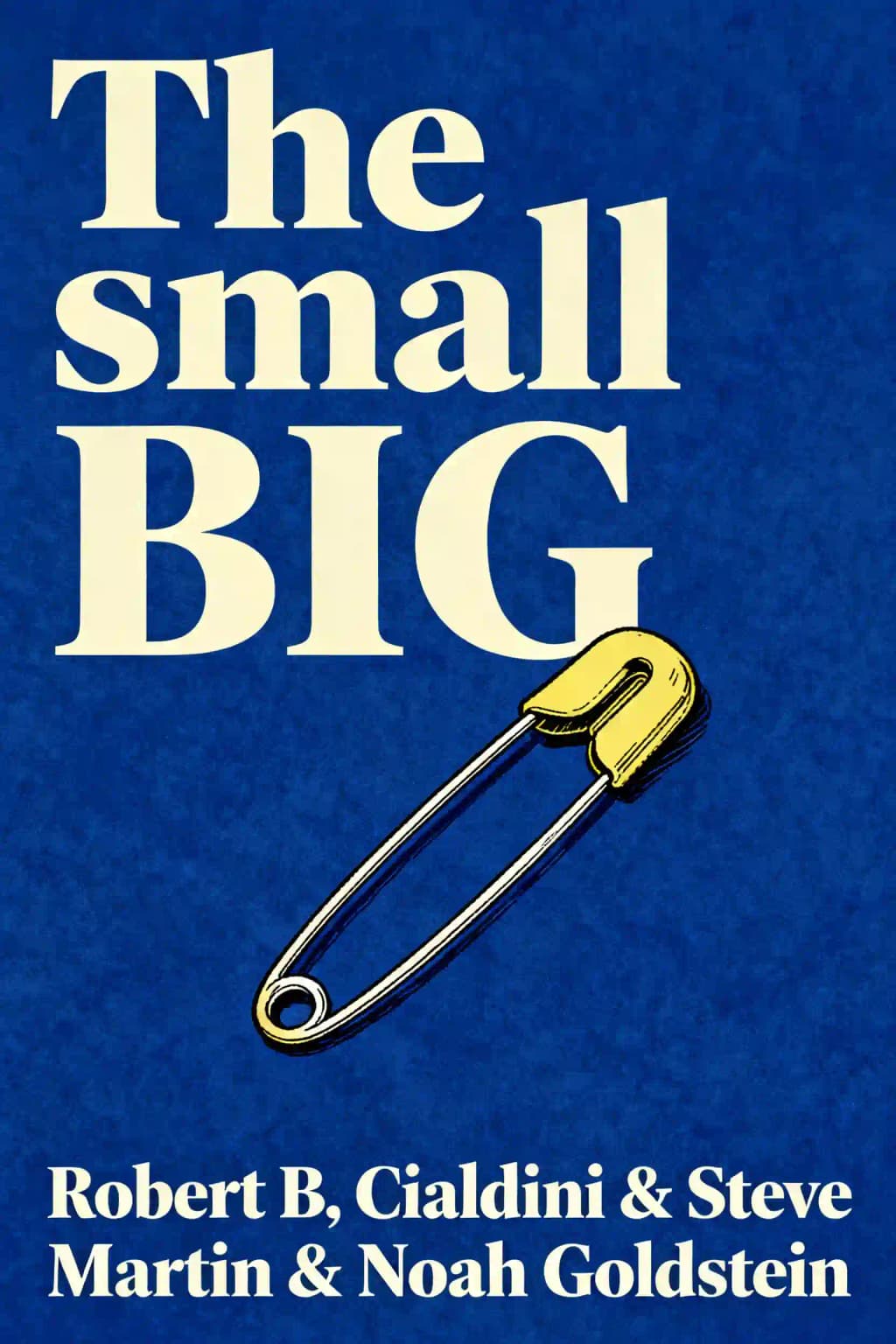
When Britney Spears cancels a concert, it makes headlines. But what about the millions of everyday no-shows that collectively cost billions? In the UK alone, missed medical appointments drain 800 million annually from the National Health Service. What if tiny, almost imperceptible changes could dramatically reduce these costly absences? "The Small Big" by Robert Cialdini, Steve Martin, and Noah Goldstein reveals precisely this counterintuitive truth: in our information-saturated world, small changes in context can create enormous differences in outcomes.
Since its 2014 publication, this book has become required reading in behavioral economics courses at top universities worldwide. Its insights have transformed government policies in multiple countries and revolutionized corporate practices across industries. The book's genius lies in challenging our traditional assumption that more information leads to better persuasion. Instead, the authors demonstrate that subtle contextual shifts-a single added sentence, a slight reframing, or a tiny procedural tweak-can dramatically alter how information is received and acted upon.
Chapitre 2
The Power of Social Proof: How Others Shape Our Behavior
When British tax officials faced the perennial problem of late tax returns, they tried something radical yet remarkably simple: adding just one sentence to their standard collection letter. This tiny change produced extraordinary results, helping collect 560 million of 650 million in targeted debt-an 86% clearance rate compared to just 57% the previous year.
The magic sentence? Simply informing recipients about the large number of citizens who actually pay their taxes on time. This leveraged the fundamental principle of social proof-our tendency to look to others' behavior as a guide for our own. Social proof works because it satisfies three powerful human motivations: making efficient decisions, affiliating with others, and maintaining a positive self-image.
What's fascinating is how blind we are to social proof's influence on us. In energy conservation studies, homeowners consistently rated "neighbors are conserving" as the least influential factor in their decisions. Yet when tested, this social proof message proved the most effective at actually changing behavior-even though participants couldn't recognize its impact before or after.
The effectiveness of social proof can be further enhanced through specificity. When British tax officials highlighted not just national compliance rates but local zip code statistics ("Most people in your town pay on time"), response rates jumped from 79% to nearly 83%. This reveals a crucial insight: messages aligned with recipients' specific social identities are significantly more powerful than generic statistics.
This principle extends beyond government communications. Online marketers could leverage IP addresses to provide location-specific social proof ("82% of New Yorkers choose this") rather than generic statistics. Even shared names create powerful connections-during the 2012 presidential election, Obama's campaign invited voters to see how many people sharing their first name had already voted early.
Chapitre 3
The Surprising Power of Deviation: When Going Against the Crowd Works Better
Going against the crowd is emotionally distressing and even physically painful. When participants in neuroscience studies made judgments contrary to group consensus, their brain's emotion centers activated, suggesting real emotional pain in defying group opinion. Using fMRI scanning, researchers observed increased activity in the amygdala and anterior cingulate cortex - regions associated with emotional distress and conflict monitoring. Despite knowing the group was wrong, participants still conformed about 40% of the time, demonstrating the powerful pull of social conformity.
But here's the fascinating twist: sometimes framing messages in terms of deviation rather than conformity works better. Psychologist Hart Blanton discovered that influence attempts are more successful when messages are framed in terms of deviation from perceived social norms rather than conformity to them. This finding challenges traditional wisdom about social influence, which typically emphasizes conformity.
The effectiveness of deviation-based messaging depends critically on existing perceptions. For example, if someone believes covering one's face while sneezing is the norm, a message highlighting the negative traits of those who don't cover up proves more effective. Conversely, if they believe not covering is normal, emphasizing the positive traits of those who do cover works better. Similar patterns emerge in areas like recycling, energy conservation, and workplace behavior.
This insight offers a powerful tool for communicators: consider your audience's perceptions of social norms before framing your message. If employees believe lateness is a common problem, highlight the positive traits of punctual workers. If they believe lateness is rare, focus on the negative traits of latecomers. In public health campaigns, understanding the perceived prevalence of behaviors like smoking or exercise can determine whether to emphasize positive deviants or negative non-conformists.
People are motivated both to conform to social norms and to define themselves as unique individuals. When people consider their identity, they become more attentive to the implications of deviating from rather than conforming to perceived norms. Research shows this effect is particularly strong among younger audiences and in contexts where individual expression is valued. Studies in consumer behavior demonstrate that people often prefer products that help them stand out while still maintaining some connection to their social group.
The small change that makes a big difference is tailoring your message to either highlight conformity or deviation based on your audience's existing perceptions. This approach has proven effective in various contexts, from environmental conservation to workplace safety. For instance, hotels found that messages emphasizing how few guests reuse towels (deviation) worked better than those highlighting how many do (conformity) when guests believed reuse rates were low. Similarly, tax compliance improves when messages emphasize either the rarity of tax evasion or the distinctiveness of honest taxpayers, depending on perceived norms.
Understanding this dual nature of social influence - the pull toward conformity and the desire for positive differentiation - enables more nuanced and effective persuasion strategies across various domains of human behavior.
Chapitre 4
Environmental Cues: How Surroundings Shape Behavior
The "broken windows theory" suggests that small signs of disorder can encourage widespread negative behavior by communicating permissive social norms. In the 1990s, New York officials under Mayor Giuliani focused on combating minor signs of disorder like graffiti, fare evasion, and aggressive panhandling. This approach, while controversial, coincided with significant reductions in serious crimes. The theory proposes that visible disorder sends a signal that no one cares about maintaining standards, thereby inviting further deterioration of social norms.
Researchers Keizer, Lindenberg, and Steg provided compelling evidence for this theory through a series of carefully controlled field experiments. In their landmark study at a Dutch shopping mall, they found that 33% of bicycle owners littered advertisements when no graffiti was present in the alleyway, but 69% littered when graffiti was visible. The presence of graffiti more than doubled the likelihood of littering, despite no direct connection between these behaviors. In another experiment, only 27% of pedestrians ignored a "do not enter" sign when bicycles were properly parked nearby, but 82% did so when bikes were locked to a fence in violation of posted rules. This demonstrated how one form of rule-breaking could normalize other violations.
Most alarmingly, theft rates of a money-containing envelope nearly doubled (from 13% to 25%) when the surrounding environment was littered. Even more striking, the effect held true across different socioeconomic areas and times of day, suggesting the influence of environmental cues transcends demographic factors. These findings reveal how powerfully subtle environmental signals influence behavior without any direct requests or commands, operating through implicit social messaging.
The most effective approach isn't merely maintaining an ordered environment but demonstrating active norm restoration. Having cleaning staff work during office hours rather than after everyone leaves shows the ongoing commitment to maintaining standards. Similarly, municipalities could support citizen groups who publicly clean up graffiti and litter, creating visible examples of community care. One study showed that passersby who witnessed someone picking up litter littered only 4% of the time, compared to 38% otherwise. This "positive contagion" effect suggests that witnessing prosocial behavior can be even more powerful than merely maintaining order.
Organizations can leverage these insights in multiple ways. Companies might schedule maintenance during working hours to demonstrate commitment to standards. Public spaces can be designed to make proper behavior more convenient, such as placing waste bins at regular intervals. Universities have found that displaying positive messages about academic integrity in examination rooms reduces cheating more effectively than threat-based warnings.
While a messy office refrigerator won't necessarily lead to corporate fraud, these findings suggest that seemingly minor environmental disorder can significantly impact behavior across multiple domains. The cumulative effect of small environmental cues can create a cascade of behavioral changes, both positive and negative. Contexts shape behavior as powerfully as information, making even small environmental changes potentially transformative for organizations seeking to influence behavior. This understanding has implications for everything from workplace design to urban planning, suggesting that investing in environmental order yields benefits far beyond mere aesthetics.
Chapitre 5
The Name Game: Harnessing the Power of Personal Connection
In the aftermath of Hurricane Sandy in 2012, news networks generated unofficial names like "Snowicane" and "Frankenstorm" to describe the devastating storm. While we don't know if these fear-inducing names increase donations, groundbreaking research by psychologist Jesse Chandler reveals that the official names of hurricanes significantly influence who donates to relief efforts. This discovery opened up new understanding about the psychology of names and their impact on human behavior.
People whose first names share an initial with a hurricane's name are dramatically more likely to donate to relief efforts. Those with R-names were 260% more likely to donate to Hurricane Rita relief than others, with similar patterns observed for Hurricane Katrina among K-named individuals. This pattern has persisted across many hurricanes over the years, including Hurricanes Ivan, Dennis, and Florence, where individuals sharing initials consistently showed higher donation rates. The effect was particularly strong when the name similarity was exact - for example, Dennis donating to Hurricane Dennis relief efforts.
This phenomenon highlights how fundamentally important our names are to us psychologically. Most people experience the "Cocktail Party Phenomenon"-the ability to detect their name being mentioned across a crowded room despite being engaged in another conversation. This selective attention demonstrates the deep neural pathways associated with our names. When asked to list their favorite letters of the alphabet, most people unconsciously choose letters from their own names, especially their initials. Research shows this preference extends to career choices, with people named Dennis or Denise being overrepresented among dentists, and those named Lawrence or Laura appearing more frequently in legal professions.
This insight offers practical applications for persuasion across various fields. Simply including someone's first name in communications can significantly increase effectiveness. An experiment with British physicians found that including a patient's first name in appointment reminder texts reduced no-shows by 57% compared to unnamed reminders. Interestingly, using full names or formal salutations produced no effect-only first names worked. Similar results have been found in email marketing campaigns, where personalized subject lines using first names increased open rates by up to 29%.
Such name-based strategies can be applied to business initiatives in multiple ways. Rather than using mysterious project names, you might gain more support by choosing names that match common first names or initials among implementation team members. Pharmaceutical sales executives might prioritize visiting Dr. Painton when launching a drug called Painaway. Companies have successfully used this approach in product naming - for instance, Amazon's Alexa was deliberately named to create a sense of familiarity and connection. Marketing teams have found success by segmenting email campaigns based on recipient names that match product names or brand initiatives. These small naming changes can truly be game-changing in building connection and influence, with some organizations reporting engagement increases of up to 40% when implementing name-based strategies.
The power of names extends beyond individual interactions to brand loyalty and customer relationships. Studies show that customers are more likely to engage with and remain loyal to brands that recognize and use their names appropriately in communications. This effect is particularly strong in service industries, where personal connection is paramount to success.
Chapitre 6
Building Bridges: Creating Connection Through Shared Identity
Business rarely stands still, and rapid change often creates unexpected challenges. Today's competitor might become tomorrow's colleague through acquisition, joint ventures, or company restructuring. These mergers of former adversaries can be particularly challenging, especially when teams have previously defined themselves in opposition to each other. The psychological barriers can be as significant as any operational or technical challenges, often manifesting in subtle resistance, reduced collaboration, and maintained social distance.
A solution comes from studying sports fans, notorious for fierce rivalries and tribal loyalties. Psychologist Mark Levine conducted revealing experiments with Manchester United supporters who witnessed an "injured jogger" (actually part of the study) wearing different shirts. When the jogger wore a plain white shirt, about a third stopped to help. When wearing a Manchester United shirt, the overwhelming majority - over 90% - helped. But when wearing rival Liverpool's shirt, fewer than 10% offered assistance. This stark contrast demonstrates how deeply ingrained group identities can affect basic human behaviors and interactions.
However, a small change made a significant difference: when Manchester United fans were first asked what they liked about being soccer supporters generally (rather than specifically about their team), they became twice as likely to help someone in a rival shirt. The key small change is focusing on shared identities rather than differences. This principle extends beyond sports - companies have successfully applied it in post-merger integration by emphasizing industry-wide challenges, shared professional values, or common customer-focused missions.
Adam Grant of Wharton suggests an even more powerful approach: identifying "uncommon commonalities" - rare traits or interests shared between new colleagues that distinguish them from other groups. This satisfies people's desire to both fit in with their new group and stand out from others. For example, discovering that team members from both merged companies share a passion for urban gardening, speak a rare language, or played the same obscure sport in college can create stronger bonds than common interests like supporting the same sports team or enjoying popular TV shows.
Managers can facilitate this by having team members complete detailed "getting-to-know-you" forms with longer lists of preferences, increasing the chances of discovering shared but unusual interests. Some successful companies have created digital platforms or apps specifically designed to help employees discover these uncommon commonalities, leading to organic relationship building across traditional organizational boundaries.
Whether managing a simple department restructure or merging industry giants, actively seeking uncommon commonalities can significantly accelerate cooperation, collaboration, and partnership between previously divided groups. Organizations that invest in identifying and highlighting these shared identities often see faster integration, reduced conflict, and more innovative collaboration as formerly separate teams begin to see themselves as part of a larger, shared identity while maintaining their unique characteristics.
Chapitre 7
The Commitment Principle: Small Actions, Big Follow-Through
A health center manager reports averaging around 300 patient no-shows monthly-people who schedule appointments but fail to appear. This problem extends beyond healthcare to business meetings, restaurant reservations, sales presentations, and student tutorials. While one missed restaurant booking might seem inconsequential, the cumulative costs are staggering. In the UK alone, missed healthcare appointments cost approximately 800 million (over $1 billion) annually.
The commitment and consistency principle offers a solution. When people make active commitments, especially public ones, they're motivated to follow through. In a beach experiment, 19 out of 20 sunbathers who verbally agreed to watch someone's radio attempted to stop a thief, compared to only 4 out of 20 who made no commitment.
Two simple strategies proved effective in medical settings: having patients read back appointment details (reducing no-shows by 3%) and having patients write their own appointment cards rather than receptionists (reducing no-shows by 18%). Both changes cost nothing to implement but could save millions. The key insight: active involvement in making commitments dramatically increases follow-through.
This principle extends beyond single actions to consistent behavior across multiple domains. Researchers tested this at a California hotel by asking guests to make environmental commitments at check-in. Those making specific commitments to reuse towels were not only more likely to follow through (66% versus 61%), but also more likely to engage in other environmental behaviors like turning off lights and air conditioning.
The most effective approach combined specific commitments with visible symbols-guests who both committed to towel reuse and received "Friends of the Earth" pins showed the highest compliance across all environmental behaviors. However, guests given pins without making commitments were the least likely to participate-even less than the control group.
The key insight: for maximum influence, use a two-step approach. First, seek specific, voluntary commitments rather than general ones. Second, create environmental cues that trigger related behaviors consistent with the initial commitment.
Chapitre 8
Motivation Beyond Money: Finding Meaning in Work
Motivating employees typically involves financial incentives, profit-sharing, or rewards-all potentially effective but expensive approaches that can create problematic reference points and erode intrinsic motivation. However, research by Adam Grant reveals a powerful, cost-free alternative: connecting employees with the meaningfulness of their work.
In a university call center study, employees who read stories from scholarship recipients who benefited from their fundraising efforts more than doubled their weekly pledges and donation amounts compared to control groups. This "task significance" intervention worked by inspiring previously unmotivated employees to make more calls per hour.
This approach costs nothing yet produces remarkable results. Managers can implement this small change by collecting and sharing customer testimonials, displaying success stories, beginning meetings with accounts of jobs well done, inviting customers to share their experiences directly (even virtually), or simply acknowledging employees' contributions.
As Grant observed in one call center, some employees feel that "doing a good job in this place is like wetting your pants in a dark suit"-they get a warm feeling no one recognizes. Sometimes the smallest change is just saying "well done" to someone who's made a difference.
This principle applies across industries and roles. Healthcare workers who see the direct impact of their efforts on patients show greater dedication and performance. Sales teams who understand how their products genuinely improve customers' lives sell more effectively. Even administrative staff perform better when they understand how their behind-the-scenes work enables others to succeed.
The small change that makes a big difference is creating clear connections between employees' daily tasks and the meaningful outcomes those tasks produce. This approach taps into our fundamental human desire to make a positive difference in the world-a motivation far more powerful and sustainable than financial incentives alone.
Chapitre 9
The Power of Precision: Small Details, Big Persuasion
When Arsenal FC made their unusual bid of 40,000,001 for soccer star Luis Suarez, the precise number grabbed global attention. Beyond attention-getting, research by Malia Mason and colleagues shows that precise opening offers in negotiations can significantly improve outcomes.
In their study, participants who received precise offers (like $1,865 or $2,135) responded with counteroffers just 10-15% higher, while those receiving round numbers ($2,000) countered with offers more than 23% higher. This effect occurred regardless of whether the precise number was higher or lower than the round figure.
The researchers found that recipients of precise offers assume the other party has thoroughly researched and prepared, giving them "good reasons" for their specific number. In a second experiment with experienced managers and executives, precise opening offers resulted in counteroffers 24% closer to the initial position than round-number offers did.
This precision advantage carried through to final settlements, suggesting you might actually get better results opening with a precise $3,935 than a round $4,000 when selling your car. This approach works across various contexts-from salary negotiations (asking for 9.8% instead of 10%) to project deadlines (requesting completion in 13 days rather than 2 weeks).
The power of precision extends beyond negotiation to pricing strategies. About 80% of supermarket products have prices ending in 9-a practice found across America, Germany, Britain, and New Zealand. Research shows .99 endings signal "a good deal" and create a "leveling down" effect-$19.99 falls into the "less than $20" band while $20.00 doesn't.
Most importantly, the left-most digit changes (from 2 to 1), which dramatically influences purchasing decisions. In a study by Manning and Sprott, when comparing pens priced at $1.99 vs. $3.00, 82% chose the cheaper option, compared to just 56% when priced at $2.00 vs. $2.99.
This principle extends beyond retail-a personal trainer might find clients more receptive to running 9.9 kilometers than 10, and scheduling a "1 hour 55 minute" meeting might attract more attendees than a 2-hour one. The small change in specificity makes a big difference in how offers are perceived and received.
Chapitre 10
Asking for Help: The Simplest Small Big
The answer to getting help is remarkably simple: just ask! Research by Frank Flynn and Vanessa Bohns reveals that people consistently underestimate-by about half-the likelihood that others will agree to their requests for help.
In studies where participants asked strangers to complete questionnaires, lend cell phones, or donate to charity, they predicted needing to ask twice as many people as actually required. This happens because requesters focus on the costs (time, effort, money) to the potential helper if they say yes, while underestimating the social costs (awkwardness, guilt, embarrassment) the person would face by saying no.
The implications are significant, particularly in workplace settings where team members might need help but incorrectly assume colleagues would refuse. Managers should explicitly communicate their willingness to assist and normalize help-seeking by sharing their own experiences.
The problem is compounded because potential helpers often overestimate the likelihood someone will ask if they need assistance-creating a situation where those needing help don't ask, and those willing to help don't offer. A small gesture like reassuring patients that "there are no silly questions" or personalizing communication can make a big difference in overcoming this barrier.
When we do receive help, expressing genuine gratitude creates powerful influence opportunities. Researchers Adam Grant and Francesca Gino found that explicitly conveying gratitude to someone who helped review a cover letter more than doubled compliance rates for subsequent requests-not just from the original recipient but even from complete strangers.
This occurs because expressing gratitude increases the favor-doer's sense of social worth. In a real-world test at a fundraising call center, employees who received a simple sixteen-word expression of gratitude from the director made 50% more phone calls the following week compared to those who received no such acknowledgment.
The small big of simply asking for help, followed by expressing genuine appreciation when it's received, creates a virtuous cycle of goodwill and cooperation that benefits everyone involved. Sometimes the most powerful influence strategies are also the simplest.