Chapitre 1
The Cosmic Horror That Lurks Beyond Human Understanding
H.P. Lovecraft once wrote that "the oldest and strongest emotion of mankind is fear, and the oldest and strongest kind of fear is fear of the unknown." These words have resonated through generations, inspiring filmmakers like Guillermo del Toro, musicians from Metallica to Nick Cave, and countless writers including Stephen King, who called Lovecraft "the twentieth century's greatest practitioner of the classic horror tale." Yet during his lifetime, Lovecraft lived in relative obscurity, dying penniless in 1937 without knowing his work would revolutionize horror literature and spawn an entire mythology that continues to terrify and fascinate readers today. His stories, with their cosmic scope and nihilistic worldview, reject traditional notions of good versus evil, instead presenting a universe indifferent to humanity where ancient, incomprehensible beings lurk just beyond our perception, waiting to reclaim what was once theirs.
Chapitre 2
Forbidden Knowledge and the Price of Curiosity
The protagonists in Lovecraft's tales are typically scholars, scientists, or intellectuals whose relentless pursuit of knowledge leads them into realms where human minds were never meant to venture. In "The Call of Cthulhu," the narrator begins with what may be Lovecraft's most famous passage: "The most merciful thing in the world is the human mind's inability to correlate all its contents." This philosophical cornerstone establishes the fundamental premise that underlies all of Lovecraft's cosmic horror - some truths are so terrible that knowing them drives one to madness.
This theme reaches its apex in "The Festival," where an unnamed narrator returns to his ancestral town of Kingsport during Yuletide, following a strange family tradition that commands return once every century. The town itself is a nightmare landscape of "ancient steeples, wharves, and labyrinthine streets with colonial houses piled at chaotic angles," while a nearby burying-ground features "black gravestones protruded like decayed fingernails of a gigantic corpse." This grotesque imagery establishes the decaying, ancient setting that will become a hallmark of Lovecraftian horror.
The narrator's quest for knowledge leads him to follow a strange procession through the town's white church and down into subterranean passages that transform from man-made crypts to primordial caverns. The descent itself symbolizes the journey into forbidden knowledge - each step taking him further from the safety of human understanding. When he witnesses the horrific ritual around a "blazing pillar" where "unspeakable hybrid winged things flopped from the darkness," he has crossed the threshold of knowledge from which there is no return.
What makes this story particularly disturbing is the revelation that the narrator's guide - an old man wearing what appeared to be a wax mask - is actually a corpse animated by something inhuman. The mask slips to reveal "what lay beneath," a sight so terrible the narrator flings himself into an underground river rather than face it. This moment crystallizes Lovecraft's warning about forbidden knowledge: once you see behind the mask of reality, you cannot unsee it, and the revelation may destroy you.
In "The Whisperer in Darkness," we find another intellectual whose curiosity leads to horror. Albert Wilmarth, a folklore professor at Miskatonic University, investigates reports of strange creatures in the Vermont hills following devastating floods. Initially skeptical, he dismisses accounts of "pinkish, five-foot crustacean-like beings with wings and multiple limbs" as superstition. But when he begins corresponding with Henry Akeley, a reclusive farmer with photographic evidence and recordings of these beings, Wilmarth's skepticism erodes.
The story builds tension masterfully as Akeley's letters grow increasingly desperate, describing attacks on his isolated farmhouse by creatures that leave behind "pools of blood and foul-smelling green sticky substance." Just when the situation seems most dire, Wilmarth receives a completely different letter claiming all is well - the creatures are merely misunderstood extraterrestrial beings seeking intellectual exchange with worthy humans. This radical shift should raise alarm, but Wilmarth's curiosity overrides his caution.
The horrific payoff comes when Wilmarth visits Akeley's home and discovers the truth - the creatures have already taken Akeley, preserving only his face and hands as a disguise. The revelation that he has been speaking to something inhuman wearing Akeley's face represents the ultimate price of forbidden knowledge. Wilmarth's intellectual curiosity has led him directly into the clutches of entities whose purposes and nature he cannot comprehend.
Chapitre 3
The Insignificance of Humanity in a Vast Cosmos
Perhaps the most psychologically devastating aspect of Lovecraft's fiction is his insistence on humanity's cosmic insignificance. Unlike traditional horror where evil can be defeated and order restored, Lovecraft presents a universe where humans are but fleeting accidents in an indifferent cosmos populated by entities so vast and ancient that they regard us as we might regard ants - if they notice us at all.
"The Colour Out of Space" perfectly embodies this theme through its portrayal of an extraterrestrial force that destroys everything it touches, not out of malice but simply because its alien nature is fundamentally incompatible with terrestrial life. The story begins with a meteorite landing on the Gardner farm near Arkham, Massachusetts. Scientists find it contains a globule of color "unlike any known colours of the normal spectrum" that eventually vanishes, leaving behind a lingering influence that slowly corrupts everything around it.
The horror unfolds gradually as the land, vegetation, animals, and finally the Gardner family themselves succumb to a creeping, inexorable deterioration. Plants grow large but inedible, filled with a "stealthy bitterness." Animals develop grotesque deformities before dying. The family members descend into madness one by one, their bodies changing in disturbing ways. Mrs. Gardner is locked in the attic when she begins "crawling on all fours and glowing slightly in the dark." The water from the well develops an "evil taste" that Ammi Pierce, the sole surviving witness, warns against drinking.
What makes this cosmic intrusion so terrifying is its complete indifference to human suffering. The entity isn't evil in any conventional sense - it's simply alien, operating according to principles incomprehensible to humans. As Nahum Gardner says with his dying breath, the thing from the meteorite "sucked the life" from everything around it, not out of malevolence but because that was simply its nature. The color eventually returns to the sky, leaving behind a "blasted heath" of grey desolation where nothing will ever grow again - a permanent scar on the landscape symbolizing humanity's vulnerability to cosmic forces we cannot control or understand.
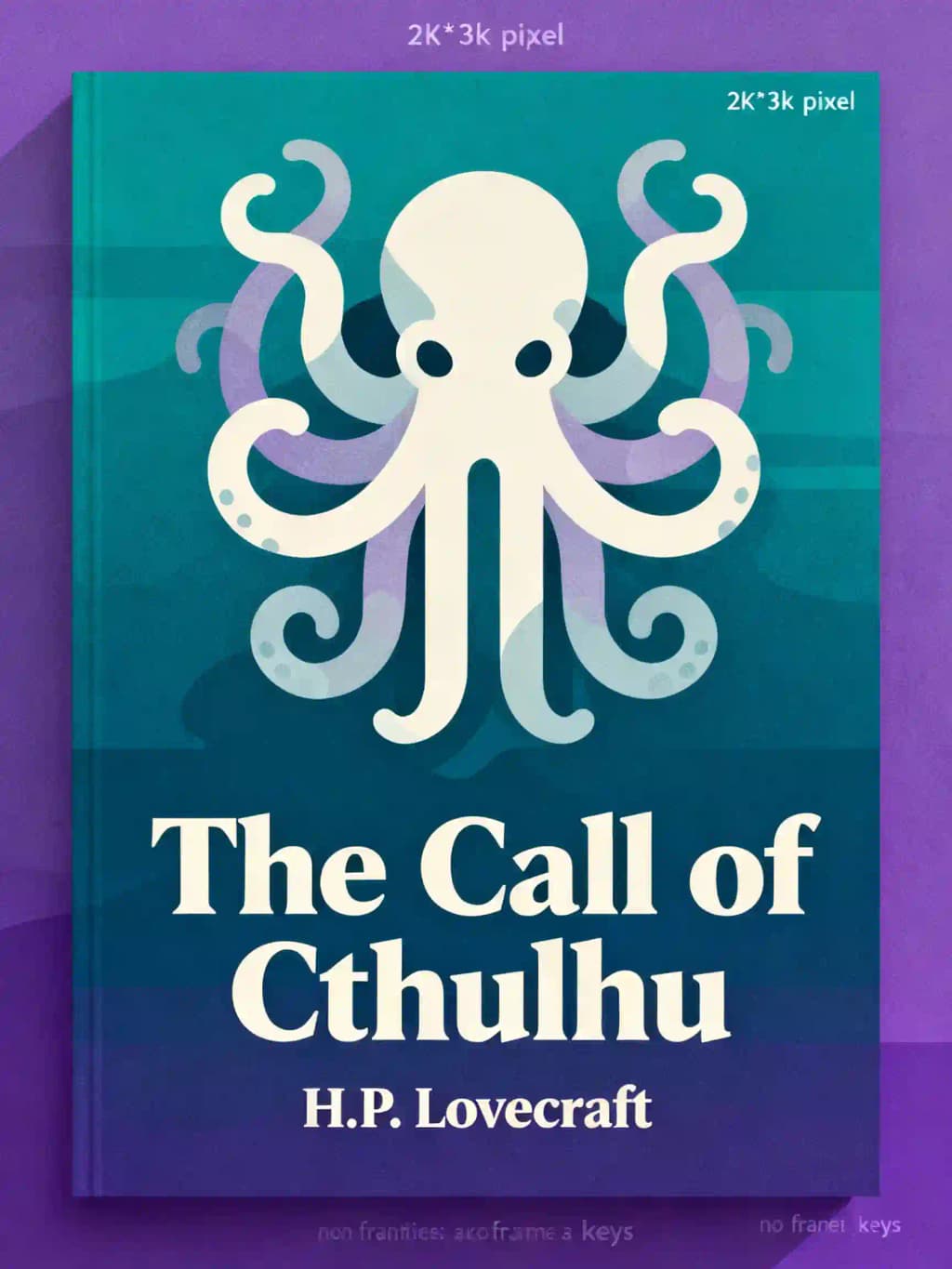
This theme reaches its zenith in "The Call of Cthulhu," where Lovecraft introduces his most famous creation - a cosmic entity so ancient and powerful that it predates humanity by eons. The story's structure is brilliantly conceived, with the narrator piecing together disparate information from his deceased great-uncle's notes, newspaper clippings, and the account of a Norwegian sailor. This fragmented narrative approach mirrors the way humans must struggle to comprehend cosmic truths that lie beyond our limited perception.
We learn of Cthulhu, a tentacled, dragon-like monstrosity who lies "dead but dreaming" in the sunken city of R'lyeh, waiting for the stars to align so he can rise again. His very existence communicates telepathically through dreams to sensitive individuals worldwide, inspiring artists to create disturbing images and cultists to perform bloody rituals. The story culminates with the accidental release of Cthulhu when R'lyeh temporarily rises from the ocean. The description of the city itself emphasizes human insignificance through its "non-Euclidean geometry" that defies our understanding of physical space.
When Cthulhu emerges, the sailors who witness it are driven to madness or death. Only the quick thinking of the Norwegian sailor Johansen, who rams the creature with his ship, allows temporary escape. Yet even this "victory" is hollow - Cthulhu is merely dispersed temporarily, reforming immediately and certain to rise again when the time is right. The message is clear: humanity's existence is but a brief interlude in cosmic history, and forces beyond our comprehension will eventually reclaim dominance of Earth.
Chapitre 4
The Horror of Degeneration and Inherited Guilt
A recurring theme in Lovecraft's fiction is the fear of degeneration - both physical and mental - often tied to ancestral sins or forbidden knowledge passed through bloodlines. This reflects both the eugenics-influenced thinking of his era and deeper anxieties about humanity's animal origins that Darwin's theories had brought to the forefront of cultural consciousness.
"The Shadow Over Innsmouth" presents one of Lovecraft's most fully realized explorations of degeneration. The story follows a young man investigating the decaying Massachusetts seaport of Innsmouth, where the inhabitants display disturbing physical abnormalities - "narrow heads," "bulgy eyes," and skin that "ain't quite right." Through the drunken ramblings of elderly Zadok Allen, he learns the town's terrible secret: decades earlier, Captain Obed Marsh made a pact with amphibious creatures known as Deep Ones, trading human sacrifices and interbreeding for gold and plentiful fishing.
The horror escalates when the narrator is forced to spend the night in Innsmouth and discovers the hybrid inhabitants attempting to capture him. His desperate escape through the night streets, pursued by shambling, croaking entities, creates palpable terror. But the true horror comes in the story's final twist - after researching his own genealogy, the narrator discovers he himself is descended from the Innsmouth bloodline. He begins experiencing dreams of underwater cities and notices physical changes as he develops the "Innsmouth look."
Rather than ending with the expected horror of transformation, Lovecraft delivers a more disturbing conclusion - the narrator embraces his inheritance, planning to free his cousin from an asylum so they can "dive down through black abysses" to the underwater city of Y'ha-nthlei where they will dwell "amidst wonder and glory forever." This willing acceptance of degeneration suggests something even more terrifying than forced transformation - the idea that part of us might welcome the surrender of humanity for something older and more primal.
"The Rats in the Walls" explores similar territory through the story of a man who restores his ancestral home, Exham Priory, only to discover his family's horrific legacy. The narrator begins hearing inexplicable sounds of rats scurrying within the walls, though no rats are present. His investigation leads to the discovery of an ancient sub-cellar and eventually a vast underground grotto filled with the remains of generations of "human cattle" - people kept in pens and bred for food by his ancestors.
The revelation of this cannibalistic heritage triggers something primal in the narrator. When found hours later, he is crouching over the half-eaten body of an expedition member, having reverted to the savage behavior of his ancestors. The story's final lines, written from an asylum, insist that "the rats, the rats in the walls" drove him to this act - but we understand these rats represent the inherited guilt and primal urges that lurk within his own psyche, passed down through generations.
This theme reaches its most concentrated expression in "Facts Concerning the Late Arthur Jermyn and His Family," where a scholarly man commits suicide after discovering his great-great-great-grandmother was not a Portuguese trader's daughter but a preserved white ape worshipped by an African tribe. The revelation that he is descended from this unholy union is so unbearable that Arthur douses himself in oil and self-immolates. The story's opening line makes its thesis explicit: "Life is a hideous thing, and from the background behind what we know of it peer daemoniacal hints of truth which make it sometimes a thousandfold more hideous."
Chapitre 5
The Thin Veil Between Worlds
Lovecraft's fiction frequently suggests that our perceived reality is merely a thin veil separating us from horrors beyond comprehension. This veil occasionally tears, allowing glimpses of what truly exists beyond our limited perception. This concept creates a persistent existential dread - the sense that normalcy could collapse at any moment, revealing something far more terrifying beneath.
"The Haunter of the Dark" exemplifies this theme through Robert Blake's fatal curiosity about an abandoned church visible from his apartment window. The church houses the Shining Trapezohedron, an ancient artifact that serves as a window between worlds, allowing an entity called "The Haunter of the Dark" to perceive our reality. This entity cannot cross into our world while light exists, but during a power outage caused by a thunderstorm, the barrier weakens.
The story builds tension through Blake's increasingly disturbed diary entries as he realizes something is watching him through the stone: "I am being watched-I know it. I think it is the Shining Trapezohedron... The Haunter of the Dark-it knows where I am." When the city's power fails during a storm, Blake's final entry reads simply: "Lights out-God help me." His body is later found with an expression of absolute terror, having glimpsed something his mind couldn't process.
The veil between worlds is also central to "From Beyond," where a scientist creates a machine that stimulates the pineal gland, allowing perception of realities normally invisible to humans. The narrator describes the horrifying revelation: "Indescribable shapes both alive and otherwise were mixed in disgusting disarray, and close to every known thing were whole worlds of alien, unknown entities." Most terrifying is the discovery that these entities have always been around us, invisible only because of our limited perceptual abilities.
"The Music of Erich Zann" presents another version of this theme through an elderly mute musician whose violin playing holds back something trying to enter our world through his window. The narrator describes glimpsing "limitless vistas of some world or worlds utterly beyond all human experience" before fleeing in terror. When he returns later, both Zann and his entire street have vanished from existence, suggesting the barrier finally failed.
These stories create a particularly modern form of horror - the fear that science and knowledge, rather than protecting us from superstition, might actually reveal terrors beyond our capacity to endure. As the narrator of "The Call of Cthulhu" warns, "someday the piecing together of dissociated knowledge will open up such terrifying vistas of reality... that we shall either go mad from the revelation or flee from the deadly light into the peace and safety of a new dark age."
Chapitre 6
The Outsider and the Fear of Self-Discovery
Many of Lovecraft's protagonists are isolated intellectuals, disconnected from society and often described as "peculiar" or "sensitive." This reflects Lovecraft's own sense of alienation as a reclusive autodidact who felt out of place in the modern world. His stories frequently explore the horror of self-discovery - the moment when one realizes one's true nature is something other than human.
"The Outsider" distills this theme into its purest form. The narrator lives alone in a dark castle, having never seen another living being or even his own reflection. Driven by longing for light and human contact, he climbs the castle's highest tower only to discover his home is actually underground. Following a path to a nearby mansion hosting a party, he enters only to have the guests flee in terror. Approaching a mirror, he finally sees his own reflection - a "leering, abhorrent monster" of decaying flesh. The narrator realizes he is not human but something ghoulish and undead, forever an outsider among mankind.
This moment of horrific self-recognition appears throughout Lovecraft's work. In "The Shadow Over Innsmouth," the narrator's discovery of his inhuman heritage initially horrifies him but eventually leads to acceptance of his true nature. In "Arthur Jermyn," the revelation of simian ancestry drives the protagonist to suicide. In "The Rats in the Walls," the narrator's reversion to cannibalism reveals the bestial nature lurking beneath his civilized veneer.
Perhaps most poignantly, "Cool Air" presents Dr. Munoz, who maintains his apartment at freezing temperatures due to a "medical condition." The narrator eventually discovers the terrible truth - Munoz has been dead for eighteen years, preserving his body and consciousness through scientific means. When his cooling system fails, he rapidly decomposes, leaving behind a note explaining: "The end is here. No more air-the preserved body is too old." This revelation transforms our understanding of the character from a brilliant eccentric to something unnatural that should not exist - a theme Lovecraft returns to repeatedly.
Chapitre 7
Ancient Cults and Forgotten Knowledge
Lovecraft's fiction frequently features secret cults preserving knowledge of ancient cosmic entities, suggesting that throughout human history, some have always known and worshipped these terrible truths. These cults represent both the allure of forbidden knowledge and the horror of what humans might become when they surrender their humanity to serve inhuman powers.
"The Call of Cthulhu" introduces the concept of a worldwide cult dedicated to the "Great Old Ones," with branches among primitive tribes, voodoo circles, and even "degenerate" immigrants in America. The cult's chant - "Ph'nglui mglw'nafh Cthulhu R'lyeh wgah'nagl fhtagn" ("In his house at R'lyeh, dead Cthulhu waits dreaming") - has become iconic in horror literature. The cultists believe that when the stars align correctly, Cthulhu will rise and usher in an age when "mankind would have become as the Great Old Ones; free and wild and beyond good and evil."
This last phrase reveals a crucial aspect of Lovecraft's cosmic horror - the cults don't worship evil in a traditional sense but rather forces beyond human moral comprehension. They seek to transcend humanity itself, a concept both terrifying and, in some ways, seductive to isolated individuals who feel alienated from society.
"The Shadow Over Innsmouth" provides the most detailed exploration of such a cult through the Esoteric Order of Dagon. What begins as economic desperation - Captain Obed Marsh seeking prosperity for his failing town - evolves into a religion centered on human sacrifice and interbreeding with the Deep Ones. The cult promises immortality of a sort, as hybrid offspring eventually transform completely and live eternally beneath the waves. This bargain - trading humanity for immortality - represents the ultimate corruption, yet by the story's end, even the narrator finds himself drawn to this inhuman existence.
"The Haunter of the Dark" features the Starry Wisdom cult, which used the Shining Trapezohedron to summon an entity that "cannot exist in light." The abandoned church where they worshipped becomes a locus of lingering evil, suggesting that places themselves can be corrupted by such knowledge. The cult's history - 200 members by 1863, connected to disappearances, and eventually driven out in 1877 - exemplifies how Lovecraft uses historical details to ground his cosmic horrors in a seemingly realistic context.
Chapitre 8
The Horror of the Indescribable
Lovecraft famously struggled with describing his most terrifying creations, often resorting to terms like "indescribable," "unnamable," or "blasphemous." This technique, far from being a weakness, actually enhances the horror by forcing readers to imagine something beyond human categories or language. By suggesting his monsters exist outside our conceptual framework, Lovecraft creates entities truly alien rather than simply exotic versions of familiar creatures.
"The Colour Out of Space" presents this concept most purely through its central entity - a color "unlike any known colours of the normal spectrum." By making the alien presence a color outside human perception, Lovecraft creates something fundamentally unimaginable yet eerily plausible. The entity's actions - gradually draining life from everything it touches - are comprehensible, but its nature remains beyond understanding.
In "The Call of Cthulhu," the narrator struggles to describe the statue of the entity: "If I say that my somewhat extravagant imagination yielded simultaneous pictures of an octopus, a dragon, and a human caricature, I shall not be unfaithful to the spirit of the thing." This layering of contradictory images suggests something that cannot be properly visualized, existing in dimensions beyond our perception.
"The Whisperer in Darkness" describes the Mi-Go as "more vegetable than animal" with "fungoid structure," composed of matter with electrons vibrating at different rates - explaining why they cannot be photographed. This scientific-sounding explanation makes their alienness more credible while still preserving their fundamental unknowability.
When Lovecraft does attempt direct description of his horrors, he often employs a technique of piling adjectives upon adjectives, creating a verbal avalanche that communicates emotional impact rather than clear visualization. In "The Shadow Over Innsmouth," the narrator finally glimpses the Deep Ones: "I think their predominant color was a greyish-green, though they had white bellies. They were mostly shiny and slippery, but the ridges of their backs were scaly... Their forms vaguely suggested the anthropoid... but their heads were the heads of fish, with prodigious bulging eyes that never closed."
This technique creates entities that feel simultaneously concrete and impossible to fully visualize - existing in the uncanny valley between the familiar and the utterly alien.
Chapitre 9
Legacy of Cosmic Dread
H.P. Lovecraft died in poverty, his work largely unrecognized during his lifetime. Yet his vision of cosmic horror has proven remarkably enduring, influencing generations of writers, filmmakers, artists, and game designers. The "Cthulhu Mythos" he created has expanded far beyond his original stories, becoming a shared universe where countless creators continue to explore the themes he pioneered.
What makes Lovecraft's horror so persistent in our cultural imagination? Perhaps it's because his cosmic perspective speaks to modern anxieties about human insignificance in an expanding universe. As scientific discoveries push human beings further from the center of creation, Lovecraft's vision of indifferent cosmic forces resonates with our deepest fears about our place in existence.
His stories reject comforting narratives where good triumphs over evil, where human courage and ingenuity save the day. Instead, they present a universe where humanity is but a momentary accident, where our entire civilization could be swept away by forces that wouldn't even notice our passing. This perspective creates a unique form of existential dread that feels particularly relevant in our age of environmental crisis, global pandemics, and technological change beyond individual control.
Yet paradoxically, there's something oddly comforting in Lovecraft's cosmic horror. By confronting the worst - a universe completely indifferent to human concerns - his stories allow us to face our deepest fears about insignificance and mortality. Like the cultists who worship Cthulhu, readers of Lovecraft's fiction participate in a ritual of knowledge, willingly exposing themselves to terrible truths as a form of psychological inoculation against existential dread.
Perhaps this explains why, nearly a century after his death, Lovecraft's star continues to rise. In an increasingly uncertain world, his unflinching vision of cosmic indifference provides a strange comfort - the recognition that our fears of insignificance, when faced directly, lose some of their power to terrify. By creating a mythology that embraces the worst possibilities of our cosmic situation, Lovecraft paradoxically helps us come to terms with our place in an indifferent universe.
In the final analysis, Lovecraft's greatest achievement may be transforming his personal fears and neuroses into a mythology that speaks to universal human concerns about knowledge, existence, and our place in the cosmos. His famous opening to "The Call of Cthulhu" - "The most merciful thing in the world is the human mind's inability to correlate all its contents" - serves as both warning and invitation to readers: proceed if you dare, but know that some knowledge, once gained, can never be unlearned.