Chapitre 1
Into the Abyss of Cosmic Terror
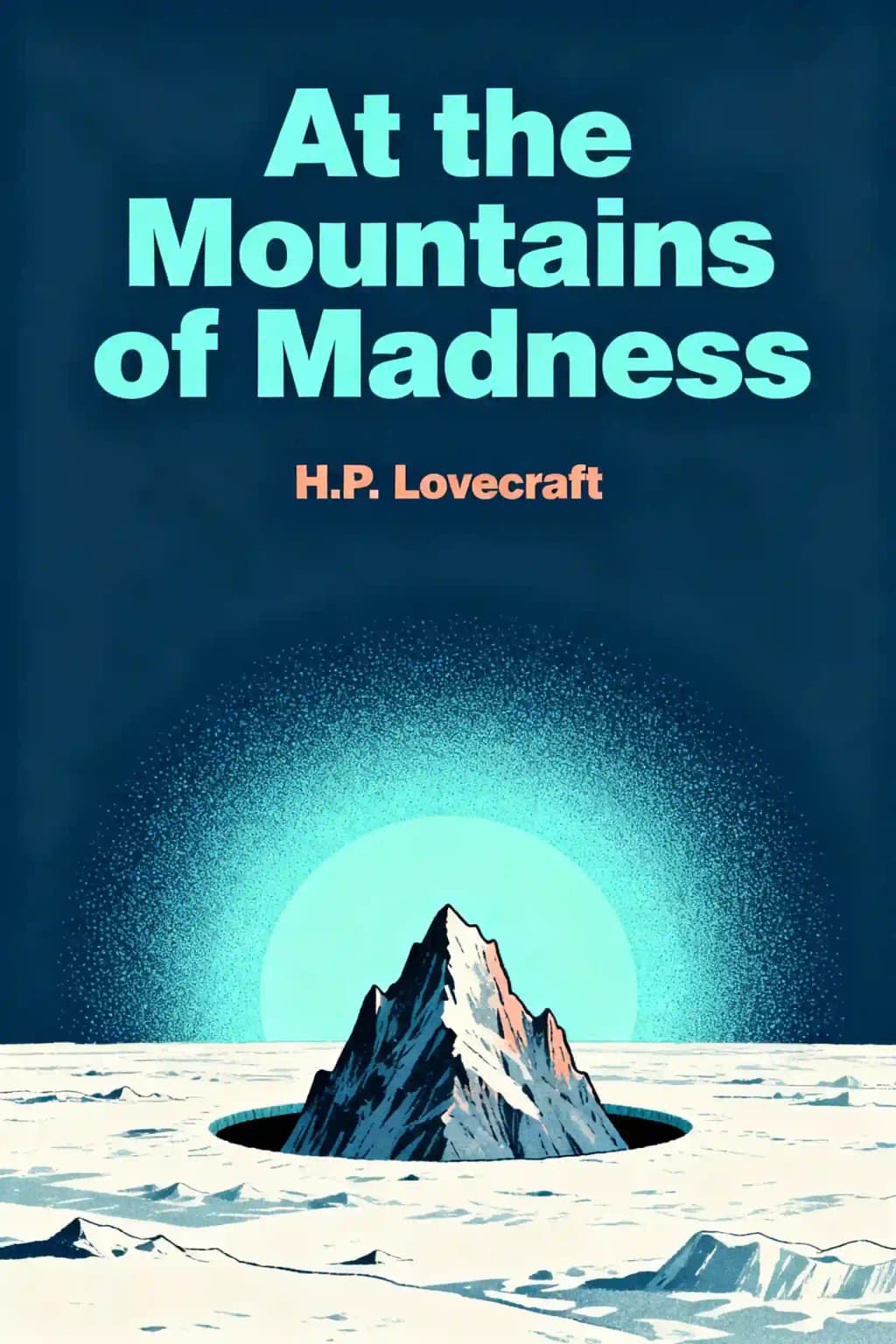
At the Mountains of Madness stands as H.P. Lovecraft's masterpiece of cosmic horror, a work that forever changed the landscape of weird fiction. This 1931 novella represents the culmination of Lovecraft's literary vision-a materialist nightmare where human significance dissolves against the backdrop of an indifferent universe. Stephen King has called Lovecraft "the twentieth century's greatest practitioner of the classic horror tale," while Guillermo del Toro spent years attempting to adapt this very work to film, only to be thwarted by studios fearing its uncompromising bleakness. The book's influence extends far beyond horror, inspiring scientific speculation about ancient Antarctic civilizations and shaping how we conceptualize the terror of the unknown. What makes Lovecraft's vision so enduring is not merely its monsters, but its philosophical terror-the suggestion that beneath the thin veneer of human understanding lurks an abyss of cosmic indifference that, once glimpsed, cannot be unseen.
Chapitre 2
The Antarctic Expedition: Science Confronts the Unknown
The narrative begins with geologist William Dyer's desperate attempt to prevent a planned Antarctic expedition. His warnings stem from his own harrowing experiences as leader of the Miskatonic University Expedition of 1930-31. This well-equipped scientific venture, featuring revolutionary lightweight drilling equipment designed by engineer Frank Pabodie, initially progresses with remarkable success. After establishing base camps near Mt. Erebus, the team makes significant geological discoveries before splitting into two groups. Biologist Lake leads a northwestern detachment following curious fossil markings, while Dyer remains at the southern base.
Lake's wireless transmissions grow increasingly excited as his team discovers an enormous mountain range rivaling the Himalayas-black peaks reaching 35,000 feet with strange cubic formations along their ridges. Flying closer, Lake describes peculiar rectangular structures resembling ancient castles and cave-mouths of unusual regularity. His scientific enthusiasm barely masks a growing alarm as they establish camp near these foothills.
The expedition's turning point comes when Lake's drilling operation breaks through into a limestone cave containing an extraordinary collection of fossils-a paleontologist's treasure trove spanning multiple geological eras. The absence of recent species suggests the deposits are at least thirty million years old, yet remarkably contain organisms typically found in much older periods. This evidence of unique biological continuity spanning hundreds of millions of years represents a revolutionary scientific discovery.
But the true horror begins with the unearthing of barrel-shaped fossils unlike anything known to science-fourteen specimens, eight perfectly preserved. Lake's detailed descriptions reveal eight-foot entities with barrel-like torsos, folding membranous wings, and five systems of tentacles, each with a starfish-shaped head bearing prismatic cilia and eye-like globes. Their muscular arms with paddle-like appendages match prehistoric rock prints spanning a billion years. Lake dubs them "The Elder Ones," noting their uncanny resemblance to mythological entities mentioned in forbidden texts.
Dissection reveals bewildering biological complexity-a thick dark-green fluid instead of blood, multiple respiratory systems, and a five-lobed brain suggesting more than five senses. Though partly vegetable in nature, they possess three-fourths of animal structure essentials. Lake's last transmission mentions building snow walls against a rising gale before communication abruptly ceases.
Chapitre 3
The Grim Discovery: Horror in the Frozen Wasteland
When all attempts to reach Lake's camp fail, Dyer leads a rescue mission with ten men and supplies. Upon arrival, they find a scene of utter devastation-the entire Lake party wiped out, with eleven dead and young Gedney missing. The official report attributes the deaths to the violent wind, claiming the bodies were too mangled for transportation.
The truth, however, is far more disturbing. The camp reveals signs of insane disorder, with strange five-pointed snow mounds resembling the greenish soapstones Lake had described. The buried entities themselves-those ancient specimens Lake had discovered-send the rescue party's imaginations reeling back to shocking primal myths. Though they publicly blame Gedney as the surviving agent of madness, privately each harbors wilder theories.
Despite aerial searches, neither Gedney nor the missing specimens are found, though they observe the endless titan barrier range with its cube formations and evenly distributed cave-mouths. Scientific curiosity about the realm beyond those mountains remains, and Dyer plans altitude flights to investigate further.
This section establishes the classic Lovecraftian pattern-scientific inquiry leading to discoveries that shatter human understanding. The expedition members, seeking only geological samples, instead uncover evidence of an ancient non-human civilization that predates all known life on Earth. The horror comes not from supernatural elements but from the materialist revelation that humans are neither the first nor the most significant inhabitants of our planet. As the narrative progresses, this cosmic perspective will only deepen, challenging our species' place in the universe.
Chapitre 4
The Ancient City: Civilization Before Humanity
Driven by scientific curiosity despite their horror, Dyer and graduate student Danforth undertake an aerial investigation beyond the mountain range. What they discover defies comprehension-a vast stone city sprawling below them, a palaeogean megalopolis compared to which fabled Atlantis and Lemuria were recent developments.
After careful reconnaissance revealing the city's enormous extent along the foothills, they land and approach the cyclopean ruins on foot. Their examination reveals star-shaped ramparts with symmetrically placed arched windows, labyrinthine layouts featuring twisted lanes and canyon-like alleys, and stone bridges connecting structures at various heights. The architecture displays a consistent five-pointedness that stirs uncomfortable subconscious certainties about the entities that built this place.
Rock specimens confirm nothing newer than Pliocene age-meaning this place had been dead at least 500,000 years. Implementing a paper trail system to avoid getting lost, they venture inside, sensing they are penetrating the secrets of a deliberately abandoned city rather than one overwhelmed by sudden calamity.
The city's defining feature is its elaborate mural sculptures-continuous horizontal bands depicting both geometric arabesques and pictorial scenes of astonishing artistry. These carvings, revealing the civilization's history, become their primary focus for photography and study. As they penetrate deeper, the hideous truth becomes undeniable-this city had been built by the Great Old Ones who had come from the stars when Earth was young, the original beings behind elder myths hinted at in forbidden texts.
The sculptures tell their story across millions of years, with the oldest buildings dating back forty to fifty million years. They reveal the star-headed beings' cosmic origins, their underwater cities, and their creation of Earth's life forms including the shoggoth slaves-viscous protoplasmic masses capable of forming temporary organs under hypnotic control.
What makes this section particularly effective is how Lovecraft transforms an archaeological discovery into cosmic horror. The explorers don't merely find ruins; they find evidence that humanity's entire understanding of life's origins is fundamentally wrong. The meticulous detail with which Lovecraft describes the city and its artistic record creates a devastating sense of authenticity-we feel we are witnessing the uncovering of genuine historical artifacts rather than fictional constructs. This scientific approach to world-building makes the horror all the more effective, as it undermines our confidence in humanity's place in the universe through seemingly credible evidence.
Chapitre 5
The History of the Old Ones: Rise and Fall of an Alien Civilization
Through their study of the mural carvings, Dyer and Danforth reconstruct the entire history of the Old Ones' civilization. The vast dead megalopolis around them was apparently the last general center of their race, built early in the Cretaceous period after a titanic earth-buckling obliterated an even vaster predecessor nearby. This region was their most sacred spot, where the first Old Ones had settled on a primal sea-bottom.
The sculptures reveal how the city's mountains had once held great temples with fantastic towers. Over ages, caves appeared and became temple adjuncts, while limestone veins were hollowed by groundwater until the entire region became a network of caverns and galleries. Eventually, explorers discovered a Stygian sunless sea lurking in earth's bowels, formed when a great river had eaten away the limestone base and joined with groundwater to create a deeper abyss.
From various carvings, they reconstruct the city's appearance across millions of years-its squares, buildings, landscape, and luxuriant Tertiary vegetation. Despite its mystic beauty, even the Old Ones had known terror, as scenes show them recoiling from something found in the river that had washed down from mysterious western mountains.
The decadent carvings reveal the city's final calamity. As the great cold approached, vegetation thinned and country life decreased. The sculptures show heating devices in houses and winter travelers in protective fabrics. Cartouches depict growing migration to warmer refuges-some to undersea cities off distant coasts, but most to the neighboring black abyss of subterranean waters.
This underground migration was facilitated by improved connecting routes, including direct tunnels from the metropolis to the abyss. The Old Ones built their new city underwater in the abyss, adapting easily to underwater life with their never-atrophied gill systems. The construction of the new cavern sea city was done scientifically, using insoluble rocks and expert workers from the nearest submarine city. Shoggoths were bred to enormous size and intelligence, now taking orders through voice mimicry rather than hypnotic suggestion.
Eventually, as the cold advanced, the Old Ones shuttled between the land city in summer and sea-cavern city in winter. Vegetation declined, terrible snows no longer melted completely even in midsummer, and most animals died off. The shoggoths were adapted to land life despite previous reluctance to do so.
What makes this historical narrative so effective is how it humanizes the Old Ones while maintaining their alienness. We see them not as monsters but as beings struggling against environmental challenges, developing technologies, and ultimately facing extinction. This creates a profound sense of cosmic perspective-the rise and fall of an entire civilization that predated humanity by millions of years, making our own history seem insignificant by comparison. The Old Ones become a mirror through which we view our own species' fragility and temporary nature.
Chapitre 6
The Descent into Darkness: Journey to the Abyss
Their study of the decadent sculptures changes Dyer and Danforth's objective to finding and traversing the chiseled avenues to the black inner world. Following their map toward the nearest tunnel-mouth, they navigate through the labyrinth of rooms and corridors, tempted constantly by the historical sculptures they must pass by.
Soon they detect something disturbing in the formerly pure air-an odor vaguely similar to what had nauseated them upon opening the graves of Lake's dissected specimens. Continuing cautiously with dimmed torches, they notice disturbed debris suggesting recent passage. Then they catch another smell-the unmistakable odor of gasoline.
Driven by burning curiosity despite their dread, they proceed until finding a makeshift camp with items from Lake's expedition: opened tin cans, spent matches, books, writing implements, and crumpled papers. The papers contain dot-groups resembling those on the soapstones and sketches of the city made in the unmistakable artistic technique of the Old Ones themselves.
Rather than flee, they are consumed by scientific curiosity. They decide to follow the route indicated in the sketches toward a great circular tower. Around 9:30 p.m., they emerge into a prodigious round space 200 feet in diameter with boldly sculptured walls and a massive stone ramp spiraling up the cylindrical wall. While examining the debris-strewn floor, they make a horrifying discovery: three sledges from Lake's camp, carefully packed and containing familiar equipment. But the greatest shock comes when they find the stiffly frozen, carefully preserved bodies of young Gedney and the missing dog.
Just as they are absorbing this horror, their stunned silence is broken by an unexpected sound-not the alien piping they might have anticipated in this dead world, but the squawking of a penguin. Following the sound, they enter an archway cleared of debris, resuming their trail-blazing with paper taken reluctantly from the sledges.
Suddenly, a bulky white shape looms ahead-a six-foot-tall albino penguin, larger than any known species and virtually eyeless. They realize these are descendants of the ancient penguins depicted in Old Ones' sculptures, having retreated to some warmer inner region whose perpetual darkness had destroyed their pigmentation and atrophied their eyes. Their presence confirms the abyss remains warm and habitable.
Pushing onward past more penguins, they descend a long corridor until reaching a prodigious open space with a black arched aperture-the entrance to the great abyss. Entering the fifteen-foot-wide tunnel, they note its megalithic masonry is well preserved. As they advance, the temperature rises noticeably, and that nameless scent intensifies.
The tunnel expands into a lofty, natural-looking elliptical cavern with an abnormally smooth floor. Continuing through the passage beyond, they are shocked by a radical degradation in the wall carvings-crude spirals and angles that seem like a parody of the Old Ones' art, suggesting some alien element has been added to their aesthetic tradition.
This section brilliantly builds tension through the explorers' gradual descent into unknown depths. Each discovery-the camp, Gedney's body, the penguins, the degraded carvings-adds another layer of mystery and dread. The journey becomes both physical and metaphorical-a descent into the depths of Earth paralleling a descent into cosmic truth that humanity was never meant to discover.
Chapitre 7
The Shoggoth: Confrontation with Cosmic Horror
As they advance deeper with both torches lit, Dyer and Danforth notice fewer penguins but catch a distant chorus of them somewhere within the earth. Puffs of visible vapor indicate the nearness of the great abyss. Then, unexpectedly, they spot stationary obstructions on the polished floor ahead-objects that are definitely not penguins.
These obstructions are accompanied by an intensification of the strange prevailing stench, now unmistakably mixed with another nameless odor. Their second torch confirms what they dread-they are like the six specimens found at Lake's camp, but their incompleteness is of infinitely greater recency, as evidenced by the thick, dark-green pool surrounding them.
Only four remain, though Lake's bulletins had mentioned eight in the group. The explorers wonder what monstrous struggle occurred in this darkness. The dominant factor in their incompleteness is total decapitation-from each one, the tentacled starfish-head has been removed through some hellish tearing or suction rather than ordinary cleavage.
When they identify the source of the second stench, Danforth gives a hysterical cry. They recognize what the sculptures had shown-the hideous slime-coating found on prostrate Old Ones slain by shoggoths in their ancient war of re-subjugation. The freshly glistening, iridescent black slime clings to the headless bodies and sparkles on the re-sculptured wall in grouped dots-a message in the language of these cosmic horrors.
In that moment, they understand cosmic fear to its uttermost depths. Yet they feel pity rather than revulsion for these Old Ones. "They weren't evil... just men of another age and order of being. Nature had played a hellish jest on them." Scientists to the last, what had they done that humans wouldn't have done in their place? They had tried to reach their living fellows in depths they had never seen-and found instead the monstrous shoggoths that had once been their slaves.
As they stand frozen in shock, a pallid mist begins curling from the abyss. Then comes a sound that shatters their conclusions-the very sound Lake's dissection had attributed to the Old Ones, resembling the wind-pipings they'd heard around the mountain caves. It forms syllables: "Tekeli-li! Tekeli-li!"
They flee immediately, though they wonder if non-aggressive conduct might spare them if captured. The mist thins, and they realize they are actually gaining on their pursuer. The mist thickens again as they reach the large open cavern where various tunnels converge. The blind albino penguins there show extreme fear of the approaching entity.
Just before emerging from the re-sculptured tunnel, the mist lifts momentarily, giving them one half-glimpse of their pursuer-a sight that accounts for half the horror that has haunted them since. They had expected to see an Old One, but what they saw was utterly different and immeasurably more hideous.
They flash both torches at the thinned mist-an unhappy act! Again comes that piping: "Tekeli-li! Tekeli-li!"
The sight cripples their consciousness so completely that they barely have sense enough to dim their torches and find the right tunnel. What they see is "a shapeless congeries of protoplasmic bubbles, faintly self-luminous, with myriads of temporary eyes forming and unforming as pustules of greenish light across its tunnel-filling front." It crushes the frantic penguins and slithers over the glistening floor. They realize that the daemonic shoggoths-given life, thought, and plastic organ patterns solely by the Old Ones, and having no language save that which the dot-groups expressed-had likewise no voice save the imitated accents of their bygone masters.
This confrontation represents the climax of cosmic horror-the moment when the explorers face not just an alien being but an entity that defies categorization in human terms. The shoggoth represents the ultimate "thing that should not be"-a protoplasmic nightmare that embodies the chaos underlying the apparent order of nature. Its ability to form and unform organs at will, to mimic the speech of its former masters, and to exist in defiance of biological laws we consider fundamental makes it the perfect embodiment of Lovecraftian horror.
Chapitre 8
Escape and Forbidden Knowledge: The Mountains of Madness
Dyer and Danforth have only dream-fragments of emerging into the great sculptured hemisphere and threading their way back through the Cyclopean rooms and corridors of the dead city. They float in a nebulous world without time, causation, or orientation. The grey half-daylight sobers them somewhat, but they avoid looking at poor Gedney and the dog in their titanic mausoleum.
Scrambling out at the top, they find themselves on a great mound of tumbled blocks, with curved walls rising westward and mountains showing beyond crumbled structures eastward. The low antarctic sun peers redly through rifts in the jagged ruins, making the ancient city seem starker against the familiar polar landscape.
Halfway uphill toward their plane, they pause to look back at the fantastic stone shapes below. The sky has lost its morning haziness, with ice-vapors having moved to zenith where their outlines seem about to settle into some bizarre pattern they fear to make conclusive.
There now lies revealed on the ultimate white horizon behind the grotesque city a dim, elfin line of pinnacled violet whose needle-pointed heights loom dream-like against the beckoning rose-color of western sky. These violet mountains can be nothing else than the terrible mountains of the forbidden land-highest of earth's peaks and focus of earth's evil, harboring nameless horrors and Archaean secrets. They are the first humans ever to see them.
Before reaching their plane, their fears transfer to the lesser but vast range whose re-crossing lies ahead. Those black, ruin-crusted slopes rear up starkly against the east, reminding them of Nicholas Roerich's paintings. When they think of the honeycombs inside them and what might have pushed its way even to the topmost hollow pinnacles, they cannot face without panic the prospect of again sailing by those suggestive skyward cave-mouths where the wind makes sounds like evil musical piping.
All is well with the plane, and they make a smooth takeoff over the nightmare city. At 24,000 feet, the height needed for the pass, navigation is practicable despite zenith disturbances. As they near the jutting peaks, the wind's strange piping becomes manifest again, and Danforth's hands tremble at the controls. Dyer takes over navigation duties, trying to keep all his skill about him as he stares at the reddish sky between the pass walls.
But Danforth, released from piloting and keyed to a dangerous nervous pitch, cannot keep quiet. He looks back at the receding city, ahead at the cave-riddled peaks, sidewise at the bleak foothills, and upward at the seething sky. Just as Dyer tries steering safely through the pass, Danforth's mad shrieking nearly causes disaster by making him fumble with the controls. They cross safely, but Danforth will never be the same.
Danforth refuses to tell what final horror made him scream so insanely-a horror he claims is mainly responsible for his present breakdown. All he has hinted is that the final horror was a mirage-not connected with the cube-mountains they crossed, but a single fantastic glimpse, among zenith-clouds, of what lay back of those other violet westward mountains the Old Ones had shunned and feared.
He occasionally whispers about "the black pit," "the carven rim," "the proto-shoggoths," "the windowless solids with five dimensions," "the nameless cylinder," "the elder pharos," "Yog-Sothoth," "the primal white jelly," "the color out of space," "the wings," "the eyes in darkness," "the moon-ladder," and other bizarre conceptions. At the time, his shrieks were confined to repeating a single mad word: "Tekeli-li! Tekeli-li!"
Chapitre 9
The Legacy of Cosmic Horror: Beyond Human Understanding
Lovecraft's At the Mountains of Madness represents the pinnacle of cosmic horror literature-a work that systematically dismantles humanity's comfortable assumptions about our place in the universe. Through the scientific expedition's discoveries, we confront several devastating revelations: that Earth harbored advanced civilizations millions of years before humans evolved; that these beings created life on Earth as a food source or experiment; that our planet's history is merely a footnote in a vast cosmic narrative spanning billions of years and countless worlds.
What makes Lovecraft's vision so disturbing is its materialist foundation. Unlike traditional horror that offers supernatural explanations we can dismiss as fantasy, Lovecraft presents his horrors as scientifically plausible discoveries waiting to be uncovered by human exploration. The Old Ones aren't demons or gods but biological entities with advanced technology who arrived from space. The shoggoths aren't magical creatures but the results of bioengineering. This scientific framing makes the horror inescapable-we cannot retreat into the comfort of dismissing it as mere superstition.
The novella's enduring power stems from its philosophical implications. If we are not the pinnacle of Earth's evolution but merely the latest in a succession of dominant species, what does this mean for human significance? If our planet's history contains vast epochs where non-human intelligences ruled, might our own civilization's reign be equally temporary? And perhaps most disturbingly, if beings as advanced as the Old Ones could be overthrown by their own creations, what might await humanity as we develop increasingly autonomous technologies?
These questions resonate even more strongly today than when Lovecraft wrote in the 1930s. As we contemplate artificial intelligence, genetic engineering, and the possibility of extraterrestrial life, the boundaries between Lovecraft's fiction and our potential future grow increasingly blurred. His vision of cosmic indifference-a universe where human concerns are insignificant against the backdrop of vast time and space-feels increasingly plausible in our age of astronomical discovery and ecological crisis.
At the Mountains of Madness continues to influence not only horror literature but science fiction, philosophy, and even scientific speculation. Its legacy lies in how it transformed horror from a genre about personal fears to one addressing existential dread-the terror not of what might harm us individually but of what our discoveries might reveal about reality itself. In Lovecraft's vision, the greatest horror isn't that monsters exist, but that the universe itself is monstrous in its indifference to human meaning. Once glimpsed, this cosmic perspective cannot be unseen-which is why Dyer concludes his narrative with a desperate plea to halt further Antarctic exploration. Some knowledge, he suggests, is too terrible for humanity to bear.