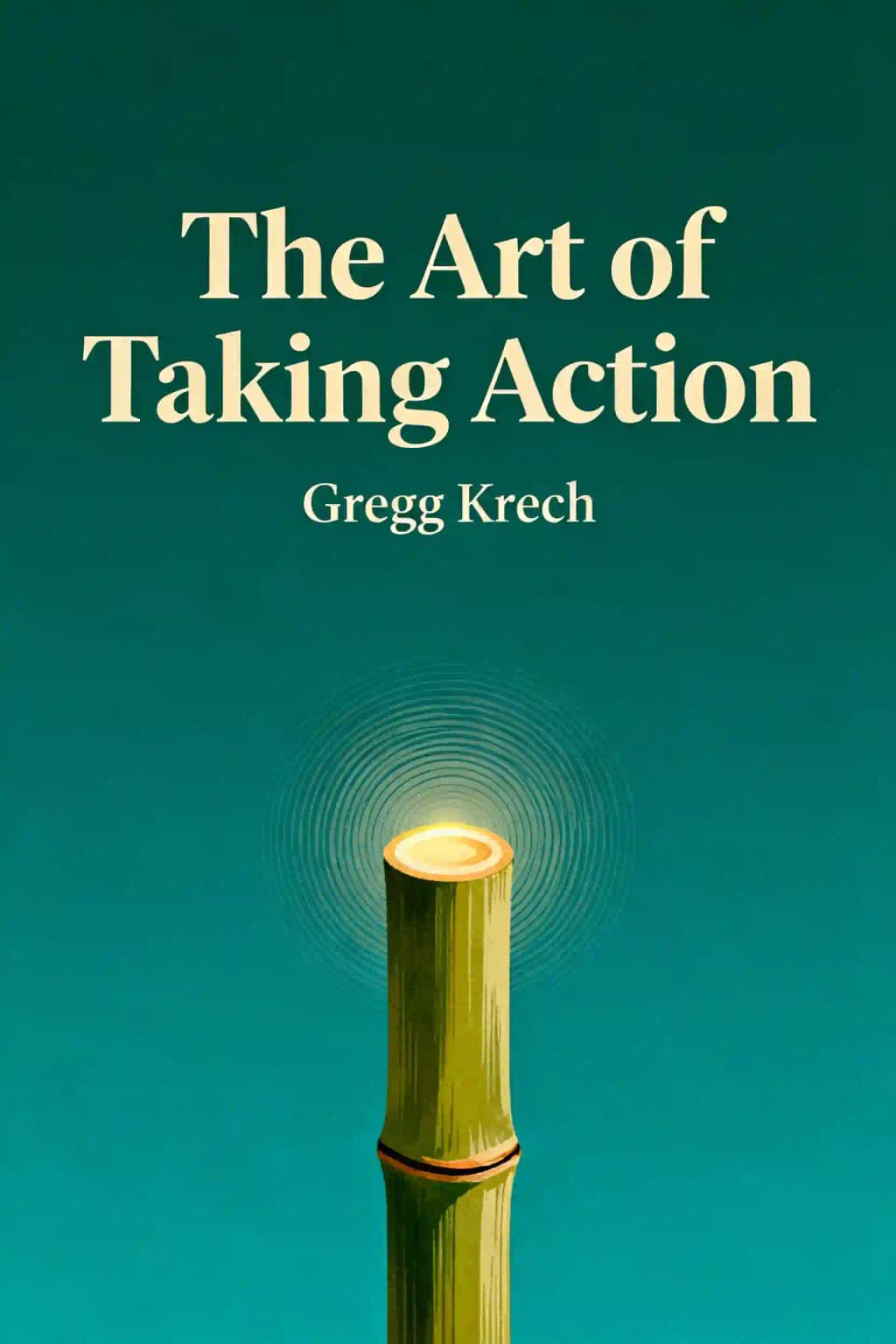
Trapped in procrastination? "The Art of Taking Action" blends Japanese psychology with practical wisdom, helping 10,000+ students embrace discomfort and find purpose. Featured in "Heroic Wisdom Daily," Krech's Eastern approach asks: Why wait for motivation when action itself creates it?
Gregg Krech, author of The Art of Taking Action: Lessons from Japanese Psychology, is a leading authority on Japanese psychology and purposeful living. As a co-founder of Vermont’s TōDō Institute, Krech integrates Morita Therapy, Naikan reflection, and kaizen principles to address modern challenges like procrastination and self-doubt.
His work blends Eastern philosophy with practical action, emphasizing behavioral change over emotional control. Krech’s expertise is further showcased in his award-winning book Naikan: Gratitude, Grace, and the Japanese Art of Self-Reflection, which explores gratitude through structured self-reflection.
As Editor-in-Chief of Thirty Thousand Days: A Journal for Purposeful Living, he curates insights on intentional living, and his ideas have been featured in The Sun, Tricycle, and Utne Reader, as well as on public television and podcasts.
With over 25 years of teaching, Krech’s methods are practiced globally in workshops, retreats, and therapeutic settings, helping individuals align action with purpose. The Art of Taking Action remains a cornerstone text in mindfulness-based productivity, endorsed by mental health professionals and translated into multiple languages.
The Art of Taking Action blends Japanese psychology principles like Morita Therapy, Kaizen, and Naikan to teach readers how to overcome procrastination and embrace purposeful action. It emphasizes acting despite discomfort, clarifying life goals, and using self-reflection to align behavior with values. Key themes include resilience, gratitude, and incremental progress.
This book is ideal for individuals struggling with indecision, procrastination, or feeling stuck. It’s valuable for personal development enthusiasts, professionals seeking productivity frameworks, and readers interested in Eastern psychology. Those navigating career transitions or existential uncertainty will find actionable strategies to reframe challenges and prioritize meaningful tasks.
Yes, particularly for its unique fusion of Japanese psychology and practical tools. Readers praise its focus on action over emotion, bite-sized kaizen principles for gradual change, and exercises like Naikan reflection to cultivate gratitude. While some critique its simplicity, it offers fresh perspectives for those tired of conventional self-help approaches.
The “demons of inaction” are mental barriers like fear, perfectionism, and confusion that block action. Krech identifies strategies people use to avoid discomfort, such as overthinking or prioritizing trivial tasks. Solutions include accepting emotions without letting them dictate behavior and breaking tasks into manageable steps.
Morita Therapy, a Japanese method, teaches action-first living—prioritizing behavior over fleeting feelings. Krech applies this by encouraging readers to act despite anxiety, using techniques like purpose-driven task selection and embracing imperfection. This contrasts with Western psychology’s focus on internal states.
Krech outlines four decision-making guides:
Unlike habit-focused titles (e.g., Atomic Habits), Krech’s work integrates Eastern philosophy with psychological resilience. It avoids rigid routines, instead teaching adaptability through acceptance of emotions and value-driven action. Critics note its narrower focus on mindset over tactical systems.
Gratitude, via Naikan reflection, helps readers recognize interdependence and counteract self-centered worries. By journaling daily on three questions—What did I receive?, What did I give?, What troubles did I cause?—users gain perspective to act compassionately.
This metaphor from Krech’s 21 Maxims advises focusing energy on actionable steps (the “tunnel”) rather than obsessing over uncontrollable external factors (the “sunlight”). It reinforces Morita’s emphasis on engaged doing over passive worrying.
Yes, by reframing anxiety as a natural signal rather than a barrier. The book teaches readers to acknowledge fear while taking small, purposeful steps—a method shown to reduce avoidance patterns and build confidence through incremental exposure.
Some readers find its Japanese psychology concepts overly abstract without concrete examples. Others note repetitive sections or a lack of scientific citations. However, most praise its originality in addressing emotional resistance holistically.
True productivity isn’t mere busyness but purposeful action aligned with values. Krech contrasts this with “urgent” tasks, urging readers to prioritize legacy-building work, relationship-building, and self-reflection—even if progress feels slow.
Ressentez le livre à travers la voix de l'auteur
Transformez les connaissances en idées captivantes et riches en exemples
Capturez les idées clés en un éclair pour un apprentissage rapide
Profitez du livre de manière ludique et engageante
The fourth horse isn't broken-it simply responds differently.
Thoughts and feelings are largely uncontrollable.
What needs doing?
It's rarely the actions we took that we regret, but rather the actions we failed to take.
Décomposez les idées clés de The Art of Taking Action en points faciles à comprendre pour découvrir comment les équipes innovantes créent, collaborent et grandissent.
Découvrez The Art of Taking Action à travers des récits vivants qui transforment les leçons d'innovation en moments mémorables et applicables.
Posez vos questions, choisissez votre style d’apprentissage et co-créez des idées qui vous correspondent vraiment.

Cree par des anciens de Columbia University a San Francisco
"Instead of endless scrolling, I just hit play on BeFreed. It saves me so much time."
"I never knew where to start with nonfiction—BeFreed’s book lists turned into podcasts gave me a clear path."
"Perfect balance between learning and entertainment. Finished ‘Thinking, Fast and Slow’ on my commute this week."
"Crazy how much I learned while walking the dog. BeFreed = small habits → big gains."
"Reading used to feel like a chore. Now it’s just part of my lifestyle."
"Feels effortless compared to reading. I’ve finished 6 books this month already."
"BeFreed turned my guilty doomscrolling into something that feels productive and inspiring."
"BeFreed turned my commute into learning time. 20-min podcasts are perfect for finishing books I never had time for."
"BeFreed replaced my podcast queue. Imagine Spotify for books — that’s it. 🙌"
"It is great for me to learn something from the book without reading it."
"The themed book list podcasts help me connect ideas across authors—like a guided audio journey."
"Makes me feel smarter every time before going to work"
Cree par des anciens de Columbia University a San Francisco

Obtenez le resume de The Art of Taking Action en PDF ou EPUB gratuit. Imprimez-le ou lisez-le hors ligne a tout moment.
There's a peculiar modern suffering we rarely name: the agony of knowing exactly what we should do while doing precisely nothing about it. You know you should call your aging parent more often. You know that side project could change your career. You know the conversation needs to happen. Yet weeks turn to months, and the gap between knowing and doing widens into a chasm of quiet self-betrayal. Gregg Krech's "The Art of Taking Action" doesn't offer another motivational pep talk or productivity hack. Instead, it presents something far more radical: Japanese psychological traditions that have guided people through this paralysis for over a century. Drawing from Morita Therapy, Kaizen, and Naikan reflection, Krech reveals a counterintuitive truth-your feelings about a task matter far less than your response to what needs doing. This isn't about forcing yourself through gritted teeth. It's about discovering that action itself creates the clarity and motivation we mistakenly believe must come first.
Buddhist tradition describes four horses responding to a driver's whip: the first moves at its shadow, the second at the driver's voice, the third when touched, and the fourth only when pain reaches bone-deep. You might respond instantly to dirty dishes yet procrastinate for months on creative projects. The revelation isn't becoming the "best" horse - it's recognizing which horse you are in each situation and working skillfully with that reality. The fourth horse possesses "the truest spirit" and "the biggest heart," understanding suffering most intimately and developing the deepest compassion. The goal isn't transforming into someone who acts instantly - it's developing techniques that work regardless of which horse you happen to be. This liberates us from exhausting self-improvement and redirects energy toward appropriate action. Your procrastination isn't a character flaw to fix - it's information about your relationship with specific tasks, revealing what needs attention.
Japanese psychology offers three complementary traditions that address paralysis at its roots. Morita Therapy centers on a radical premise: accept uncomfortable feelings while acting anyway. Facing public speaking anxiety? Don't try to calm down - accept the anxiety completely while giving the speech. Thoughts and feelings flow through us like weather patterns, largely beyond our control. What we can control is action. The question shifts from "How do I feel about this?" to "What needs doing?" Kaizen works through steps so small they bypass resistance entirely. Floss one tooth. Write one sentence. These micro-actions create movement without triggering fear, compounding over time like interest - slow, steady evolution rather than dramatic transformation. Naikan provides reflective foundation through three questions: What have I received from others? What have I given? What troubles have I caused? This structured reflection reveals how deeply we're supported - the farmer who grew your breakfast, the engineer who designed your plumbing, the parent who stayed up through childhood illnesses. Naikan shifts motivation from obligation to gratitude, prompting action not because we must but because we're moved by what we've received. Together, these approaches form a complete system: Morita provides the framework for acting despite discomfort, Kaizen offers the method of small steps, and Naikan supplies the motivation of gratitude.
Procrastination's costs extend beyond personal disappointment. The Zeigarnik effect keeps unfinished tasks active in consciousness, consuming mental energy and creating persistent anxiety. Our inaction creates damaging ripples for others-the colleague staying late, the spouse handling neglected tasks, the friend adjusting their schedule. These ripples erode trust and create resentment. The existential costs accumulate quietly: dreams unrealized, potential untapped, regrets multiplying. What haunts us isn't the actions we took, but those we avoided-conversations dodged, risks not taken, creative projects never started. Most insidious is how inaction disguises itself as busyness. We stay occupied with email, social media, and minor tasks while avoiding important work, creating the illusion of productivity while crucial priorities remain unaddressed. Understanding these broader impacts transforms procrastination from personal failing to pattern with consequences-not just for our productivity, but for our relationships and the legacy we're creating.
The hardest part of any action is starting. We wait for perfect conditions - complete information, ideal timing, sufficient motivation. This waiting keeps us perpetually preparing rather than doing. The counterintuitive truth: start before you're ready. As Steven Pressfield writes, "Don't prepare - begin." Our real enemy isn't lack of preparation but Resistance itself - that internal force generating endless excuses. Action isn't something that comes after figuring things out. Action *is* how we figure things out. Like a cook experimenting with stew, we must try things, taste, adjust, sometimes start over. Thinking keeps us stuck while action creates clarity. Several techniques overcome this inertia. The "slightest move" recognizes that once the body starts moving, emotional state naturally shifts. Or try "just showing up": commit only to being physically present with your materials. Another approach asks "What do we have here?" - a question shifting attention from feelings to concrete reality. These techniques bypass overthinking and engage directly with reality. The suffering of anticipation is almost always worse than the reality of doing.
Taking action means working with reality as it presents itself, not as we wish it to be. Trees grow wherever they're planted-they don't lament poor soil or insufficient sunlight. They simply do their best with what they have. One writer realized after fantasizing about perfect conditions that all she really needed was "a ballpoint pen and the back of a dry cleaning receipt... and the faith to take that first step." Our likes and dislikes create conditioned responses forming the basis for many of life's challenges. Mastering the ability to change these preferences is mastering life itself-otherwise we become victims bound by them. Initial excitement motivates us to begin projects but inevitably fades. The Sanskrit word "arambhashura" describes "heroes at the beginning" who start with enthusiasm but soon lose motivation. The key is continuing what remains important even after excited feelings vanish. The Buddhist concept of "ocho"-overcoming by going around-offers a wiser approach than direct confrontation. Rather than battling challenging emotional states head-on, we navigate around them, like walking around ice instead of crossing it. This requires wisdom rather than strength, choosing to work with reality rather than against it.
We spend much of our lives as audience members-reading books others wrote, watching movies others filmed, spectating at sporting events. While appreciating others' creativity has value, we neglect our own creative expression. It's easier to consume than create, yet everyone possesses creative capacity waiting to be exercised. The challenge is shifting from audience to actor, from passive consumer to active creator of your life's meaning. Don't let uncertainty prevent you from starting-take just ten minutes to do something creative today. This shift means embracing impermanence: both difficult situations and pleasant ones will change. Your legacy isn't measured by tasks completed but by integrity, kindness, quality of attention, and gratitude. A successful day isn't determined by checking boxes but by how we treated others and maintained our presence. We're creating our legacy in each moment, not in some distant future. You're leaving a mark right now-the only question is what kind. In a world obsessed with feeling motivated before acting, this ancient wisdom offers something revolutionary: permission to begin exactly where you are, feeling exactly how you feel, doing exactly what needs doing. Your feelings will never give you permission. Your circumstances will never be perfect. The moment you've been waiting for is this one.