Chapitre 1
Magic's Return: When Ravens Rule the English Sky
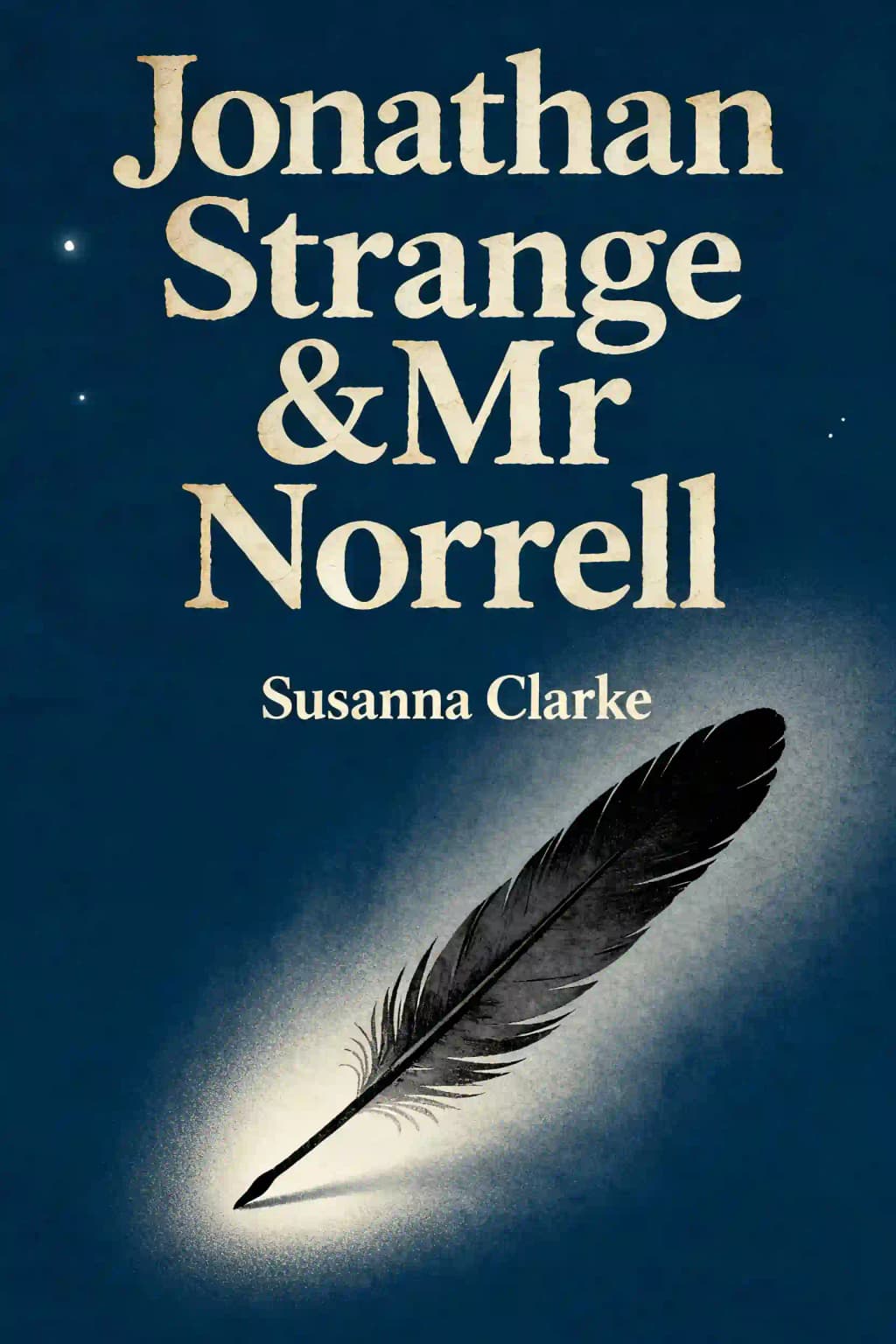
In a world where magic is merely an academic curiosity, two men are about to change everything. Jonathan Strange & Mr Norrell, Susanna Clarke's debut novel that took her ten years to write, became an instant literary sensation upon its 2004 publication. This 800-page alternate history of 19th-century England captivated readers worldwide, selling over 4 million copies and winning multiple awards including the Hugo Award and Time Magazine's Best Novel of the Year. Neil Gaiman called it "unquestionably the finest English novel of the fantastic written in the last seventy years," while the New York Times praised its "sly and irresistible" storytelling. The BBC's lavish 2015 adaptation further cemented its status as a modern classic that redefined how fantasy literature could engage with historical fiction. But what makes this tale of two magicians so enduringly powerful?
Chapitre 2
The Last Magician in England: Mr. Norrell's Solitary Ascent
In early 19th century England, magic has become nothing but a scholarly pursuit-until Mr. Gilbert Norrell reveals himself as the nation's only practicing magician. This reclusive, peevish little man with his vast library of magical texts has spent decades in isolation perfecting his craft. When challenged by the York Society of Magicians-gentlemen who merely read about magic rather than perform it-Norrell makes his public debut by animating the stone statues of York Cathedral, forcing his rivals to disband and acknowledge him as England's sole true magician.
Norrell's motivations are complex: he genuinely believes magic should be restored as a respectable English profession, yet he jealously guards his knowledge and abilities. He despises the "foolish, inaccurate" books on magic that fill gentlemen's libraries while hoarding rare texts for himself. Most significantly, he seeks to erase John Uskglass-the legendary Raven King who ruled Northern England for three centuries-from magical discourse, considering fairy magic dangerous and disreputable.
Upon arriving in London, Norrell struggles to gain influence until a pivotal moment: Sir Walter Pole's beautiful fiancee, Emma Wintertowne, dies before their wedding. Desperate to prove magic's practical value, Norrell resurrects her-but only by striking a dangerous bargain with a fairy gentleman with thistle-down hair, who demands "half the lady's life" in payment. This fateful decision sets in motion the novel's central conflict, as Lady Pole begins spending her nights enchanted in the fairy's realm of Lost-hope while appearing listless and strange during her days in England. The resurrection makes Norrell famous, but the hidden cost will haunt all involved.
Norrell's character embodies the novel's exploration of how knowledge becomes power-he controls magical discourse by buying every magical book in England, forcing other would-be practitioners to approach him as the gatekeeper of their discipline. His partnership with the government during the Napoleonic Wars shows magic's potential for national service, yet his fear of sharing knowledge ultimately limits what he can accomplish alone.
Chapitre 3
The Second Magician Rises: Jonathan Strange's Natural Talent
Jonathan Strange emerges as Norrell's perfect foil-young, handsome, sociable, and possessed of an intuitive magical talent that contrasts with Norrell's methodical study. After a chance encounter with a street magician named Vinculus who prophesies his magical destiny, Strange discovers his abilities almost accidentally. Where Norrell spent decades in solitary study, Strange performs impressive magic within months of beginning his education.
Strange's motivation to become a magician initially stems from his desire to impress Arabella Woodhope, the woman he loves. Yet as his talents develop, he grows genuinely passionate about advancing English magic. Unlike Norrell, Strange embraces magical innovation and experimentation. When he joins Wellington's army during the Napoleonic Wars, he creates practical battlefield magic-summoning roads through impassable terrain, animating mud hands to pull down French cavalry, and raising dead Neapolitans to carry messages (though this last spell haunts him afterward).
The relationship between the two magicians evolves from master-pupil to an uneasy partnership and eventually to rivalry. Norrell initially delights in finding someone who shares his passion for magic, yet grows increasingly threatened by Strange's independent thinking. Their philosophical differences become irreconcilable when Strange publishes a controversial review arguing that John Uskglass's wild magic remains the foundation of all English magical practice-directly contradicting Norrell's attempts to create a "respectable" modern magic divorced from fairy influence.
This intellectual schism reflects the novel's broader theme of rationalism versus romanticism. Norrell represents Enlightenment values-orderly, documented magic based on reason and study-while Strange increasingly embodies the Romantic ideal of the intuitive genius drawing power from nature and emotion. Their divergent approaches to magic mirror the cultural tensions of early 19th century England, caught between Georgian rationality and Romantic imagination.
Chapitre 4
The Gentleman with the Thistle-Down Hair: Fairy Enchantment
The novel's most captivating antagonist is the unnamed fairy gentleman with thistle-down hair-beautiful, capricious, and utterly amoral. After Norrell's bargain grants him power over Lady Pole, he extends his enchantment to Stephen Black, Sir Walter's dignified Black butler. Each night, both are forced to attend endless balls at his decaying mansion of Lost-hope, dancing until dawn while their bodies in England waste away.
The gentleman represents fairy magic at its most dangerous-ancient, powerful, and operating by rules incomprehensible to humans. His affection is as destructive as his hatred; he genuinely believes he's honoring Stephen Black by plotting to make him King of England (after murdering everyone ahead of him in succession). His casual cruelty-transforming a man into an oak tree for bumping into Stephen, or hanging Vinculus from a hawthorn tree-contrasts with his childlike delight in beautiful objects and elaborate entertainments.
Through this character, Clarke explores colonialism's parallels to fairy enchantment. The gentleman appropriates humans for his amusement without regard for their autonomy, just as imperial powers claimed foreign lands and peoples. Stephen Black's double oppression-enslaved by human society through racism and by fairy magic through enchantment-creates the novel's most poignant narrative arc. Born on a slave ship, named by a master, Stephen has built a respectable life through extraordinary competence, yet remains defined by others' perceptions and desires.
The fairy's obsession with Stephen culminates in the novel's most surprising twist: when Strange and Norrell attempt to summon John Uskglass by addressing "the nameless slave," their spell instead reaches Stephen Black, granting him momentary power over all England's natural elements-enough to destroy his enchanter and claim his freedom by becoming king of a fairy realm himself.
Chapitre 5
The Raven King's Shadow: Ancient Magic Returns
John Uskglass, the Raven King, never physically appears in the novel yet dominates its magical philosophy with an almost divine omnipresence. This mysterious figure - stolen as a child into Faerie, returned to conquer Northern England, and ruling for three centuries before vanishing - represents magic in its purest, wildest form. His reign marked a golden age of English magic, when the boundaries between the human and fairy worlds were permeable, and magic flowed freely through the landscape. The stories of his reign describe him commanding armies of ravens, speaking with trees and rivers, and writing his laws into the very bedrock of England.
Norrell attempts to erase Uskglass from magical history, claiming modern magic can exist without him. He systematically purchases and sequesters books mentioning the Raven King, rewrites historical accounts to diminish his importance, and promotes a sanitized version of magical practice based purely on academic study. Strange increasingly believes the opposite - that all English magic derives from the Raven King's systems and cannot be separated from them. His experiences in the Peninsular War, where he witnessed magic's raw power in combat, convince him that magic is fundamentally wild and untameable. This debate mirrors real-world tensions between tradition and innovation, between respecting historical foundations and creating new paradigms. It also reflects broader cultural conflicts between rationalism and romanticism that characterized the novel's historical setting.
The novel suggests that magic itself has consciousness and intention, existing as a semi-sentient force that flows through the land. The prophecy delivered by Vinculus - written on his body in magical symbols that constantly shift and change - reveals that Strange and Norrell themselves are merely parts of a spell John Uskglass is performing. Their actions, seemingly driven by free will, ultimately fulfill the Raven King's long-dormant plans to restore magic to England. Even their apparent rivalry serves his greater purpose, as their combined strengths - Norrell's scholarship and Strange's intuition - are necessary to reawaken England's magical heritage.
This concept reaches its climax when Strange and Norrell attempt to summon the Raven King in Hurtfew Abbey. Instead of appearing personally, he transforms Norrell's precious books into ravens that destroy the library - symbolic of how wild magic cannot be contained in scholarly texts. The birds tear through the carefully organized shelves, releasing ancient knowledge back into the world. The Raven King's magic works through nature itself; his return manifests not as a person but as a reawakening of magical awareness throughout England, with trees speaking to stones and stones speaking to water. The very landscape remembers its ancient king, and the novel suggests that true magic cannot be separated from the wild, untamed forces of nature that the Raven King embodied.
Chapitre 6
Enchantment's Price: Personal Costs of Magic
The novel's emotional core lies in the profound personal sacrifices demanded by magic, revealing how supernatural power exacts devastating tolls on its practitioners and those close to them. Lady Pole's fate serves as a haunting example - restored to life through magic only to endure a half-existence, spending her nights dancing in Lost-hope while her days are marked by apparent madness. Those around her see only hysteria and melancholy, unable to perceive the fairy enchantment that has claimed half her life. Her husband's political career and their marriage crumble as she appears increasingly unstable, though she desperately tries to communicate her supernatural imprisonment.
Arabella Strange's fate parallels Lady Pole's in its cruelty. The gentleman with thistle-down hair, obsessed with her beauty and vitality, orchestrates her abduction with calculated precision. The enchanted moss-oak substitute he leaves behind perfectly mimics her appearance, creating a tragic deception that culminates in a false corpse. This replacement serves as a particularly cruel form of magic - allowing her loved ones to mourn a death that never occurred while Arabella herself endures captivity in Faerie.
Jonathan Strange's descent into magical obsession represents perhaps the most dramatic transformation. His initial enthusiasm for magic evolves into desperate determination as he searches for his wife. The tincture of distilled madness he creates - derived from distilled mouse bones and other arcane ingredients - demonstrates his willingness to sacrifice his sanity for magical insight. The perpetual darkness that eventually surrounds him becomes both his prison and his protection, a visible manifestation of magic's isolating effects. His tragedy deepens as he comes tantalizingly close to understanding the fairy enchantments at work - seeing the signs but misinterpreting their significance until it's too late.
Norrell's story reveals how magic's price can be paid gradually, almost imperceptibly. His bargain with the gentleman with thistle-down hair brings him the recognition he craves, but corrupts the very revival of English magic he sought to achieve. His self-imposed isolation in his library at Hurtfew Abbey transforms into a more insidious form of solitude - surrounded by people yet increasingly disconnected from genuine human interaction. Drawlight and Lascelles, his social intermediaries, exemplify this isolation, using his social awkwardness for their own gain while remaining completely ignorant of the depth and beauty of magical knowledge he possesses.
The novel suggests that magic's greatest cost manifests in the erosion of human connections. This theme appears consistently - from Norrell's willing withdrawal from society to Strange's obsessive studies that strain his marriage even before Arabella's enchantment. The fairy enchantments themselves seem designed to sever human bonds, trapping their victims in isolated half-lives. Yet Clarke weaves hope through this darkness - Strange and Norrell's relationship evolves from rivalry to partnership, suggesting that magical knowledge, while isolating, can also forge unique bonds. Their time together in Strange's darkness reveals an unexpected truth: shared magical obsession can create its own form of intimacy, even as it separates them from the wider world.
Chapitre 7
England's Magical Restoration: A New Era Begins
The novel's resolution brings not an ending but a profound transformation that reshapes the magical landscape of England. Strange and Norrell vanish dramatically into the magical realms, taking with them their grand houses and precious libraries - including Hurtfew Abbey and all its ancient tomes. Their departure creates literal and metaphorical space for magic to flourish in new ways throughout England.
Lady Pole emerges from her decades-long enchantment fundamentally changed, carrying with her deep knowledge of fairy realms that she shares selectively with trusted confidants. She gradually reintegrates into human society, though she never fully sheds her otherworldly experiences. Stephen Black makes a more radical choice, accepting the crown of a fairy kingdom - transforming from a servant in England to a sovereign in the otherworld, fulfilling Lost Hope's true destiny.
Arabella Strange's reunion with Jonathan proves bittersweet. Their brief encounter in Venice shows their deep connection remains intact, yet Strange must return to his magical wanderings in the King's Roads. His promise to return "when two magicians shall appear in England" becomes both comfort and curse to Arabella, who establishes herself as a respected figure in Venice's intellectual circles while waiting.
Magic's return to England manifests in unexpected ways. New practitioners emerge from all walks of life - from country parsons discovering they can speak to birds, to shopkeepers finding they can mend broken objects with a touch. The magical community quickly divides into philosophical camps: "Strangite" practitioners embrace experimental and intuitive approaches, while "Norrellites" advocate for careful study and controlled application of magical theory.
John Childermass emerges as a crucial bridge between these factions. His years observing both masters give him unique insight into their strengths and weaknesses. His declaration that he follows both Strange and Norrell "in some degree" becomes a model for a more balanced approach to magical practice. His partnership with Vinculus, keeper of the Raven King's book written on his skin, helps preserve crucial magical knowledge while making it accessible to new practitioners.
The democratization of magic transforms English society. Women like Miss Redruth establish schools of magical theory, while working-class practitioners bring practical magic into daily life - healing livestock, improving crops, and solving local problems. The government establishes a Department of Magical Affairs, though it struggles to regulate this newly accessible power. The Raven King's prophecy fulfills itself not through a single dramatic event but through countless small magical awakenings across the country, creating a new magical ecosystem more diverse and vital than anything in England's past.
Chapitre 8
The Language of Birds: Clarke's Literary Achievement
Susanna Clarke's literary accomplishment extends beyond her intricate plot and memorable characters, establishing a new benchmark for historical fantasy. Her distinctive narrative voice - combining Jane Austen's keen social observation with the scholarly footnotes reminiscent of academic magical texts - creates a uniquely immersive reading experience that transports readers into an alternate version of Regency England. The novel's extensive system of footnotes (numbering over 200) serves multiple purposes: providing historical context, offering fascinating magical anecdotes, and creating a sense of academic authenticity that grounds the fantastical elements in scholarly tradition.
Clarke's prose style masterfully captures early 19th century literary conventions while maintaining accessibility for modern readers. She employs period-specific vocabulary and sentence structures that echo the works of Austen and other Regency writers, yet never becomes obtuse or difficult to follow. Her dialogue particularly shines in its authenticity, featuring the measured wit and subtle barbs characteristic of the era. The verbal sparring between Strange and Norrell exemplifies this skill, with their exchanges carrying layers of meaning beneath seemingly polite conversation. Even minor characters speak in distinct voices that reflect their social status and education while remaining true to the period's linguistic patterns.
The novel's pacing - deliberate and atmospheric - mirrors the storytelling conventions of the time period it emulates. Clarke takes time to build her world through careful observation and detailed description, allowing readers to fully inhabit its magical England rather than merely visiting it. This measured approach pays dividends in creating a rich tapestry of magical and mundane life intertwined.
Most remarkably, Clarke makes her fantasy world feel historically authentic by grounding magical elements in realistic social contexts and institutions. Magic affects everything from Parliamentary politics to military strategy, from domestic service to international diplomacy, in ways that feel both surprising and inevitable. The novel's exploration of class dynamics is particularly nuanced, showing how magic both reinforces and disrupts traditional social hierarchies. Issues of race and gender receive similar treatment - the marginalization of women practitioners and the colonization of fairy magic mirror real-world historical patterns while offering fresh perspectives on power and privilege. Through this careful integration of magical elements with historical social structures, Clarke creates a work that functions both as compelling fantasy and as insightful social commentary on both past and present.
The author's attention to historical detail extends to her portrayal of the period's intellectual life. References to real historical figures and events are seamlessly woven together with fictional magical elements, creating a sense that this alternate history could have existed alongside the one we know. Clarke's invention of a rich tradition of English magic, complete with its own canonical texts and historical debates, adds another layer of authenticity to the world she creates.
Chapitre 9
The Mirror and the Labyrinth: Reflections on Power and Knowledge
At its philosophical core, Jonathan Strange & Mr Norrell examines how knowledge becomes power and how power shapes knowledge. Norrell controls magic by restricting access to information - hoarding rare books, suppressing alternative viewpoints, and positioning himself as England's sole authority on practical magic. Strange, conversely, democratizes magical knowledge through publication and open practice, believing that magic belongs to all of England. Their opposing approaches reflect fundamental tensions in how societies manage and distribute knowledge.
The fairy gentleman - known as the man with the thistle-down hair - represents a third form of power, wielding magic through enchantment that distorts perception and reality itself. His magic operates through mirrors, dreams, and illusions, suggesting that power can manifest through controlling not just knowledge but people's understanding of reality. The Raven King, meanwhile, embodies a more primordial form of power that flows through nature itself - wild, untameable, and resistant to institutional control.
The novel's intricate system of magical symbols creates a complex meditation on knowledge and power. Mirrors appear throughout the narrative as portals between worlds and revealers of truth, yet they also distort and deceive - much like how knowledge itself can both illuminate and mislead. Labyrinths serve as powerful metaphors for learning and discovery: they conceal secrets yet follow precise patterns, suggesting that knowledge acquisition requires both structure and exploration. Ravens act as messengers and symbols of wisdom, yet retain their essential wildness - perhaps suggesting that true knowledge can never be fully domesticated or controlled.
Books themselves become contested symbols of power throughout the narrative. Norrell's library represents both the preservation and the imprisonment of knowledge, while Strange's published work represents its liberation - yet both approaches have their dangers and limitations. The tension between written and practical knowledge, between theory and application, runs throughout the novel.
These themes resonate powerfully with contemporary issues surrounding information access and control. The struggle between institutional authority (represented by Norrell) and innovative disruption (embodied by Strange) mirrors modern debates about academic gatekeeping, open access publishing, and intellectual property rights. The novel's suggestion that magic - like knowledge - ultimately resists absolute control speaks to current discussions about information freedom in the digital age, the role of expertise in society, and the balance between preserving and sharing knowledge.
Chapitre 10
The Spell Continues: Legacy of a Modern Classic
Jonathan Strange & Mr Norrell transformed fantasy literature by demonstrating how the genre could engage seriously with historical settings and philosophical ideas while maintaining its sense of wonder. Its success paved the way for other literary fantasy works that blur genre boundaries and appeal to mainstream audiences. The novel's influence can be seen in works like Erin Morgenstern's The Night Circus and Helene Wecker's The Golem and the Jinni, which similarly weave magical elements into meticulously researched historical settings.
The novel's scholarly approach to magic - complete with detailed footnotes, historical references, and a complex magical system - established a new standard for world-building in fantasy literature. Clarke's work showed that fantasy could be both intellectually rigorous and enchanting, inspiring authors to create similarly detailed magical universes grounded in academic traditions and historical research.
The book's enduring appeal lies in its perfect balance of elements - meticulous historical detail with imaginative magic, intellectual depth with emotional resonance, social comedy with genuine wonder. Clarke's portrayal of magic as both scholarly pursuit and wild, unpredictable force resonates with readers who seek both rational understanding and mysterious enchantment. The novel's exploration of power dynamics, colonialism, and the relationship between rationality and imagination continues to spark discussion and analysis years after its publication.
Like the great libraries of Hurtfew Abbey and Ashfair, the novel contains layers of meaning that reveal themselves through multiple readings. Its intricate plot structure mirrors the complexity of its themes, while its dry wit and sharp social observations provide a perfect counterpoint to its darker supernatural elements. The relationship between Strange and Norrell - their rivalry, partnership, and eventual reconciliation - serves as a metaphor for the tension between innovation and tradition that remains relevant today.
Like the spell John Uskglass casts through Strange and Norrell, Clarke's novel continues working its magic on readers long after they turn the final page. It reminds us that the boundaries between reality and fantasy, history and imagination, are perhaps more permeable than we believe. The book's lasting influence can be seen not only in literature but in other media, including the BBC adaptation and various stage productions, proving that its unique blend of historical authenticity and magical wonder continues to captivate new audiences in different forms.