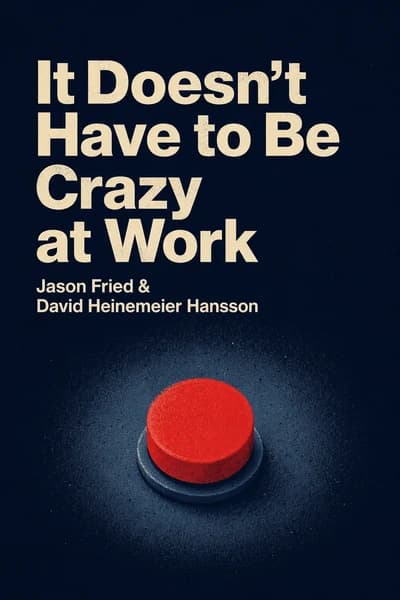
It Doesn't Have to Be Crazy at Work
Aperçu de It Doesn't Have to Be Crazy at Work
Tired of workplace chaos? Basecamp founders challenge burnout culture in this New York Times bestseller. Endorsed by top developers as a "manifesto for sanity," it reveals why protecting focus time builds better companies. What if success doesn't require 80-hour weeks?
Thèmes clés dans It Doesn't Have to Be Crazy at Work
- asynchronous communication
- burnout prevention
- deep work
- sustainable growth
- workplace boundaries
Citations de It Doesn't Have to Be Crazy at Work
Calm is a better long-term strategy.
If you don't create the time and space for people to think, they won't have anything to say.
Interruption is the enemy of productivity.
Humans aren't machines.
Discomfort is usually your body's response to something wrong.
Personnages de It Doesn't Have to Be Crazy at Work
- Jason FriedCo-author and co-founder of Basecamp
- David Heinemeier HanssonCo-author and co-founder of Basecamp
À propos de l'auteur
À propos de l'auteur de It Doesn't Have to Be Crazy at Work
Jason Fried and David Heinemeier Hansson, bestselling authors of It Doesn’t Have to Be Crazy at Work, are renowned advocates for reimagining workplace culture through calm, sustainable practices. As co-founders of Basecamp (est. 1999), their project-management software and contrarian business philosophies have shaped modern discussions about productivity, remote work, and eliminating corporate burnout. Their expertise stems from decades of running a profitable tech company while rejecting Silicon Valley’s “hustle culture” norms.
This book expands on themes from their previous works, including Rework (a Wall Street Journal bestseller) and Remote: Office Not Required, which popularized distributed teams. Fried and Hansson frequently share insights through their blog Signal v. Noise and keynote talks challenging conventional management practices.
It Doesn’t Have to Be Crazy at Work debuted as an instant bestseller, praised for its actionable strategies to reduce stress without sacrificing growth. Their principles are implemented daily at Basecamp and adopted by organizations worldwide seeking humane, focused work environments.
Telecharger le resume de It Doesn't Have to Be Crazy at Work
Obtenez le resume de It Doesn't Have to Be Crazy at Work en PDF ou EPUB gratuit. Imprimez-le ou lisez-le hors ligne a tout moment.
FAQ sur ce livre
It Doesn’t Have to Be Crazy at Work challenges modern workplace chaos by advocating for "calm companies" that prioritize sustainability over burnout. Co-authors Jason Fried and David Heinemeier Hansson (creators of Basecamp) share strategies to reduce distractions, minimize meetings, and focus on meaningful work. Key ideas include rejecting overwork culture, embracing "good enough" quality, and fostering transparency through direct questions.
Managers, entrepreneurs, and employees in high-stress industries will benefit most. The book offers actionable advice for leaders seeking to improve team well-being and productivity, as well as individuals navigating toxic work environments. It’s particularly relevant for tech professionals and remote teams.
Yes, especially for its practical, no-nonsense approach. The authors provide over 15 years of proven strategies from Basecamp, including anti-burnout tactics like capping workweeks at 40 hours and avoiding speculative projects. Critics praise its concise structure (68 short chapters) and relatable examples.
- Prioritize calm: Replace hustle culture with sustainable workflows.
- Compromise strategically: Use "good enough" quality for non-critical tasks to focus energy on essentials.
- Ask direct questions: Foster transparency with prompts like "What’s something nobody dares to talk about?"
- Launch early: Test ideas in real markets rather than endless internal debates.
While both books advocate simplicity, Crazy at Work specifically targets systemic workplace stressors. It expands on Basecamp’s operational refinements post-Rework, with new frameworks like "The Calm Company" philosophy and tactics for reducing digital distractions.
Some reviewers note the advice heavily reflects Basecamp’s unique context as a small, private tech firm. The book offers fewer implementation roadmaps for large corporations or industries with rigid hierarchies.
The authors advocate replacing vague check-ins with specific questions like "What advice would you give before we start this project?" This reduces political maneuvering and surfaces honest feedback. They also recommend written updates over meetings to minimize interruptions.
This principle argues against perfectionism in non-essential tasks. For example, using basic documentation formats instead of overly designed reports frees resources for critical projects like customer-facing features. The goal is excellence where it matters most.
While not exclusively about remote teams, the book’s emphasis on asynchronous communication and outcome-based evaluation aligns with distributed work models. It advises setting clear boundaries (e.g., no after-hours messaging) to prevent burnout.
Instead of endless internal debates or beta tests, the authors advocate shipping functional products quickly. Real-market feedback provides more actionable insights than theoretical planning, allowing teams to iterate efficiently.
The book recommends replacing most meetings with written briefs and limiting remaining discussions to 30 minutes. It also proposes "no-talk Thursdays" – meeting-free days for deep work.
- "The only way to get more done is to have less to do."
- "When everything’s high priority, nothing is."
These emphasize focused execution over chaotic multitasking.