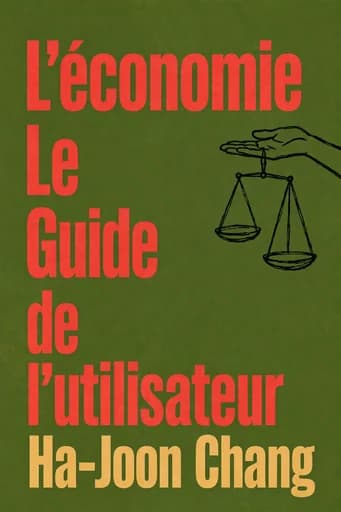
Ever wondered why economics feels like a secret club? Ha-Joon Chang's bestselling guide demystifies the "dismal science" with wit and clarity, earning 4.16/5 stars from 8,000+ readers. Nominated for Goodreads' Business Book Award, it's revolutionizing how universities teach this essential discipline.
Ha-Joon Chang, author of Economics: The User’s Guide, is a renowned institutional economist and leading critic of neoliberal capitalism. A research professor at SOAS University of London and former Cambridge faculty member, Chang combines academic rigor with accessible storytelling to challenge mainstream economic dogma. His work focuses on globalization, industrial policy, and the historical evolution of economic systems, informed by advisory roles for the United Nations, World Bank, and governments worldwide.
Chang’s bestselling books, including Kicking Away the Ladder and 23 Things They Don’t Tell You About Capitalism, have redefined debates on trade, development, and inequality. Known for blending historical analysis with contemporary critique, his works bridge academic economics and public discourse. A recipient of the Gunnar Myrdal and Wassily Leontief prizes, Chang’s ideas are taught in universities and cited in policy debates globally.
His writings, translated into 45 languages, have sold over 2.5 million copies, cementing his status as one of the most influential heterodox economists of his generation. Chang’s latest book, Edible Economics, further demonstrates his knack for making complex ideas digestible through unconventional analogies.
Economics: The User’s Guide offers a pluralist introduction to global economics, blending history, real-world examples, and critiques of mainstream theories. Ha-Joon Chang explains economic fundamentals while comparing nine schools of thought—from Classical to Keynesian—and their relevance to issues like globalization, inequality, and government policy. The book emphasizes that no single theory can fully explain economic behavior.
This book suits newcomers seeking a jargon-free economics primer and professionals wanting a critical, non-dogmatic perspective. Chang’s accessible style caters to readers interested in how economic policies shape daily life, from trade debates to workplace dynamics. It’s particularly valuable for those skeptical of “one-size-fits-all” neoliberal narratives.
Yes—it’s praised for demystifying economics through humor, historical context, and practical examples. Chang balances theory with critiques of capitalism’s flaws, making it ideal for readers seeking alternatives to mainstream textbooks. Reviewers highlight its “snippet-ready” clarity and relevance to contemporary issues like automation and climate policy.
Chang analyzes nine schools, including:
He argues that combining perspectives (e.g., Neoclassical + Keynesian) offers richer insights than rigid adherence to one school.
Chang presents globalization as a double-edged sword: it boosts wealth but exacerbates inequality and environmental harm. He critiques “free trade” absolutism, using examples like China’s state-led growth and the Eurozone crisis to argue for balanced policies protecting workers and local industries.
Yes. Chang challenges neoclassical myths—like “markets self-correct”—and highlights the dangers of deregulation and austerity. He advocates for pluralism, stressing that economic decisions are political and require ethical scrutiny, not just technical analysis.
The book references the 2008 financial crisis, East Asia’s industrialization, and U.S. manufacturing decline. Chang uses these to show how policies like tariffs (e.g., South Korea’s auto industry) or welfare spending (e.g., Nordic models) can drive success or failure.
Chang argues selective intervention is often necessary. For example, he praises post-WWII Europe’s mixed economies and critiques 1980s neoliberalism. However, he warns against unchecked state power, advocating context-specific solutions like progressive taxation and labor protections.
Unlike conventional texts that prioritize mathematical models, Chang focuses on historical narratives, institutional power dynamics, and ethical questions. It’s less technical but more critical of capitalism’s inequalities, making it a complement to—not replacement for—standard curricula.
Some economists argue Chang oversimplifies complex theories (e.g., conflating neoclassical and neoliberal ideas) and gives excessive weight to heterodox views. Critics also note the schools-of-thought framework, while useful, risks pigeonholing nuanced thinkers.
It addresses 2025’s pressing issues: AI-driven job displacement, climate economics, and post-pandemic inequality. Chang’s emphasis on policy flexibility—like green industrial strategies—resonates in debates over decarbonization and universal basic income.
Chang uses analogies (e.g., comparing economies to ecosystems), witty critiques of “zombie ideas,” and relatable examples like housing markets. He avoids equations, opting for plain-language explanations of GDP, inflation, and trade balances.
Ressentez le livre à travers la voix de l'auteur
Transformez les connaissances en idées captivantes et riches en exemples
Capturez les idées clés en un éclair pour un apprentissage rapide
Profitez du livre de manière ludique et engageante
Economics is 95% common sense deliberately made to look difficult.
Economics is fundamentally a political argument.
Economic theories, no matter how brilliant, are specific to their time and space.
Décomposez les idées clés de Economics en points faciles à comprendre pour découvrir comment les équipes innovantes créent, collaborent et grandissent.
Découvrez Economics à travers des récits vivants qui transforment les leçons d'innovation en moments mémorables et applicables.
Posez vos questions, choisissez votre style d’apprentissage et co-créez des idées qui vous correspondent vraiment.

Cree par des anciens de Columbia University a San Francisco
"Instead of endless scrolling, I just hit play on BeFreed. It saves me so much time."
"I never knew where to start with nonfiction—BeFreed’s book lists turned into podcasts gave me a clear path."
"Perfect balance between learning and entertainment. Finished ‘Thinking, Fast and Slow’ on my commute this week."
"Crazy how much I learned while walking the dog. BeFreed = small habits → big gains."
"Reading used to feel like a chore. Now it’s just part of my lifestyle."
"Feels effortless compared to reading. I’ve finished 6 books this month already."
"BeFreed turned my guilty doomscrolling into something that feels productive and inspiring."
"BeFreed turned my commute into learning time. 20-min podcasts are perfect for finishing books I never had time for."
"BeFreed replaced my podcast queue. Imagine Spotify for books — that’s it. 🙌"
"It is great for me to learn something from the book without reading it."
"The themed book list podcasts help me connect ideas across authors—like a guided audio journey."
"Makes me feel smarter every time before going to work"
Cree par des anciens de Columbia University a San Francisco

Obtenez le resume de Economics en PDF ou EPUB gratuit. Imprimez-le ou lisez-le hors ligne a tout moment.
Economics isn't the intimidating, equation-filled discipline you might imagine. It's actually 95% common sense deliberately dressed up in complex language. When someone claims "there is no alternative" to a particular economic policy, they're making a political statement disguised as scientific fact. The 2008 financial crisis dramatically illustrated this reality, as supposedly infallible economic models failed spectacularly, revealing the field's limitations. Economics affects everything from the food on your table to the phone in your pocket, yet most people avoid engaging with it, intimidated by its apparent complexity. What if you could see through the smoke and mirrors? Economics is fundamentally about how society organizes production, distribution, and consumption-decisions that shape our daily lives. Rather than accepting a single "correct" economic perspective, understanding multiple viewpoints empowers you to think critically about the forces shaping your world. Imagine being able to decode economic news and policies, recognizing the values and assumptions behind them, rather than accepting them as inevitable "scientific" conclusions.
When Adam Smith wrote about markets in 1776, he described small factories, 80-hour workweeks, and face-to-face transactions between acquainted parties. His "invisible hand" concept showed how competition guided self-interest toward social benefit. Today's landscape is unrecognizable. Modern corporations employ millions through complex bureaucracies spanning multiple countries. On Amazon, algorithms determine search results, seller success, and pricing. Major retailers like Walmart shape global manufacturing sectors. The financial system has evolved from local banks to a sophisticated network of derivatives, digital payments, and algorithmic trading. Consider how your economic life differs from your grandparents'. You might subscribe to services rather than owning products, work remotely, or earn income from digital content - activities inconceivable in Smith's era. While supply and demand principles remain valid, applying them meaningfully requires understanding how technology and institutions have transformed our economic relationships.
Remember being told that free markets and free trade are the only path to prosperity? This story contradicts the actual history of how today's wealthy nations developed - like someone climbing a ladder and then kicking it away so others can't follow. Britain, portrayed as free trade's pioneer, actually developed through strategic protectionism initiated in 1721, only embracing free trade in 1860 after securing industrial dominance. The United States maintained the world's highest industrial tariffs for nearly a century during its development. Alexander Hamilton explicitly argued that American industries needed protection from superior British competition - the "infant industry argument." After American independence, British Prime Minister William Pitt declared colonists shouldn't "manufacture so much as a horseshoe nail." Such concern reveals that free trade doesn't naturally benefit everyone equally. Countries unable to protect their emerging industries found themselves trapped in producing raw materials, remaining economically subordinate. Economic development typically requires strategic government intervention, not simply unfettered markets.
Economics isn't a single perspective but a restaurant offering diverse viewpoints across nine schools of thought. The Classical School introduced the "invisible hand" where self-interest creates social benefits. Neoclassical economics emphasizes rational choice and mathematical precision. Marxist economics analyzes class conflict between workers and capitalists. The Developmentalist Tradition advocates strategic intervention for building productive capabilities in developing economies. The Austrian School defends free markets not because humans are rational, but because we aren't-arguing complex economies can't be centrally planned. Schumpeterians highlight innovation and "creative destruction" as capitalism's engine. Keynesians created macroeconomics, analyzing the economy beyond its individual parts. Institutionalists examine how social rules shape economic behavior, while Behaviouralists study how actual humans make economic decisions. When consuming economic news, identify which theoretical lens is being applied. Unemployment might be viewed as a market clearing problem (Neoclassical), a systemic feature of capitalism (Marxist), or insufficient aggregate demand (Keynesian). Each perspective reveals different aspects of the same phenomenon and suggests different solutions. No single theory captures economic life's full complexity.
Economic textbooks portray individuals as rational utility-maximizers, but large organizations actually dominate our economy. The 200 largest corporations produce about 10% of world output. Walmart employs over 2.3 million people, while Apple's supply chain spans 43 countries. When these giants shift policies, entire industries transform through complex processes involving multiple stakeholders - far different from individual consumer choices. Trade unions enable collective worker bargaining, while systems like Germany's "co-determination" formalize collective decision-making by placing workers on corporate boards. In all functioning economies, government remains the most important economic actor, typically employing up to 25% of the workforce with expenditure representing 10-55% of national output. Even individuals don't match economic theory's portrayal. We exhibit "multiple-self" problems, behaving differently across various roles. Our preferences aren't internally generated but shaped by our social environment. We're motivated by patriotism, fairness, friendship, curiosity, and love - not just self-interest. Next time you hear policies justified based on "rational individual choice," remember this reality gap. Our economy is dominated by organizations making collective decisions, not isolated individuals maximizing personal utility.
Banking operates as a confidence trick dependent on collective belief. If depositors believe their bank can repay them, it will; if not, it won't. Banks promise immediate access to cash while keeping only a fraction as reserves, creating more money than physically exists. This works because withdrawals are typically staggered. However, if doubt spreads about solvency, depositors rush to withdraw funds, creating a self-fulfilling prophecy of failure-a "bank run" as seen in 2008. This "trick" is actually banking's purpose: creating more money by exploiting the fact that not everyone needs liquidity simultaneously. Before 2008, financial institutions created complex products like CDOs that obscured underlying risks. When the US housing bubble burst, even supposedly safe investments proved worthless, as they were based on shaky assets like subprime mortgages. Financial crises have increased significantly since deregulation began in the mid-1970s. The proportion of countries experiencing banking crises rose from nearly zero before the 1970s to 35 percent after 2008. Without stricter regulation, these crises will continue harming homeowners, workers, and retirees. Sustainable prosperity requires stable financial foundations, not clever financial engineering.
Economics isn't about memorizing formulas - it's about thinking critically about forces shaping our world. When examining economic arguments, ask "Who benefits?" Numbers in economics, despite appearing objective, are constructed from contested theoretical concepts. How we define metrics like unemployment significantly affects policy decisions. Modern economics overly focuses on markets, neglecting that the economy also includes firm directives and government influence. This market fixation has led policymakers to overlook manufacturing decline and work quality. We should consider diverse perspectives in economic debates, remaining humble about our theories. Though changing economic reality seems difficult, history shows "impossible" changes do happen - from abolishing slavery to women's suffrage. Economics belongs to everyone, not just experts. By understanding its diverse perspectives and recognizing its political nature, you gain power to engage meaningfully with the economic forces shaping your life. Remember: economics is too important to be left to economists alone. It's your economy too.