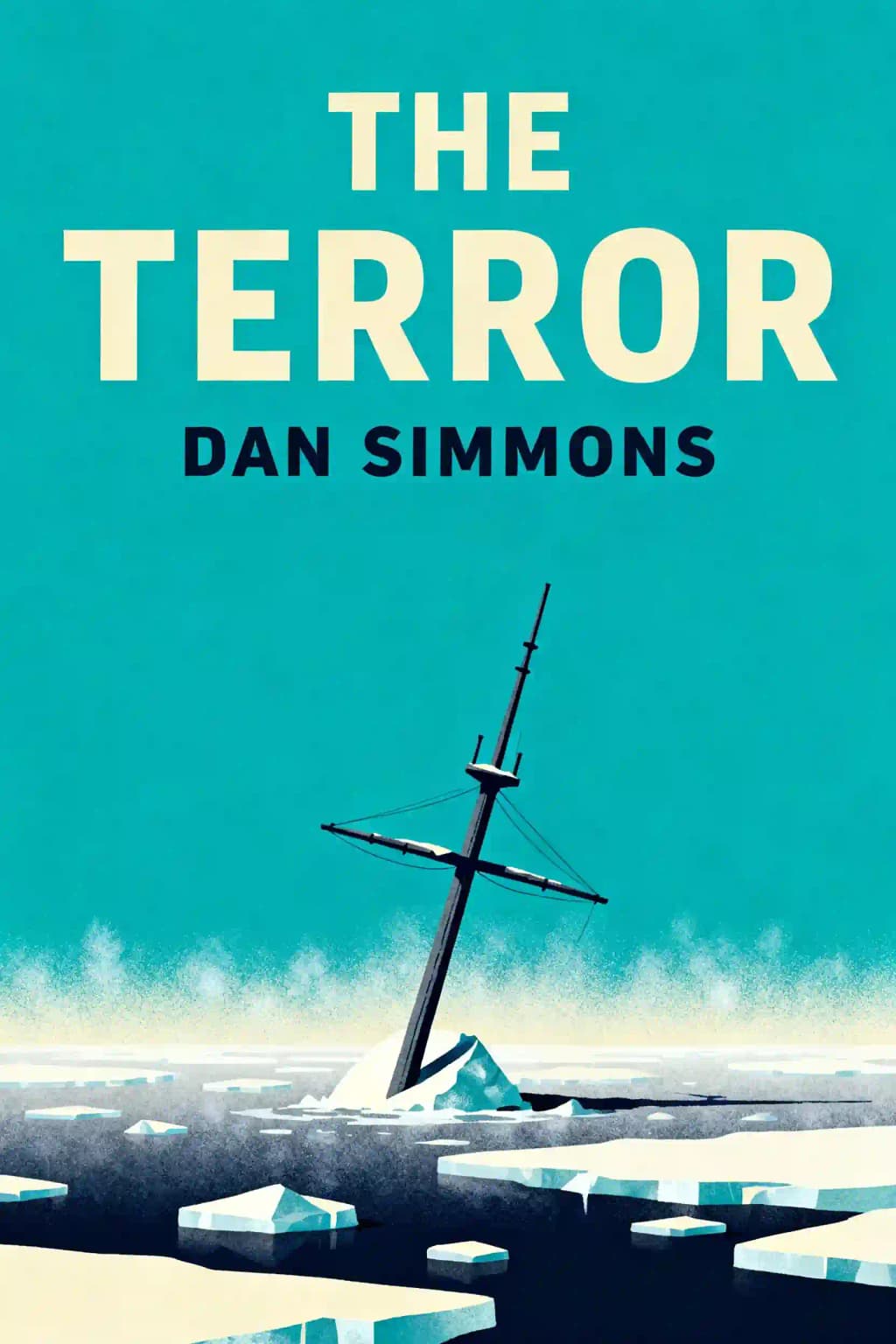
Stranded in Arctic ice, two ships face a terror beyond freezing death. This International Horror Guild Award winner blends historical tragedy with supernatural horror so masterfully that AMC turned it into a hit series, proving history's darkest mysteries make the most chilling fiction.
Dan Simmons is the acclaimed author of The Terror, an award-winning master of science fiction, horror, and historical fiction known for blending rigorous research with atmospheric storytelling.
Born in Peoria, Illinois in 1948, Simmons holds degrees in English and Education and worked as an elementary school teacher before pursuing writing full-time in 1989.
The Terror, published in 2007, exemplifies his talent for historical horror, reimagining the doomed Franklin Expedition with supernatural elements. The novel won the British Fantasy Award in 2008 and showcases Simmons' ability to merge documented history with psychological terror.
Simmons' versatility spans multiple genres and celebrated works. His science fiction epic Hyperion won the Hugo Award for Best Novel in 1990, while his horror novel Carrion Comfort earned the Bram Stoker Award. Other notable works include Drood, The Abominable, and the Ilium/Olympos series.
Throughout his career, Simmons has accumulated nine Locus Awards, four Bram Stoker Awards, and a World Fantasy Award, establishing him as one of contemporary fiction's most decorated genre-crossing authors.
The Terror by Dan Simmons is a historical horror novel that reimagines the doomed 1845 Franklin Expedition to find the Northwest Passage. The crew of HMS Terror and HMS Erebus become trapped in Arctic ice and face starvation, disease, lead poisoning, and a supernatural creature called the Tuunbaq that stalks them across the frozen wasteland. The 2007 novel blends real historical figures with supernatural elements to explore what happened to the lost expedition.
The Terror is perfect for readers who enjoy historical fiction, horror, and survival narratives. Fans of immersive, character-driven stories set against brutal environments will appreciate Dan Simmons' 900-page epic. History enthusiasts interested in Arctic exploration and naval expeditions will find the meticulously researched details compelling. The novel also appeals to readers who appreciate psychological horror and stories about human endurance under extreme conditions.
The Terror is widely considered an excellent book that excels at blending history and horror into an engaging, immersive experience. Dan Simmons creates memorable characters and maintains tension throughout the lengthy narrative, making the 900-page commitment worthwhile. The vivid descriptions of Arctic conditions and the slow unraveling of the expedition create a gripping atmosphere. However, readers should be prepared for graphic violence, historical racism and sexism, and descriptions of cannibalism.
Dan Simmons is an American author known for genre-blending fiction who wrote The Terror in 2007. Beyond The Terror, Simmons is acclaimed for the Hyperion Cantos science fiction series, which won multiple Hugo Awards. He has written across multiple genres including horror (Summer of Night, Carrion Comfort), historical fiction, and science fiction, demonstrating remarkable versatility as a writer throughout his career.
The Terror is based on the real Franklin Expedition of 1845-1848, which disappeared while searching for the Northwest Passage. Dan Simmons uses actual crew members as characters, including Captain Sir John Franklin, Captain Francis Crozier, and Commander James Fitzjames. The historical elements—the ships becoming trapped in ice, crew deaths, and the expedition's disappearance—are factual. However, the supernatural creature and specific plot events are fictionalized to answer the mystery of what happened.
The Tuunbaq is a supernatural demon creature from Inuit mythology that stalks the Franklin Expedition throughout The Terror. Created by the goddess Sedna to kill other spirits, the Tuunbaq was eventually banished to the Arctic after turning on its creator.
The creature resembles an immense polar bear with intelligence and supernatural abilities:
Captain Francis Crozier becomes the expedition's sole survivor in The Terror by Dan Simmons. After being shot and left for dead by mutineer Cornelius Hickey, Crozier is rescued by Lady Silence, who treats his wounds with native medicine. He experiences visions revealing the Tuunbaq's true nature and eventually has his tongue cut out, becoming a shaman himself. Crozier abandons his British identity, takes the Inuit name Taliriktug, and starts a family with Lady Silence (Silna).
Lady Silence, whose real name is Silna, is an Inuit shaman whose tongue was sacrificed to communicate with the Tuunbaq. Named by the expedition's surgeon because she appears mute, she follows the crew after they accidentally kill her companion. Lady Silence becomes central to understanding the supernatural threat, as shamans like her maintained peace with the Tuunbaq by staying out of its domain. She ultimately saves Captain Crozier's life and becomes his partner in Inuit culture.
The Terror explores survival, human endurance, and the limits of British imperial ambition against nature's power. Dan Simmons examines how rationalism and technological superiority fail against Arctic brutality and spiritual forces. The novel addresses colonialism through the crew's attitudes toward the Inuit and their exploitation of the environment.
Other themes include:
The Terror ends with Captain Crozier as the sole survivor, having transformed into an Inuit shaman named Taliriktug living with Lady Silence and their two children. The mutineer Cornelius Hickey and his cannibalistic group perish, with Hickey killed by the Tuunbaq after murdering his companions. Years later, Crozier's family encounters HMS Terror drifted hundreds of miles south; he sets the decaying ship ablaze and watches it sink, symbolically severing ties with his former life.
The Terror by Dan Simmons is approximately 900 pages long, making it a substantial reading commitment. Despite its length, reviewers note that Dan Simmons maintains strong pacing throughout, with tension and action interspersed between character development and historical detail. The extensive page count allows Simmons to deeply explore the expedition's slow deterioration, multiple character perspectives, and the Arctic environment's oppressive nature.
The Terror receives some criticism for repetitive descriptions of crushing ice, scraping sounds, and oppressive cold, though many readers find this effective for atmosphere. Some chapters feel like filler with limited plot consequence, and the supernatural creature conveniently appears and disappears rather than having consistent confrontations. The novel includes gratuitous details in sex scenes and displays period-accurate racism, sexism, and homophobia that some readers find uncomfortable, though the narrative doesn't glorify these attitudes.
Ressentez le livre à travers la voix de l'auteur
Transformez les connaissances en idées captivantes et riches en exemples
Capturez les idées clés en un éclair pour un apprentissage rapide
Profitez du livre de manière ludique et engageante
the most terrifying monsters might be the ones we create ourselves.
The monster becomes both a literal threat and a metaphor for the expedition's doom.
The creature possesses near-human intelligence.
civilization's rapid dissolution when faced with extreme circumstances.
the expedition fractures along both hierarchical and moral lines.
Décomposez les idées clés de The Terror en points faciles à comprendre pour découvrir comment les équipes innovantes créent, collaborent et grandissent.
Condensez The Terror en indices de mémoire rapides mettant en évidence les principes clés de franchise, de travail d'équipe et de résilience créative.

Découvrez The Terror à travers des récits vivants qui transforment les leçons d'innovation en moments mémorables et applicables.
Posez n'importe quelle question, choisissez la voix et co-créez des idées qui résonnent vraiment avec vous.

Cree par des anciens de Columbia University a San Francisco
"Instead of endless scrolling, I just hit play on BeFreed. It saves me so much time."
"I never knew where to start with nonfiction—BeFreed’s book lists turned into podcasts gave me a clear path."
"Perfect balance between learning and entertainment. Finished ‘Thinking, Fast and Slow’ on my commute this week."
"Crazy how much I learned while walking the dog. BeFreed = small habits → big gains."
"Reading used to feel like a chore. Now it’s just part of my lifestyle."
"Feels effortless compared to reading. I’ve finished 6 books this month already."
"BeFreed turned my guilty doomscrolling into something that feels productive and inspiring."
"BeFreed turned my commute into learning time. 20-min podcasts are perfect for finishing books I never had time for."
"BeFreed replaced my podcast queue. Imagine Spotify for books — that’s it. 🙌"
"It is great for me to learn something from the book without reading it."
"The themed book list podcasts help me connect ideas across authors—like a guided audio journey."
"Makes me feel smarter every time before going to work"
Cree par des anciens de Columbia University a San Francisco

Obtenez le resume de The Terror en PDF ou EPUB gratuit. Imprimez-le ou lisez-le hors ligne a tout moment.
Imagine being trapped in perpetual darkness, surrounded by endless ice that groans and shifts beneath your feet like a living thing. The year is 1845, and Sir John Franklin leads two ships-HMS Terror and HMS Erebus-into the Arctic to discover the fabled Northwest Passage. Despite their technological advantages-steam engines, central heating, and provisions for three years-they are woefully unprepared for what awaits. Captain Francis Crozier, an experienced polar navigator with a drinking problem and broken heart, serves as second-in-command, his Irish background marking him as an outsider in the class-conscious Royal Navy. By October 1847, disaster has struck. Both ships are hopelessly trapped in ice. Franklin has died under mysterious circumstances, leaving the embittered Crozier in command of 126 increasingly desperate men. Their food supplies-thousands of canned goods-were improperly sealed by a corrupt contractor, slowly poisoning the crew. Worse still, something is stalking them on the ice-a massive creature that combines the worst features of a polar bear with something far more ancient and malevolent. When spring fails to bring the expected thaw, Crozier makes the fateful decision to abandon the ships and march south-a journey of over 800 miles across the most inhospitable terrain on Earth.