The Mom Test: Finding Business Truth
Stop relying on polite feedback that kills startups. Learn how to ask the right questions to bypass ego and uncover real market demand.
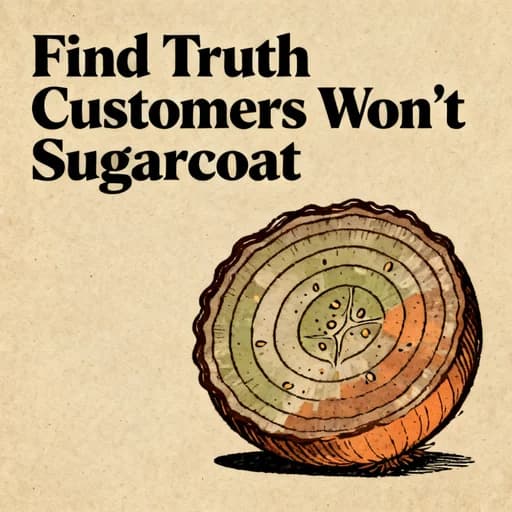
Mejor cita de The Mom Test: Finding Business Truth
The core insight is that even your mom will lie to you about your business idea because she loves you and doesn't want to hurt your feelings. Almost everyone else will lie to you too, because social pressure makes it easier to give a compliment than to tell the hard, honest truth.
Generated with BeFreed
An audio lesson about the book The Mom Test, covering its key ideas and takeaways.


Preguntas frecuentes
Asking for an opinion on an idea puts people in a position where they feel social pressure to be supportive and polite. Most people, especially friends and family, will give you "polite lies" or compliments to avoid hurting your feelings. This results in false validation, leading entrepreneurs to build products that no one actually wants or buys because the foundation was based on social niceties rather than market reality.
The first rule is to talk about the person's life instead of your idea to avoid biasing their answers. The second rule is to ask about specific actions they took in the past rather than hypothetical future behaviors, as people are poor at predicting what they will do. The third rule is to listen more than you talk; if you are talking more than 20% of the time, you are likely pitching rather than learning.
Bad data consists of compliments, fluff, and feature ideas. Compliments like "That’s cool" carry zero data and are usually just a way to end a conversation. Fluff includes generic claims or future-tense promises like "I would buy that." Genuine interest, or "commitment," is measured by whether the person is willing to give up something valuable, such as their time for a follow-up, their reputation by providing an introduction, or their money through a pre-order.
Formal meetings often cause people to become guarded or switch into a mode where they provide "correct" rather than honest answers. Additionally, formal interviews require significant time for scheduling and travel. Casual "micro-conversations" lasting only five minutes can often uncover the same amount of truth regarding a problem without the pressure of a pitch, allowing founders to gather data much faster.
A "who-where" pair is a way to slice a broad market into a very narrow, findable segment, such as "non-native speaking PhD students" (the who) at a "specific upcoming conference" (the where). Startups often fail by trying to please too many different types of customers at once. By focusing on a narrow group, a founder can make marketing clearer and ensure the product's features solve a specific, high-signal problem for that group.
Creado por exalumnos de la Universidad de Columbia en San Francisco
"Instead of endless scrolling, I just hit play on BeFreed. It saves me so much time."


"I never knew where to start with nonfiction—BeFreed’s book lists turned into podcasts gave me a clear path."


"Perfect balance between learning and entertainment. Finished ‘Thinking, Fast and Slow’ on my commute this week."
"Crazy how much I learned while walking the dog. BeFreed = small habits → big gains."
"Reading used to feel like a chore. Now it’s just part of my lifestyle."

"Feels effortless compared to reading. I’ve finished 6 books this month already."
"BeFreed turned my guilty doomscrolling into something that feels productive and inspiring."

"BeFreed turned my commute into learning time. 20-min podcasts are perfect for finishing books I never had time for."
"BeFreed replaced my podcast queue. Imagine Spotify for books — that’s it. 🙌"

"It is great for me to learn something from the book without reading it."
"The themed book list podcasts help me connect ideas across authors—like a guided audio journey."
"Makes me feel smarter every time before going to work"
Creado por exalumnos de la Universidad de Columbia en San Francisco
"Instead of endless scrolling, I just hit play on BeFreed. It saves me so much time."
"I never knew where to start with nonfiction—BeFreed’s book lists turned into podcasts gave me a clear path."
"Perfect balance between learning and entertainment. Finished ‘Thinking, Fast and Slow’ on my commute this week."
"Crazy how much I learned while walking the dog. BeFreed = small habits → big gains."
"Reading used to feel like a chore. Now it’s just part of my lifestyle."
"Feels effortless compared to reading. I’ve finished 6 books this month already."
"BeFreed turned my guilty doomscrolling into something that feels productive and inspiring."
"BeFreed turned my commute into learning time. 20-min podcasts are perfect for finishing books I never had time for."
"BeFreed replaced my podcast queue. Imagine Spotify for books — that’s it. 🙌"
"It is great for me to learn something from the book without reading it."
"The themed book list podcasts help me connect ideas across authors—like a guided audio journey."
"Makes me feel smarter every time before going to work"
"Instead of endless scrolling, I just hit play on BeFreed. It saves me so much time."
"I never knew where to start with nonfiction—BeFreed’s book lists turned into podcasts gave me a clear path."
"Perfect balance between learning and entertainment. Finished ‘Thinking, Fast and Slow’ on my commute this week."
"Crazy how much I learned while walking the dog. BeFreed = small habits → big gains."
"Reading used to feel like a chore. Now it’s just part of my lifestyle."
"Feels effortless compared to reading. I’ve finished 6 books this month already."
"BeFreed turned my guilty doomscrolling into something that feels productive and inspiring."
"BeFreed turned my commute into learning time. 20-min podcasts are perfect for finishing books I never had time for."
"BeFreed replaced my podcast queue. Imagine Spotify for books — that’s it. 🙌"
"It is great for me to learn something from the book without reading it."
"The themed book list podcasts help me connect ideas across authors—like a guided audio journey."
"Makes me feel smarter every time before going to work"
"Instead of endless scrolling, I just hit play on BeFreed. It saves me so much time."
"I never knew where to start with nonfiction—BeFreed’s book lists turned into podcasts gave me a clear path."
"Perfect balance between learning and entertainment. Finished ‘Thinking, Fast and Slow’ on my commute this week."
"Crazy how much I learned while walking the dog. BeFreed = small habits → big gains."
"Reading used to feel like a chore. Now it’s just part of my lifestyle."
"Feels effortless compared to reading. I’ve finished 6 books this month already."
"BeFreed turned my guilty doomscrolling into something that feels productive and inspiring."
"BeFreed turned my commute into learning time. 20-min podcasts are perfect for finishing books I never had time for."
"BeFreed replaced my podcast queue. Imagine Spotify for books — that’s it. 🙌"
"It is great for me to learn something from the book without reading it."
"The themed book list podcasts help me connect ideas across authors—like a guided audio journey."
"Makes me feel smarter every time before going to work"