Schumpeter and the Theater of Power: Rethinking Democracy
Explore Joseph Schumpeter's honest take on democracy as a competitive institutional arrangement where leaders vie for votes in a theater of power.
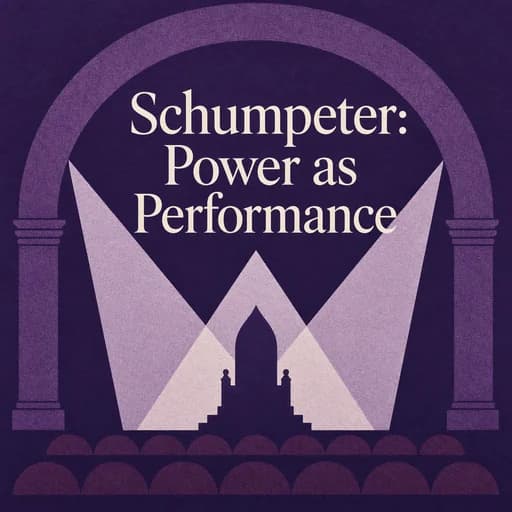
Mejor cita de Schumpeter and the Theater of Power: Rethinking Democracy
Democracy is an institutional arrangement where individuals gain the power to decide things by competing for your vote; it is less like a town hall and more like a job interview where the candidates are trying to convince you they’re the only ones who can do the work.
Generated by Panna
An analysis of Joseph Schumpeter's 'Capitalism, Socialism, and Democracy' focusing on Chapter XXII's theory of democratic competition. The lesson should connect Schumpeter's elite-competition model to modern power structures, specifically examining how gendered voices are represented or marginalized within those structures, and the role social media plays in mediating this relationship. Use precise terminology from Schumpeterian theory and feminist critique.



Preguntas frecuentes
Joseph Schumpeter proposed a brutally honest take on democratic theory, suggesting it is less about a rational process of the people's will and more of an institutional arrangement. In his view, democracy is a competition where individuals gain the power to decide issues by competing for the public's vote. This perspective flips the traditional script, suggesting that the primary role of the people is simply to produce a government rather than to direct specific policies.
Traditional views often teach that democracy is a grand process where representatives act as vessels for the well-defined opinions of the people. Schumpeterian democracy challenges this by framing the system as a struggle or a show, similar to a job interview. Instead of the people deciding on complex issues like trade policy, they participate in a political competition where candidates convince voters of their necessity and competence to lead the government.
In the 'Theater of Power,' voter behavior is centered on the act of choosing between competing elites rather than mastering complex policy details. Schumpeter argues that the people's main function is to produce a government through their votes. This elite theory of democracy suggests that candidates often define the work that needs to be done and then compete to convince the public that they are the only ones capable of performing those tasks.
Creado por exalumnos de la Universidad de Columbia en San Francisco
"Instead of endless scrolling, I just hit play on BeFreed. It saves me so much time."


"I never knew where to start with nonfiction—BeFreed’s book lists turned into podcasts gave me a clear path."


"Perfect balance between learning and entertainment. Finished ‘Thinking, Fast and Slow’ on my commute this week."
"Crazy how much I learned while walking the dog. BeFreed = small habits → big gains."
"Reading used to feel like a chore. Now it’s just part of my lifestyle."

"Feels effortless compared to reading. I’ve finished 6 books this month already."
"BeFreed turned my guilty doomscrolling into something that feels productive and inspiring."

"BeFreed turned my commute into learning time. 20-min podcasts are perfect for finishing books I never had time for."
"BeFreed replaced my podcast queue. Imagine Spotify for books — that’s it. 🙌"

"It is great for me to learn something from the book without reading it."
"The themed book list podcasts help me connect ideas across authors—like a guided audio journey."
"Makes me feel smarter every time before going to work"
Creado por exalumnos de la Universidad de Columbia en San Francisco
"Instead of endless scrolling, I just hit play on BeFreed. It saves me so much time."
"I never knew where to start with nonfiction—BeFreed’s book lists turned into podcasts gave me a clear path."
"Perfect balance between learning and entertainment. Finished ‘Thinking, Fast and Slow’ on my commute this week."
"Crazy how much I learned while walking the dog. BeFreed = small habits → big gains."
"Reading used to feel like a chore. Now it’s just part of my lifestyle."
"Feels effortless compared to reading. I’ve finished 6 books this month already."
"BeFreed turned my guilty doomscrolling into something that feels productive and inspiring."
"BeFreed turned my commute into learning time. 20-min podcasts are perfect for finishing books I never had time for."
"BeFreed replaced my podcast queue. Imagine Spotify for books — that’s it. 🙌"
"It is great for me to learn something from the book without reading it."
"The themed book list podcasts help me connect ideas across authors—like a guided audio journey."
"Makes me feel smarter every time before going to work"
"Instead of endless scrolling, I just hit play on BeFreed. It saves me so much time."
"I never knew where to start with nonfiction—BeFreed’s book lists turned into podcasts gave me a clear path."
"Perfect balance between learning and entertainment. Finished ‘Thinking, Fast and Slow’ on my commute this week."
"Crazy how much I learned while walking the dog. BeFreed = small habits → big gains."
"Reading used to feel like a chore. Now it’s just part of my lifestyle."
"Feels effortless compared to reading. I’ve finished 6 books this month already."
"BeFreed turned my guilty doomscrolling into something that feels productive and inspiring."
"BeFreed turned my commute into learning time. 20-min podcasts are perfect for finishing books I never had time for."
"BeFreed replaced my podcast queue. Imagine Spotify for books — that’s it. 🙌"
"It is great for me to learn something from the book without reading it."
"The themed book list podcasts help me connect ideas across authors—like a guided audio journey."
"Makes me feel smarter every time before going to work"
"Instead of endless scrolling, I just hit play on BeFreed. It saves me so much time."
"I never knew where to start with nonfiction—BeFreed’s book lists turned into podcasts gave me a clear path."
"Perfect balance between learning and entertainment. Finished ‘Thinking, Fast and Slow’ on my commute this week."
"Crazy how much I learned while walking the dog. BeFreed = small habits → big gains."
"Reading used to feel like a chore. Now it’s just part of my lifestyle."
"Feels effortless compared to reading. I’ve finished 6 books this month already."
"BeFreed turned my guilty doomscrolling into something that feels productive and inspiring."
"BeFreed turned my commute into learning time. 20-min podcasts are perfect for finishing books I never had time for."
"BeFreed replaced my podcast queue. Imagine Spotify for books — that’s it. 🙌"
"It is great for me to learn something from the book without reading it."
"The themed book list podcasts help me connect ideas across authors—like a guided audio journey."
"Makes me feel smarter every time before going to work"