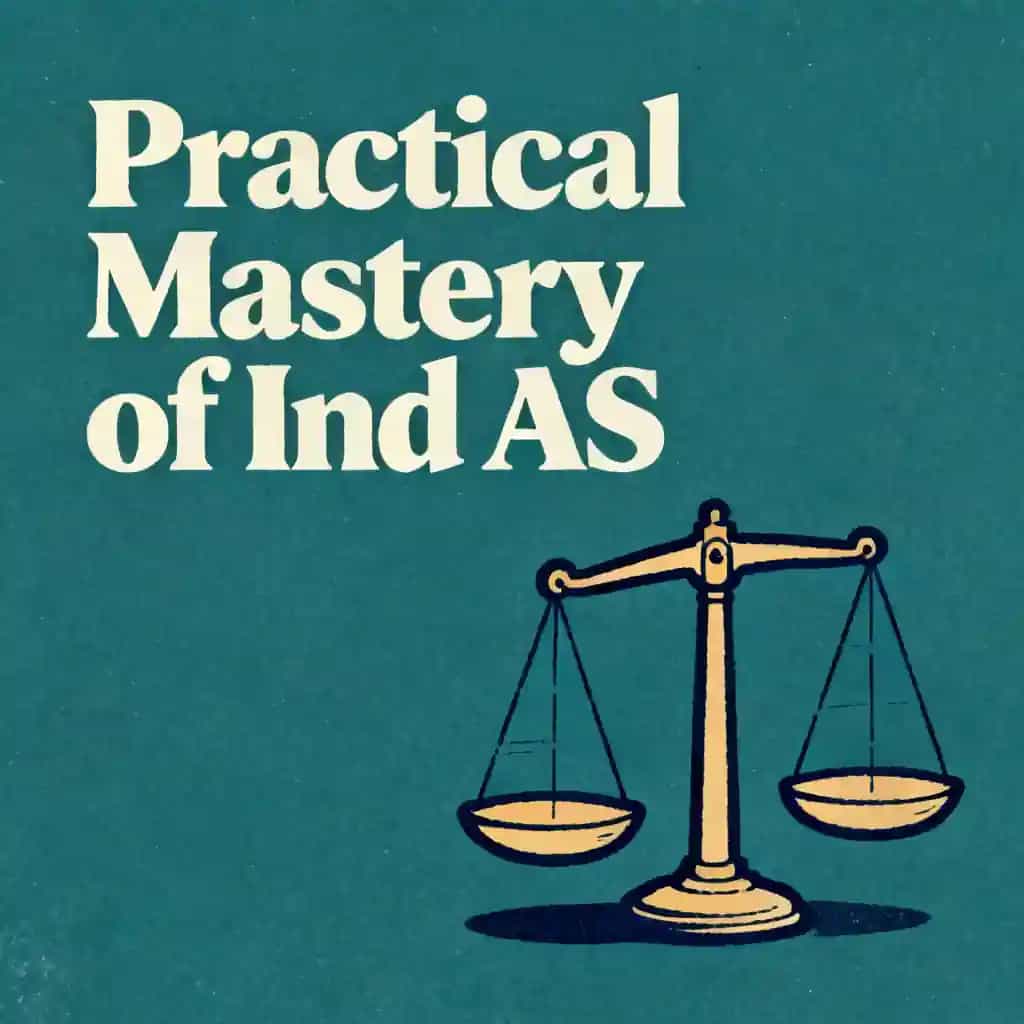
Transitioning to Ind AS is a move from a rules-based system to a principles-based one, shifting the focus from the legal form of a transaction to its true economic substance. Once a company crosses the threshold and triggers this transition, it is a one-way street—the 'Rule of Irrevocability' means you are locked into these global standards for perpetuity.
Practical insights into the implementation of Indian Accounting Standards (Ind AS) for listed companies and unlisted companies, focusing on key challenges and solutions for a smooth transition



Creado por exalumnos de la Universidad de Columbia en San Francisco
"Instead of endless scrolling, I just hit play on BeFreed. It saves me so much time."
"I never knew where to start with nonfiction—BeFreed’s book lists turned into podcasts gave me a clear path."
"Perfect balance between learning and entertainment. Finished ‘Thinking, Fast and Slow’ on my commute this week."
"Crazy how much I learned while walking the dog. BeFreed = small habits → big gains."
"Reading used to feel like a chore. Now it’s just part of my lifestyle."
"Feels effortless compared to reading. I’ve finished 6 books this month already."
"BeFreed turned my guilty doomscrolling into something that feels productive and inspiring."
"BeFreed turned my commute into learning time. 20-min podcasts are perfect for finishing books I never had time for."
"BeFreed replaced my podcast queue. Imagine Spotify for books — that’s it. 🙌"
"It is great for me to learn something from the book without reading it."
"The themed book list podcasts help me connect ideas across authors—like a guided audio journey."
"Makes me feel smarter every time before going to work"
Creado por exalumnos de la Universidad de Columbia en San Francisco

Jackson: Hey Nia, I was just looking at some financial news and it hit me—transitioning to Ind AS isn't just a simple software update. It’s more like moving from a local dialect to a global language.
Nia: That is a perfect way to put it! And here’s the kicker: once you make that move, there’s no going back. It’s called the "Rule of Irrevocability." Even if your company’s net worth drops below the threshold later, you are locked into Ind AS for perpetuity.
Jackson: Wait, so it’s a one-way street? That’s a huge stakes game for unlisted companies approaching that 250 crore mark.
Nia: Exactly. It changes everything from how you recognize revenue to how you value your office leases. It’s a massive shift from historical costs to current market realities.
Jackson: I can see why finance teams might be sweating this. So, let’s dive into the "Am I eligible?" checklist to see who exactly needs to buckle up for this transition.
Jackson: So, we’ve established that this is a permanent commitment. But for the folks listening who are sitting on the fence, or maybe just crossing into that "big league" territory—how do they know if the clock is officially ticking for them?
Nia: Great question. The Ministry of Corporate Affairs—the MCA—didn't just flip a switch for everyone at once. They used a phased approach. It really comes down to three main pillars: your net worth, your listing status, and your corporate relationships. If you’re a listed company—meaning your equity or debt is on a recognized stock exchange in India or even abroad—you’re in. Phase Two, which kicked off back in April 2017, basically swept up all listed companies regardless of their net worth.
Jackson: Even the smaller ones?
Nia: Well, the only real exception there is for companies listed on the SME exchange. They have a different path. But for everyone else, if you're on the main board, Ind AS is your new reality. Now, for the unlisted world, that's where the 250 crore net worth threshold comes in. If you hit that number on your audited balance sheet at the end of a financial year, you have to adopt Ind AS starting April 1st of the very next year.
Jackson: I noticed you said "audited net worth." Does that mean if I’m sitting at 240 crores but I *expect* to hit 260 next month because of a big deal, I should start the transition now?
Nia: Actually, no! This is a common pitfall. The roadmap is very clear: it’s based on actual, audited figures from the previous year. Projections or "gut feelings" about growth don't trigger the mandate. You wait until that audited report confirms you've crossed the line. But once you do—boom—the "once triggered, always applicable" rule we mentioned earlier kicks in. Even if your net worth dips to 200 crores the year after, you’re still an Ind AS company.
Jackson: That’s intense. And what about the "relationship" pillar you mentioned? That sounds like it could catch a lot of people off guard.
Nia: Oh, absolutely. This is the "cascading effect." If a parent company meets the criteria, all its subsidiaries, associates, and joint ventures have to follow suit. It doesn't matter if the subsidiary is a tiny startup with a net worth of only five crores. If the parent is an Ind AS entity, the whole family moves together to ensure the consolidated financial statements actually make sense.
Jackson: So it’s like a digital sync—if the main account upgrades, all the sub-profiles have to upgrade too so they can still talk to each other.
Nia: Precisely! And it even extends to foreign operations. If an Indian parent company moves to Ind AS, its foreign subsidiary—say, in London or New York—doesn't necessarily have to change its local filings in those countries. But for the Indian parent to prepare its consolidated reports, that foreign sub has to provide a "reporting package" that’s fully aligned with Ind AS.
Jackson: That sounds like a massive coordination headache. You’re essentially asking a team in a different country to learn a new set of rules just for the home office.
Nia: It is a heavy lift. And it works the other way, too. If an Indian company is a subsidiary of a foreign parent, it doesn't just get to follow the parent's GAAP. It has to assess its own net worth and listing status in India. If it hits the Indian thresholds, it must adopt Ind AS, even if the parent company is using something else entirely. It’s all about maintaining that high-quality, transparent standard within the Indian economic environment.
Jackson: Okay, so we know who’s in. Now let's talk about the "what." You mentioned earlier that this isn't just a software update. It’s a change in the very philosophy of accounting. Coming from the old Indian GAAP—or IGAAP—what is the biggest shock to the system?
Nia: It’s the move from a "rules-based" system to a "principles-based" one. Think of it as moving from following a rigid recipe to understanding the science of cooking. Under the old rules, we looked a lot at the legal form of a transaction. If a document said "Equity," we called it equity. But Ind AS 32 tells us to look at the "economic substance."
Jackson: Give me a real-world example of that. How does a piece of paper lie to us?
Nia: Well, it's not lying, it's just about the reality of the obligation. Take Redeemable Preference Shares. In the old days, because they were called "shares," they’d sit pretty in the Share Capital section of the balance sheet. But think about it—if the company is *legally required* to pay that money back to the investor at a certain date, is it really equity?
Jackson: Sounds more like a loan to me.
Nia: Exactly! And that’s how Ind AS sees it. It reclassifies those shares as debt. Now, imagine you’re a CFO and suddenly your "Debt-to-Equity" ratio doubles overnight because of this one change. You haven't borrowed a single extra rupee, but on paper, your risk profile just skyrocketed. This can actually trigger "covenant breaches" in your existing bank loans.
Jackson: Wow. So you could literally be in default on a loan because the accounting rules changed, even though your business is doing exactly what it was doing yesterday?
Nia: Yes, and that’s why communication with lenders is a top-tier priority during transition. Another huge pillar here is the "Time Value of Money." Ind AS is obsessed with it. In the old world, if you had a long-term interest-free loan from a promoter, you just recorded the amount you received. Under Ind AS, you have to discount that to its "present value." You’re essentially acknowledging that a rupee today is worth more than a rupee five years from now.
Jackson: It sounds more honest, but also a lot more complicated. You have to start making assumptions about interest rates and fair values, right?
Nia: Spot on. And "Fair Value" is the big one—Ind AS 113. We’re moving away from historical cost. If you bought land twenty years ago for ten lakhs, IGAAP would keep it at ten lakhs. Ind AS wants to know what it’s worth *now*. This brings the balance sheet closer to reality, but it introduces volatility. If market values swing, your Profit and Loss statement—your P&L—swings with it.
Jackson: I can see why investors would love the transparency, but I can also see why a CEO would hate the unpredictability. You could have a "paper loss" just because the market had a bad week at the end of your reporting period.
Nia: Precisely. It’s a "Balance Sheet Approach" rather than just a "Matching Concept" approach. We aren't just trying to match this year's costs to this year's revenue; we’re trying to accurately represent the value of every asset and liability the company holds at that specific moment in time. It’s a much more dynamic way of looking at a business.
Jackson: So, if I’m a finance lead and I’ve just realized we’ve crossed the 250 crore threshold, I’m probably panicking a little. Where do I even start? Is there a "Year Zero" for this?
Nia: There is! It’s called Ind AS 101—the standard for First-Time Adoption. Think of it as the bridge you cross to get from IGAAP island to Ind AS continent. It’s designed to make the transition transparent but also manageable. The most important thing to understand is your "Date of Transition." If your first Ind AS year is 2025-26, your transition date is actually April 1st, 2024.
Jackson: Wait, why go back so far?
Nia: Because you need "comparatives." Investors need to see this year's Ind AS numbers side-by-side with last year's numbers, calculated using the *same* rules. So you effectively have to rewrite your previous year's books as if you were already on Ind AS.
Jackson: That sounds like a nightmare. You’re telling me I have to go back and re-calculate every transaction from a year I’ve already closed?
Nia: It’s a lot of work, which is why Ind AS 101 offers some "Optional Exemptions." For example, there’s the "Deemed Cost" election for Property, Plant, and Equipment. Instead of trying to figure out what the depreciation *would* have been for the last twenty years under new rules, the company can choose to use the fair value on the transition date as the new starting point. Or, even simpler, they can just carry over the old IGAAP book value as the "deemed cost."
Jackson: Okay, that’s a huge relief. It’s like a "get out of jail free" card for historical data.
Nia: Exactly. There are also exemptions for business combinations. You don't necessarily have to go back and re-calculate the "goodwill" for a merger that happened ten years ago. You can leave those old acquisitions as they were. But—and this is a big "but"—there are also "Mandatory Exceptions." For things like "Estimates," you can't use hindsight.
Jackson: What do you mean by "no hindsight"?
Nia: It means you can't look back at an estimate you made in 2024 and say, "Well, now that I know what actually happened in 2025, I’ll change my 2024 estimate to look smarter." You have to stick to the information you had at that time, unless there’s objective evidence of an error. It keeps the transition honest.
Jackson: That makes sense. It prevents companies from "window dressing" their past to make their current growth look better. What about the actual presentation? I’ve heard there are some intense reconciliation requirements.
Nia: Oh, the reconciliations are the heart of the transition report. You have to provide a clear map showing how you got from your "Old GAAP Equity" to your "Ind AS Equity." You also have to reconcile your "Total Comprehensive Income." If your profit was 100 crores under the old rules but it’s 115 crores under Ind AS, you have to explain every single rupee of that 15-crore difference. Was it fair value gains? Was it interest-free loan discounting? Investors want to see the "why" behind the numbers.
Jackson: It’s like showing your work on a math test. You can't just give the answer; you have to show the steps.
Nia: Precisely. And for unlisted companies, this is where "Internal Controls" become vital. Your existing IT systems might not be set up to track things like "Fair Value" or "Expected Credit Losses." Transitioning often requires a "System Diagnostic" to see if your ERP—your enterprise resource planning software—can even handle these new data points. If it can't, you’re looking at a lot of manual spreadsheets, which is just an invitation for errors.
Jackson: Let’s circle back to the "Net Worth" calculation for a second. We’ve been talking about this 250 crore and 500 crore threshold, but how is that actually calculated? Is it the same way we’ve always done it?
Nia: It’s defined under Section 2(57) of the Companies Act, 2013. You take your paid-up share capital, add all reserves created out of profits and your securities premium account. Then you subtract accumulated losses, deferred expenditure, and miscellaneous expenditure not written off.
Jackson: Sounds straightforward enough.
Nia: You’d think so! But there are specific exclusions. For the purpose of Ind AS applicability, you have to strip out "Revaluation Reserves" and any "Write-back of Depreciation." Essentially, the government wants to measure your *real* financial strength—the capital you’ve actually realized—not just an artificial increase in value because you decided your building is worth more today.
Jackson: That’s a key distinction. It stops companies from "re-valuing" their way into Ind AS—or out of it. And you mentioned this is based on "Standalone" financial statements, right? Not the consolidated ones?
Nia: Exactly. This is another common area of confusion. You look at the individual company’s strength. If the standalone entity hits the mark, it triggers the requirement for the whole group. And it’s not just a one-time check. If you didn't meet the threshold back in 2014, you don't just get a permanent pass. You have to re-evaluate every single year.
Jackson: It’s like a recurring health check. The moment your "net worth vitals" hit that 250 crore mark on an audited balance sheet date, the transition clock starts for the very next financial year.
Nia: Right. And here’s a scenario for you: what if a company follows a different financial year? Say, January to December instead of the Indian April to March?
Jackson: Oh, interesting. How does the roadmap apply then?
Nia: The roadmap uses March 31st as its reference point. So, if the rule says to check your net worth as of March 31, 2014, and your company ends its year in December, you look at your audited statements from December 31, 2013. You use the audited date *immediately preceding* the reference date.
Jackson: That’s a great practical tip. It’s all about finding the most recent "official" snapshot of the company. Now, what about companies that are "in the process of listing"? That sounds like a bit of a grey area.
Nia: It’s actually quite strictly defined. The moment you start the process—say, by filing an offer document with SEBI or a similar regulator—you are considered a "listed company" for Ind AS purposes. You don't get to wait until the shares are actually trading. The logic is that if you’re asking the public for money, you should be using the highest standard of reporting from day one.
Jackson: That’s a high bar. So if you’re a startup planning an IPO, you need to be Ind AS-ready *before* you even file your paperwork.
Nia: Precisely. And this applies even if you’re listing debt, not just equity. If you’re issuing listed debentures, you’re an Ind AS company. It’s all about protecting the people who are lending you money or buying your shares by giving them a clear, globally comparable view of your finances.
Jackson: We touched on this earlier, but I want to dig deeper into the "Relationship Criterion." Specifically, the headache of dealing with a complex group structure. Let’s say I’m an Indian parent company, I’m on Ind AS, and I have a subsidiary in Singapore. You said the Singapore sub doesn't have to change its local filings, but it still has to provide an Ind AS "reporting package." How does that actually work in practice?
Nia: It’s essentially a dual-accounting process. The Singapore team keeps their books according to Singapore GAAP for their local tax man and regulators. But at the end of every quarter or year, they have to perform a "GAAP Conversion." They take their local numbers and apply Ind AS adjustments—maybe changing how they recognize revenue or how they account for employee benefits—so the Indian parent can "consolidate" them into one big Ind AS report.
Jackson: That sounds like double the work for the Singapore team. I can imagine that doesn't make the Indian headquarters very popular!
Nia: It definitely requires some "diplomacy" and a lot of training! But it’s non-negotiable. If the parent reports in Ind AS, the whole group’s results must be in Ind AS. And it’s not just about subsidiaries. It includes "Associates" and "Joint Ventures" too.
Jackson: What if the relationship ends? Say the Indian parent sells its stake in that Singapore company. Does the Singapore company—if it’s incorporated in India—get to go back to the old, easier IGAAP?
Nia: Nope! Remember that "one-way street" we started with? Once a company adopts Ind AS because of its relationship with a parent, it stays on Ind AS forever, even if the parent-subsidiary relationship is severed. The only way out is if there’s a specific regulatory relaxation, which is extremely rare.
Jackson: That is such a vital point for anyone looking at mergers or acquisitions. If you buy a company that was once part of an Ind AS group, you’re "inheriting" that Ind AS requirement, even if your own company is much smaller.
Nia: Exactly! It’s part of the due diligence process. You need to know what accounting "language" the target company is speaking. And it works the other way too—if you’re an unlisted company and you acquire a subsidiary that *already* meets the Ind AS threshold, congratulations, you just became an Ind AS parent!
Jackson: It’s contagious!
Nia: In a way, yes! The moment that relationship is established—if it’s during the financial year—you have to adopt Ind AS for that entire year, including the comparative numbers for the previous year. Now, if the relationship starts *after* the year ends but before the board approves the accounts, you get a bit of a grace period. You can finish that year on the old rules and start Ind AS the following year.
Jackson: That’s a small mercy. What about branch offices of foreign companies in India? Say, a big US tech giant has a branch in Bangalore. Does that branch have to follow Ind AS?
Nia: This is a common point of confusion. The Ind AS roadmap applies to "companies" as defined under the Companies Act. A branch office is just an extension of the foreign entity; it’s not a separate Indian company. So, generally speaking, an Indian branch of a foreign LLC or Inc. doesn't fall under the Ind AS mandate, even if it has a huge presence here. It’s not "incorporated" in India.
Jackson: Okay, so the "incorporation" bit is the key. If you’re not an Indian company, the roadmap doesn't have a hook in you.
Nia: Right. But the moment that foreign company decides to "incorporate" an Indian subsidiary, then the net worth and listing rules start to apply to that new sub. It’s a very structured system—no one gets in by accident, but once you’re in, you’re in for good.
Jackson: We’ve covered a lot of ground—the "who," the "what," and the "how." For the finance leaders listening, let’s wrap this up with a concrete "action plan." If you’re facing a transition in the next 12 to 18 months, what are the first three things you should do today?
Nia: Number one: The Diagnostic Assessment. Don't wait until the end of the year. Hire a specialist to do a "Gap Analysis." You need to know exactly where your current IGAAP numbers will clash with Ind AS. Is it your lease agreements? Your employee pension plans? Your long-term revenue contracts? You need to quantify that impact now so there are no surprises for your board or your investors later.
Jackson: Quantify the impact early—love that. What’s number two?
Nia: Number two: System and Process Audit. Check your ERP. Can it handle "Fair Value" inputs? Can it track component-level depreciation? If your software isn't ready, your team is going to be buried in manual spreadsheets, and that’s where the "restatement risk" comes from. You might need to upgrade your tech or at least build some very robust new reporting templates.
Jackson: And number three?
Nia: Communication. This is the "soft skill" of accounting. You need to talk to your bankers and lenders *before* the transition. Explain how your debt-to-equity ratio might change. Explain that your business hasn't changed, just the yardstick we use to measure it. You don't want to be explaining a technical "covenant breach" when you're already in the middle of an audit.
Jackson: That makes so much sense. It’s about managing expectations. I also wanted to mention the "First-Time Adopter's Cheat Sheet" we talked about. There are those reconciliations—Equity, Profit and Loss, and Cash Flows. Those are your "big three" for the transition report.
Nia: Absolutely. And don't forget the "Disclosures." Ind AS is much more "talkative" than the old rules. It requires detailed notes on things like "significant accounting judgments" and "sensitivity analysis." If you have a Level 3 fair value measurement—something that isn't traded on an open market—you have to explain exactly how you came up with that price.
Jackson: It sounds like the "notes" section of the financial statements is about to get a lot thicker.
Nia: Oh, definitely. It’s not just about the numbers; it’s about the narrative. You’re telling the story of the company’s value. And my final tip for the listeners: look for the "Optional Exemptions" in Ind AS 101. They are your best friends. Whether it’s using "Deemed Cost" for your old factory or not re-calculating ancient mergers, those exemptions are there to keep you from drowning in historical data.
Jackson: Use the tools that are given to you. Don't make it harder than it needs to be. This has been such a fascinating look at what is arguably the biggest shift in Indian corporate history over the last decade.
Nia: It really is. It’s about putting India on the global stage. By speaking the same accounting language as 140 other countries, Indian companies are making it easier for foreign investors to trust their numbers and bring in that vital capital.
Jackson: It’s a language of trust. I love that.
Jackson: As we bring this to a close, I’m struck by how much this transition is a "mindset shift" for the whole organization, not just the accountants. It’s about moving from a culture of "following the rules" to a culture of "explaining the value."
Nia: You've hit the nail on the head. Ind AS forces management to really understand the economic reality of their decisions. When you see the impact of an interest-free loan or a long-term lease right there in your P&L, it changes how you think about those deals. It makes the "hidden" costs visible.
Jackson: It’s like turning on the lights in a room where you’ve been walking around in the dark for years. You might see some dust you didn't know was there, but at least you’re not tripping over the furniture anymore!
Nia: Exactly! And to everyone listening who is navigating this right now—whether you’re a listed giant or an unlisted company just hitting that 250 crore mark—remember that this is a journey. It’s okay to ask for help, it’s okay to lean on those Ind AS 101 exemptions, and it’s okay to take the time to get your systems right.
Jackson: The goal isn't just compliance; it’s clarity. It’s about giving your stakeholders—your employees, your lenders, and your investors—a window into the true financial health of the business.
Nia: And that clarity is what builds a sustainable, global-facing company. So, take a look at your net worth today. Check those relationship ties with your parent or subsidiaries. And start the conversation with your team about what "substance over form" really means for your specific industry.
Jackson: Thank you so much for joining us for this deep dive into Ind AS. It’s a complex world, but hopefully, we’ve made the roadmap feel a little less daunting.
Nia: It’s been a pleasure! I hope this helps our listeners feel more confident as they step onto that "one-way street" toward global standards.
Jackson: We’ll leave you with this: what’s one "legal form" in your business that might actually be a different "economic substance"? Take a moment to reflect on that—it might just be the first step in your Ind AS journey. Thanks for listening.