The Double-Slit Experiment and Reality: Quantum Physics Explained
Explore how the double-slit experiment and Klaus Jönsson’s 1961 study challenge our common-sense reality and the fundamental nature of atoms and electrons.
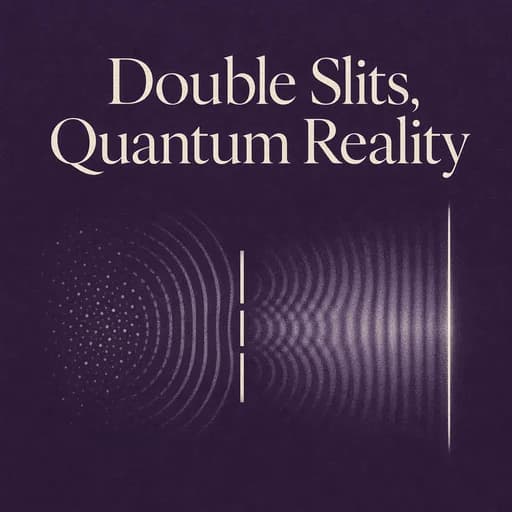
Mejor cita de The Double-Slit Experiment and Reality: Quantum Physics Explained
At the most fundamental level, things can exist in two places at once, and the simple act of looking at something can actually change what it is.
Generated by Aditya
Create a 45–60 minute beginner-level audio lesson based strictly on the provided transcript about quantum physics and its philosophical implications. Follow Marc Andreessen's analytical framework: verify all facts, label claims (FACT, INFERENCE, SPECULATION, HYPOTHESIS), and assign confidence levels. Cover the Double-Slit experiment (Thomas Young, Klaus Jönsson), wave-particle duality, superposition, decoherence, and entanglement. Explain from first principles (atoms, electrons, photons) using vivid analogies like water ripples and LEGO bricks. Connect the science to philosophical perspectives (Newton, Foucault, Bohm, Rovelli, Eastern philosophy) while clearly distinguishing established physics from speculation. Conclude with the requested summaries on takeaways, mental models, and the specific proof/misconceptions regarding the Double-Slit experiment and consciousness.


Preguntas frecuentes
The double-slit experiment is a landmark study in quantum physics that challenges our common-sense view of a solid, predictable world. While we often assume the universe is made of separate, well-behaved objects that stay put, this experiment demonstrated that at a fundamental level, things can exist in two places at once. This discovery suggests that the nature of reality is far more mysterious than the stable, everyday world we perceive through our senses.
Klaus Jönsson was a physicist who conducted a pivotal experiment in 1961 using electrons. His work effectively threw a brick through the window of common-sense reality by proving that subatomic particles do not always behave like solid, predictable objects. This experiment haunted physicists for decades because it confirmed that the building blocks of our world, such as atoms and electrons, follow quantum rules that contradict our daily experiences of physical matter.
In the context of quantum physics and the double-slit experiment, the simple act of looking at something can actually change what it is. While we expect objects like a coffee mug to remain solid and definite whether we are in the room or not, the behavior of electrons suggests otherwise. This implies that observation plays a critical role in determining the state of matter, challenging the idea that the universe consists of objects that exist independently of being watched.
Creado por exalumnos de la Universidad de Columbia en San Francisco
"Instead of endless scrolling, I just hit play on BeFreed. It saves me so much time."


"I never knew where to start with nonfiction—BeFreed’s book lists turned into podcasts gave me a clear path."


"Perfect balance between learning and entertainment. Finished ‘Thinking, Fast and Slow’ on my commute this week."
"Crazy how much I learned while walking the dog. BeFreed = small habits → big gains."
"Reading used to feel like a chore. Now it’s just part of my lifestyle."

"Feels effortless compared to reading. I’ve finished 6 books this month already."
"BeFreed turned my guilty doomscrolling into something that feels productive and inspiring."

"BeFreed turned my commute into learning time. 20-min podcasts are perfect for finishing books I never had time for."
"BeFreed replaced my podcast queue. Imagine Spotify for books — that’s it. 🙌"

"It is great for me to learn something from the book without reading it."
"The themed book list podcasts help me connect ideas across authors—like a guided audio journey."
"Makes me feel smarter every time before going to work"
Creado por exalumnos de la Universidad de Columbia en San Francisco
"Instead of endless scrolling, I just hit play on BeFreed. It saves me so much time."
"I never knew where to start with nonfiction—BeFreed’s book lists turned into podcasts gave me a clear path."
"Perfect balance between learning and entertainment. Finished ‘Thinking, Fast and Slow’ on my commute this week."
"Crazy how much I learned while walking the dog. BeFreed = small habits → big gains."
"Reading used to feel like a chore. Now it’s just part of my lifestyle."
"Feels effortless compared to reading. I’ve finished 6 books this month already."
"BeFreed turned my guilty doomscrolling into something that feels productive and inspiring."
"BeFreed turned my commute into learning time. 20-min podcasts are perfect for finishing books I never had time for."
"BeFreed replaced my podcast queue. Imagine Spotify for books — that’s it. 🙌"
"It is great for me to learn something from the book without reading it."
"The themed book list podcasts help me connect ideas across authors—like a guided audio journey."
"Makes me feel smarter every time before going to work"
"Instead of endless scrolling, I just hit play on BeFreed. It saves me so much time."
"I never knew where to start with nonfiction—BeFreed’s book lists turned into podcasts gave me a clear path."
"Perfect balance between learning and entertainment. Finished ‘Thinking, Fast and Slow’ on my commute this week."
"Crazy how much I learned while walking the dog. BeFreed = small habits → big gains."
"Reading used to feel like a chore. Now it’s just part of my lifestyle."
"Feels effortless compared to reading. I’ve finished 6 books this month already."
"BeFreed turned my guilty doomscrolling into something that feels productive and inspiring."
"BeFreed turned my commute into learning time. 20-min podcasts are perfect for finishing books I never had time for."
"BeFreed replaced my podcast queue. Imagine Spotify for books — that’s it. 🙌"
"It is great for me to learn something from the book without reading it."
"The themed book list podcasts help me connect ideas across authors—like a guided audio journey."
"Makes me feel smarter every time before going to work"
"Instead of endless scrolling, I just hit play on BeFreed. It saves me so much time."
"I never knew where to start with nonfiction—BeFreed’s book lists turned into podcasts gave me a clear path."
"Perfect balance between learning and entertainment. Finished ‘Thinking, Fast and Slow’ on my commute this week."
"Crazy how much I learned while walking the dog. BeFreed = small habits → big gains."
"Reading used to feel like a chore. Now it’s just part of my lifestyle."
"Feels effortless compared to reading. I’ve finished 6 books this month already."
"BeFreed turned my guilty doomscrolling into something that feels productive and inspiring."
"BeFreed turned my commute into learning time. 20-min podcasts are perfect for finishing books I never had time for."
"BeFreed replaced my podcast queue. Imagine Spotify for books — that’s it. 🙌"
"It is great for me to learn something from the book without reading it."
"The themed book list podcasts help me connect ideas across authors—like a guided audio journey."
"Makes me feel smarter every time before going to work"





![[fc21b978-6ba7-4fb0-a93d-41dbd148aaa7:c0000] Quantum Mechanics Explained FROM SCRATCH.txt p1-1](/_next/image?url=https%3A%2F%2Fd1y2du6z1jfm9e.cloudfront.net%2Fassets%2Fpodcast%2Fblue.png&w=1024&q=50)
![[fc21b978-6ba7-4fb0-a93d-41dbd148aaa7:c0001] Quantum Mechanics Explained FROM SCRATCH.txt p1-1](/_next/image?url=https%3A%2F%2Fd1y2du6z1jfm9e.cloudfront.net%2Fassets%2Fpodcast%2Fgreen.png&w=1024&q=50)

![[521d8b6f-5b98-4f7c-ae5e-a9132678f003:c0000] The following content is provided under a Creative Common… p1-1](/_next/image?url=https%3A%2F%2Fd1y2du6z1jfm9e.cloudfront.net%2Fassets%2Fpodcast%2Fpurple.png&w=1024&q=50)