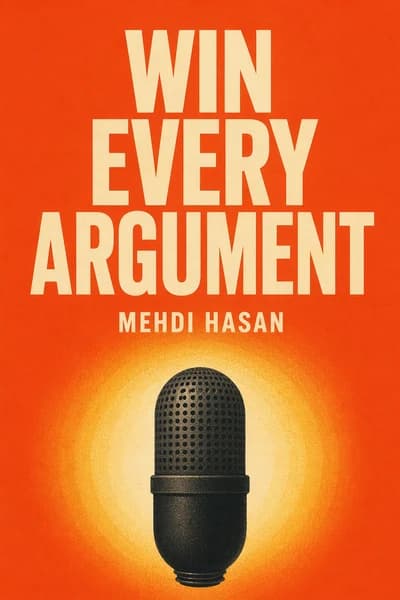
Win Every Argument
The Art of Debating, Persuading, and Public Speaking
Resumen de Win Every Argument
Master debater Mehdi Hasan reveals the ancient art of persuasion that made him MSNBC's most formidable voice. A New York Times bestseller that transforms Aristotle's rhetoric into modern weapons. Why do politicians fear facing him? These techniques work everywhere - from boardrooms to dinner tables.

Temas clave en Win Every Argument
- rhetorical strategies
- emotional persuasion
- audience analysis
- public speaking techniques
- evidence-based debating
Citas de Win Every Argument
Winning arguments isn't just an academic exercise-it's a superpower.
Emotions aren't 'intruders in the bastion of reason' but rather 'indispensable for rationality.'
Stories are '22 times more memorable than facts alone.'
Delayed gratification makes receipts more powerful.
Personajes en Win Every Argument
- Mehdi HasanAuthor, journalist, and professional debater
- Michael Dukakis1988 presidential candidate used as a case study
- Jamie OliverChef and speaker used as a case study for hooks
- ElliotPatient in a neuroscience case study on emotion
Sobre el Autor
Sobre el autor de Win Every Argument
Mehdi Raza Hasan, author of Win Every Argument: The Art of Debating, Persuading, and Public Speaking, is an award-winning British-American political journalist, broadcaster, and expert in rhetorical strategy.
Known for his incisive interview style and command of debate tactics, Hasan draws on decades of experience as a senior contributor to The Intercept, host of the Deconstructed podcast, and former presenter for Al Jazeera’s UpFront and Head to Head.
His career spans roles at MSNBC, The Guardian, and The New Statesman, where he honed his reputation for challenging power structures and dissecting political discourse. A co-author of Ed: The Milibands and the Making of a Labour Leader, Hasan merges academic rigor with real-world insights from interviewing global leaders and moderating high-stakes debates.
Recognized among the world’s "500 Most Influential Muslims" and a British Muslim Award winner, he founded the independent media platform Zeteo in 2024 to amplify underrepresented voices.
Win Every Argument distills his proven techniques into actionable advice, reflecting his mission to equip readers with tools for intellectual and civic engagement.
Descargar resumen de Win Every Argument
Obtén el resumen de Win Every Argument como PDF o EPUB gratis. Imprímelo o léelo sin conexión en cualquier momento.
Preguntas Frecuentes Sobre Este Libro
Win Every Argument by Mehdi Hasan is a guide to mastering persuasion, debating, and public speaking, blending classical rhetoric with modern tactics. It covers techniques like dismantling the "Gish gallop" (overwhelming opponents with false claims), leveraging the "rule of three" for structuring arguments, and balancing emotional appeals (pathos) with factual evidence (logos). The book draws from Aristotle’s principles, historical examples, and Hasan’s experience as a political debater.
This book is ideal for professionals, students, activists, and anyone seeking to improve their persuasive communication. It’s particularly useful for public speakers, debaters, or those navigating high-stakes discussions (e.g., workplace negotiations, social media debates). Critics note its political slant, so readers seeking bipartisan perspectives may need to supplement with other resources.
To counter the Gish gallop—a tactic flooding arguments with misinformation—Hasan advises:
- Isolate one claim: Disprove a representative example to undermine the opponent’s credibility.
- Control the flow: Prevent evasive maneuvers by insisting on addressing one point at a time.
- Expose the tactic: Alert the audience to the manipulative strategy being used.
The “rule of three” structures arguments into three main points (beginning, middle, end) for clarity and memorability. Examples include past/present/future or problem/solution/benefit. Hasan emphasizes this framework helps audiences absorb and retain complex ideas, citing its use by orators like Churchill.
Hasan argues confidence is critical—even surpassing pure competence—because it projects authority and engages listeners. Tips include practicing in low-risk settings (e.g., family debates), maintaining strong posture, and pacing speech. However, he stresses confidence must be paired with factual groundwork to avoid empty rhetoric.
“Receipts” are evidence (quotes, data) used to disprove opponents. Hasan advises:
- Collect contradictions: Highlight inconsistencies in the opponent’s past statements.
- Time strategically: Deploy receipts at pivotal moments for maximum impact, rather than upfront.
Critics note Hasan’s occasional self-aggrandizement and politically one-sided examples, which may alienate non-progressive readers. Some argue the strategies assume good-faith opponents, limiting effectiveness in toxic debates (e.g., social media trolling).
Unlike academic texts, Hasan’s book modernizes Aristotle’s ethos, pathos, and logos with actionable steps for digital-era conflicts. It leans less on theory and more on real-world applications, such as rebutting viral misinformation or handling hostile interviewers.
Yes—its focus on critical thinking, evidence-based persuasion, and managing polarized debates remains vital amid AI-driven misinformation and social media fragmentation. However, readers may need to adapt tactics for emerging platforms.
- Structure wins: Use the rule of three and narrative arcs to organize arguments.
- Emotion + evidence: Pair data with relatable stories (pathos).
- Anticipate tactics: Prepare counters for common maneuvers like the Gish gallop.
While Hasan uses progressive examples (e.g., debating Trump supporters), he frames techniques as ideologically neutral. However, reviewers caution that his left-leaning lens may oversimplify counterarguments in bipartisan contexts.
Yes. The book advises gradual exposure (e.g., practicing at family gatherings), visualizing success, and refining body language (e.g., eye contact, pacing). It also stresses audience empathy: “Most people want you to succeed”.