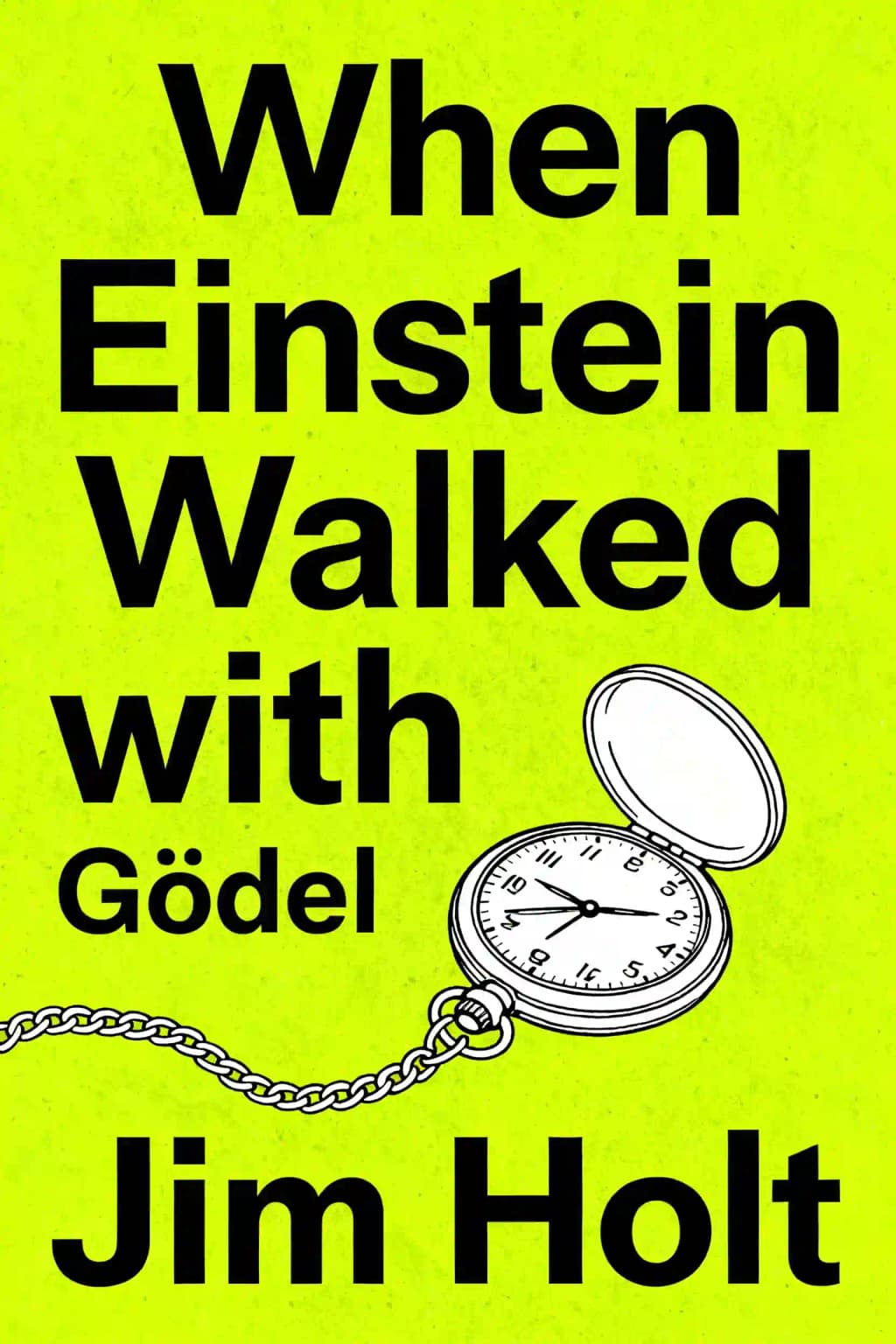
Journey through intellectual frontiers where Einstein and Godel once strolled. Jim Holt's acclaimed essays make complex science delightfully accessible, praised by Freeman Dyson himself. What profound mysteries did these geniuses uncover that still shape our understanding of reality today?
Jim Holt, acclaimed author of When Einstein Walked with Gödel: Excursions to the Edge of Thought, is a prominent essayist and journalist renowned for making complex scientific and philosophical concepts accessible to general audiences. A longtime contributor to The New York Times, The New Yorker, and The New York Review of Books, Holt’s work bridges mathematics, theoretical physics, and existential inquiry.
Reflecting his academic background in mathematics (University of Virginia) and philosophy (Columbia University), his 2012 bestseller Why Does the World Exist? An Existential Detective Story, a National Book Critics Circle Award finalist translated into over a dozen languages, established his reputation for tackling profound metaphysical questions with narrative verve.
Holt’s earlier book, Stop Me If You’ve Heard This: A History and Philosophy of Jokes, showcases his ability to intertwine scholarly analysis with humor. A frequent media presence on BBC, CNN, and NBC, Holt’s essays distill abstract ideas into engaging explorations, earning recognition for their clarity, wit, and intellectual daring. When Einstein Walked with Gödel continues this tradition, offering readers a provocative journey through the minds of revolutionary thinkers.
When Einstein Walked with Gödel is a collection of essays exploring profound scientific and mathematical concepts, from relativity and quantum mechanics to infinity and logic. Jim Holt examines groundbreaking ideas through the lens of historical figures like Einstein, Gödel, and Alan Turing, blending accessible explanations with insights into their personal and intellectual journeys.
This book is ideal for science enthusiasts, philosophy readers, and anyone curious about fundamental questions in physics and mathematics. Holt’s engaging writing makes complex topics like Gödel’s incompleteness theorems or Einstein’s relativity approachable for general audiences while offering fresh perspectives for experts.
Yes—critics praise Holt’s ability to distill advanced concepts into witty, thought-provoking essays. The book received acclaim for its blend of biographical storytelling and scientific rigor, making it a standout in science writing. Fans of Why Does the World Exist? will appreciate Holt’s trademark clarity and humor.
In their later years, Einstein and Gödel formed an unlikely friendship during walks at Princeton. Despite Einstein’s fading reputation for rejecting quantum theory and Gödel’s paranoid tendencies, they bonded over discussions about physics, philosophy, and the nature of time. Their dialogues symbolized a meeting of two revolutionary minds.
Key themes include quantum mechanics, Gödel’s incompleteness theorems, relativity, and the paradoxes of infinity. Holt also explores lesser-known ideas, like Gödel’s belief that the U.S. Constitution contains a logical contradiction and whether the universe has a definitive future.
Holt simplifies Gödel’s proof that no mathematical system can be both complete and consistent, revealing inherent limits to human knowledge. The theorems challenged the notion of absolute truth in logic, reshaping philosophy and science. Gödel’s work is framed as a pivotal moment in intellectual history.
Yes—essays profile figures like Emmy Noether (pioneer in symmetry physics), Benoit Mandelbrot (fractals), and Alan Turing (computing). Holt highlights their contributions while weaving in anecdotes, such as Turing’s wartime codebreaking and Mandelbrot’s artistic approach to mathematics.
Some note the book’s focus on essay collections over deep biographical analysis. While praised for breadth, readers seeking exhaustive accounts of Einstein or Gödel may prefer dedicated biographies like A World Without Time.
Both books tackle existential questions, but When Einstein Walked with Gödel emphasizes scientific history over metaphysics. It retains Holt’s humorous style and interdisciplinary approach but shifts focus to thinkers who shaped modern physics and mathematics.
Holt recounts Gödel’s obsessive fear of poisoning, Einstein’s disdain for quantum “spookiness,” and Turing’s tragic persecution for his sexuality. These stories humanize iconic figures while underscoring the societal challenges they faced.
Yes—essays delve into how scientific discoveries intersect with philosophy, such as whether math is invented or discovered, the nature of time, and the ethical dimensions of AI (via Turing’s work). Holt bridges abstract theory with real-world relevance.
The book compiles revised essays originally published in The New Yorker and The New York Review of Books. Each chapter stands alone but collectively explores themes of genius, creativity, and the limits of human understanding, framed by Holt’s accessible commentary.
Siente el libro a través de la voz del autor
Convierte el conocimiento en ideas atractivas y llenas de ejemplos
Captura ideas clave en un instante para un aprendizaje rápido
Disfruta el libro de una manera divertida y atractiva
Time is mysterious and seemingly self-contradictory.
I cannot be proven.
Time slows for moving observers.
Time is only an illusion, albeit a persistent one.
Time itself might be an illusion.
Desglosa las ideas clave de When Einstein Walked with Gödel en puntos fáciles de entender para comprender cómo los equipos innovadores crean, colaboran y crecen.
Destila When Einstein Walked with Gödel en pistas de memoria rápidas que resaltan los principios clave de franqueza, trabajo en equipo y resiliencia creativa.

Experimenta When Einstein Walked with Gödel a través de narraciones vívidas que convierten las lecciones de innovación en momentos que recordarás y aplicarás.
Pregunta lo que quieras, elige la voz y co-crea ideas que realmente resuenen contigo.

Creado por exalumnos de la Universidad de Columbia en San Francisco
"Instead of endless scrolling, I just hit play on BeFreed. It saves me so much time."
"I never knew where to start with nonfiction—BeFreed’s book lists turned into podcasts gave me a clear path."
"Perfect balance between learning and entertainment. Finished ‘Thinking, Fast and Slow’ on my commute this week."
"Crazy how much I learned while walking the dog. BeFreed = small habits → big gains."
"Reading used to feel like a chore. Now it’s just part of my lifestyle."
"Feels effortless compared to reading. I’ve finished 6 books this month already."
"BeFreed turned my guilty doomscrolling into something that feels productive and inspiring."
"BeFreed turned my commute into learning time. 20-min podcasts are perfect for finishing books I never had time for."
"BeFreed replaced my podcast queue. Imagine Spotify for books — that’s it. 🙌"
"It is great for me to learn something from the book without reading it."
"The themed book list podcasts help me connect ideas across authors—like a guided audio journey."
"Makes me feel smarter every time before going to work"
Creado por exalumnos de la Universidad de Columbia en San Francisco

Obtén el resumen de When Einstein Walked with Gödel como PDF o EPUB gratis. Imprímelo o léelo sin conexión en cualquier momento.
Picture Albert Einstein-wild-haired, wearing his rumpled sweater-walking alongside Kurt Godel, impeccably dressed in a dark suit, both deep in conversation about whether time itself might be an illusion. This wasn't a scene from a philosophical novel. Throughout the 1940s and early 1950s, these two intellectual giants took daily walks together in Princeton, forming one of history's most remarkable friendships. Einstein, already a global celebrity whose theories had revolutionized physics, found his intellectual equal in Godel, a brilliant but troubled logician whose mathematical discoveries had shattered the foundations of mathematics itself. Their partnership bridged physics and pure logic, relativity and mathematical philosophy, fame and obscurity. What made their bond extraordinary wasn't just their genius-it was how two fundamentally different personalities, both refugees from Nazi Europe, found common ground in questioning reality's deepest structures. Einstein once confessed he went to his office primarily "to have the privilege of walking home with Kurt Godel."