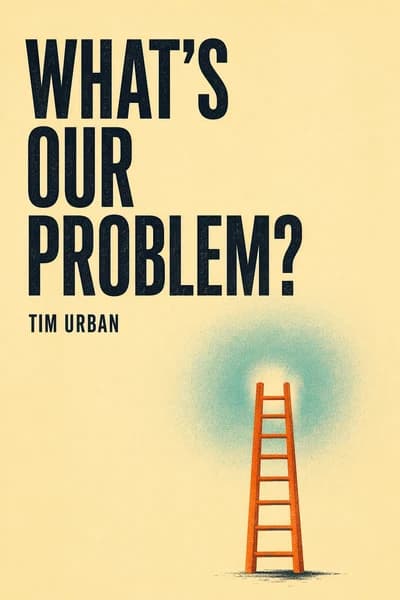
What's Our Problem?
A Self-Help Book for Societies
Resumen de What's Our Problem?
In "What's Our Problem?", Tim Urban's six-year research unveils a revolutionary 4-rung "Ladder" framework that transcends left-right politics. Praised for its 300 illustrations and mind-shifting perspective, it challenges how we think - not just what we think - about society's most divisive issues.
Temas clave en What's Our Problem?
- intellectual humility
- tribalism psychology
- cognitive bias
- echo chamber dynamics
- critical thinking frameworks
Citas de What's Our Problem?
Zealots treat ideas not as experiments to test but as precious babies to protect.
Attorneys prioritize winning above all.
Echo Chambers cultivate low-rung thinking by treating certain beliefs as sacred.
People become either heroes or villains, policies either entirely right or wrong, and nuance disappears.
Political Disney World divides everything into pure good (1s) and pure bad (0s).
Personajes en What's Our Problem?
- Tim UrbanAuthor and creator of the blog Wait But Why
- Marc AndreessenTech leader who praised the book's framework
- Sam AltmanTech leader and supporter of the book's ideas
Sobre el Autor
Sobre el autor de What's Our Problem?
Tim Urban, bestselling author of What’s Our Problem? A Self-Help Book for Societies, is a celebrated writer, illustrator, and TED speaker renowned for distilling complex ideas into accessible insights.
The book, blending social critique with evolutionary psychology, reflects Urban’s decade-long exploration of human behavior through his viral blog Wait But Why, which averages over a million monthly visitors and 600,000 email subscribers.
A Harvard graduate and co-founder of education company Arborbridge, Urban combines analytical rigor with stick-figure humor to dissect societal polarization and cognitive biases. His 2016 TED Talk on procrastination ranks among the platform’s top three most-viewed talks with 66 million views, while his AI-focused writings earned praise from Elon Musk and shaped public discourse on emerging technologies.
Urban’s work has been featured in The Washington Post, Time, and The Atlantic, establishing him as a leading voice in bridging academic concepts with mainstream audiences. What’s Our Problem? builds on his signature style of marrying deep research with witty storytelling, cementing his reputation as a critical thinker for the digital age.
Descargar resumen de What's Our Problem?
Obtén el resumen de What's Our Problem? como PDF o EPUB gratis. Imprímelo o léelo sin conexión en cualquier momento.
Preguntas Frecuentes Sobre Este Libro
What's Our Problem? examines modern societal challenges through Tim Urban's signature blend of humor, stick-figure illustrations, and deep research. It analyzes cultural polarization, cognitive biases, and systemic flaws, framing society as a "self-help patient" needing collective introspection. Urban explores topics like misinformation, ideological echo chambers, and the psychology driving societal dysfunction, offering a roadmap for critical thinking and constructive dialogue.
This book is ideal for readers interested in sociology, psychology, or political discourse who enjoy accessible yet rigorous analysis. Policymakers, educators, and engaged citizens will find value in its frameworks for understanding polarization, media dynamics, and groupthink. Fans of Urban’s Wait But Why blog will appreciate his trademark wit and visual storytelling.
Yes—Urban’s ability to simplify complex societal issues into relatable concepts makes this book a standout. Its mix of data-driven insights, humor, and actionable advice caters to both casual readers and academics. The book’s focus on real-world applications, like navigating misinformation or improving public discourse, ensures practical relevance.
While echoing Wait But Why’s humor and stick-figure style, the book adopts a more structured, solutions-focused approach to societal issues. It expands on themes like tribalism and cognitive biases introduced in his AI and procrastination articles, offering cohesive frameworks rather than standalone deep dives.
Key ideas include:
- Chronocentrism: Humanity’s tendency to overvalue current norms.
- The “Two-Room Problem”: How echo chambers amplify polarization.
- Cognitive Bunkers: Mental shortcuts that hinder rational discourse.
- The Attention Economy’s impact on public thought and behavior.
Chronocentrism refers to the societal bias of viewing contemporary values as inherently superior to past or future perspectives. Urban argues this blinds societies to systemic flaws, using examples like historical moral blind spots (e.g., slavery) to urge humility in modern judgment.
Urban dissects polarization as a byproduct of social media algorithms, tribal psychology, and “motive-over-matter” thinking (prioritizing group loyalty over facts). He proposes “idea gardens”—spaces for good-faith debate—and tools to identify cognitive biases like confirmation bending.
The book advocates for:
- Meta-awareness: Recognizing systemic flaws in human cognition.
- Institutional innovation: Restructuring media, education, and tech to discourage tribalism.
- Steel-manning: Engaging opposing views in their strongest form.
- Long-term thinking to counteract chronocentric biases.
While his viral TED Talk focused on individual procrastination, this book scales those insights to societal “procrastination”—collective avoidance of hard problems like climate change or inequality. Both works emphasize breaking cycles of short-term thinking.
Some reviewers argue Urban’s solutions lean overly optimistic given entrenched systemic issues. Others note his focus on Western democracies limits global applicability. However, most praise his ability to frame existential challenges with clarity and hope.
As AI, climate policies, and global conflicts dominate headlines, the book’s analysis of misinformation, decision-making under uncertainty, and ethical frameworks remains urgent. Its lessons on navigating “post-truth” landscapes align with current debates about AI ethics and geopolitical polarization.
Notable lines include:
- “Societies don’t fail because they’re evil—they fail because they’re stuck.”
- “The loudest rooms in the internet’s house are its worst meeting places.”
- “Progress happens one uncomfortable conversation at a time.”
Urban employs stick-figure diagrams to visualize abstract ideas like “information ecosystems” and “thought bacteria.” Key metaphors include societal “immune systems” attacking good ideas and “cognitive wildfires” spreading through digital platforms.
Fans of this book may enjoy:
- Enlightenment Now by Steven Pinker (data-driven optimism)
- The Righteous Mind by Jonathan Haidt (moral psychology)
- Atomic Habits by James Clear (systems-focused change)