Capítulo 1
Wealth Building's Ancient Secret: The Stoic Path
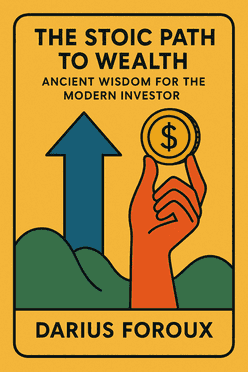
Have you ever wondered why some investors remain calm during market crashes while others panic and sell at the worst possible time? Warren Buffett famously said, "Be fearful when others are greedy, and greedy when others are fearful," yet most people do exactly the opposite. The answer might be found in an unexpected place: ancient philosophy. "The Stoic Path to Wealth" by Darius Foroux reveals how principles developed over 2,000 years ago provide the psychological foundation for building lasting prosperity in today's volatile markets. This book has become a favorite among Silicon Valley executives and Wall Street veterans alike, with readers praising its unique approach to combining timeless wisdom with practical financial strategies. As markets become increasingly unpredictable, Foroux's framework offers something more valuable than stock picks or timing strategies-it teaches investors how to master their emotions, the true key to financial success.
Capítulo 2
From War-Torn Tehran to Financial Freedom
Born during the Iraq war in Tehran, Foroux's family fled to the Netherlands with nothing. Growing up in a household where money arguments were constant, he developed an urgent desire to become wealthy. After studying business, he landed at ING bank as a mutual funds adviser, only to watch his personal investments collapse during the 2008 financial crisis-losing 60% on his ING shares when he sold at $11 after buying at $27.
This painful experience temporarily destroyed his confidence in the stock market. Yet avoiding investing is financial suicide in a world where inflation steadily erodes cash value. Since 1980, inflation has averaged 3.06% annually, meaning $1,000 from 1980 would be worth only $240 by 2022. Meanwhile, the S&P 500 has returned about 10% annually since 1928 (8.38% after inflation), turning that same $1,000 into nearly $30,000.
Today's investors face three major challenges: First, market volatility has intensified dramatically-in 2022, the S&P 500 moved at least 1% in either direction on 87% of trading days, volatility previously seen only during the 2008 crisis. Second, the investment landscape is overwhelming with over 59,000 companies worldwide to invest in, plus countless ETFs, mutual funds, and other instruments, creating decision paralysis. Third, prior negative experiences create psychological barriers-studies show 97-99% of active individual traders lose money in the short term, leaving many burned and reluctant to re-enter the market despite understanding they're missing opportunities.
The breakthrough insight is that successful investing requires mastering emotions through Stoicism. As Benjamin Graham wisely noted, "Individuals who cannot master their emotions are ill-suited to profit from the investment process." True wealth isn't just about getting rich at all costs-it's about prospering financially while maintaining peace of mind, when your money compounds on its own and you're liberated from exchanging time for money.
Capítulo 3
Ancient Wisdom for Modern Markets
Stoicism began when Zeno of Citium, a wealthy merchant, lost his fortune in a shipwreck near Athens in the third century BC. Seeking answers, he discovered Socrates' teachings and met the philosopher Crates, launching a philosophical tradition that would spread throughout Greece and Rome. The foundation of Stoicism is elegantly simple: focus on what you can control (your actions, beliefs, and judgments) and accept what you cannot (external events, others' opinions, the economy).
Four key Stoic philosophers provide the wisdom applied throughout the book: Seneca, a Roman statesman born into wealth who emphasized attaining true freedom through nonattachment to wealth; Musonius Rufus, who stressed simple, frugal living to strengthen character; Epictetus, born to an enslaved mother, who taught radical acceptance of things beyond our control; and Marcus Aurelius, who became emperor at nineteen and wrote his Meditations during his most stressful times as ruler.
Contrary to common belief, Stoicism doesn't reject wealth-it provides a framework for protecting both sanity and money. Epictetus taught that earning money while maintaining integrity is perfectly acceptable: "If you can make money remaining honest, trustworthy, and dignified, by all means do it." The Stoics themselves were investors who sacrificed immediate gratification for future peace and prosperity.
The core insight is that investing challenges stem from emotional reactions rather than rational decision-making. By applying Stoic principles, one becomes master of emotions and finances, developing what Foroux calls the "Stoic Edge"-the ability to manage emotions and avoid common investing mistakes. This edge is built through three steps: investing in yourself, accepting loss, and letting your results compound over time.
Capítulo 4
Skills That Pay More Than Money
True wealth begins not with market investments but with investing in yourself. Developing valuable skills provides lasting economic value that persists through market fluctuations-skills remain when money may disappear.
Jesse Livermore, considered the greatest stock trader of all time, exemplifies this principle. Beginning as a farm boy who escaped to Boston at fourteen, he started as a "board boy" at Paine Webber, absorbing trading knowledge and developing pattern recognition skills that would become technical analysis. Unable to afford legitimate brokerage accounts, he initially traded at bucket shops, consistently winning until banned.
When bucket shops declined, Livermore applied his skills to legitimate markets, turning $10,000 into $50,000 in a week during a bull market. His career featured dramatic rises and falls-making $1 million during the 1907 Panic before losing everything on a cotton trade, declaring bankruptcy twice yet always rebounding through skill. His greatest triumph came during the 1929 crash when he made $100 million ($1.5 billion today) through short selling while others lost everything.
To develop skills that create lasting value, follow the Skill Springboard framework:
1) Work with your natural abilities rather than fighting your nature-pursue skills at the intersection of passion and talent, as Livermore did with his math skills and finance interest.
2) Learn from the best to accelerate growth-surround yourself with high performers.
3) Break free from mentors to develop your unique approach-like Livermore creating his own trading method after learning from others.
4) Do your best without overexertion to prevent burnout-unlike Livermore who went bankrupt three times by taking excessive risks.
Continuous education is the path not just to financial freedom but liberation from ignorance and the ability to maintain tranquility regardless of circumstances. As Marcus Aurelius reminds us, what seems impossible becomes achievable through human determination and effort.
Capítulo 5
Decoding the Market's Hidden Language
Everyone seeks shortcuts to wealth, but successful investors like Warren Buffett start from the bottom and master fundamentals before building wealth. After being rejected by Harvard Business School at age 19, Buffett attended Columbia where he met his mentor Benjamin Graham. Working at his father's brokerage firm, he discovered the uncomfortable difference between investing as a skill versus the business of investing-he disliked selling stocks to clients, especially when his recommendations lost them money.
Despite making his first investment at age eleven and growing his personal portfolio to nearly $20,000 by age twenty-one, clients would dismiss his advice, asking "What does your dad think?" After a failed gas station venture cost him 20% of his net worth, Buffett persisted, eventually joining Graham-Newman where he conducted meticulous research, going directly to companies and SEC filings rather than relying on analysts' reports. When Graham retired in 1956, Buffett returned to Omaha with $140,000 in personal capital to start his own fund.
The stock market evolved from simple marketplaces dating back to 3000 BC into a sophisticated system with underlying principles that drive its behavior. Understanding these principles gives investors a rational approach to navigate what seems like a mysterious and irrational market:
First, earnings are the fundamental driver of stock prices. Unlike prime real estate that maintains value through location, no company remains perpetually popular. Stock prices rise when companies grow earnings or show promise of future profit.
Second, macro factors like recessions, geopolitics, wars, natural disasters, interest rates, and systemic financial problems influence the pace of market growth. These factors generate media narratives that cause short-term fluctuations but rarely derail long-term market growth.
Third, collective psychology creates market swings between fear and greed. Markets rarely achieve equilibrium, operating instead on psychological extremes. Short-term price movements often contradict expectations, driven by anticipation and unexpected news.
Most investors lack understanding of market psychology and succumb to herd behavior-buying high and selling low, a guaranteed wealth destroyer. The Stoic approach means working within existing rules rather than fighting them, looking inward for solutions. As Marcus Aurelius advised, when disturbed by circumstances, return to yourself and maintain harmony.
Capítulo 6
The Investing Habit That Creates Wealth
Investing isn't an occasional activity but a lifestyle focused on consistently growing your net worth. Daily actions that lead to growth matter more than daily results. Geraldine Weiss's story illustrates this principle perfectly.
In 1966, a mysterious investor using the pseudonym "G. Weiss" launched the newsletter Investment Quality Trends. By 1977, its subscribers' exceptional returns caught the attention of Louis Rukeyser, host of Wall $treet Week. When "G. Weiss" appeared on the show, viewers discovered she was Geraldine Weiss, a 50-year-old mother of four who had adopted the pseudonym to navigate the blatant misogyny of 1960s finance.
Despite graduating from UC Berkeley in 1945 with a business degree and devouring investing books, Weiss postponed her finance career to raise a family. When she finally tried entering the industry at age 36, she faced constant rejection, with firms offering only secretarial positions despite her knowledge. After four years of rejection, Weiss co-founded Investment Quality Trends. When early newsletters signed with her full name received poor response compared to identical ones signed by her male co-founder, she changed her signature to "G. Weiss"-and subscriptions flooded in.
The newsletter's recommendations yielded an 11.8% annualized return between 1986-2022, turning $1,000 into over $55,000. When Weiss finally revealed her identity on television after a decade of success, subscribers were shocked but the results spoke for themselves.
Habits form through consistent repetition, as Epictetus noted: "Every habit and faculty is maintained and increased by the corresponding actions." Two Stoic laws help form an investing habit:
LAW 1: START SMALL - Begin with modest sums to get accustomed to market fluctuations. Epictetus advised new Stoic students to "start with small things"-applying indifference to a broken ceramic cup before extending to more significant matters.
LAW 2: MAKE IT AUTOMATIC - Remove manual decisions by committing to regular investing regardless of market conditions. Automating finances eliminates emotional interference, focusing on what you control (your behavior) rather than what you don't (market movements).
Capítulo 7
Embracing Loss as Part of the Journey
Fear of losing money prevents many from investing, but both Stoics and successful investors view loss differently-as temporary and inevitable parts of the wealth-building process. Cathie Wood's career exemplifies long-term vision despite short-term setbacks.
After AllianceBernstein rejected her proposal to invest in disruptive technologies, she founded ARK Invest in 2014, focusing on groundbreaking fields like AI and gene editing. Her strategy didn't yield immediate results-ARK's main fund was down 2% in 2016 while the S&P 500 gained 12%. Wood invested $5 million of her own money to keep the business afloat and even risked losing control of her company to raise capital.
Her persistence paid off spectacularly when ARK gained 87% in 2017, 35% in 2019, and an astounding 152% in 2020. By early 2021, ARK managed $50 billion in assets. Despite a 67% decline in 2022, Wood maintained her conviction, tweeting that ARK was "sacrificing short-term profitability for exponential and highly profitable long-term growth."
To build wealth, investors must overcome their natural tendency to avoid losses. The market typically experiences multiple corrections annually, with declines of 5-20%. As Stoics, we must recognize these fluctuations as natural, neither good nor bad. Three steps can help build resilience toward temporary setbacks:
1. NEVER LET THEM SWEAT YOU - Practice calm responses to market downturns, imagining how you'd discuss losses matter-of-factly with others. When you publicly maintain that temporary declines are normal and manageable, you begin believing your own narrative.
2. DO NOTHING WHEN THE MARKET CRASHES - During market panics with alarming headlines, the Stoic investor recognizes there's nothing to worry about. Major crashes will happen multiple times in your lifetime-when you're down significantly in a day, do nothing.
3. INVEST MORE IF YOU CAN - When markets drop, prioritize investing over non-essential purchases. Practice mental preparation for significant losses: imagine your portfolio dropping substantially. Regularly meditating on these scenarios during bull markets helps take the sting out when real losses occur.
Capítulo 8
Protecting Your Wealth from Catastrophic Loss
As your wealth grows, the temptation to chase higher returns through increased risk becomes dangerous. The key to sustained wealth building lies not in maximizing gains but in preventing catastrophic losses that you can't recover from.
Edward Thorp, a mathematician with a PhD from UCLA, revolutionized blackjack by proving it could be beaten mathematically. After publishing his strategy in "Beat the Dealer" (1966), he applied his analytical approach to Wall Street. His early investing attempts taught him crucial lessons when he lost half his money on Electric Autolite stock. Consulting his wife Vivian, he realized he was "playing a game he didn't understand."
Thorp adjusted his strategy based on his blackjack principles: understand the game, stay invested long enough to bet when probabilities favor you, and expect losses. By 1975, he became a millionaire. Unlike many investors, Thorp avoided losses by steering clear of people and companies he didn't trust-notably declining to invest in Long-Term Capital Management despite its impressive returns. LTCM later collapsed, losing 90% of its capital and requiring a Federal Reserve bailout.
Three Stoic rules help avoid catastrophic losses:
1. INVEST IN WHAT YOU KNOW - Stock valuation is more art than science. While professional investors spend countless hours researching companies, most individual investors lack the time or expertise to properly evaluate stocks. Investing in broad market indices like the S&P 500 means you only need to understand the market as a whole, not individual companies.
2. DON'T INVEST WITH BORROWED MONEY - Throughout market history, bubbles form when too many people borrow money to chase rising assets. For long-term investors, the potential rewards of borrowing simply don't justify the risks.
3. INVEST WITH MONEY YOU CAN DO WITHOUT FOR A LONG TIME - Since 1926, the U.S. stock market has delivered positive returns in 95% of ten-year periods. The moment you plan to use market returns for short-term goals, you're ignoring the mathematics of long-term investing. The most Stoic approach is to mentally say goodbye to your investment money for at least a decade.
Capítulo 9
Finding Balance: The Middle Path to Wealth
The endless pursuit of more-whether money, opportunities, or experiences-ultimately leads to our destruction. True inner peace comes from appreciating that we can have enough of anything in life, allowing us to escape the trap of perpetual wanting and greed.
John Bogle's story illustrates this principle perfectly. After being fired from Wellington Management, Bogle read economist Paul Samuelson's "Challenge to Judgement" article, which inspired him to create a mutual fund tracking the S&P 500 without managers or high fees. In 1975, he founded Vanguard with just two employees, launching the First Index Investment Trust (now Vanguard 500 Index Mutual Fund) within a year.
Initially mocked by Wall Street as "Bogle's folly" and "a sure path to mediocrity," Vanguard grew from $11 million to $100 million by 1982, reached $1 billion by 1988, and eventually $8.1 trillion by 2022. Despite creating this wealth, Bogle was worth only $80 million when he died in 2019, as he structured Vanguard to be owned by its funds rather than individuals, regularly gave half his salary to charity, and believed investment returns belonged to investors.
Stoicism follows the "golden mean" or "middle way," balancing between Cynicism's rejection of material possessions and Epicureanism's pursuit of pleasure. To maintain balance, practice these exercises:
1. DESIRE ONLY WHAT'S WITHIN YOUR CONTROL - Epictetus teaches that desiring things outside our control leads to disappointment. Change your self-talk about things you don't control, shifting from "I need/want/wish X to happen" to "It would be nice if X happens."
2. MODERATE YOUR HABITS - Moderation begins with our diet, according to Musonius. The author shares his personal journey of losing 50 pounds after a dietician advised him to always leave a small portion on his plate as an exercise in self-control. This practice of moderation transfers to other areas of life. Just as we shouldn't eat an entire bag of chips when a handful will do, we shouldn't demand 100% returns when 10% is reasonable.
Capítulo 10
Let Time Work Its Magic Through Compounding
True wealth means breaking free from exchanging time for money by letting your money work for you through compounding. Small returns accumulate into significant growth over time, providing satisfaction through consistent investing.
Peter Lynch's journey from caddy to legendary fund manager began when his father died and he worked at a country club, where he met Fidelity's president. Despite managing Fidelity's Magellan Fund during difficult market conditions in the 1970s, Lynch achieved remarkable returns through intensive research, growing the fund from $18 million to $14 billion with a 29% average annual return. Despite his success, Lynch retired at 46, realizing that despite loving his job, the time demands cost him precious moments with his young children.
Compounding wealth doesn't require constant attention-simply invest consistently and reinvest returns to generate earnings on previous earnings. Though growth initially resembles a hockey stick's handle (slow and steady), it eventually curves dramatically upward. The challenge is maintaining investment discipline through the flat period, which typically lasts two decades.
To maximize your compounding success:
1. OPTIMIZE FOR RETURN ON TIME (ROT) - Beyond financial return on investment (ROI), consider return on time-how much energy you receive for each hour invested. For most investors, passive investing offers better ROT than active management, allowing money to compound while freeing time for what truly matters.
2. START INVESTING NOW, NOT TOMORROW - Stoicism emphasizes immediate action on worthwhile pursuits. Form the habit today by purchasing index funds through your banking app or brokerage, rather than waiting for perfect conditions.
3. AVOID HIGH FEES - Investment costs and fees are the greatest threats to long-term returns. Even small fee differences compound dramatically-a 0.72% difference in fees results in over $150,000 less wealth after thirty years on identical $10,000 investments with $500 monthly contributions.
Capítulo 11
Trust Yourself: The Ultimate Investment Edge
As the steward of your financial well-being, trusting your judgment becomes crucial once you've developed investment knowledge. Stanley Druckenmiller's career illustrates this principle perfectly.
After establishing his successful hedge fund at age 28, he joined George Soros's Quantum Fund despite warnings from mentors. Though initially intimidated by Soros's reputation as "the greatest investor that ever lived," Druckenmiller eventually demanded independence, leading to impressive returns of 31.5%, 29.6%, and 53.4% in consecutive years. Their partnership peaked with the legendary bet against the British pound that generated $1 billion in a month.
However, when Druckenmiller abandoned his own judgment during the tech bubble, hiring Silicon Valley manager Carson Levit and chasing inflated tech stocks against his better instincts, the fund lost 22% ($7.6 billion), leading to his resignation. Despite his greatness, Druckenmiller paid the ultimate price for trusting someone else's judgment over his own.
To strengthen your judgment, follow these strategies:
1. AIM FOR PURE JUDGMENT - Separate emotions from facts. Charlie Munger warned against envy, calling it "a really stupid sin" with "a lot of pain and no fun." Pure judgment requires focusing on data and facts while keeping your mindset free of opinions, emotions, and ego.
2. DETACH FROM OUTCOMES - Sometimes good decisions lead to bad outcomes and vice versa. The key is making decisions aligned with your values while avoiding attachment to results. By detaching from outcomes, we can focus entirely on making the best possible decisions without anxiety or regret.
3. RECOGNIZE WHAT YOU DON'T KNOW - Masayoshi Son, despite his reputation as a fearless investor, recognized when he didn't understand Bitcoin and sold at a loss, feeling "so much better" afterward. Even skilled investors avoid assets they don't understand. Recognizing your limitations allows you to focus on areas where your strengths truly lie.
Capítulo 12
The Power of Unwavering Consistency
Your behavior, not your choice of assets, determines wealth-building success. Despite encountering contradictory advice and alternative methods, unwavering belief in your chosen path enables consistency. Mohnish Pabrai's story illustrates this principle perfectly.
Growing up in Mumbai's poverty, Pabrai watched his entrepreneur father endure multiple bankruptcies while maintaining remarkable resilience. After earning a computer engineering degree from Clemson University, he worked at Tellabs while starting TransTech as a side business. Within six years, TransTech became an Inc. 500 company, and Pabrai had saved $1 million.
His investment journey began when he discovered Peter Lynch's book at Heathrow Airport, which led him to study Warren Buffett and Charlie Munger's value investing approach. In 1999, he sold TransTech for $20 million during the tech bubble and launched Pabrai Funds with $1 million. His Dhandho investing strategy-emphasizing minimizing risk while maximizing returns-achieved a 1,204 percent return from 2000 to 2018.
To stay committed to your investment plan through market cycles:
1. IGNORE THE NOISE - In 1999, as tech stocks dominated headlines, Pabrai ignored the market frenzy. To succeed as long-term investors, we must distinguish signal from noise, ignoring self-proclaimed market geniuses who claim to predict bull markets or crashes.
2. COMPARE YOURSELF WITH PEOPLE WHO DON'T INVEST - When tempted to chase others' wealth or deviate from your plan, Seneca advised looking not at those ahead of you but "at all the ones behind you."
3. SET FINANCIAL GOALS THAT ARE WITHIN YOUR CONTROL - Focus on controllable aspects: discretionary spending, effort in developing marketable skills, and consistency in saving and investing. Instead of fixed dollar amounts, think in percentages-aim to invest 30% of your net income if possible, or at least 10%.
Capítulo 13
Becoming Unshakable: The Granite Mind
The lesson of King Midas serves as a reminder that more doesn't lead to freedom. Social media creates envy and feelings of missing out, but these negative emotions are your greatest enemy when building wealth. Following the Stoic path means keeping emotions in check while consistently investing in yourself, accepting loss, and allowing your money to compound.
The practical approach to implementing this philosophy starts with an emergency fund of six months' expenses in a high-yield savings account. Then invest 100% in U.S. stocks through an S&P 500 index fund during your wealth-accumulation phase. Even modest investments compound dramatically: investing just 10% of median household income ($5,700/year) over 30 years yields $1.2 million at average market returns; 30% yields $3.7 million.
For those interested in more active approaches, the 90/10 rule offers balance: invest 90% of your portfolio in index funds while using 10% for higher-risk trades. Successful traders aren't day traders but selective opportunists who make several profitable trades yearly, setting strict rules like capping losses at 10% and taking profits at 20%.
By staying focused on actions rather than overnight success stories, your Stoic Edge strengthens through recessions, pandemics, and other chaos. The ultimate prize is freedom-mental and financial strength that makes you "like granite," unmoved by market volatility while others panic. As Marcus Aurelius advised, "concentrate every minute like a Roman...on doing what's in front of you with precise and genuine seriousness." The market rewards those who approach it with seriousness and punishes those who gamble.