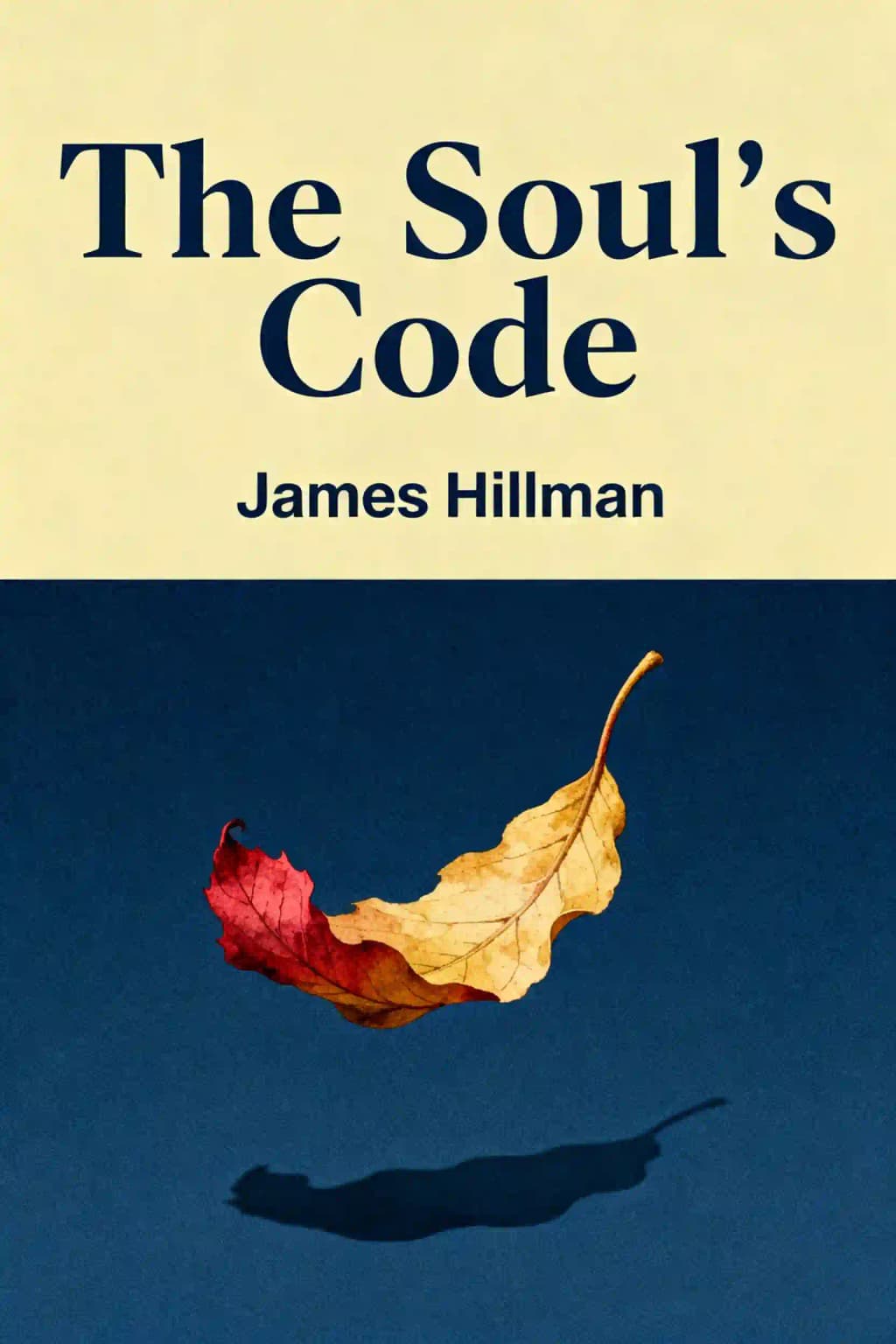
The Soul's Code
Resumen de The Soul's Code
What if your destiny was encoded in your soul from birth? James Hillman's "The Soul's Code" challenges modern psychology with his "acorn theory," beloved by depth psychologists and spiritual seekers. Thomas Moore called Hillman's perspective revolutionary - your unique calling awaits discovery.
Temas clave en The Soul's Code
- acorn theory
- innate destiny
- daimonic guidance
- archetypal psychology
- mythic imagination
Citas de The Soul's Code
The acorn theory: each person bears a uniqueness that asks to be lived and that is already present before it can be lived.
Character is fate.
Our dreams recover what the world forgets.
The daimon does not go away.
These wounds are not just scars but doors into your soul.
Personajes en The Soul's Code
- James HillmanAuthor and psychologist who proposes the acorn theory
- Giordano BrunoPhilosopher who championed a magical worldview
Descargar resumen de The Soul's Code
Obtén el resumen de The Soul's Code como PDF o EPUB gratis. Imprímelo o léelo sin conexión en cualquier momento.
Preguntas Frecuentes Sobre Este Libro
The Soul’s Code explores the "acorn theory," proposing that each person’s life follows a unique blueprint guided by an inner force called the "daimon." Hillman argues against reductionist views of fate (genetics/environment), instead emphasizing soulful purpose and innate potential. The book blends psychology, mythology, and philosophy, using examples from iconic figures like Mozart and Gandhi to illustrate how early traits hint at one’s destiny.
This book suits seekers of self-discovery, psychology enthusiasts, and fans of Jungian ideas. It’s valuable for those questioning life’s purpose, creatives exploring their calling, or anyone seeking an alternative to deterministic views of human behavior. Hillman’s poetic style appeals to readers open to metaphysical concepts and mythological frameworks.
Yes, particularly for its provocative reframing of destiny. A New York Times bestseller, it challenges conventional psychology by prioritizing soulful purpose over external factors. While critics note its abstract language, its enduring popularity (25+ years) stems from its empowering message: you’re here to fulfill a unique “image” planted at birth.
The acorn theory metaphor suggests humans grow like oak trees—guided by an innate blueprint (the “acorn”) containing their destiny. Hillman rejects oversimplified cause-effect explanations, asserting that early behaviors, struggles, or fascinations signal one’s daimon at work. For example, Aretha Franklin’s childhood choir singing foreshadowed her legendary career.
Hillman’s daimon is a pre-birth spiritual companion from Plato’s Republic (Myth of Er) that guides individuals toward their calling. Unlike Freud’s superego or Jung’s archetypes, it’s a non-moral force ensuring alignment with one’s soul-code. Neglecting it leads to stagnation, while heeding it brings fulfillment, even amid adversity.
Critics argue Hillman’s approach is overly fatalistic, downplaying free will and societal influences. Kirkus Reviews notes his “bloated” prose and lack of practical guidance, while others find the daimon concept too abstract. However, supporters praise its mythic depth and resistance to reductionist psychology.
Hillman, a founder of archetypal psychology, expands Jung’s ideas by emphasizing soul over ego. While Jung focused on individuation through archetypes, Hillman prioritizes the daimon’s call to destiny. The book bridges ancient myths (Plato’s daimon) with modern self-actualization concepts, making Jungian thought more accessible.
Yes—it reframes confusion or dissatisfaction as the daimon signaling misalignment. Hillman advises revisiting childhood passions and recurring patterns to decode one’s calling. For instance, a lawyer feeling unfulfilled might discover her daimon pushing her toward advocacy or creative writing.
Notable lines include:
- “The soul’s code is unique for each person, yet recognizable across lifetimes.”
- “Adversity isn’t an obstacle to the daimon—it’s often its instrument.”
- “You are born with a character; it is given, a gift like the blue eyes… of the acorn.”
While both address purpose, Frankl’s work focuses on finding meaning through suffering, whereas Hillman emphasizes predestined potential. Frankl offers concrete logotherapy techniques, while Hillman provides a mythic lens. The books complement each other: one existential, the other archetypal.
No—the book avoids step-by-step methods, favoring reflective storytelling. Hillman suggests analyzing childhood memories, recurring dreams, and “typos” in life (unplanned events that shift your path) as clues. For structured exercises, readers might pair it with journaling or therapy.
In an era of AI and existential uncertainty, Hillman’s focus on innate human purpose counters algorithmic determinism. The book resonates with Gen Z and millennials seeking authenticity, offering a timeless antidote to burnout culture by framing struggles as soul-code alignment.