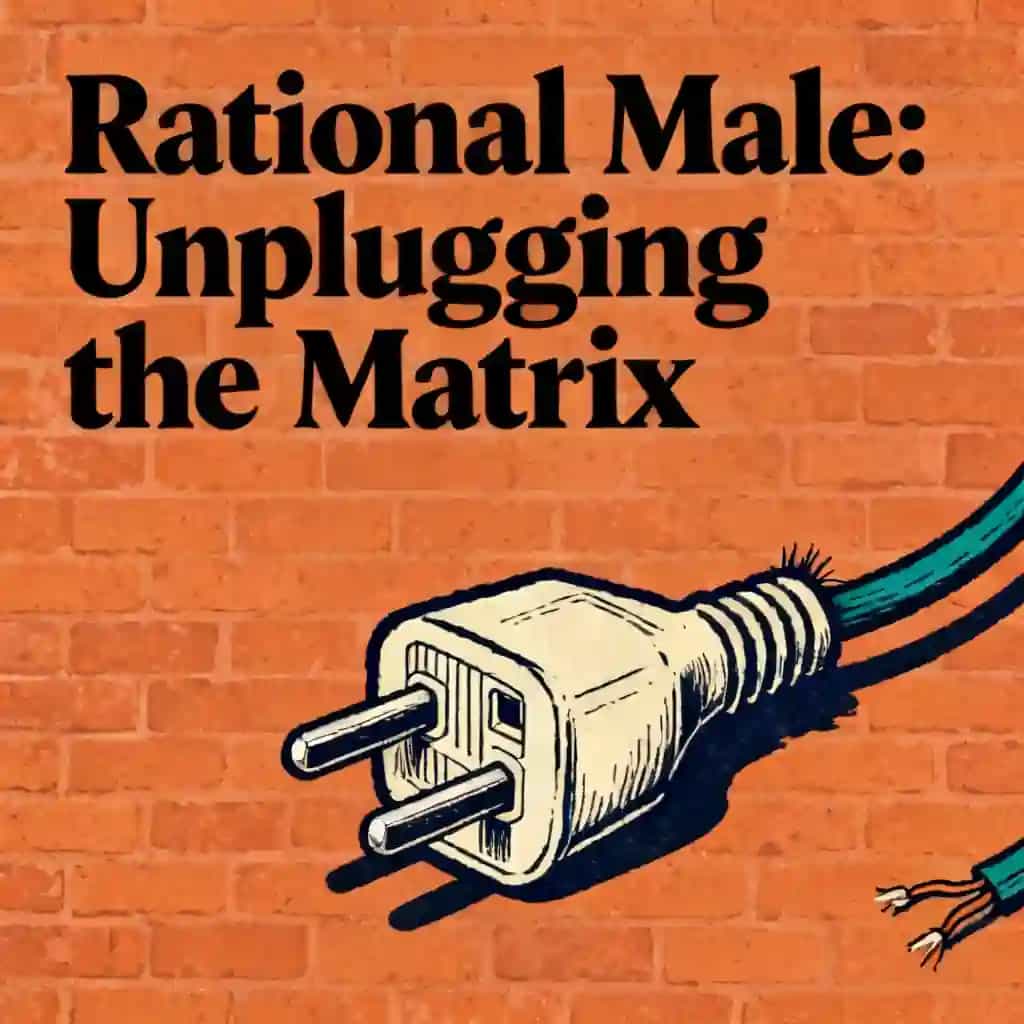
Rollo Tomassi's controversial masterpiece decodes female maturity stages and sexual marketplace dynamics, earning a devoted 4.5-star following among men seeking relationship clarity. Can understanding "hypergamy" truly protect you from manipulation? Manosphere leaders call it "necessitous reading" for navigating modern gender dynamics.
Rollo Tomassi (George W. Miller) is the bestselling author of The Rational Male: Preventive Medicine and a pioneering voice in men’s self-help, evolutionary psychology, and intersexual dynamics. A behavioral psychology graduate and former graphic designer, Tomassi gained recognition through his blog The Rational Male and YouTube channel, where he analyzes modern relationships and masculinity.
His work challenges conventional wisdom on dating and gender roles, blending evolutionary biology with pragmatic advice—an approach that’s earned him the title “Godfather of the Manosphere” from Dr. Phil and appearances on platforms like Mikhaila Peterson’s podcast.
Tomassi’s Rational Male series, including Positive Masculinity and Religion, has become essential reading in men’s development circles, translated into over 40 languages. His YouTube channel (200K+ subscribers) features deep dives into sexual strategy and social dynamics, while his blog remains a hub for Red Pill philosophy.
Controversial yet influential, Tomassi’s frameworks are cited by mainstream commentators and online communities alike. The Rational Male: Preventive Medicine has sold tens of thousands of copies globally, solidifying its status as a modern classic in male-centric personal growth.
This book analyzes intersexual dynamics through evolutionary psychology, focusing on women's life phases and hypergamy (women's dual mating strategy). It offers men practical frameworks to navigate relationships by understanding feminine social primacy, complementary masculinity, and predictable behavioral patterns across women's maturity stages.
Men seeking to understand relationship dynamics through evolutionary psychology lenses, particularly those interested in Red Pill philosophy. It's valuable for individuals navigating dating markets, dealing with divorce, or seeking self-improvement strategies against modern mating challenges.
For readers seeking unconventional perspectives on gender dynamics, it provides actionable insights about hypergamy and female behavioral patterns. Critics argue some concepts promote misogynistic views, while supporters praise its pragmatic approach to male self-development.
Hypergamy refers to women's evolutionary drive to secure superior genetic traits and resource provisions through mate selection. Tomassi details its dual strategy: short-term pairings with genetically dominant "Alpha" males and long-term commitments with reliable "Beta" providers.
Tomassi outlines four key stages:
This framework ranks women's relationship priorities:
The book argues men often misinterpret their position in this hierarchy.
Tomassi advocates for "Complementary Masculinity" – men maintaining traditional masculine traits (assertiveness, competence) while adapting to modern feminist norms. This balance helps avoid being exploited in relationships while remaining socially functional.
Critics accuse the book of promoting misogynistic stereotypes and biological determinism. Some mental health professionals contend it oversimplifies complex human behaviors, while supporters argue it exposes uncomfortable truths about mating strategies.
Unlike mainstream relationship guides, Preventive Medicine rejects emotional validation tactics. It shares similarities with evolutionary psychology works like David Buss' The Evolution of Desire but uses more confrontational Red Pill terminology.
A pseudonym for George W. Miller (b. 1969), a graphic designer-turned-relationship commentator. As a leading Red Pill philosophy voice, he combines evolutionary psychology with controversial observations about modern dating markets. Tomassi claims his marital experience informs his perspectives.
The title metaphor suggests men should:
This proactive approach aims to avoid common relationship pitfalls.
Key applications include:
The book advises against committed relationships before establishing strong personal foundations.
Siente el libro a través de la voz del autor
Convierte el conocimiento en ideas atractivas y llenas de ejemplos
Captura ideas clave en un instante para un aprendizaje rápido
Disfruta el libro de una manera divertida y atractiva
This explains why even introverted men can be perceived as "Alpha" if they possess the right physical features.
Women begin preferring older men (typically 4-6 years older) as they develop appreciation for confidence and Alpha character traits.
Sex becomes a utility - a reward for desired behavior rather than genuine passion.
Hypergamy isn't static but varies based on a woman's self-perceived s
Desglosa las ideas clave de The Rational Male en puntos fáciles de entender para comprender cómo los equipos innovadores crean, colaboran y crecen.
Experimenta The Rational Male a través de narraciones vívidas que convierten las lecciones de innovación en momentos que recordarás y aplicarás.
Pregunta cualquier cosa, elige tu estilo de aprendizaje y co-crea ideas que realmente resuenen contigo.

Creado por exalumnos de la Universidad de Columbia en San Francisco
"Instead of endless scrolling, I just hit play on BeFreed. It saves me so much time."
"I never knew where to start with nonfiction—BeFreed’s book lists turned into podcasts gave me a clear path."
"Perfect balance between learning and entertainment. Finished ‘Thinking, Fast and Slow’ on my commute this week."
"Crazy how much I learned while walking the dog. BeFreed = small habits → big gains."
"Reading used to feel like a chore. Now it’s just part of my lifestyle."
"Feels effortless compared to reading. I’ve finished 6 books this month already."
"BeFreed turned my guilty doomscrolling into something that feels productive and inspiring."
"BeFreed turned my commute into learning time. 20-min podcasts are perfect for finishing books I never had time for."
"BeFreed replaced my podcast queue. Imagine Spotify for books — that’s it. 🙌"
"It is great for me to learn something from the book without reading it."
"The themed book list podcasts help me connect ideas across authors—like a guided audio journey."
"Makes me feel smarter every time before going to work"
Creado por exalumnos de la Universidad de Columbia en San Francisco

Obtén el resumen de The Rational Male como PDF o EPUB gratis. Imprímelo o léelo sin conexión en cualquier momento.
Ever wondered why some relationships follow eerily predictable patterns despite our best intentions? The Rational Male: Preventive Medicine pulls back the curtain on the unspoken rules governing male-female dynamics. This isn't just another dating guide-it's a comprehensive analysis of how women's attraction triggers shift throughout their lives, and how men can navigate these changes rather than being blindsided by them. While controversial in mainstream circles, these insights have resonated with millions of men who recognize patterns they've experienced but couldn't articulate. The book's influence has spread primarily through word-of-mouth rather than marketing, with even figures like Joe Rogan referencing its concepts.
Women's priorities shift dramatically throughout their lives-understanding this timeline is crucial for men seeking to build meaningful relationships. During the "Teen Phase" (15-25), physical attributes and social status dominate mate selection. Young women prioritize visceral attraction without much concern for long-term considerations. This explains why even introverted men can be perceived as "Alpha" if they possess the right physical features. This period often concludes with "The Break Phase," typically during senior year of high school. As college approaches, young women face a conflict between continuing a monogamous relationship or pursuing new options. This creates frustration for young men who believe their loyalty will be rewarded. Between 20-25, women enter "The Party Years," experiencing peak attractiveness around 22-23. During this phase, they enjoy maximum dating options while developing self-assurance. Physical attraction remains paramount, but status and wealth potential gain importance as women recognize their sexual agency's transactional nature. They begin preferring slightly older men as they develop appreciation for confidence and leadership traits.
Around ages 28-30, women enter the "Epiphany Phase"-a conscious awareness that their attractiveness is declining relative to younger competition. This isn't about "hitting the Wall" suddenly, but recognizing diminished capacity to compete for the most desirable men. During this phase, many women rationalize past choices ("I've grown personally," "I've learned my lesson about Bad Boys") while broadcasting newfound maturity to provider-type men they previously ignored. Their attraction priorities shift from physical and dominant traits toward dependability, financial stability, humor, and compatibility. For men who've patiently waited in the wings, this phase seems like vindication-their strategy of perseverance will finally be rewarded. The painful reality? For women settling down after exciting relationships, intimacy often becomes reserved and self-conscious. She rationalizes this by claiming she's "doing it for the right reasons this time"-primarily securing long-term stability and family. As one man painfully observed: "I got married to a whore, that fucks like a prude."
After securing commitment, women enter the Security Phase focused on maintaining the relationship and often starting a family. This typically lasts 7-9 years, during which domestic life takes center stage. However, around the 7-year mark, a psychological reevaluation occurs-the famous "7-Year Itch." This phenomenon coincides with children becoming more autonomous, allowing both parents to reassess their situation. For women, this means comparing her provider husband against memories of past lovers or imagined upgrades. From an evolutionary perspective, this timing aligns with when children become more self-sufficient, requiring less male investment. During what follows (the Development Phase), women experience an internal conflict. While craving security (intensifying with each child), they simultaneously yearn for the excitement they enjoyed in their younger years. For women who settled for provider males, this manifests as relentless testing-both of his provisioning capacity and waiting for the Alpha qualities she hoped he'd develop. After children arrive, priorities shift dramatically. Intimacy becomes transactional-a reward for desired behavior rather than genuine passion. When confronted with his discontent, the husband often faces shaming: "Is sex all that's important to you?"
At the heart of female sexual strategy lies Hypergamy-women's evolved biological imperative to secure both optimal genetic material and reliable provisioning. Since these qualities rarely exist in the same male, women have developed methods to optimize their innate hypergamous nature. This dual strategy is driven by hormonal cycles. During ovulation, women's brains respond differently to masculine features, particularly in regions evaluating risk and reward. This forms the basis of the "Alpha Fucks/Beta Bucks" principle: seeking genetic benefits from some men and investment from others. Hypergamy varies based on a woman's self-perceived value and ability to capitalize on it. Women struggle to balance between "cashing in" too early (missing a more optimal partner) or too late (settling for someone suboptimal). In today's society, these dynamics have become increasingly transparent, as exemplified by Sheryl Sandberg's advice: "date the bad boys, the cool boys, the commitment-phobic boys, the crazy boys. But do not marry them."
Men are expected to perform-this fundamental truth underpins male existence. Whether performing wheelies on a bicycle to attract attention or earning advanced degrees, men must demonstrate value. Women's attraction and love are all rooted in this conditional performance. Many newly "Red Pill" aware men feel indignant that they should have to "be someone they're not" to maintain a woman's interest. The simple fact is that men must internalize their performance-you already are your performance whether you direct it or not. For men, there is no true rest from performance, as women's hypergamy demands constant reconfirmation of a man's worthiness. The best forms of demonstrating value are unintentional and genuine-walking into a room with evident social proof, or showing competence in challenging situations. Whether intentional or not, you cannot remove yourself from the performance equation-you can cease directing your performance, but you cannot exit the game.
The most powerful preventive medicine? Make yourself your mental point of origin rather than prioritizing women. The author notes he was most attractive when he didn't realize it-enjoying women naturally despite having little wealth or status. It's when he made women a goal rather than a source of enjoyment that he became needy. Your mental point of origin is your internalized understanding of how you fit into your own life's framework. While children naturally put themselves first, boys are raised to provide for others, conditioning them to focus outward in hopes of reciprocation. Making yourself your mental point of origin isn't about narcissism-it positions you to better help others and judge who deserves your effort. Women should only ever be a complement to a man's life, never the focus of it. Young men today, despite claims of independence, eagerly limit their potential by rushing into monogamy. Men should remain non-exclusive until at least 30-35, allowing them to develop career, passions, and understanding of human behavior. As men mature and increase in value, the balance tips in their favor. A single 35-year-old man with moderate success possesses two invaluable resources: time and freedom-the true currency of a fulfilling life.