The Panama Papers reveals how a 2.6-terabyte data leak - the largest in history - exposed 140 politicians hiding billions offshore. This Pulitzer Prize-winning investigation triggered global outrage, toppled Iceland's prime minister, and changed financial regulations worldwide. What secrets are the wealthy hiding from you?
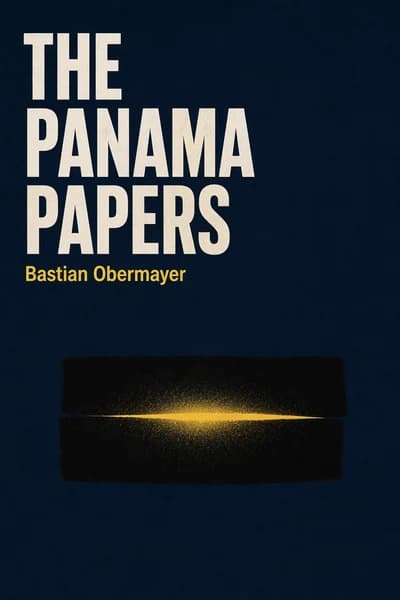
Bastian Obermayer is the Pulitzer Prize-winning investigative journalist and bestselling author of The Panama Papers: Breaking the Story of How the Rich and Powerful Hide Their Money, a landmark work of nonfiction that unveils systemic global tax evasion and offshore financial secrecy. A veteran reporter for Germany’s Süddeutsche Zeitung, Obermayer collaborated with the International Consortium of Investigative Journalists (ICIJ) to analyze the largest data leak in history, exposing corruption among world leaders, celebrities, and corporations.
His career spans groundbreaking investigations like the Paradise Papers and Swiss Leaks, and he co-founded Forbidden Stories, a nonprofit continuing the work of journalists under threat.
Obermayer’s expertise in financial crime and accountability is reflected in his other books, including Brother, What Have You Done (on Catholic Church abuse) and Letters From the Front (chronicling German soldiers in Afghanistan). His work has earned the Barlett & Steele Award, IRE Medal, and TEDx recognition. The Panama Papers, a New York Times bestseller translated into over 20 languages, sparked global reforms and inspired an Academy Award–nominated Netflix documentary, solidifying its status as a defining exposé of 21st-century financial corruption.
The Panama Papers chronicles the largest data leak in history, exposing how global elites hid wealth through 214,000 offshore companies. Investigative journalists Bastian Obermayer and Frederik Obermaier reveal how politicians, billionaires, and criminals used shell corporations to evade taxes and launder money, based on 11.5 million documents from Panamanian law firm Mossack Fonseca. The book details the year-long, collaborative effort of 400 journalists across 80 countries to unmask systemic financial corruption.
This book is essential for readers interested in financial crime, investigative journalism, or global inequality. It appeals to those curious about offshore tax havens, whistleblower dynamics, and the secretive networks enabling elite wealth concealment. Policymakers, activists, and students of economics or political science will find its insights into regulatory failures and systemic corruption particularly valuable.
Yes—it combines gripping investigative storytelling with critical insights into global financial systems. The authors blend meticulous research with narrative tension, offering a frontline perspective on unraveling one of history’s most consequential leaks. Its relevance persists in 2025, as offshore tax evasion remains a pressing issue.
Obermayer, a Pulitzer-winning journalist at Süddeutsche Zeitung, received the initial leak and coordinated the global probe. He co-authored the book with Frederik Obermaier, providing firsthand accounts of decrypting documents, verifying sources, and navigating ethical dilemmas in collaborative journalism.
Some critics argue the book prioritizes storytelling over deep financial analysis, leaving technical mechanisms of offshore schemes under-explained. Others note limited coverage of post-leak legal repercussions. However, its strength lies in humanizing investigative journalism’s role in democracy.
Unlike narrower exposés, this book emphasizes cross-border collaboration, showcasing how 400+ journalists overcame logistical and political hurdles. It uniquely blends memoir-style narration with hard-hitting data, offering both personal and systemic perspectives on financial secrecy.
The revelations triggered resignations (e.g., Iceland’s PM), anti-corruption protests, and renewed scrutiny of tax havens. Over $1.2 billion in fines were levied globally, and reforms like the EU’s public beneficial ownership registers emerged post-leak.
The book’s themes resonate with debates over crypto-based tax evasion and decentralized finance (DeFi). It underscores how new technologies often replicate old secrecy tactics, urging updated regulatory frameworks.
While the book itself hasn’t been adapted, the leak inspired documentaries like The Laundromat (2019) and Panama Papers (2022). These complement the book’s focus on Mossack Fonseca’s operations and investigative workflows.
Siente el libro a través de la voz del autor
Convierte el conocimiento en ideas atractivas y llenas de ejemplos
Captura ideas clave en un instante para un aprendizaje rápido
Disfruta el libro de una manera divertida y atractiva
clients "usually want to hide their money from ex-wives and the taxman."
provide anonymity for a price.
Desglosa las ideas clave de The Panama papers en puntos fáciles de entender para comprender cómo los equipos innovadores crean, colaboran y crecen.
Experimenta The Panama papers a través de narraciones vívidas que convierten las lecciones de innovación en momentos que recordarás y aplicarás.
Pregunta cualquier cosa, elige tu estilo de aprendizaje y co-crea ideas que realmente resuenen contigo.

Creado por exalumnos de la Universidad de Columbia en San Francisco
"Instead of endless scrolling, I just hit play on BeFreed. It saves me so much time."
"I never knew where to start with nonfiction—BeFreed’s book lists turned into podcasts gave me a clear path."
"Perfect balance between learning and entertainment. Finished ‘Thinking, Fast and Slow’ on my commute this week."
"Crazy how much I learned while walking the dog. BeFreed = small habits → big gains."
"Reading used to feel like a chore. Now it’s just part of my lifestyle."
"Feels effortless compared to reading. I’ve finished 6 books this month already."
"BeFreed turned my guilty doomscrolling into something that feels productive and inspiring."
"BeFreed turned my commute into learning time. 20-min podcasts are perfect for finishing books I never had time for."
"BeFreed replaced my podcast queue. Imagine Spotify for books — that’s it. 🙌"
"It is great for me to learn something from the book without reading it."
"The themed book list podcasts help me connect ideas across authors—like a guided audio journey."
"Makes me feel smarter every time before going to work"
Creado por exalumnos de la Universidad de Columbia en San Francisco

Obtén el resumen de The Panama papers como PDF o EPUB gratis. Imprímelo o léelo sin conexión en cualquier momento.
Imagine receiving a cryptic message asking if you're "interested in data" - then discovering you've been handed the keys to exposing a secret financial world. This is exactly what happened to journalist Bastian Obermayer, triggering what would become the largest journalistic collaboration in history. The Panama Papers - 11.5 million leaked documents from Panamanian law firm Mossack Fonseca - revealed how the wealthy and powerful hide their assets through elaborate offshore structures. This wasn't just about individual wrongdoing; it exposed a shadow financial system where the privileged few effectively opt out of taxes and regulations that govern everyone else. The revelations toppled governments, embarrassed world leaders from Vladimir Putin to David Cameron, and sparked global outrage. As President Obama noted following the leak, "The problem is that a lot of this stuff is legal, not illegal." The Panama Papers pulled back the curtain on a parallel financial reality - one designed to be impenetrable, yet suddenly laid bare for all to see.
The offshore industry operates through a sophisticated system of shell companies - legal entities that exist solely to hold assets while concealing ownership. These "empty boxes" are registered in tax havens like the British Virgin Islands, Panama, or Nevada, with layers of anonymity built in through intermediaries and nominee directors. One such director, Leticia Montoya, managed over 25,000 companies from her Panama bungalow. Jurgen Mossack and Ramon Fonseca - founders of Mossack Fonseca - presented themselves as legitimate businessmen. Mossack, whose father was a former Waffen-SS corporal turned CIA informant, established the Panama law firm in 1977 before partnering with Fonseca, a prominent Panamanian politician and presidential adviser. Despite claims of following "the highest standards of due diligence," the firm routinely overlooked compliance concerns. They used coded email aliases like "Harry Potter" and maintained relationships with controversial figures, including Assad regime associates and a convicted child rapist.
One of the most explosive revelations centered on Vladimir Putin's friend Sergei Roldugin, a cellist and godfather to Putin's daughter. Despite publicly claiming poverty, the Panama Papers showed Roldugin controlled offshore companies handling billions in suspicious transactions - including unsecured credit lines, backdated deals, and questionable fees. In one case, his company acquired rights to a $200 million loan for just one dollar. The money trail connected to Putin's St. Petersburg associates who became wealthy after his rise to power. Many were linked to Rossiya Bank, which grew from obscurity into a major institution under Putin's protection. The Papers also exposed other world leaders' offshore dealings. Iceland's Prime Minister Sigmundur Gunnlaugsson secretly owned a shell company with claims against failed banks he was negotiating with - leading to protests and his resignation. Ukraine's President Poroshenko established an offshore company during a crucial battle with pro-Russian forces. The leak implicated other prominent figures, including Pakistan's Prime Minister, relatives of China's President Xi Jinping, the UAE president, and Kofi Annan's son.
While Mossack Fonseca created offshore structures, major banks were key enablers in this shadow financial system. The Panama Papers exposed over 500 banks using Mossfon's services, with Deutsche Bank alone managing more than 400 offshore companies. These banks systematically facilitated offshore concealment despite public denials. Deutsche Bank received special privileges, including blank pre-signed powers of attorney to insert client names anonymously. They operated dboffshore.com, openly promoting their "30-year commitment to offshore financial services." The duplicity was clear. Commerzbank claimed their offshore activities were "old cases," yet continued ordering shell companies through 2013 - while accepting an 18 billion euro government bailout. State-backed institutions like Landesbank Baden-Wurttemberg and HSH Nordbank were also major Mossfon clients, effectively helping wealthy clients avoid taxes owed to their own governments. Three German banks have paid millions in fines for enabling tax evasion. The leaks revealed banks didn't merely process transactions - they actively created and managed offshore structures for wealthy clients, knowing these arrangements were designed to bypass tax laws and regulations.
The offshore system exposed by the Panama Papers extends beyond finance. In sports, Lionel Messi's Panamanian shell company and FIFA ethics committee member Juan Pedro Damiani's ties to FIFA defendants revealed deep-rooted corruption. The art world saw similar patterns, with offshore companies concealing ownership of valuable pieces like Modigliani's "Seated Man with a Cane" - a painting allegedly stolen by Nazis. For enhanced secrecy, "nominee shareholders" add protection, while complex structures combine multiple jurisdictions - such as British Virgin Islands companies owned by Panamanian foundations controlled by Nevada trusts. While not illegal, these offshore entities excel at hiding assets from tax authorities, creditors, and ex-spouses. As one Mossack Fonseca employee noted, clients typically "want to hide their money from ex-wives and the taxman," creating a two-tier society where the wealthy operate under different rules.
The Panama Papers investigation united over 400 journalists from more than 100 media organizations across 80 countries, led by journalists Bastian Obermayer and Frederik Obermaier in partnership with the International Consortium of Investigative Journalists. The technical scope was staggering - 2.6 terabytes of data, far exceeding previous leaks. The team implemented rigorous security measures, including dual-encrypted drives with decoy files and secret partitions, complex passwords, and tamper-detection methods like glitter nail polish on computer housings. ICIJ specialists developed custom tools and employed intelligence agency-grade software to process hundreds of thousands of documents. The investigation carried significant risks, particularly for journalists in authoritarian countries - Russian journalists at Novaya Gazeta had lost four colleagues since 2000. The April 3, 2016 publication sparked immediate global impact. As #panamapapers topped Twitter trends, the fallout included Iceland's prime minister's resignation, protests in Malta, and worldwide investigations of implicated officials.
The Panama Papers exposed how offshore secrecy enables a "neo-feudal concentration of wealth" where financial elites create their own legal system, facilitating both tax evasion and criminal activities. Two solutions could end tax havens: automatic global exchange of bank account information and transparent global registers of company ownership. Economist Gabriel Zucman argues that even notorious tax havens would comply when faced with serious sanctions. Major nations themselves perpetuate the system. The United States maintains domestic tax havens in Nevada, Wyoming and Delaware, while the UK controls tax havens through its overseas territories. Germany, despite its reformist image, often blocks transparency initiatives. The costs are enormous - Africa loses twice its development aid through tax evasion, while the EU loses a trillion euros annually to tax fraud. Beyond financial losses, offshore secrecy undermines democracy and worsens inequality. Yet digitization makes absolute secrecy increasingly difficult to maintain. As the Panama Papers' source noted: "The next revolution will be digitized. Or perhaps it has already begun." This leak may mark the beginning of the end for a system that lets the powerful play by different rules.