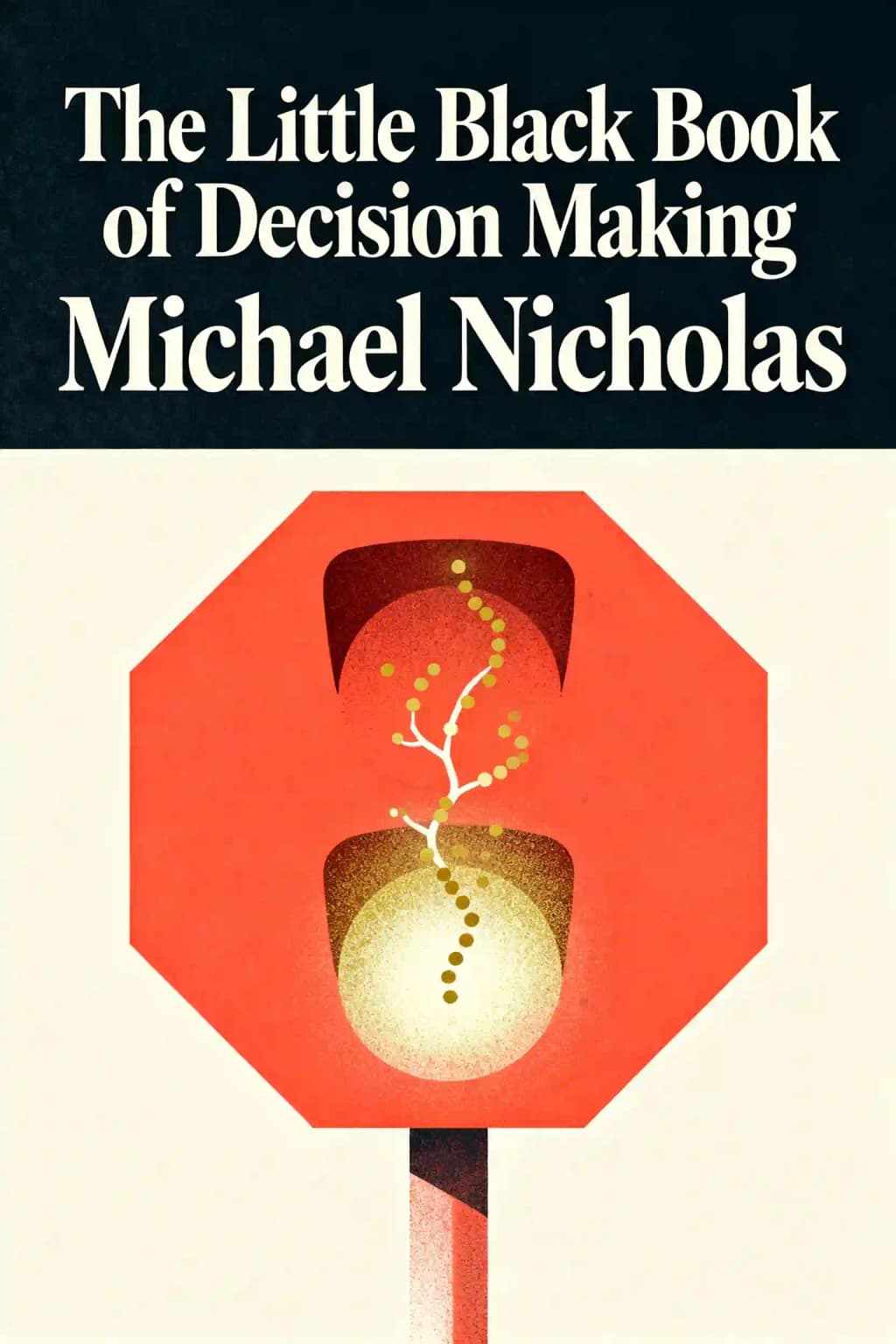
Little Black Book of Decision Making
Making Complex Decisions with Confidence in a Fast-Moving World
Resumen de Little Black Book of Decision Making
In a world of decision paralysis, Michael Nicholas delivers a game-changing guide endorsed by top executives. Beyond logic, this 2017 bestseller reveals why mindfulness and emotional intelligence trump rational thinking alone. What crucial blind spot is sabotaging your choices right now?

Temas clave en Little Black Book of Decision Making
- cognitive bias mitigation
- intuitive intelligence
- risk assessment failure
- mental heuristics
- evidence-based reasoning
Citas de Little Black Book of Decision Making
Decision-making capability has become the ultimate competitive advantage.
Success is a lousy teacher. It seduces smart people into thinking they can't lose.
We cannot solve a problem from the level of consciousness that created it.
Everything innovative eventually becomes obsolete.
Personajes en Little Black Book of Decision Making
- Michael NicholasAuthor, chartered engineer, and leadership coach
- Baruch FischoffResearcher who studied hindsight bias
- Frederick Winslow TaylorPioneer of scientific management in business
- David CookFounder who revolutionized the video rental industry
Sobre el Autor
Sobre el autor de Little Black Book of Decision Making
Michael Nicholas, author of The Little Black Book of Decision Making, is a leadership coach, corporate trainer, and decision-making expert renowned for blending scientific rigor with practical insights. With a background as a chartered engineer, he transitioned to integrating psychological research and leadership strategies, working with major UK blue-chip companies to optimize team dynamics and organizational decision-making.
His book addresses cognitive biases, decision fatigue, and systematic approaches to overcoming overwhelm, drawing from decades of experience and frameworks like those pioneered by Daniel Kahneman.
Nicholas has authored multiple works on leadership and cognitive psychology, and his methodologies are applied in corporate training programs globally. A sought-after speaker, he combines academic authority with real-world applicability, emphasizing predictable outcomes in complex human interactions. The Little Black Book of Decision Making has garnered widespread reader acclaim, reflected in its 3.84/5 Goodreads rating, and remains a trusted resource for professionals seeking to refine their strategic thinking.
Descargar resumen de Little Black Book of Decision Making
Obtén el resumen de Little Black Book of Decision Making como PDF o EPUB gratis. Imprímelo o léelo sin conexión en cualquier momento.
Preguntas Frecuentes Sobre Este Libro
The Little Black Book of Decision Making examines the interplay between rational analysis and intuition, providing frameworks to avoid cognitive biases and improve decision quality in fast-paced environments. Michael Nicholas combines neuroscience and real-world examples to help readers refine their judgment, emphasizing adaptability in business and leadership contexts.
Leaders, managers, and professionals facing complex decisions in dynamic industries (e.g., finance, healthcare, tech) will benefit most. The book’s practical insights into balancing logic with gut feeling also appeal to entrepreneurs and those seeking to sharpen their emotional intelligence in high-stakes scenarios.
Yes—it offers actionable strategies for avoiding decision-making traps like confirmation bias and overreliance on intuition. Readers praise its blend of academic rigor and real-world applicability, making it a valuable resource for leaders navigating uncertainty.
- Dual-process theory: Balancing deliberate analysis with subconscious intuition.
- Cognitive traps: Identifying biases like anchoring or sunk-cost fallacy.
- Adaptive decision-making: Adjusting logic/intuition ratios based on context.
- Emotional intelligence: Leveraging self-awareness to reduce errors.
Nicholas describes intuition as a subconscious synthesis of experience and pattern recognition. He argues it must be “honed” through reflection and paired with logical checks to avoid pitfalls like snap judgments in unfamiliar scenarios.
- Pre-mortem analysis: Visualizing potential failures before finalizing choices.
- Scenario planning: Stress-testing decisions against multiple outcomes.
- Bias audits: Systematically identifying and neutralizing cognitive distortions.
It advocates for “meta-cognition”—consciously evaluating how you approach decisions—to improve team collaboration, risk assessment, and innovation. Case studies illustrate applying frameworks to hiring, strategy pivots, and crisis management.
Some reviewers note a focus on corporate contexts over personal decisions. Others suggest additional tools for quantifying intuition’s role, though most praise its balance of theory and practicality.
Drawing on 30+ years in military leadership (e.g., First Gulf War) and corporate consulting (HSBC, Deloitte), Nicholas emphasizes resilience, emotional intelligence, and adaptive thinking—themes reflected in the book’s pragmatic tone.
Yes—its principles for balancing logic/emotion apply to relationships, financial planning, and career changes. Techniques like bias audits help individuals avoid impulsive choices during stressful transitions.
Unlike purely academic texts, it prioritizes actionable steps over theoretical models. Compared to Thinking, Fast and Slow, it offers more direct workplace applications and fewer statistical deep dives.
Nicholas suggests reserving 10% of decision-making time to challenge assumptions—e.g., asking, “What if our initial data is flawed?” This habit reduces overconfidence and fosters agility.