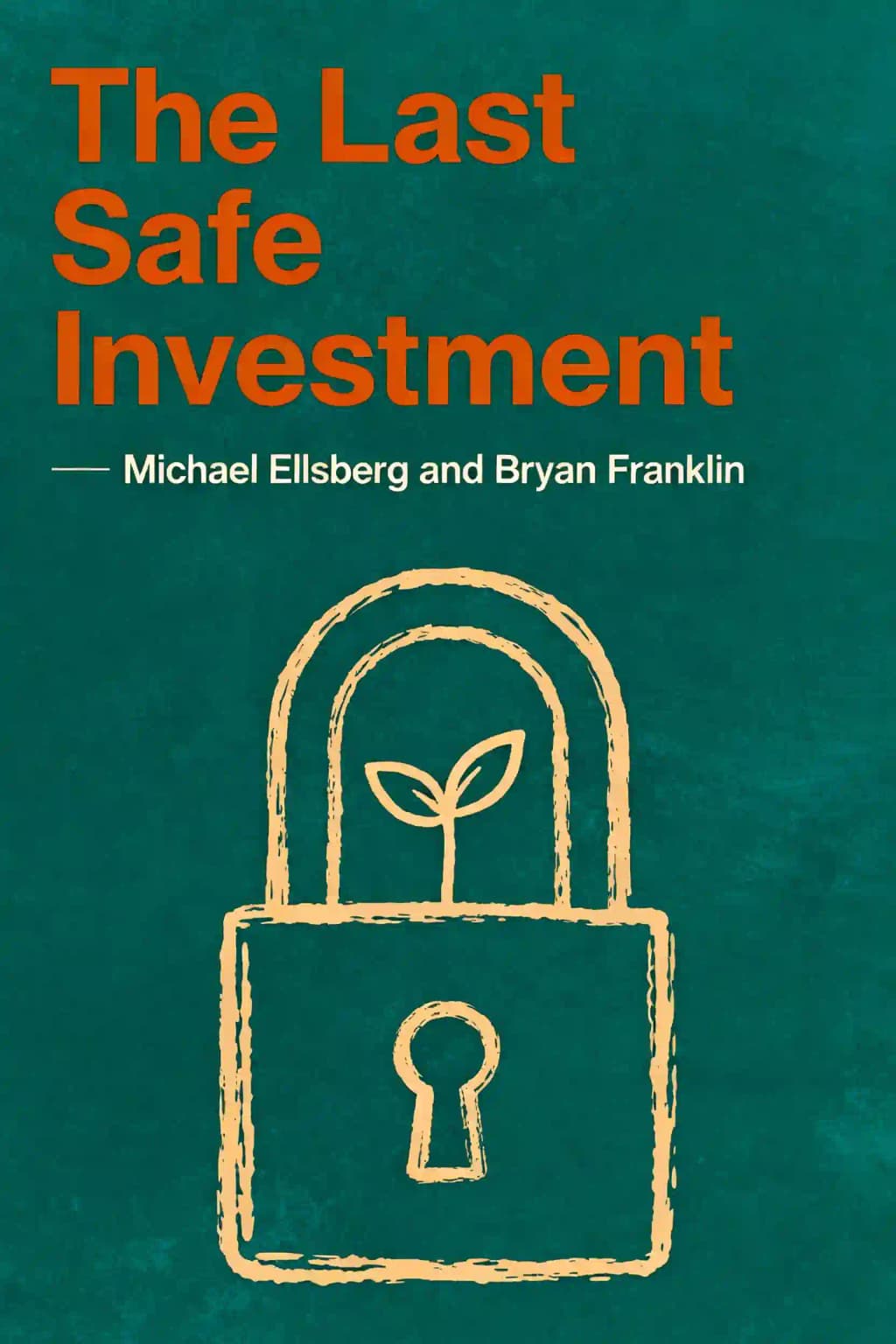
The Last Safe Investment
Spending Less for Pleasure, Satisfaction, and Financial Security
Resumen de The Last Safe Investment
Forget Wall Street wisdom. "The Last Safe Investment" reveals why investing in your skills, relationships, and personal growth yields greater returns than stocks. This provocative guide has reshaped financial planning by challenging readers: What if YOU are your most valuable asset?

Temas clave en The Last Safe Investment
- human capital investment
- systemic spending
- earning potential optimization
- happiness exchange rate
- alternative wealth building
Citas de The Last Safe Investment
The only truly safe investment is yourself.
Money alone cannot provide happiness.
Your earning potential is the most variable and predictable asset you possess.
Tribes transform True Wealth assets by distributing ownership costs.
The traditional advice isn't just ineffective - it's fundamentally flawed.
Personajes en The Last Safe Investment
- Michael EllsbergAuthor and proponent of the SAFE investment plan
- Bryan FranklinAuthor and expert in self-amplifying ecosystems
Sobre el Autor
Sobre el autor de The Last Safe Investment
Michael Ellsberg, career development expert and co-author of The Last Safe Investment: Spending Now to Increase Your True Wealth Forever, is a bestselling author known for challenging conventional education and career paths. His prior work The Education of Millionaires became a career-advice staple, featured in The New York Times and Forbes, where he maintains a blog on entrepreneurial success.
Berkley-born Ellsberg combines civil liberties advocacy with practical wealth-building strategies, reflecting his dual focus on financial freedom and personal fulfillment.
Bryan Franklin, business strategist and co-author, brings billion-dollar scaling expertise from coaching 35 Google executives and seven unicorn company CEOs. His systems for leadership in uncertain markets directly inform the book’s emphasis on investing in lifelong earning potential.
Together, their 2016 manifesto redefines wealth as security, creativity, and relationships—themes developed through Franklin’s corporate talks and Ellsberg’s sex-worker advocacy writing for The Daily Beast.
The book’s “three disciplines” framework has been cited in TEDx talks and implemented by Fortune 500 teams, with Blinkist ratings reflecting its 4.1/5 popularity among 272+ reviewers.
Descargar resumen de The Last Safe Investment
Obtén el resumen de The Last Safe Investment como PDF o EPUB gratis. Imprímelo o léelo sin conexión en cualquier momento.
Preguntas Frecuentes Sobre Este Libro
The Last Safe Investment challenges traditional financial advice by arguing that self-investment—developing skills and relationships—is the most reliable path to wealth. Authors Michael Ellsberg and Bryan Franklin propose a "systematic spending" model to optimize personal growth, career success, and happiness. They emphasize focusing on controllable assets like earning potential rather than stocks or real estate.
This book suits professionals seeking career growth, anxious savers disillusioned with traditional investing, and entrepreneurs aiming to maximize personal impact. It’s particularly relevant for those open to rethinking financial strategies to prioritize skill-building and holistic wealth.
Yes—readers praise its bold reframing of wealth-building, with 20 Minute Books calling it a "revolutionary guide" for financial security. Critics note some self-promotional content but highlight actionable frameworks for increasing earning power and systemic life improvements.
Systematic spending involves allocating time/money to areas that compound across multiple life domains. Examples include learning negotiation skills (boosting career and personal confidence) or improving health (enhancing productivity and relationships). The authors argue this creates "true wealth" beyond monetary gains.
Both Ellsberg books critique traditional success metrics, but The Last Safe Investment focuses specifically on redefining financial strategies. It expands on his earlier themes by introducing structured frameworks like the "three disciplines" model for lifelong growth, whereas Education emphasizes entrepreneurial skill-building.
Some readers find the emphasis on self-investment overly idealistic for those with limited resources. Others note occasional promotional references to the authors’ coaching services, though most agree the core concepts remain valuable.
“False wealth is the accumulation of finite resources in the hopes of satisfying infinite desires.” This highlights the authors’ argument against traditional investing and for prioritizing skills that generate lasting value.
The book advises investing in "super-skills" like sales and communication, which transfer across industries. For example, mastering persuasive writing could aid both marketing roles and entrepreneurial ventures, creating career flexibility.
With AI disrupting traditional jobs, the book’s focus on human-centric skills (creativity, emotional intelligence) aligns with current workforce trends. Its systemic approach helps readers adapt to economic uncertainty.
- Earning Power: Develop high-impact skills.
- Relationship Wealth: Cultivate trusted partnerships.
- Happiness Optimization: Align spending with joy-generating activities.
These interconnected disciplines form the book’s wealth-building framework.
As a Brown graduate critiquing formal education (author of The Education of Millionaires) and advocate for sex workers’ rights, Ellsberg brings a contrarian perspective. His focus on unconventional success paths underpins the book’s challenge to financial norms.
- Prioritize skill development over stock portfolios.
- Evaluate spending by its cross-domain ripple effects.
- Build "advisor equity" by solving others’ problems—a sustainable wealth generator.