Capítulo 1
A Gothic Masterpiece That Shaped Literature and Architecture
Victor Hugo's "The Hunchback of Notre-Dame" stands as one of the most influential novels of the 19th century, captivating readers since its publication in 1831. The novel's impact extends far beyond literature-it sparked a preservation movement that saved Notre-Dame Cathedral from demolition and inspired countless adaptations across media. When Disney released its animated version in 1996, it introduced a new generation to Hugo's complex characters, though with a significantly altered storyline. The book remains a cultural touchstone, appearing on countless "must-read" lists and university syllabi worldwide. Even celebrities like Emma Watson have cited it among their favorite classics, praising its exploration of societal prejudice and human compassion. Beyond its entertainment value, the novel serves as a powerful social commentary on class divisions, religious hypocrisy, and the treatment of those deemed "different"-themes that remain startlingly relevant in our modern world.
Capítulo 2
The Magnificent Cathedral: A Character of Stone
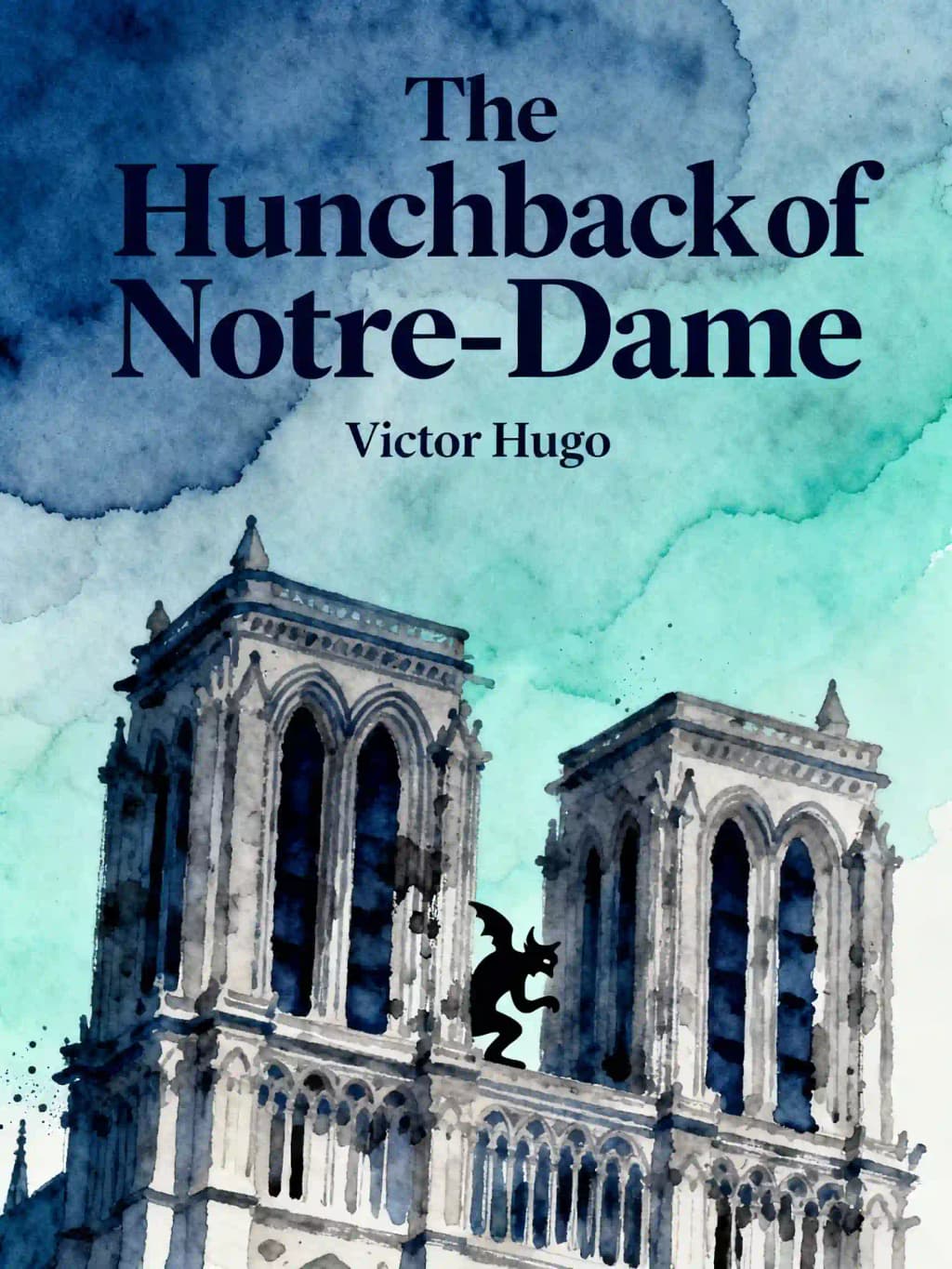
At the heart of Hugo's masterpiece stands Notre-Dame Cathedral-not merely as a backdrop but as a living, breathing character in its own right. Hugo's passionate descriptions of the cathedral's Gothic architecture transform stone into poetry, revealing his deep reverence for medieval craftsmanship. The cathedral represents the collective genius of generations of anonymous artisans who poured their souls into creating this magnificent structure over centuries.
Notre-Dame serves as both sanctuary and prison throughout the narrative. For Quasimodo, the cathedral's bell-ringer, it provides the only home he has ever known-a place where his deformity matters less than his extraordinary strength and agility. The massive bells become his closest companions, and he moves through the cathedral's hidden passages and towering heights with the ease of a creature born to this stone habitat. "He had tamed the cathedral," Hugo writes, describing how Quasimodo had formed "a mysterious harmony between this creature and the edifice."
The cathedral also functions as a powerful symbol of medieval Paris itself-a city stratified by rigid social hierarchies yet teeming with vibrant life. Hugo presents a bird's-eye view from the cathedral towers, revealing Paris as three distinct cities: the City (the island), the University (left bank), and the Town (right bank). This panoramic perspective allows readers to grasp the novel's vast social landscape, from the beggars and thieves of the Court of Miracles to the nobility in their mansions.
Perhaps most significantly, Notre-Dame embodies Hugo's theory about architecture as humanity's primary mode of expression before the printing press. In the pivotal chapter "The One Will Kill the Other," he argues that before Gutenberg, great buildings were humanity's books-stone texts that preserved ideas across generations. The cathedral's intricate carvings, statues, and stained glass told stories to a largely illiterate population. Hugo laments the desecrations Notre-Dame suffered through centuries, from revolutionary destruction to well-intentioned but misguided "improvements" that stripped away its medieval character.
When Hugo wrote his novel, Notre-Dame stood neglected and threatened with demolition. The book's immense popularity sparked public interest in the cathedral's preservation, leading to a major restoration project. In this way, Hugo's pen quite literally saved the stones he so lovingly described-a remarkable testament to literature's power to shape reality.
Capítulo 3
Quasimodo: Beauty Within the Beast
Quasimodo stands as one of literature's most complex and sympathetic outcasts-a character whose physical deformity masks an inner beauty that few in his world can recognize. Born with a hunchback, a massive wart covering one eye, and legs as crooked as "half-circles," he is abandoned as an infant on the charity bed at Notre-Dame's entrance. The crowd that gathers calls him a "deformed monkey" and "monster of abomination," suggesting he should be "burned or drowned" rather than allowed to live.
Only Claude Frollo, the austere archdeacon, shows compassion, adopting the child and naming him Quasimodo ("Almost Complete") to mark the day of his discovery-Quasimodo Sunday. Under Frollo's care, Quasimodo grows into a powerful young man who becomes the cathedral's bell-ringer. This occupation ultimately renders him deaf, adding another layer of isolation to his already solitary existence. Cut off from human society by both his appearance and his inability to hear, Quasimodo develops an extraordinary relationship with Notre-Dame itself: "The cathedral was not only his society, but his universe. It was all nature to him."
Hugo masterfully reveals Quasimodo's humanity through his devotion to two beings: Claude Frollo and Esmeralda. His loyalty to Frollo stems from profound gratitude-"the only human connection in his life." When Quasimodo says of Frollo, "He took me in, nourished me, raised me, taught me," we understand the depth of his attachment. This devotion makes his later betrayal of Frollo all the more powerful.
Quasimodo's love for Esmeralda represents the novel's most poignant emotional arc. After she shows him a simple kindness-bringing him water when he suffers on the pillory-he develops an almost religious devotion to her. When he rescues her from execution, hiding her in the cathedral, their relationship reveals the novel's central irony: the beautiful girl fears the physically repulsive man who loves her purely, while she pines for the handsome captain who views her as merely another conquest.
In one of the novel's most touching scenes, Quasimodo leaves two vases at Esmeralda's window-a beautiful but cracked crystal one containing withered flowers, and a common earthen jug with fresh blooms. This gesture symbolizes his understanding of himself in relation to her: "I am like that broken vase, and you prefer the earthen pitcher." Yet his devotion never wavers, even when unrequited. His final act-lying down beside Esmeralda's corpse in her tomb until he too dies-represents the ultimate expression of his love, transcending the physical world that had judged him so harshly.
Capítulo 4
Esmeralda: Innocence in a Corrupt World
Esmeralda emerges as a vibrant splash of color against the grey stone backdrop of medieval Paris. First introduced dancing in the public square with her white goat Djali, she captivates everyone who sees her-from the common people who toss coins into her tambourine to the archdeacon who watches from the shadows with forbidden desire. With her "golden bodice" and "many-colored skirts," she represents an exotic beauty in a drab world.
Born Agnes to a French mother, Esmeralda was stolen as an infant by gypsies who left a deformed child in her place. Raised among the Romani, she maintains a remarkable innocence despite her profession as a street performer. Hugo repeatedly emphasizes her purity-she wears an amulet containing a small shoe, believing it will help her find her mother only if she remains a virgin. This commitment to chastity becomes central to the plot when she marries Gringoire to save him from hanging but refuses to consummate the union.
Esmeralda's tragic flaw is her infatuation with Captain Phoebus, whose handsome exterior masks a shallow, selfish nature. After he rescues her from Quasimodo's attempted abduction, she develops an obsessive devotion to him, even teaching her goat to spell his name. When she finally meets him again, she naively believes his seductive promises, unaware that he views her as merely another conquest. This misplaced love leads directly to her downfall when Claude Frollo stabs Phoebus during their assignation, leaving Esmeralda to be blamed for the attack.
Throughout her imprisonment, torture, and condemnation, Esmeralda maintains a childlike faith that Phoebus will save her. Even when faced with Claude Frollo's offer to escape death if she yields to him, she chooses execution rather than betrayal of her love for Phoebus. "Be yours, priest? Never!" she declares. "Nothing shall ever unite us-not even hell!"
The novel's most heartrending scene comes when Esmeralda finally reunites with her mother, Paquette (now the recluse Sister Gudule), moments before her execution. After fifteen years of hatred for the gypsies she believed stole her child, Gudule recognizes her daughter through the matching shoes they each preserved. Their joyful reunion lasts only minutes before soldiers tear them apart, leading Esmeralda to the gallows while her mother dies trying to protect her.
Esmeralda's character embodies the novel's central theme of fate's cruelty. Despite her goodness and innocence, she becomes a victim of others' desires-Frollo's obsession, Phoebus's callousness, and society's superstition. Her death symbolizes the destruction of beauty and purity in a world governed by prejudice and power.
Capítulo 5
Claude Frollo: The Fall of a Brilliant Mind
Claude Frollo presents one of literature's most complex villains-a man whose intellectual brilliance and initial virtue make his descent into obsession and cruelty all the more disturbing. As a young man, Frollo embodied the ideal scholar-priest: brilliant, disciplined, and devoted to knowledge. Orphaned at nineteen, he sacrificed his own ambitions to raise his infant brother Jehan, taking holy orders to support them both. His adoption of the deformed foundling Quasimodo further demonstrated his capacity for compassion.
Hugo traces Frollo's transformation from respected archdeacon to murderous stalker with psychological precision. The catalyst for this change is his first glimpse of Esmeralda dancing in the square-a moment that awakens desires his religious training had suppressed. "Before I met you, I was happy," he later tells her. "I was pure; my soul was filled with limpid light. No head was held more proud and radiant than mine." His obsession with Esmeralda represents not merely physical lust but a fundamental crisis of faith.
Frollo's character embodies the novel's critique of religious hypocrisy and intellectual pride. Despite his vows of chastity, he develops an all-consuming passion for Esmeralda. Rather than acknowledging his own moral failure, he blames her, the devil, and fate itself. "It was she who did this," he claims, refusing to accept responsibility for his desires. His scientific pursuits-initially focused on legitimate scholarship-gradually shift toward alchemy and the occult as he seeks to control forces beyond human understanding.
The archdeacon's relationship with Quasimodo reveals another dimension of his character. Having raised the hunchback from infancy, Frollo commands absolute devotion from him. Yet he exploits this loyalty, using Quasimodo as an instrument to kidnap Esmeralda. When Quasimodo later chooses to protect Esmeralda rather than obey his master, Frollo experiences this as the ultimate betrayal.
Frollo's final confrontation with Esmeralda in her cell represents the complete corruption of his once-noble character. Offering to save her from execution if she will yield to him, he presents a stark choice: "Choose between me and the gallows!" When she rejects him, choosing death over dishonor, his love transforms into murderous rage. His demonic laughter as he watches her hanging reveals how completely his obsession has destroyed his humanity.
The archdeacon's death-hurled from Notre-Dame's tower by Quasimodo-provides a fitting end to his tragic arc. The man who once commanded the heights of intellectual and spiritual authority dies broken on the pavement below, a victim of the same destructive passions he refused to control.
Capítulo 6
Fate and Free Will: The Inexorable Force of ANATKH
The Greek word "ANATKH" (meaning fate or necessity), which Hugo discovered carved into Notre-Dame's wall, serves as the philosophical cornerstone of the novel. This mysterious inscription inspired him to explore how destiny shapes human lives despite our illusions of choice and agency. Throughout the narrative, characters struggle against forces beyond their control, only to find themselves inexorably drawn toward their predetermined ends.
Hugo establishes this fatalistic worldview from the beginning, describing how the word was "carved by some hand" in the cathedral wall, suggesting that even the anonymous carver was merely an instrument of fate. The novel's structure reinforces this theme, as seemingly random events and chance encounters ultimately reveal themselves as links in an unbreakable chain leading to tragedy.
Claude Frollo, despite his intellectual prowess and religious authority, becomes obsessed with this concept. He carves "ANATKH" on his cell wall during a moment of despair, recognizing that his rational mind cannot overcome his irrational passion for Esmeralda. When he tells her, "Destiny has seized upon us both," he articulates the novel's central premise-that human will, no matter how strong, cannot overcome predetermined fate.
The novel's intricate web of impossible loves further illustrates this theme: Frollo loves Esmeralda, who despises him; Quasimodo loves Esmeralda, who fears him; Esmeralda loves Phoebus, who merely desires her; Gringoire admires Esmeralda but lacks passion for her. These misaligned affections create a pattern of inevitable suffering that no character can escape.
Perhaps the most poignant expression of fate's power comes through Esmeralda's reunion with her mother. For fifteen years, both women preserved a tiny shoe as their only connection to each other. Their paths crossed repeatedly in Paris without recognition, until the final moments before Esmeralda's execution. This cruel timing-allowing recognition only when it's too late to save her-epitomizes the novel's vision of fate as a force that toys with human hopes before crushing them.
Even the novel's setting reinforces this theme. Medieval Paris, with its rigid social hierarchies and superstitious worldview, represents a society where individual choice means little against the forces of church, state, and mob. The public square where Quasimodo is crowned "Pope of Fools" is the same place where Esmeralda will later be hanged-a spatial embodiment of fate's circular nature.
Yet within this deterministic framework, Hugo suggests that human dignity lies in how we respond to our inevitable fate. Quasimodo's choice to protect Esmeralda against his master's commands represents a small but significant assertion of free will. Similarly, Esmeralda's refusal to yield to Frollo even to save her life demonstrates that while we cannot escape our destiny, we retain some control over how we meet it.
Capítulo 7
The Court of Miracles: Society's Underbelly
The Court of Miracles represents one of Hugo's most vivid creations-a hidden kingdom of outcasts existing alongside yet separate from official Paris. This notorious thieves' quarter earned its name because beggars who feigned disabilities during the day would miraculously "recover" upon returning to their sanctuary at night. Hugo describes it as "a city of outlaws in the midst of the city itself," governed by its own king and operating according to its own laws.
When Gringoire stumbles into this forbidden territory, he encounters a nightmarish scene: cripples suddenly walking, blind men seeing, and invalids transformed into robust thieves. The Court functions as a dark mirror of mainstream society, with its own hierarchy, justice system, and even religious parody in the form of the "Pope of Fools" celebration. Clopin Trouillefou, the "King of Tunis" who rules this shadow realm, dispenses justice as swiftly and arbitrarily as any royal judge.
Hugo uses the Court of Miracles to explore society's treatment of its marginalized members. Rather than portraying these outcasts as merely victims, he shows how they have created an alternative community with its own codes and customs. Their attempted rescue of Esmeralda from Notre-Dame demonstrates a fierce loyalty to their own-"She is our sister!"-that contrasts with the callousness of mainstream society toward those it deems expendable.
The Court also serves as a political metaphor. Hugo hints that these "vagabonds" represent a nascent revolutionary force that will eventually challenge established authority. When Jacques Coppenole tells the king, "The people's hour has not yet come," he foreshadows the French Revolution when the Bastille would fall to similar crowds. The failed assault on Notre-Dame to rescue Esmeralda suggests that this revolutionary potential remains unformed in the medieval period, but the seeds of future upheaval are clearly present.
Through the character of Pierre Gringoire-the failed poet who finds unexpected acceptance among these thieves-Hugo explores the thin line separating respectable society from its outcasts. When economic necessity forces Gringoire to abandon philosophy for street performance, he discovers that social status depends more on circumstance than inherent worth. His "marriage" to Esmeralda to escape hanging symbolizes his initiation into this alternative society, though he never fully commits to its values.
The Court of Miracles ultimately reveals Hugo's complex view of human community. While he acknowledges its brutality and criminality, he also recognizes it as a space where society's rejects have created their own form of belonging. In a world where official institutions like the Church and monarchy often fail to provide justice or compassion, these outcasts have fashioned a crude but functional alternative-one that occasionally displays more genuine solidarity than the supposedly civilized world above.
Capítulo 8
The Changing Face of Paris: Architecture as Human Expression
Hugo's novel presents a passionate defense of Gothic architecture at a time when medieval buildings were being demolished or "improved" according to neoclassical tastes. Through detailed descriptions of Notre-Dame and other Parisian landmarks, he argues that architecture represents the primary form of human expression before the invention of printing. "The human race," he writes, "has had no important thought which it has not written down in stone."
The chapter "A Bird's-Eye View of Paris" offers a magnificent panorama of the fifteenth-century city, with Notre-Dame at its center. Hugo reconstructs the medieval cityscape with loving precision, describing the three distinct districts-the City (on the island), the University (left bank), and the Town (right bank)-each with its own character. This meticulous recreation serves both narrative and philosophical purposes, allowing readers to imagine a Paris that had largely disappeared by the 1830s while arguing for the preservation of what remained.
In the pivotal chapter "The One Will Kill the Other," Hugo develops his theory about the relationship between architecture and printing. Before Gutenberg, he argues, architecture was humanity's primary text-from prehistoric monuments to Gothic cathedrals. Each architectural era reflected its society: "theocratic buildings" (Hindu, Egyptian, Roman) expressed priestly authority, while "popular architecture" (Phoenician, Greek, Gothic) embodied liberty and human creativity.
The printing press, according to Hugo, revolutionized human expression by making thought "more imperishable than ever; it is volatile, irresistible, indestructible." No longer needing "mountains of stone" to preserve ideas, humanity could now use mere paper and ink. This technological shift gradually diminished architecture's cultural importance, reducing it from a vital form of expression to mere construction. The Renaissance marked architecture's decline into "classicism"-beautiful but no longer carrying the profound symbolic weight of medieval buildings.
Hugo's theory reflects his Romantic sensibility, particularly his admiration for the anonymous craftsmen who built the great Gothic cathedrals. Unlike Renaissance and later architects who sought personal recognition, these medieval artisans worked collectively, pouring their creativity into structures that would outlast them. Their buildings represented "not the work of an individual, but of a society, the offspring not of a man, but of a nation."
The novel's publication had real-world consequences for Parisian architecture. Its popularity drew attention to Notre-Dame's dilapidated condition, leading King Louis-Philippe to commission architects Eugene Viollet-le-Duc and Jean-Baptiste Lassus to restore the cathedral in 1844. Though modern preservationists might question some of their methods, this restoration saved Notre-Dame from potential demolition and established the principle that medieval buildings deserved protection.
Through his passionate defense of Gothic architecture, Hugo helped shift public perception of medieval structures from outdated relics to valuable cultural heritage. His detailed descriptions of Notre-Dame's facade, towers, and interior created a literary monument that complemented the physical one, ensuring that readers would appreciate the cathedral's beauty and significance even if they never visited Paris.
Capítulo 9
The Power of the Mob: Justice and Cruelty in Medieval Paris
Throughout the novel, Hugo depicts the medieval crowd as a volatile force capable of both festive celebration and horrific cruelty. From the opening scene at the Feast of Fools to Esmeralda's execution, collective behavior reveals the darker aspects of human nature when individual responsibility dissolves into mob mentality.
The novel begins with Paris celebrating the double festival of Epiphany and the Feast of Fools-a carnivalesque occasion when social hierarchies temporarily invert. The crowd's initial enthusiasm for Gringoire's mystery play quickly shifts to the grimace contest that crowns Quasimodo the "Pope of Fools." This rapid change in focus demonstrates the crowd's fickle nature and preference for spectacle over substance. When they parade Quasimodo through the streets, their celebration contains a cruel edge-they mock his deformity while pretending to honor him.
This cruelty becomes explicit during Quasimodo's punishment at the pillory. The same people who crowned him their "pope" now take sadistic pleasure in his suffering. Hugo describes how "every projectile that struck the pillory wrung from him a writhe of anguish, and made his face yet more hideous." Only Esmeralda shows compassion, bringing him water when he cries out in thirst. This contrast between individual mercy and collective brutality runs throughout the novel.
The judicial system itself institutionalizes this cruelty. When Quasimodo appears before the deaf judge Florian Barbedienne, their mutual inability to hear creates an absurd situation that would be comical if the consequences weren't so severe. The court sentences Quasimodo to public flogging and an hour in the pillory without any genuine attempt to determine guilt or innocence. Similarly, Esmeralda's trial features torture, superstition, and predetermined guilt rather than actual justice.
Hugo reserves his most scathing critique for the crowd that gathers to watch Esmeralda's execution. The same people who once delighted in her dancing now eagerly anticipate her death as entertainment. When she briefly escapes execution through sanctuary at Notre-Dame, they quickly shift allegiance again, supporting the vagabonds' attack on the cathedral to "rescue" her-though their motives seem more aligned with chaos than compassion.
Through these scenes, Hugo illustrates how justice in medieval Paris operated through spectacle rather than principle. Public executions served as both entertainment and social control, with the crowd's participation essential to legitimizing state violence. The pillory, the torture chamber, and the gallows all require witnesses to fulfill their function-punishment becomes performance.
Yet Hugo doesn't simply condemn the medieval crowd as uniquely barbaric. By drawing parallels to contemporary events, he suggests that modern society, despite its pretensions to enlightenment, maintains similar patterns of collective cruelty. The novel's publication in 1831 followed closely after the July Revolution of 1830, when Parisian crowds had once again taken to the streets. Hugo's depiction of medieval mob violence implicitly questions how much progress civilization had actually made in the intervening centuries.
Capítulo 10
Enduring Legacy: A Monument in Words
Hugo's masterpiece transcends its historical setting to address universal themes of love, prejudice, and the human capacity for both cruelty and compassion. Its enduring power lies in the author's ability to create characters who, despite their medieval context, embody timeless aspects of human experience. Quasimodo's isolation, Esmeralda's innocence, and Frollo's inner conflict continue to resonate with readers across cultures and generations.
The novel's influence extends far beyond literature. Its immediate impact on architectural preservation helped save Notre-Dame and other medieval buildings from destruction or misguided "improvements." Hugo's passionate defense of Gothic architecture contributed to a broader reevaluation of the Middle Ages during the Romantic period, challenging Enlightenment dismissals of medieval culture as merely superstitious and backward.
In popular culture, "The Hunchback of Notre-Dame" has inspired countless adaptations across media. From Lon Chaney's silent film performance in 1923 to Disney's animated version in 1996, each generation has reinterpreted Hugo's characters according to its own sensibilities. These adaptations, while often softening the novel's darker elements, have helped maintain its cultural presence and introduced new audiences to Hugo's world.
The novel's exploration of social outcasts has particular resonance in modern discussions of inclusion and diversity. Quasimodo's treatment by society offers a powerful meditation on how physical difference becomes a basis for exclusion and cruelty. Similarly, Esmeralda's persecution as a "witch" because of her ethnicity and unconventional lifestyle speaks to contemporary concerns about prejudice and scapegoating.
Perhaps most significantly, Hugo's novel reminds us of literature's power to preserve what might otherwise be lost. Just as he argued that printing replaced architecture as humanity's primary mode of expression, his own work demonstrates how words can capture and transmit the essence of a physical structure. When Notre-Dame suffered devastating fire damage in 2019, many turned to Hugo's descriptions as a source of solace and a guide for restoration-proof that his "monument in words" continues to protect and celebrate the monument in stone.
In the end, "The Hunchback of Notre-Dame" endures because it speaks to something fundamental in the human condition-our struggle to find meaning and connection in a world often governed by cruelty and chance. Through the tragic intertwined fates of his characters, Hugo created a work that, like the cathedral at its center, stands as testimony to human creativity and resilience in the face of time's relentless passage.