Capítulo 1
When Doppelgangers and Ghosts Collide: A Tale of Identity, Deception, and Second Chances
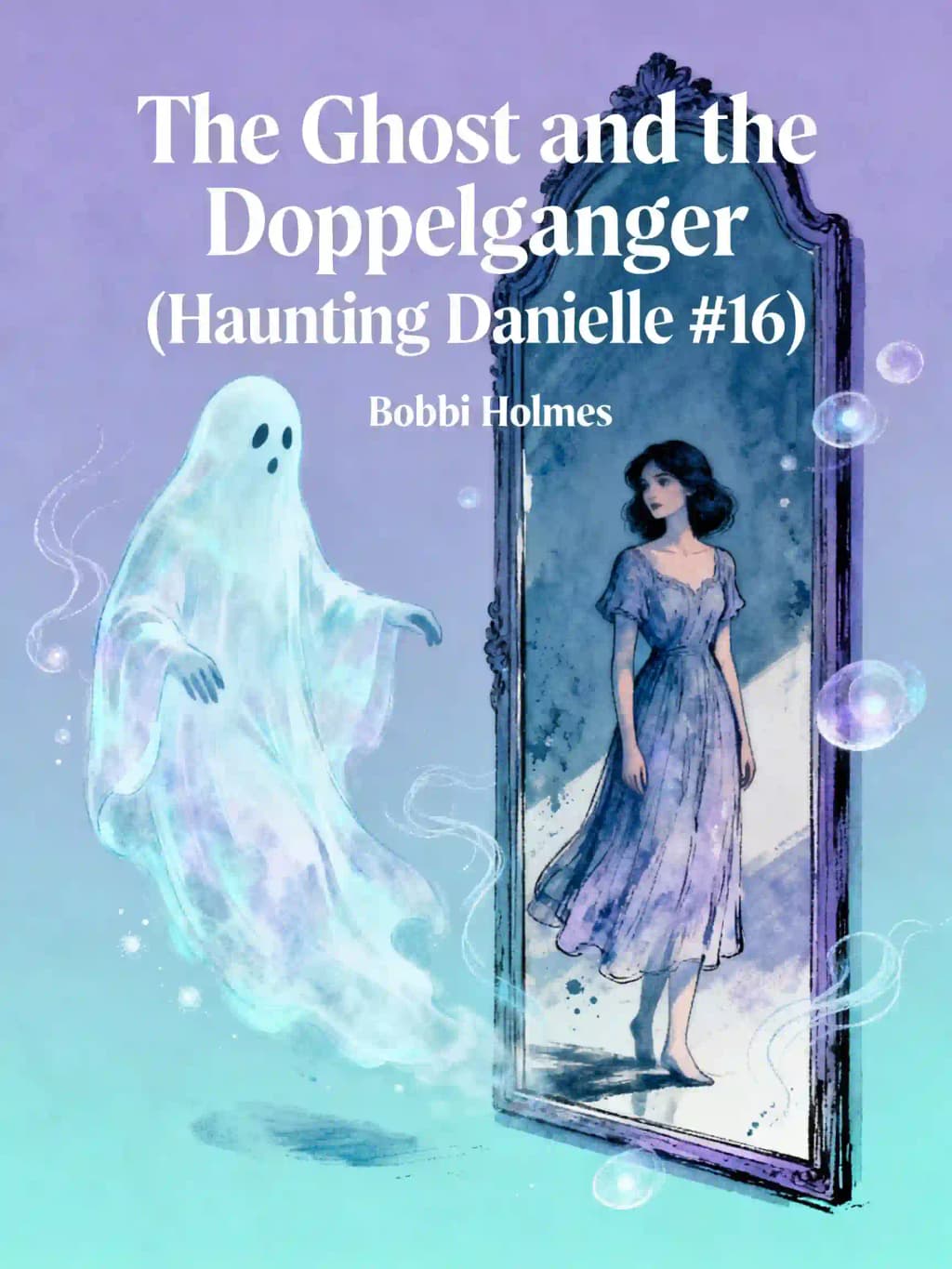
What happens when the past and present collide in the most uncanny way? In the sleepy coastal town of Frederickport, Oregon, Danielle Boatman's life is about to be turned upside down when she meets a man who looks exactly like the ghost who haunts her home. "The Ghost and the Doppelganger" has captivated readers with its unique blend of paranormal mystery and heartfelt romance, earning it a devoted following among supernatural fiction enthusiasts. The book stands as the 16th installment in Bobbi Holmes' beloved Haunting Danielle series, which has garnered praise for its fresh take on ghost stories. Even Stephen King once remarked that Holmes has "a gift for making the impossible feel not just possible, but inevitable." The novel's exploration of identity, forgiveness, and second chances resonates with readers looking for depth beyond typical ghost stories.
Capítulo 2
A Haunted House and Its Unexpected Visitors
Danielle Boatman's life at Marlow House has settled into a comfortable routine. She runs her bed and breakfast while sharing the space with Walt Marlow, the charming ghost who has haunted the property since his murder nearly a century ago. Their unique friendship has evolved into something deeper, though the obvious barriers between the living and the dead keep their relationship in a perpetual state of romantic limbo.
This delicate balance is disrupted when Danielle receives an email from a man claiming to be Walt's cousin. Clint Marlow explains he wants to commission reproductions of the family portraits hanging in Marlow House, particularly those of Walt and his wife Angela. Though initially hesitant, Danielle agrees to host Clint, his fiancee Stephanie, and the artist they've hired for two weeks.
When Clint arrives, Danielle is stunned by his appearance-he looks exactly like Walt, down to the striking blue eyes and distinctive facial features. The physical resemblance is so uncanny that Danielle momentarily freezes when they shake hands, experiencing a profound moment of physical contact that she's never had with Walt despite their emotional connection. Stephanie, Clint's fiancee with a slight Southern accent, becomes visibly annoyed at Danielle's lingering handshake.
However, the resemblance proves to be purely physical. While Walt is cultured, kind, and thoughtful, Clint quickly reveals himself to be rude and dismissive. He mocks Walt's love of reading, makes crude comments about Walt's marriage, and displays an overtly physical relationship with Stephanie that makes Danielle uncomfortable. When Clint rudely rebuffs Danielle's friends at a local restaurant, declaring he has no interest in getting "chatty with someone who I will never see again," it becomes clear that despite sharing DNA with Walt, Clint couldn't be more different in character.
Meanwhile, the artist who introduces himself as Jim Hill raises suspicions. Ian, Danielle's friend and local tech expert, insists the man is using a false identity. This sets in motion an investigation that will uncover layers of deception surrounding Clint's true intentions for visiting Marlow House.
Capítulo 3
The Art of Deception: Uncovering a Sophisticated Scheme
What initially appears to be a simple commission for portrait reproductions gradually reveals itself as an elaborate con. Through careful investigation, Danielle and her friends discover that "Jim Hill" is actually Macbeth Bandoni, a notorious art forger specializing in masterpiece reproductions who has been arrested multiple times but never convicted.
The mystery deepens when Walt observes Bandoni's unusual behavior-meticulously examining the backs of the paintings and frames rather than focusing on the painted surfaces themselves. This peculiar interest suggests there's more to the portraits than meets the eye.
Through conversations with Eva's ghost at the cemetery and research by Ian, the truth emerges: the portraits of Walt and his wife Angela were painted by Jacque Jehan Bonnet, a now-famous French artist whose work sells for millions. Clint and Stephanie recognized the distinctive signature from an art show in San Diego and concocted an elaborate scheme to steal the valuable originals and replace them with Bandoni's expert reproductions.
The plan unfolds when Clint arranges a dinner with Danielle and Police Chief MacDonald at Pearl Cove, creating an opportunity for Bandoni to orchestrate the switch. While everyone is away from Marlow House, Bandoni calls in three accomplices dressed entirely in black who carefully remove Walt's original paintings from their frames, replace them with the reproductions, and load the originals into a crate.
"The art of a con is never letting your mark know they've been taken," Clint had explained to Stephanie earlier, though she had expressed discomfort at being characterized as thieves. Their scheme seems perfect-Clint has made a show of having the only key to the crate, involved others in loading it, and successfully created an alibi by dining with Danielle and the police chief during the actual theft.
What they didn't account for was Walt's ghostly presence witnessing the entire switch-or his supernatural ability to reverse their carefully executed plan while everyone slept.
Capítulo 4
Supernatural Justice: When Ghosts Intervene
Rather than involve the police and endure another court case, Danielle agrees to Walt's suggestion that he switch the paintings back overnight. In one of the book's most entertaining sequences, Walt executes an elaborate plan to retrieve Bandoni's key from his bedside table, moving silently through the darkened house like a phantom cat burglar. With practiced precision, he meticulously removes the originals from their frames, carefully preserving the aging hardware and period-appropriate mounting techniques that had fooled the experts.
The scene takes a delightfully comical turn when Bandoni unexpectedly appears for a midnight snack and witnesses what appears to be his masterpiece floating serenely in midair. The forger's face drains of color, his eyes widening in horror before he promptly faints dead away. Walt, ever the gentleman even in ghost form, takes advantage of the moment to complete the switch, secure the reproductions in the crate, and - in a particularly amusing display of ghostly strength - levitates the unconscious Bandoni back to his bed, even thoughtfully arranging the covers. When Bandoni awakens the next morning, he repeatedly shakes his head and mutters about cutting back on late-night cheese, dismissing the floating painting as nothing more than a particularly vivid dream.
Danielle orchestrates the final act of deception with remarkable cunning. Knowing that Clint and Bandoni will want one last look at their prize before departure, she creates an ingenious distraction. Just as they're examining the paintings, she casually mentions that Walt's portrait seems somehow different - particularly the mysterious twinkle in his eyes that wasn't there before. The suggestion sends both men into a barely concealed panic, prompting them to hastily secure the crate with Ian's unwitting assistance, desperate to escape before anyone can look too closely at their supposed masterpieces.
As Clint and Stephanie speed away from Marlow House, their conversation reveals the full scope of their calculated betrayal. Clint has methodically erased his former life - resignation letter submitted, apartment emptied, bank accounts cleared, and new identities secured. Stephanie gleefully describes their plans for a luxurious new life in Europe, funded by their ill-gotten gains. Their dialogue exposes not just greed but a complete absence of remorse for betraying Danielle's trust.
However, supernatural justice has its own elegant way of settling scores. As their van approaches the treacherous curves near Pilgrim's Point, the vengeful ghost of Darlene Gusarov materializes in the road, her spectral form illuminated by their headlights. Stephanie's terrified reaction sends the vehicle careening off the cliff's edge, resulting in a spectacular crash on the beach below. The impact kills Stephanie instantly, while Clint survives but remains comatose in the hospital, his spirit now trapped in a peculiar limbo - conscious enough to witness the consequences of his actions but powerless to interact with the physical world, a fitting punishment for his duplicity.
Capítulo 5
The Ethical Dilemma: A Body Without a Soul, a Soul Without a Body
The accident creates an extraordinary ethical dilemma that forms the heart of the novel's second half. Clint's spirit has separated from his comatose body, leaving him in a liminal state between life and death. He desperately wants to join Stephanie, who has already moved on to the afterlife, but discovers he cannot follow her as long as his physical body remains viable-his body tethers him to the earthly plane.
Meanwhile, Walt has existed for nearly a century as a ghost bound to Marlow House, unable to experience the physical world despite his growing feelings for Danielle. Their relationship exists in an impossible space-a deep emotional connection without the possibility of physical expression.
Eva Thorndike, another ghost with mysterious "privileges" due to her "status," proposes a radical solution: Clint could give his body to Walt, who was "cheated out of life," allowing Clint to move on to be with Stephanie. This proposition creates the central moral question of the novel: Is it ethical for Walt to take over Clint's body, even with permission? Would it be a second chance at life rightfully earned, or a form of spiritual theft?
The characters wrestle with this question from different perspectives. Walt initially finds the concept "repugnant" when first suggested, but gradually comes to consider it as a genuine possibility. Danielle struggles with her desire to have Walt physically present in her life while questioning whether such an arrangement could work. Chris, who harbors feelings for Danielle himself, surprisingly supports Walt accepting Clint's offer, believing that with both men alive, he'd have a "fair chance" with Danielle.
The dilemma is complicated by Clint's wavering commitment to his offer. While he initially seems sincere in his desire to join Stephanie, he later contemplates double-crossing Walt by pretending to have amnesia if he changed his mind at the last minute, wondering which is more important-love or money.
Capítulo 6
The Nature of Forgiveness and Moving On
As Walt contemplates accepting Clint's extraordinary offer, deeper themes of forgiveness and moving on emerge in unexpected ways. Angela's ghost appears to Danielle in a pivotal moment, notably dressed in a conservative 1925 dress suit - a stark departure from her signature flapper attire that symbolizes her own transformation. With visible emotion, she pleads with Danielle to convince Walt to accept Clint's offer, revealing that her decades-long spiritual imprisonment hinges on Walt's decision. If he makes a definitive move toward either life or afterlife, her penance will finally end, allowing her soul to find peace.
This revelation uncovers the intricate web of spiritual consequences that has kept both Walt and Angela earthbound for nearly a century. Angela's inability to move on stems not just from her role in Walt's murder, but from the weight of guilt and unresolved karma. Walt, meanwhile, has remained tethered to Marlow House through a complex mixture of stubbornness, unfinished business, and what he's now beginning to recognize as a divine purpose.
During an emotionally charged conversation with Danielle, Walt shares a profound revelation about forgiveness. He explains that his time observing Danielle and Lily's modern relationship dynamics helped him understand the severely limited choices available to women in his era. Angela, he realizes, was trapped in a society that offered few options for independence or self-determination. Walt's admission that he never truly loved Angela, having married her more as a social "catch" than for genuine love, carries a heavy weight of regret. His understanding of true love has evolved through witnessing contemporary relationships and, most significantly, through his growing feelings for Danielle - a revelation that causes her to blush deeply and adds another layer of complexity to their unusual relationship.
Eva, serving as a spiritual guide, provides crucial insight into the metaphysical aspects of their situation. She explains to Danielle that the natural order requires spirits to continue their journey after death, comparing it to a river's flow. However, like eddies in that river, spirits can become trapped by confusion, trauma, or unfinished business. Using the movie "Heaven Can Wait" as a relatable reference point, Eva suggests that Walt's remarkable century-long persistence isn't mere stubbornness - it indicates his earthly journey was prematurely interrupted. She elaborates that while free will can disrupt intended life paths - as demonstrated by Walt's brother-in-law's murderous act - the universe sometimes provides mechanisms for correction. Walt's steadfast refusal to move on, rather than being simple obstinacy, has paradoxically earned him this unprecedented second chance.
These interweaving conversations transform the narrative from a conventional ghost story into a profound meditation on the nature of forgiveness, destiny, and cosmic justice. The characters grapple with fundamental questions about whether some wrongs can be remedied even after death, if the universe operates on principles of balance and restoration, and how free will intersects with fate. Their experiences suggest that while death may seem final, the spiritual realm offers unexpected opportunities for healing, growth, and the resolution of past injustices.
Capítulo 7
Saying Goodbye: The Weight of Impossible Choices
Walt's momentous decision to attempt taking over Clint's body creates one of the most emotionally charged sequences in the book. Before leaving, he must say goodbye to the life he's known at Marlow House, uncertain whether he'll succeed in his attempt or simply vanish forever into the unknown. The weight of this choice manifests in every careful preparation he makes, from organizing his few ghostly possessions to making peace with the possibility that this could be his final farewell to the place he's called home for decades.
His farewells are particularly touching with Sadie the dog and Max the cat, companions who have shared his supernatural existence without judgment or fear. To them, he explains that if Clint returns to Marlow House, it would really be him, though their special communication would end. Walt reveals the deeper nature of their connection - while he speaks aloud to the animals, it's not his words they understand but rather a mental telepathy between them, a spiritual bond that transcends normal animal-human communication. This unique connection, he explains with evident sorrow, will be lost regardless of the outcome. The scene is made more poignant by Sadie's mournful whimpers and Max's unusual stillness, as if both animals understand the gravity of the moment.
The most heart-wrenching goodbye is between Walt and Danielle, their relationship having evolved from initial wariness to deep friendship and unspoken love. As he prepares to leave, she is tearful but understanding, showing remarkable strength in supporting his decision despite her own grief. Their final moments together are filled with unspoken words and meaningful glances, years of shared experiences hanging between them. Walt vanishes with characteristic subtlety, leaving Danielle crying and whispering, "Come back to me" into the empty air. The house feels eerily empty without his presence, and Danielle wanders through all the rooms, finding it larger and quieter without him. Each space holds memories: the kitchen where they shared countless conversations, the library where they solved mysteries together, and finally the attic where Walt's spotting scope stands silently, a testament to his ongoing fascination with the world beyond Marlow House's walls. She goes to bed alone, crying as she realizes she may never again see Walt's spirit lounging casually on her bed discussing the day's events, their easy companionship now just a memory.
This separation creates a profound sense of loss and uncertainty that permeates every corner of Marlow House. The questions multiply: Has Walt truly left forever? Will he successfully take over Clint's body? Or might something go wrong, with another spirit-perhaps the "disgruntled spirit who died during surgery" that Eva mentioned-taking the opportunity to claim Clint's unoccupied form? The possibility of this darker outcome adds another layer of anxiety to an already emotionally charged situation.
The weight of these questions creates a tension that drives the final chapters of the book, as Danielle waits anxiously for news about whether Walt has successfully made the transition or been lost forever. Every phone call, every knock at the door carries the potential for life-changing news, keeping both Danielle and readers in a state of sustained anticipation.
Capítulo 8
The Awakening: Identity in a New Form
The resolution unfolds gradually, building layers of tension and uncertainty about who exactly has awakened in Clint's body. When the patient regains consciousness at the hospital, he claims to have complete amnesia, unable to remember not only his name but any details of his past life. This creates a complex web of possibilities-it could be Walt struggling with the psychological trauma of consciousness transfer, Clint himself engaging in elaborate deception, or perhaps even an unexpected third consciousness that has somehow intercepted the transition process.
The situation becomes more intricate when Barry Mountifield, Stephanie's protective and controlling father, arrives unexpectedly from Texas. A wealthy oil executive used to managing situations, he immediately attempts to take charge of Clint's medical care and future arrangements. He spends hours at the patient's bedside, methodically recounting stories about Stephanie and their life together, effectively trying to reconstruct Clint's identity through his own narrative. This raises questions about memory formation and identity - could these stories actually shape who the patient becomes?
Meanwhile, Danielle faces increasing obstacles in her attempts to reach Walt/Clint. After being caught using forged hospital credentials and claiming to be Clint's sister, she's formally barred from the hospital premises. Security guards are posted at the ward entrance, and Barry ensures that only approved visitors can enter. The separation creates an almost unbearable tension for Danielle, who must wait helplessly while potentially losing her connection to Walt.
When Chief MacDonald finally manages to arrange a supervised visit through his police authority, the moment of truth arrives with heart-stopping intensity. The physical changes are jarring - Clint's normally perfectly styled hair now stands in messy spikes, his athletic frame is diminished by hospital rest, and his right leg is encased in a heavy cast. Yet something in those striking blue eyes catches Danielle's attention - a familiar depth and warmth that seems to transcend the physical form. The moment their hands touch, she experiences an unmistakable surge of energy, reminiscent of her supernatural connection with Walt.
The definitive confirmation comes in a carefully orchestrated moment of privacy. While his elderly roommate struggles with a noisy breathing treatment, he whispers two pieces of information that only Walt could know: the true reason for Clint's death ("Clint chose love over money") and an intimate detail from Walt and Danielle's first meeting - the specific calendar she showed him from her purse, including the picture of Maine lighthouses on that month's page. These private details serve as irrefutable proof of Walt's successful transition.
His quiet declaration, "I want to go home with you," marks not just an ending but a beginning - the start of a complex journey as they navigate their relationship in this new reality. They face numerous challenges ahead: explaining the personality changes to friends and family, dealing with Clint's legal and financial obligations, and learning to relate to each other in physical form after their purely spiritual connection. Yet in this moment, the simple truth of their reunion overshadows all future complications.
Capítulo 9
The Promise of New Beginnings
The novel concludes with a masterful blend of resolution and anticipation, weaving together multiple threads of possibility. Walt's successful transition into Clint's body marks a pivotal moment that transforms an impossible romance into a tangible reality. This corporeal shift opens the door for a physical relationship with Danielle, yet it also introduces a complex web of challenges that neither character fully anticipated.
Walt's adjustment to modern life proves particularly compelling, as he grapples with the mundane aspects of existence that have evolved dramatically since his time as a ghost. Simple tasks like using smartphones, navigating social media, or even driving a car become monumental challenges. His attempts to maintain Clint's professional and personal relationships while being an entirely different person inside create moments of both humor and tension. The legal implications of assuming Clint's identity also loom large, forcing Walt to navigate a precarious balance between truth and necessary deception.
The supernatural elements of Walt's transformation remain intriguingly ambiguous. Though now flesh and blood, he experiences occasional moments of ghostly awareness - sensing presences others cannot detect and maintaining a mysterious connection to the supernatural realm. The promotional material for the sequel suggests these residual abilities will expand rather than diminish, hinting at a unique hybrid existence that bridges the mortal and spiritual worlds.
Danielle and Walt's relationship enters a fascinating new phase that challenges their established dynamic. The ethereal quality of their ghost-human romance must now confront practical realities: shared living spaces, physical intimacy, and the day-to-day challenges of building a life together. Their adjustment period reveals how much of their initial attraction was built on the very impossibility of their connection, forcing them to rebuild their relationship on new terms. Danielle particularly struggles with reconciling her memories of Walt's ghostly form with his new physical presence in Clint's body.
The ending masterfully reinforces the novel's exploration of identity, adaptation, and the nature of love itself. Through Walt's transformation, the story poses profound questions about the essence of personhood - whether we are defined by our physical form, our memories, or something more intangible. The conclusion suggests that true identity persists beyond physical boundaries, while simultaneously acknowledging how deeply our experiences are shaped by our corporeal existence.
This final chapter serves as both culmination and catalyst, resolving the central conflict while seeding numerous possibilities for future development. The author leaves readers with a meditation on the nature of second chances and the courage required to embrace them, suggesting that the greatest adventures often begin when we think the story is ending. Through Walt and Danielle's evolving relationship, we see how love can adapt and grow when faced with extraordinary circumstances, proving that the heart's capacity for acceptance and change knows no bounds.